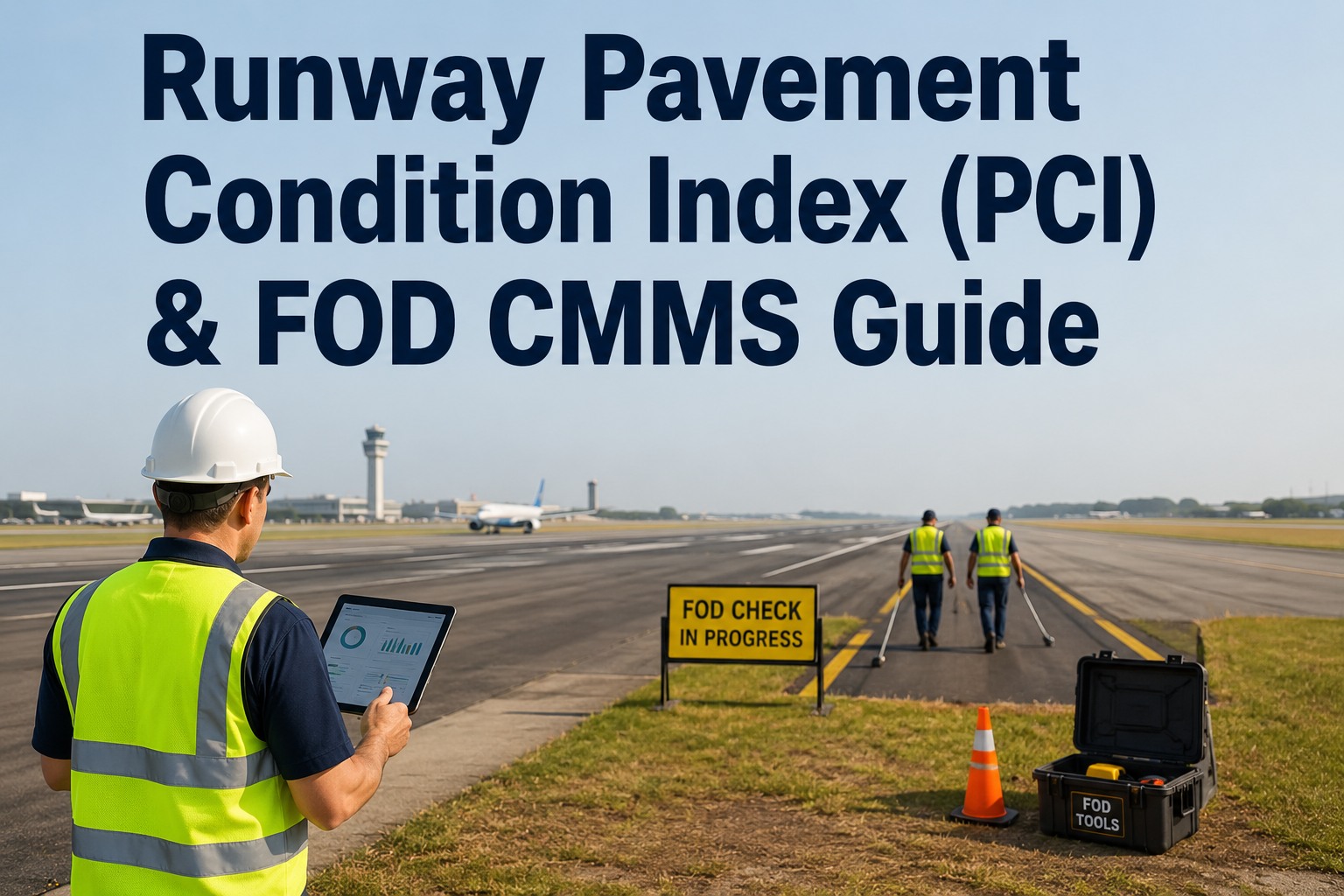
Runway pavement is the single most expensive asset on an airfield, and its Condition Index (PCI) is the leading indicator that tells you whether the next 12 months will be routine or catastrophic. A 10-point PCI drop typically doubles spalling volume, triples loose-joint FOD, and pushes emergency closure risk from rare to monthly. Pairing ASTM D5340 distress surveys with a CMMS that ties inspection results directly to sweep schedules and treatment triggers is how modern airports convert pavement data into fewer flight delays. Start with a Start Free Trial of Oxmaint to see your PCI, FOD, and work-order history on one dashboard.
RUNWAY PCI & FOD · CMMS PLAYBOOK 2026
Is your runway telling you the next closure before it happens?
PCI is the only forward-looking metric that connects capital planning to daily FOD risk. When the index slips below 70, spalling accelerates, debris generation triples, and reactive patching consumes the maintenance budget. A CMMS turns that signal into scheduled action — automatically.
PAVEMENT ECONOMICS
What a slipping PCI actually costs your airfield
Industry benchmark data from FAA AC 150/5380-7 shows that preventive maintenance applied at PCI 70–80 costs roughly $1.50 per square yard. The same treatment at PCI 55 climbs to $12–$18, and full reconstruction below PCI 40 exceeds $120 per yard. The window between "watch" and "emergency" is narrower than most teams plan for.
Each 5-point PCI loss below 80 multiplies spalling-driven FOD events by an estimated 1.8×. A runway holding at PCI 78 generates roughly 12 documented FOD incidents per quarter; the same surface at PCI 63 produces 38.
WORKED EXAMPLE · MID-SIZE REGIONAL AIRPORT
A 2,700-meter primary runway with PCI tracking at 74 was costing a regional airport $48,000/year in reactive patching, after-hours sweep callouts, and 3 partial closures. After deploying a CMMS-linked PCI program — quarterly surveys, automated sweep triggers tied to distress density, and a single mill-and-overlay at PCI 71 — annual pavement spend dropped to $19,000 and FOD-related closures fell to zero over 14 months.
ASTM D5340 DISTRESS CATALOG
The seven distress types that drive your PCI score
Every runway PCI survey under ASTM D5340 logs distress by type, severity (low/medium/high), and quantity. Each combination carries a deduct value that feeds the composite index. Tracking these seven categories inside a CMMS lets you forecast treatment windows instead of guessing.
Interconnected fatigue cracks signaling base failure. Deduct value spikes at high severity — early fog seal at low severity preserves the slab.
Rectangular patterns from asphalt shrinkage. Indicates aging binder; crack seal before water reaches the base course.
The #1 FOD generator. Loose fragments enter the travel path within 72 hours of formation — sweep trigger must fire instantly.
Aggregate loss produces fine FOD across the full runway width. Surface treatment restores friction and seals the matrix.
Failed sealant allows water infiltration, accelerating base erosion beneath slabs. Reseal cycles should be CMMS-scheduled every 4–6 years.
Asphalt bulging from braking loads at taxiway exits. Often misread as surface wear — requires mill and inlay, not overlay.
Localized grade loss traps water and hides ponding FOD. Laser-grade survey integration catches depressions >6mm before they pond.
PCI PROGRAM TIMELINE
A 12-month pavement condition workflow
A defensible PCI program runs on a fixed annual rhythm. Each phase feeds the next, and every output lands inside the CMMS so a treatment recommendation becomes a scheduled work order — not a forgotten PDF.
Sample-unit walk or vehicle survey per ASTM D5340. Target 100% coverage of the primary runway; results uploaded to CMMS within 48 hours.
CMMS calculates deduct values, flags sample units below PCI 70, and auto-generates a heat map of high-risk zones.
System issues recommended actions (fog seal, crack seal, mill-and-inlay) with cost estimates and priority ranking tied to closure risk.
Low-severity crack sealing and fog seal applied during overnight windows. Work orders closed with photo evidence and material batch records.
Sweep frequency increases on high-distress zones identified in the survey. Weekly spot inspections log new spalling within 24 hours of detection.
A 10% random resample validates the treatment's effectiveness and recalibrates the decline curve for capital planning.
Three-year pavement forecast generated from CMMS data — projected PCI, treatment timing, and budget requirements delivered to operations leadership.
FOD DETECTION INTEGRATION
From spalling detection to sweep trigger in under 5 minutes
The average manual FOD reporting loop — spotter radios operations, operations logs a ticket, dispatch assigns a sweeper — takes 22 minutes. During peak operations that gap closes two departure slots. A CMMS-integrated detection pipeline compresses that to under 5 minutes by automating the middle three steps.
| Workflow Step | Manual Process | CMMS-Integrated | Time Saved |
|---|---|---|---|
| FOD Detection | Visual patrol, radio call | Sensor + camera auto-flag | 8 min |
| Ticket Creation | Paper log, manual entry | Auto-generated in CMMS | 6 min |
| Sweeper Dispatch | Radio dispatch, verbal confirm | Push notification to sweeper | 4 min |
| Closure Coordination | ATC phone call, manual hold | ATC auto-notified via API | 3 min |
| Post-Sweep Verification | Visual recheck, paper sign-off | Photo closure in CMMS | 2 min |
| Total Cycle Time | 23 → 5 min | ||
TREATMENT DECISION MATRIX
Matching PCI bands to the right pavement treatment
A treatment matrix removes debate from pavement decisions. When the CMMS reads a sample-unit PCI, it references this table and issues a recommendation automatically — including materials, crew size, and overnight window requirements.
- Annual joint inspection
- Scheduled sweeping per ops tempo
- Friction testing per FAA AC 150/5320-12
- Crack seal (medium severity)
- Fog seal on raveling zones
- Sweep frequency +25% on flagged units
- Mill and inlay (2–4 inches)
- Full-depth repair at joints
- Daily FOD patrol on treated zones
- Full structural reconstruction
- Base course replacement
- Extended closure planning required
TURN PCI DATA INTO ACTION
Stop reacting to runway distress. Start predicting it.
Oxmaint ties your PCI surveys, FOD reports, and sweep schedules into one automated workflow. See the platform in a 30-minute walkthrough.
FREQUENTLY ASKED
Runway PCI & FOD — what teams ask first
How often should a runway PCI survey be conducted?
FAA Advisory Circular 150/5380-7 recommends a full PCI survey every 1 to 3 years depending on traffic volume and pavement age. For commercial-service runways exceeding 50,000 annual operations, an annual full survey plus a 10% mid-cycle resample is the defensible standard. A CMMS schedules these automatically and flags any sample unit that drops more than 5 points between cycles.
What PCI threshold should trigger a FOD sweep increase?
Any sample unit falling below PCI 70 — or showing medium-to-high severity spalling — should immediately raise sweep frequency by at least 25%. The CMMS reads the latest survey density values and adjusts the sweep schedule without manual intervention. You can configure these thresholds during onboarding or Book a Demo to review them with our aviation team.
Can a CMMS integrate with automated FOD detection systems?
Yes. Oxmaint accepts inbound webhooks from pavement-mounted radar, camera-based FOD scanners, and friction testers. Each detection event auto-creates a ticket, geo-tags the location, and notifies the on-shift sweeper crew. Typical end-to-end latency from detection to dispatch notification is under 90 seconds.
How long does it take to deploy a PCI + FOD CMMS at a mid-size airport?
A typical regional airport with one primary runway and two crosswind runways goes live in 4 to 6 weeks. The timeline includes asset import (2 weeks), PCI history migration (1 week), sweep-route configuration (1 week), and crew training (1 week). You can accelerate this by starting a Start Free Trial and importing your existing distress logs in CSV format.
What is the typical payback period for a runway PCI CMMS program?
Most mid-size airports recover the platform cost within 8 to 14 months. Savings come from three sources: deferred major rehabilitation (catching distress at PCI 75 instead of 60 saves $10+ per square yard), reduced emergency sweep callouts (typically 40–60% fewer), and avoided closure hours. A single prevented overnight closure at a commercial airport often exceeds the annual software cost.
READY WHEN YOU ARE
Build your data-driven pavement program today
Join airports using Oxmaint to track PCI, automate FOD response, and plan capital with confidence — all from one dashboard.
Free 14-day trial · No credit card