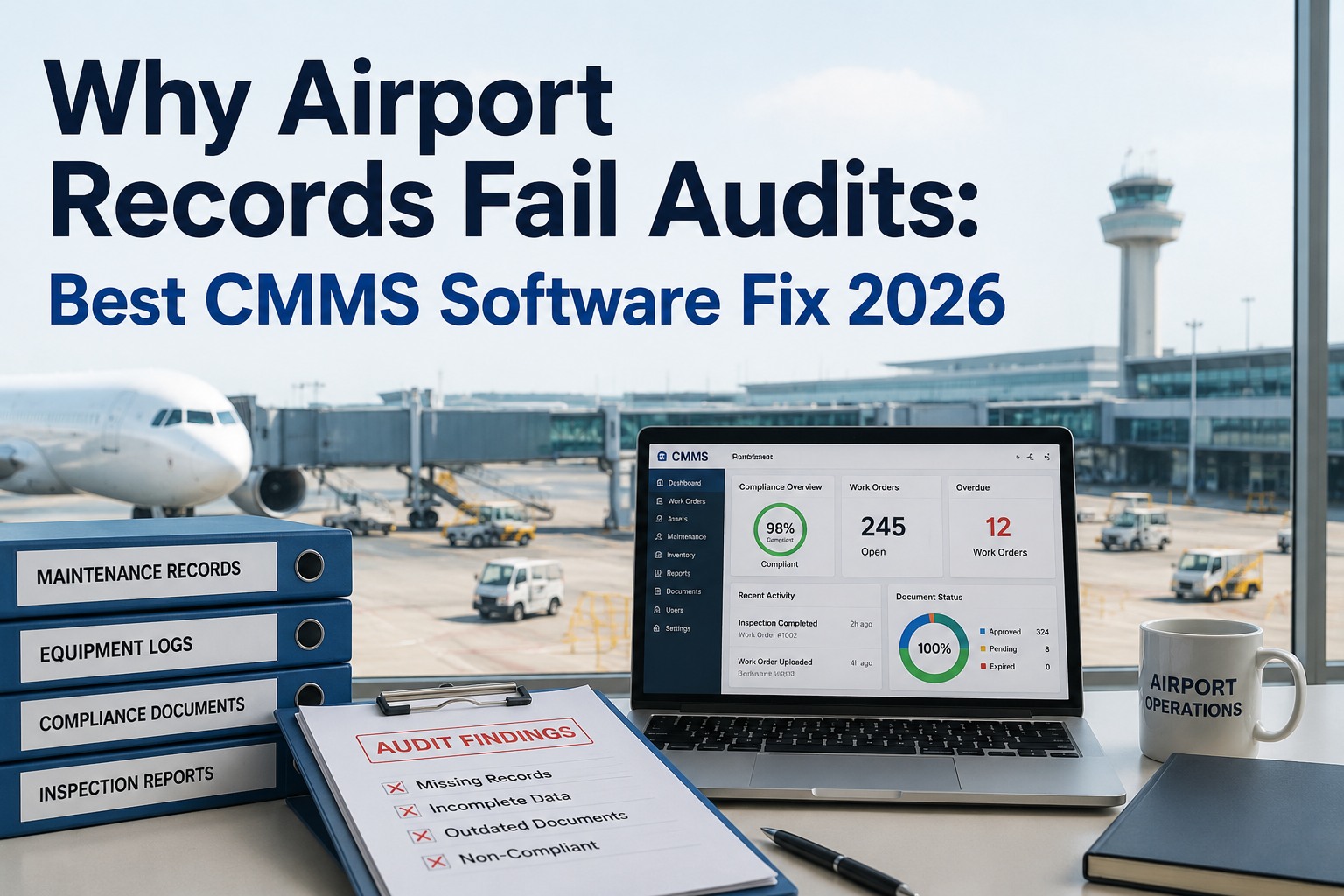
When a baggage system motor seizes during a peak bank, or a jet bridge hydraulic system fails mid-boarding, the cost isn't one repair bill — it's a cascade. Airline studies put the average cost of an aircraft delay at about $101 per minute, and a single tarmac-impacting fault can ripple across dozens of flights within the hour. A transformer failure can run $50,000 to $150,000 an hour in airline penalty claims alone. That's the problem with airport unplanned downtime: the real cost lives in the cascade, not the callout, and it almost never gets traced back to the asset that caused it. This is where downtime software changes the conversation — not just by preventing failures, but by making the cost of each one visible and the maintenance budget defensible, so every dollar spent traces back to an asset, a work order, and a business reason a CFO can review. This guide breaks down what airport unplanned downtime actually costs in 2026, where it concentrates, the prevention playbook that cuts it 30–50%, and how a CMMS turns the annual budget cycle from a debate into a data conversation. Book a free downtime-cost review for your airport.
The Real Cost of Downtime Lives in the Cascade, Not the Callout
One tarmac fault ripples across dozens of flights — and almost never gets traced back to the asset behind it.
$101/min
Average airline cost of an aircraft delay, per minute
$50–150K/hr
Airline penalty exposure from a cascading transformer failure
30–50%
Unplanned downtime reduction from condition-based maintenance
30 days
Advance warning AI can give — turning $150K events into $5–25K repairs
Where the Cost Actually Comes From
A downtime event isn't a single line item — it's four costs stacked on top of each other. Most maintenance budgets only ever capture the first one, which is exactly why the true cost of unplanned downtime is chronically understated in the annual review.
The Direct Repair
The visible cost — parts and labor. And the most inflated: an emergency callout runs at premium rates, with expedited parts shipping, versus the standard rate of the same job planned.
The Delay Cascade
The big one. At roughly $101 per aircraft-minute, a fault that delays dozens of flights compounds fast — and a transformer or runway-lighting event can reach $50–150K per hour in penalties.
The Compliance Penalty
Missed PMs under FAA, EASA, and ICAO oversight aren't just breakdown risk — they can trigger regulatory penalties reaching tens of thousands of dollars per violation, per day.
The Passenger & Brand Hit
Hardest to price, real all the same — a sweltering terminal from an HVAC failure, mishandled bags at ~$100 each, missed connections, and the reputational cost of chaos at the gate.
Where Downtime Concentrates · The High-Impact Assets
Downtime cost isn't spread evenly across an airport's 4,000-plus assets — it clusters on a handful of high-utilization, high-consequence systems. These are where prevention pays back first, and where any program should start.
01
Baggage Handling Systems
The highest-priority asset. One BHS failure at peak delays hundreds of bags across dozens of flights. IoT on motors and gearboxes flags issues 3–4 weeks out.
02
Jet Bridges (PBBs)
An inoperable bridge forces gate reassignments and boarding chaos. Hydraulic and drive monitoring cuts unplanned gate closures ~60%; replacement runs $1.5–3M.
03
Terminal HVAC & Chillers
A summer HVAC failure is both a passenger-experience disaster and, in extreme-heat markets, a regulatory concern. Compressor and filter monitoring prevents it.
04
Airfield Lighting & Electrical
A single failed approach light can close a runway; a transformer fault cascades into gate closures. The tightest response window and highest penalty exposure.
05
Escalators & Elevators
Drive-motor and mechanism failures create immediate accessibility-compliance issues and passenger disruption, especially where they're the only link between levels.
06
Ground Support Equipment
A tug, belt loader, or GPU failing at the gate costs $50–100 per delay-minute. Real-time tracking and PM libraries cut GSE downtime 30–50%.
Price Your Downtime by Asset in 30 Minutes
Working session with our aviation team — bring your critical asset list. We'll map where your downtime cost concentrates, model the prevention payback, and show how OxMaint traces every event back to an asset, a work order, and a cost your CFO can review.
The Prevention Playbook · Reactive to Predictive
Cutting unplanned downtime isn't one move — it's a progression. Each stage builds on the last, moving the operation from firefighting toward a measurable reliability program where emergencies are the exception.
1
Centralize the Asset Registry
Replace paper logs, per-terminal silos, and radio dispatch with one asset registry. You can't prevent — or cost — what you can't see. An AI-driven registry can map an airport in under a week.
2
Lift PM Compliance Above 80%
A PM-compliance rate below 80% is a red flag. Auto-scheduled, tracked preventive tasks move compliance toward the 96% mark that keeps both breakdowns and regulatory penalties at bay.
3
Add Condition Monitoring on Critical Assets
Put IoT sensors on the high-impact few — baggage motors, jet-bridge hydraulics, HVAC compressors. Catch a baggage motor 3–4 weeks out and a jet-bridge fault ~19 days before the threshold.
4
Predict & Plan the Repair
With 30-day failure prediction, convert a $150K emergency into a $5–25K planned repair done in an overnight window — the shift that delivers 30–50% less downtime and 18–25% lower cost.
The Payoff · From Cost Center to Defensible Budget
The prevention playbook doesn't just cut downtime — it produces the data that makes the maintenance budget defensible. That's the deeper shift: from a cost center that gets questioned to a reliability program that can prove its return.
30–50%
Less Unplanned Downtime
Condition-based maintenance on critical assets consistently cuts unplanned downtime by a third to a half versus a calendar baseline.
18–25%
Lower Maintenance Cost
Planned repairs at standard rates, fewer emergency premiums, and eliminated parts stockouts bring total maintenance cost down materially.
12–24 mo
ROI Window
Airport CMMS deployments show consistent positive ROI within 12–24 months — often 6–18 when starting with the highest-impact assets.
98%+
Infrastructure Availability
A data-driven program sustains availability above 98% — and every point protects millions in airline-penalty exposure.
How OxMaint Cuts Airport Unplanned Downtime
OxMaint replaces paper work orders and siloed systems with one AI-native platform — a centralized registry, auto-scheduled PM, IoT condition monitoring, and reliability reporting that makes every maintenance dollar traceable back to an asset, a work order, and a business reason, from one dashboard on desktop or mobile.
Map
Centralized Asset Registry
One registry across terminals, airfield, and ground ops — replacing per-terminal silos and paper, mapped in under a week with QR tags and location hierarchy.
Schedule
PM Compliance Engine
Auto-generate and track preventive tasks with tiered inspection calendars, lifting PM compliance toward 96% and keeping FAA, EASA, and ICAO records audit-ready.
Monitor
IoT Condition Monitoring
Stream live condition data from baggage motors, jet-bridge hydraulics, HVAC, and lighting — flagging anomalies and forecasting remaining useful life on the critical few.
Predict
30-Day Failure Warning
Auto-generate work orders before assets fail, converting a $150K emergency into a planned overnight repair — the core of 30–50% less unplanned downtime.
Trace
Cost-to-Asset Attribution
Every dollar traceable to an asset, a work order, and a business reason — turning the maintenance budget from a debate into a data conversation your CFO trusts.
Report
Reliability & Compliance
MTTR, availability, and PM-compliance dashboards plus FAA Part 139-ready audit trails, with SAP and Maximo overlay across one airport or a network.
Turn the Budget Cycle Into a Data Conversation
Cut unplanned downtime 30–50% and defend every operating and capital request with data. See how OxMaint makes airport maintenance measurable, predictive, and traceable to the dollar. Free forever plan available.
Frequently Asked Questions
What does airport unplanned downtime actually cost?
Far more than the repair bill, because the real cost lives in the cascade. A downtime event stacks four costs: the direct repair (inflated by emergency callout rates and expedited parts), the delay cascade (at roughly $101 per aircraft-minute, one fault delaying dozens of flights compounds fast, and a transformer or runway-lighting event can reach $50,000–$150,000 per hour in airline penalties), the compliance penalty (missed PMs under FAA, EASA, or ICAO oversight can trigger fines of tens of thousands of dollars per violation per day), and the passenger and brand hit (mishandled bags around $100 each, a sweltering terminal, missed connections). Most budgets capture only the first, which is why downtime is chronically underpriced.
Book a cost review.
Which airport assets cause the most costly downtime?
Downtime cost concentrates on a handful of high-utilization, high-consequence systems rather than spreading evenly across the thousands of assets an airport runs. Baggage handling systems are typically the highest priority — one peak-hour failure delays hundreds of bags across dozens of flights. Jet bridges come next, since an inoperable bridge forces gate reassignments and cascading delays. Terminal HVAC and chillers create passenger-experience and, in hot climates, regulatory failures. Airfield lighting and electrical distribution carry the tightest response window and highest penalty exposure — a single approach light can close a runway. Escalators and elevators raise accessibility-compliance issues, and ground support equipment failing at the gate costs $50–100 per delay-minute. Starting prevention with these assets delivers the fastest payback.
How much can a CMMS reduce unplanned downtime?
Airports deploying condition-based and predictive maintenance on critical assets consistently see unplanned downtime fall 30–50%, alongside 18–25% lower overall maintenance cost, with reported returns between roughly 10:1 and 30:1 and positive ROI typically within 12–24 months — often 6–18 when starting with the highest-impact assets like baggage handling and HVAC. The mechanism is the shift from reactive and calendar-based work to data-driven prediction: IoT sensors catch a baggage conveyor motor 3–4 weeks before failure or a jet-bridge hydraulic issue around 19 days ahead, so the repair happens in a planned overnight window at standard rates instead of as a peak-hour emergency. A single percentage point of availability protects millions in airline-penalty exposure.
Sign up free to baseline your downtime.
How does downtime software make a maintenance budget defensible?
By making every cost traceable. The core problem with airport maintenance budgets is that downtime costs are diffuse and rarely tied back to the asset that caused them, so the annual review becomes a debate rather than a data conversation. A CMMS records every work order, part, labor hour, and failure against a specific asset, and links each to a business reason — a compliance requirement, an avoided delay cascade, a deferred capital replacement. That means every operating and capital request can be defended with evidence: this PM program prevents this failure mode on this asset, which carries this delay exposure. When maintenance spend traces cleanly back to an asset, a work order, and a business reason a CFO can review, the budget stops being a cost to cut and becomes an investment with a demonstrable return.
How does OxMaint help cut airport unplanned downtime?
OxMaint replaces paper work orders and siloed per-terminal systems with one AI-native platform: a centralized asset registry mapped in under a week, a PM-compliance engine with tiered inspection calendars that lifts compliance toward 96% and keeps FAA, EASA, and ICAO records audit-ready, IoT condition monitoring that streams live data from baggage motors, jet-bridge hydraulics, HVAC, and airfield lighting, and AI that predicts failures up to 30 days ahead and auto-generates work orders — converting six-figure emergencies into planned overnight repairs. Crucially, it traces every maintenance dollar back to an asset, a work order, and a business reason, with MTTR, availability, and compliance dashboards, FAA Part 139-ready audit trails, and SAP and Maximo overlay across one airport or a whole network. A free forever plan and live demos are available.