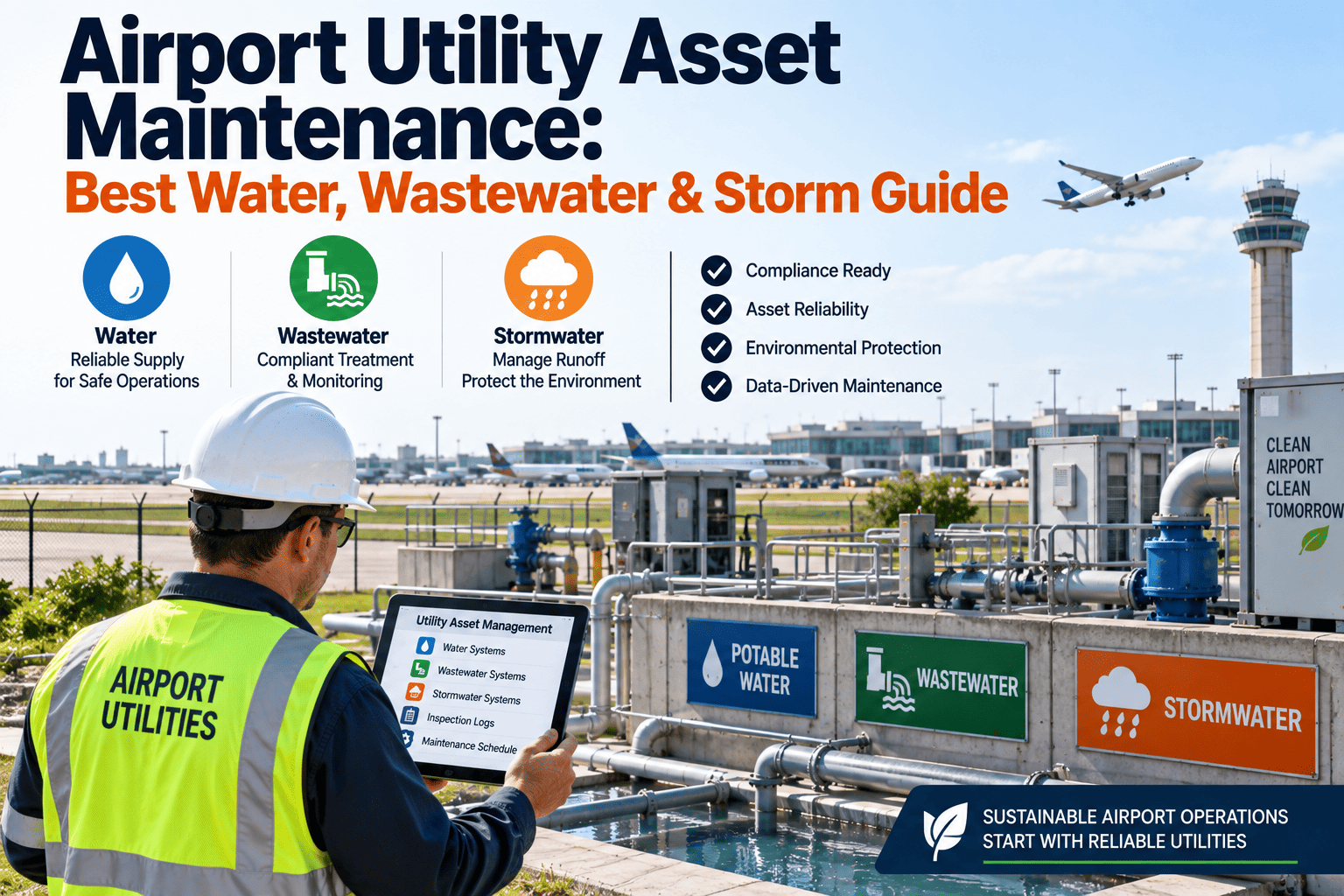
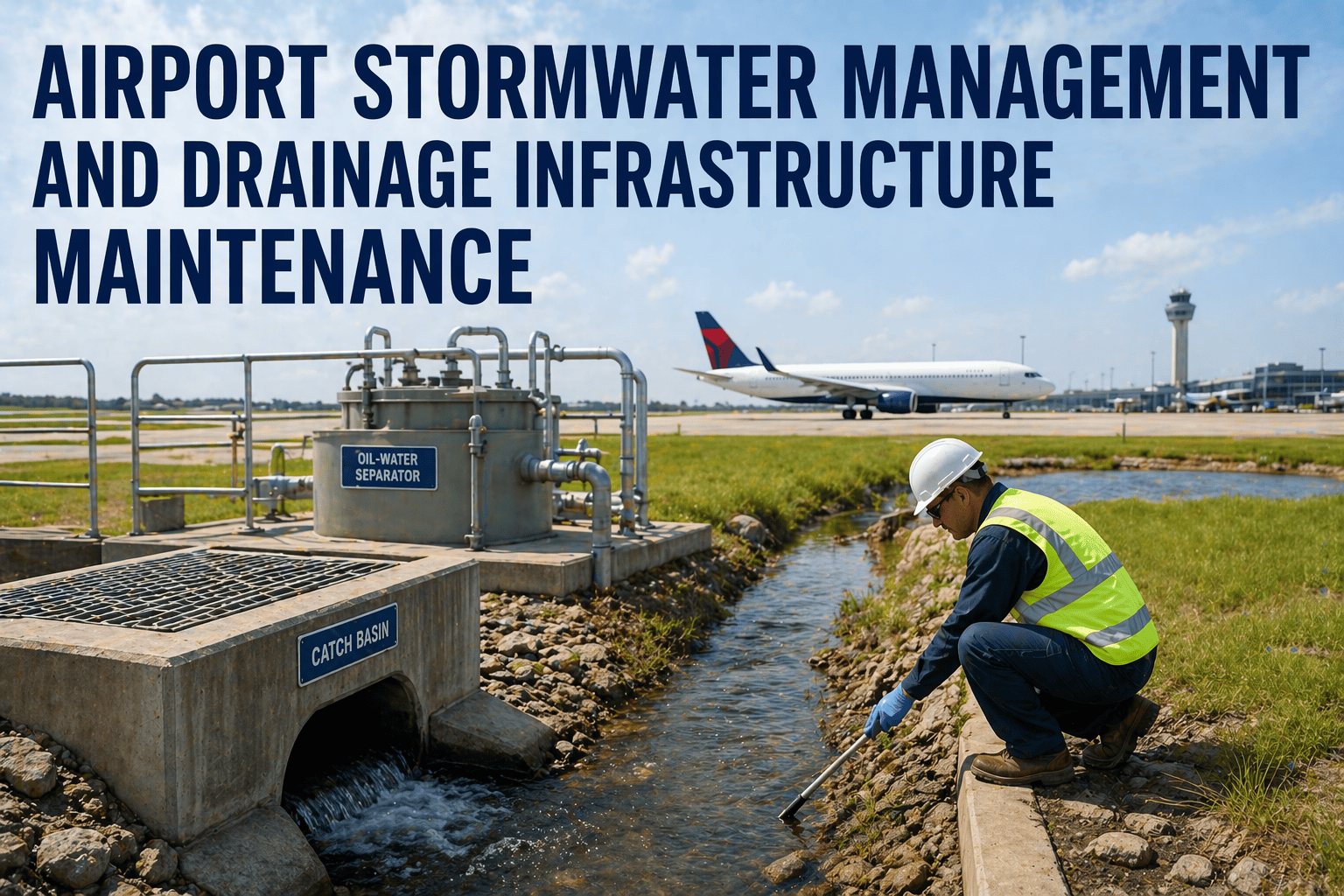
An airport is a small city with three water problems. Potable water on one system serving terminals, hangars and catering. Wastewater on a second system draining every restroom, kitchen and hangar sink. Stormwater on a third system carrying runoff from runways, aprons and fuel farms into whatever receiving water sits at the airport boundary. All three carry regulatory obligations that show up as sampling schedules, discharge permits, lift-station uptime and oil-water separator maintenance logs — and all three land on the same audit desk when a regulator asks for records. This guide walks the utility maintenance discipline using OXMAINT AI, the AI-powered CMMS for airport utility asset teams.
Airport Operations · Utility Asset Management · Water Systems
Three Water Systems. Three Regulators. One Records Programme.
OXMAINT AI, the AI-powered CMMS/maintenance management software, holds the full airport utility programme on one platform — potable sampling schedules, wastewater lift-station PMs, stormwater separator inspections, discharge permit records and every regulatory sample tied to the sample point it came from.
Sample Point Registry
Lift Station Uptime Log
SPCC Evidence Chain
3 Streams
potable · wastewater · stormwater — three separate compliance chains
5 Asset Classes
wells, tanks, lift stations, separators, outfalls
4 Regulators
drinking-water · wastewater · stormwater · SPCC — records demanded on request
1 Chain
from sample bottle to lab result to regulator filing
The 3 Utility Streams — What Each One Actually Regulates
Each stream has its own regulator, its own sampling cadence and its own asset class. Confusing them is the fastest way to a compliance finding. OXMAINT AI holds each stream as a separate compliance chain sharing the same asset register. Sign up free and build your utility streams in OXMAINT AI.
POTABLE WATER
Drinking Supply
Serves: Terminals, hangars, catering kitchens, airline crew facilities, employee restrooms
Assets: Wells or utility feed, treatment, storage tanks, distribution mains, backflow preventers, sample points
Regulator: Drinking water authority — routine bacteriological and chemical sampling
Cadence: Bacteriological monthly · chemical quarterly to annual · backflow annually
WASTEWATER
Sanitary Sewer
Collects: Restroom waste, kitchen and catering effluent, hangar wash bays (with pretreatment), aircraft lav service
Assets: Gravity mains, lift stations, force mains, grease interceptors, on-site treatment where applicable
Regulator: Publicly-owned treatment works or state — industrial user permit terms apply
Cadence: Lift station PMs monthly · grease interceptor per POTW schedule · sample per permit
STORMWATER
Surface Runoff
Collects: Runway, apron, roadway and roof runoff — all surface water leaving airport property
Assets: Catch basins, storm sewers, oil-water separators, detention ponds, outfalls, monitoring points
Regulator: NPDES / MS4 permit — often industrial stormwater permit for airports
Cadence: Wet-weather sampling per permit · quarterly visual inspections · annual comprehensive
The 5 Asset Classes That Need PM Discipline
Utility asset failures usually happen at five specific asset classes. A programme that PMs these on cadence and holds the records is a programme that passes audits and avoids the emergency call at 03:00 when a lift station overflows onto an apron. OXMAINT AI holds each class with its own PM stream. Book a demo to see the asset class library.
W
Wells & Booster Pumps
Well pumps, booster stations, hydropneumatic tanks, pressure switches — foundation of potable supply
PM: pump vibration quarterly · motor thermography annually · draw-down test annually
T
Storage Tanks
Elevated water tanks, ground-level potable tanks, sewage wet wells — capacity of the system
PM: coating inspection annually · interior cleaning per code · vent screen inspection quarterly
L
Lift Stations
Submersible pumps, wet wells, control panels, backup power, high-level alarms — points of failure risk
PM: pump run-time balance monthly · wet well cleaning quarterly · alarm test monthly · generator test monthly
O
Oil-Water Separators
Coalescing plates, oil chambers, sludge chambers, outlet weirs — the SPCC-critical asset
PM: sludge depth check monthly · oil pumpout on threshold · coalescer inspection quarterly · full cleanout annually
P
Sample Points & Outfalls
Backflow preventers, sample taps, monitoring wells, discharge outfalls — where the regulator looks
PM: backflow annual test · sample tap cleaning per protocol · outfall visual after major storms
The Sample-to-Filing Chain — Where Compliance Actually Fails
Compliance rarely fails at the lab. It fails at the chain — the bottle without a legible label, the chain-of-custody form nobody signed, the sample point that isn't on the registry, the missed filing deadline. OXMAINT AI walks the whole chain from bottle to filing. Start free and set up your sample chain.
01 · Schedule
Sample WO Fires
Cadence-driven WO opens with sample point ID, parameter list, bottle type, courier window
▼
02 · Collection
Sample Collected
Field technician logs bottle ID, sample time, field parameters (temp, pH, chlorine residual), photograph
▼
03 · Custody
Chain of Custody Signed
CoC document generated and signed — every hand-off recorded from collector to courier to lab
▼
04 · Lab Result
Result Attached
Lab report attaches to the sample WO — structured data where lab exports it, PDF where it doesn't
▼
05 · Exceedance Check
Threshold Compared
Result auto-checked against permit limits — exceedances raise a defect and trigger notification workflow
▼
06 · Regulatory Filing
DMR / Monthly Report Compiled
Discharge Monitoring Report or equivalent compiled from the period's samples — filed and retained
Oil-Water Separators — The SPCC Asset That Fails Audits
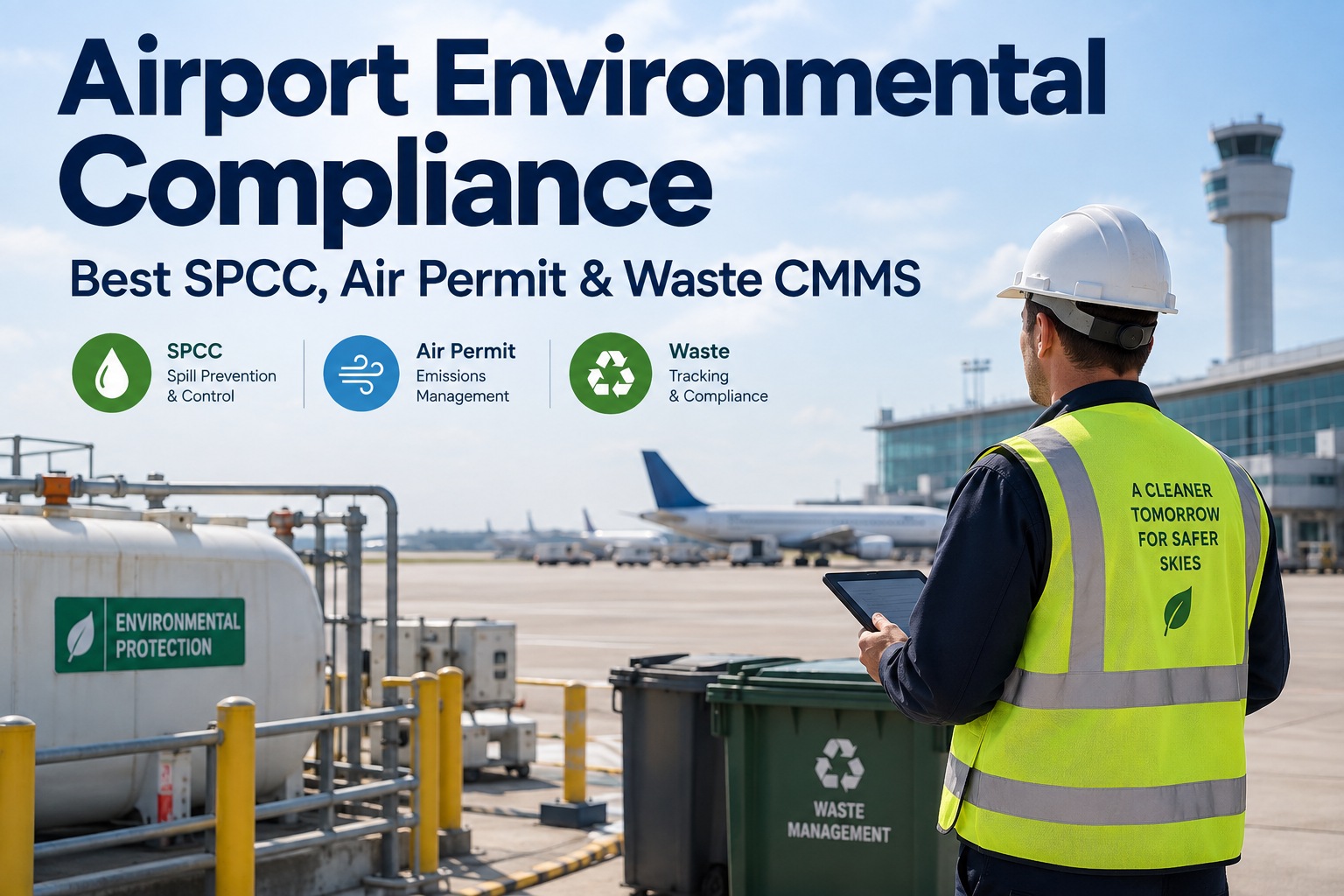
Oil-water separators are the single asset most likely to appear in an audit finding. They serve fuel farms, hangar wash bays and de-icing pads — three of the highest-risk discharge sources on the airport. The SPCC (Spill Prevention Control and Countermeasure) plan names them by asset. OXMAINT AI holds each separator with its own PM chain and inspection record. Book a demo to see separator records.
Oil-Water Separator PM Discipline
Monthly
Sludge Depth & Oil Layer Check
Sludge depth measured with sludge judge · oil layer thickness recorded · photograph attached · pumpout WO raised at threshold
Monthly
Sample Effluent for Oil & Grease
Effluent grab or composite sample per permit · O&G tested at accredited lab · result attached to separator record
Quarterly
Coalescer Plate Inspection
Coalescer plates inspected for fouling, damage, and displacement · cleaning performed if fouled · replacement if damaged
Quarterly
Inlet & Outlet Structure Check
Inlet baffles and outlet weirs inspected · structure integrity confirmed · debris removed · flow path verified
Annual
Full Cleanout & Confined Space Entry
Full contents pumped out · confined space entry PM inspection · structural integrity assessment · corrective actions logged
Annual
SPCC Plan Update Attachment
Asset condition summary generated for SPCC plan · engineer-certified where jurisdiction requires · plan revision retained
Three Regulators. One Records Query. Answered In Seconds.
OXMAINT AI holds every sample, every PM, every lift-station log, every separator cleanout on one platform — so a regulator question about any of three utility streams gets an evidenced answer, not a two-week records hunt.
Lift Station Uptime — The Metric That Prevents Overflows
A lift station overflow on an active apron is a compliance event and an operations event on the same day. Lift station uptime is the KPI that predicts it — pumps alternating cleanly, backup power tested, alarms healthy, run-time balanced. OXMAINT AI trends uptime per station and flags degradation early. Sign up free and see lift station uptime live.
Illustrative Lift Station Health Panel
Terminal Lift Station 1
HEALTHY
Hangar Lift Station 3
HEALTHY
Cargo Lift Station 2
WATCH
Remote Lift Station 5
ACTION
Fuel Farm Lift Station 4
HEALTHY
Green = target met · Amber = single-pump risk · Red = intervention required · trend continuous, refreshed live
What OXMAINT AI Gives an Airport Utility Team
Purpose-built for airport utility asset owners — one platform behind the sample point registry, the lift station uptime log, the separator PM chain and the SPCC evidence file. Start free and load your utility assets into OXMAINT AI.
3-Stream Asset Register
Potable, wastewater and stormwater held as separate compliance chains sharing one asset register.
Sample-to-Filing Chain
Every sample tied to its point, its bottle, its CoC, its lab result and its regulatory filing — one query walks the chain.
Exceedance Auto-Alert
Lab results auto-checked against permit limits — exceedances raise a defect and trigger notification workflow immediately.
Lift Station Uptime Trending
Every pump cycle, alarm event and backup power test retained — uptime KPI trends live per station.
SPCC Asset Ledger
Every oil-water separator condition, cleanout and inspection retained for SPCC plan evidence and audit response.
Regulator-Ready Reports
DMRs, monthly compliance reports and record-request packages generated from the platform in the format regulators expect.
"
Our utility programme had six spreadsheets, three shared drives and a filing cabinet in the field office. When the drinking-water inspector asked for two years of bacteriological results at one sample point, it took a week to prove we'd sampled every month. When the same question came in after consolidation, we filtered the sample WO log by point and by year and had the answer on screen in under a minute. The reason we consolidated wasn't reporting speed — it was that we'd stopped trusting the spreadsheets.
Utility Systems Superintendent · Regional International Airport
Frequently Asked Questions
Can OXMAINT AI import lab results directly from accredited laboratories?
Yes — labs that export EDI or CSV can push results directly to the sample WO, with parameters mapped to permit fields. Labs sending only PDFs have those attached to the WO with a manual key-in of headline values for exceedance checking.
Sign up free and configure lab integration.
How does the platform handle industrial stormwater permits with multiple outfalls?
Each outfall is an asset on the register with its own sample cadence, permit parameters and monitoring schedule. Wet-weather sampling triggers based on precipitation thresholds. Records roll up per outfall or across the permit as required.
Book a demo to see multi-outfall setup.
Can the platform manage cross-connection and backflow prevention testing programmes?
Yes — every backflow preventer is registered as an asset with its own test cadence, certified tester assignment and result retention. Test reports attach to the asset for the life of the device.
Start free and set up your backflow programme.
Does OXMAINT AI track SPCC plan revisions and inspection cycles?
Yes — SPCC-covered assets carry a plan reference field. Inspection records, cleanouts and any material changes trigger a plan-review WO so the plan stays current with the physical asset condition.
Book a demo to see SPCC workflow.
How long does typical implementation take for a utility team?
Most airport utility teams go live on one stream (typically potable) within 4-6 weeks and complete all three streams within 3 months. Historical sample data can be back-loaded to give trend context from day one.
Sign up free and start this month.
Potable. Wastewater. Stormwater. Every Sample. Every Asset. Every Filing.
Move your airport utility programme onto OXMAINT AI — 3-stream asset register, sample-to-filing chain, exceedance auto-alerting, lift station uptime trending and SPCC asset ledger on one platform, evidenced for the life of every asset.