Airport water systems serve tens of thousands of passengers daily across terminals, hangars, lounges, and food courts — and a single unplanned failure in that infrastructure can trigger regulatory shutdowns, health emergencies, or cascading disruption across the entire facility. Managing Legionella risk, backflow prevention, and aging pipe networks without a structured maintenance system is not a compliance gap — it is an operational liability. Start a free trial to see how Oxmaint centralizes airport plumbing maintenance, or book a demo and walk through a live plumbing compliance workflow.
Infrastructure Management / Preventive Maintenance
Airport Water Supply and Plumbing Infrastructure Maintenance
How structured plumbing maintenance programs protect airport water quality, prevent Legionella outbreaks, ensure backflow compliance, and reduce reactive repair costs across terminals and airside facilities.
68%
of Legionella outbreaks in public buildings traced to inadequate water system monitoring and maintenance records
4.8x
higher cost of emergency plumbing repairs versus scheduled preventive maintenance interventions
$2.1M
average regulatory penalty exposure for airports with undocumented backflow testing and water quality records
35%
reduction in water-related maintenance costs achieved through CMMS-driven preventive schedules and inspection tracking
Protect Your Water Infrastructure
Put Plumbing Compliance on Autopilot
Oxmaint schedules backflow tests, Legionella inspections, and fixture checks automatically — with full audit trails attached to every asset record. Start a free trial or book a demo to see it in action.
What Airport Water Infrastructure Management Actually Covers
Airport water systems are not a single network — they are layered infrastructure spanning potable supply lines, fire suppression mains, grey water circuits, drainage systems, and process water for ground support equipment. Each subsystem carries distinct compliance obligations, failure modes, and maintenance cadences. Without a unified management framework, tracking obligations across hundreds of assets across multiple terminals becomes impossible to do reliably.
01
Potable Water Distribution
Mains, risers, sub-mains, and terminal fixtures supplying drinking water to passengers, food operators, and staff. Subject to municipal water quality standards and internal Legionella water management programs.
02
Backflow Prevention Assemblies
Reduced pressure zone assemblies, double check valves, and atmospheric vacuum breakers protecting potable supply from contamination. Required annual testing in most jurisdictions with documented certification records.
03
Fire Suppression Supply
Dedicated fire mains, sprinkler systems, and standpipe networks requiring quarterly and annual flow testing, tamper switch monitoring, and valve position verification under NFPA 25 and local fire codes.
04
Drainage and Waste Systems
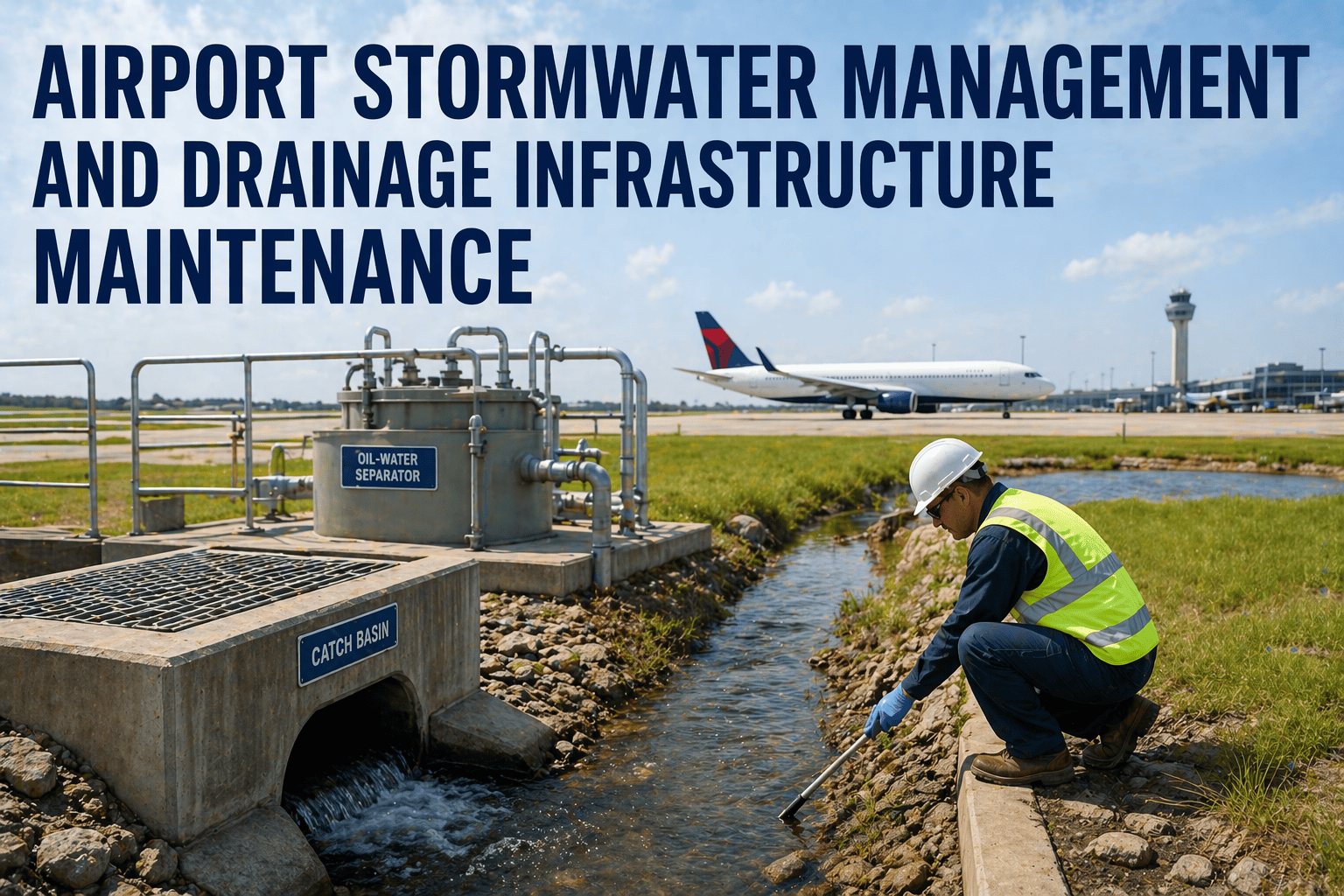
Terminal floor drains, grease traps, aircraft fuel separator drains, and waste ejector systems. Blockages in high-traffic terminals escalate quickly — drain maintenance cadences must match actual usage loads, not fixed calendars.
05
Cooling Tower Water Systems
HVAC cooling tower basins present the highest Legionella risk in most airport portfolios. Biocide dosing schedules, blowdown cycles, and biological sampling are non-negotiable regulatory requirements in all major jurisdictions.
06
Booster Pump Stations
Pressure booster sets maintaining terminal water pressure regularity across multi-story facilities. Pump condition, seal integrity, and impeller wear monitoring prevent the low-pressure events that push bacteria into distribution dead legs.
07
Low-Use Fixture Management
Rarely used faucets, showers, and drinking fountains in gate areas and utility corridors accumulate stagnant water — the primary Legionella colonisation condition. Weekly flushing schedules and documentation are required by most water management plans.
08
Grease Trap and Interceptor Maintenance
Food court and concession grease interceptors require scheduled pumping intervals based on loading — not fixed calendars. Overflow events create cross-contamination risks, regulatory violations, and tenant complaints that escalate to airport management.
Where Airport Plumbing Management Breaks Down
Most airports do not have a plumbing infrastructure failure — they have a maintenance visibility failure. The water system keeps running until something forces attention. By then, the cost and risk exposure are already significant.
No Centralized Asset Registry
Backflow assemblies, PRV stations, and isolation valves exist in separate spreadsheets, service binders, or contractor records. No single source shows what assets exist, where they are, and when each was last serviced.
62% of airports rely on paper-based or spreadsheet plumbing records
Legionella Risk Gaps
Water management plan flushing schedules are created but not enforced. Low-use fixtures in remote gate areas go weeks without flushing. Cooling tower sampling is delayed when contractors are unavailable. Documentation gaps create liability.
Average 23-day gap between required and actual Legionella flushing events in unmanaged facilities
Missed Backflow Test Deadlines
Annual backflow certification deadlines are tracked manually across dozens of assemblies. Missed certifications create water authority non-compliance notices, service disruption threats, and insurance coverage gaps.
1 in 4 backflow assemblies at large facilities is overdue for testing at any given time
Reactive Drain Maintenance
Terminal drains are cleared when blocked, not on a schedule. High-traffic gate areas and food courts experience overflow events that require emergency response, facility closure, and passenger disruption — all avoidable with scheduled jetting.
Emergency drain clearance costs 3.2x the cost of scheduled preventive jetting
How Oxmaint Manages Airport Water Infrastructure
01
Complete Plumbing Asset Registry
Every backflow assembly, PRV, isolation valve, pump station, grease trap, cooling tower, and fixture group is registered with location, specification, service history, and compliance due dates — searchable by terminal, zone, or asset type.
02
Automated Compliance Scheduling
Backflow annual tests, cooling tower sampling, Legionella risk assessments, and low-use fixture flushing are scheduled automatically against each asset record. Upcoming deadlines surface in dashboards weeks in advance — not after a citation.
03
Legionella Water Management Tracking
Water management plan (WMP) flushing events, temperature logs, biocide dosing records, and biological sampling results are logged against each system asset. Compliance rate dashboards show exactly where the program is on track and where it is not.
04
Mobile Work Orders for Field Technicians
Technicians receive work orders on mobile with asset location, procedure checklist, and required documentation fields. Fixture flush logs, temperature readings, and completion photos are captured on-site — no paper, no transcription delay.
05
Contractor Work Order Management
Licensed plumbers and backflow testers are issued work orders directly through Oxmaint. Certification documents, test reports, and sign-off records are attached to the asset record on completion — audit-ready without chasing paperwork.
06
Audit-Ready Compliance Reporting
Generate water authority reports, Legionella compliance summaries, and backflow certification registers in minutes. Every record has timestamps, technician attribution, and digital signatures — ready for water authority inspection, insurance review, or internal audit.
07
Condition-Based Pipe and Asset Monitoring
Track asset condition scores for ageing pipe sections, pump stations, and pressure vessels. Condition trend data feeds 5-year CapEx forecasting models — so rehabilitation budgets are built on asset data, not facility manager estimates.
08
Multi-Terminal Portfolio Visibility
For airports operating multiple terminals or concourses, Oxmaint provides portfolio-level compliance dashboards — showing overdue inspections, open work orders, and asset condition across every building in a single view.
Reactive vs. Planned: The Real Cost Difference
| Maintenance Scenario |
Reactive Approach |
Planned with Oxmaint |
Business Impact |
| Backflow Assembly Testing |
Tested after citation or service threat — fines + emergency contractor rates |
Auto-scheduled 6 weeks before annual deadline — standard contractor pricing |
Avoids water authority penalties and service interruption risk |
| Cooling Tower Biocide Dosing |
Manual tracking — missed doses go unnoticed until sampling shows failure |
Dosing schedule tied to asset record — missed events trigger alerts |
Legionella risk controlled continuously, not retroactively |
| Drain Clearing |
Emergency response after overflow — average $3,400 per incident with closure |
Scheduled jetting by traffic zone — average $800 per event, no closure |
4.2x lower cost, zero passenger disruption events |
| Low-Use Fixture Flushing |
Ad hoc when remembered — Legionella colonisation risk in dead legs |
Weekly work orders auto-generated per WMP schedule — 100% compliance rate |
Documented WMP compliance for every fixture in every terminal |
| Booster Pump Maintenance |
Reactive repair after pressure complaint or alarm — $8,000–$22,000 per event |
Quarterly PM schedule with condition scoring — caught before failure |
Prevents low-pressure events that accelerate bacterial growth in supply lines |
| Audit Preparation |
2–4 weeks assembling records from paper binders and contractor emails |
Reports generated in minutes from live compliance dashboard |
Passes audit in hours instead of weeks — zero records gaps |
Legionella Management: The Highest-Risk Obligation in Airport Water Systems
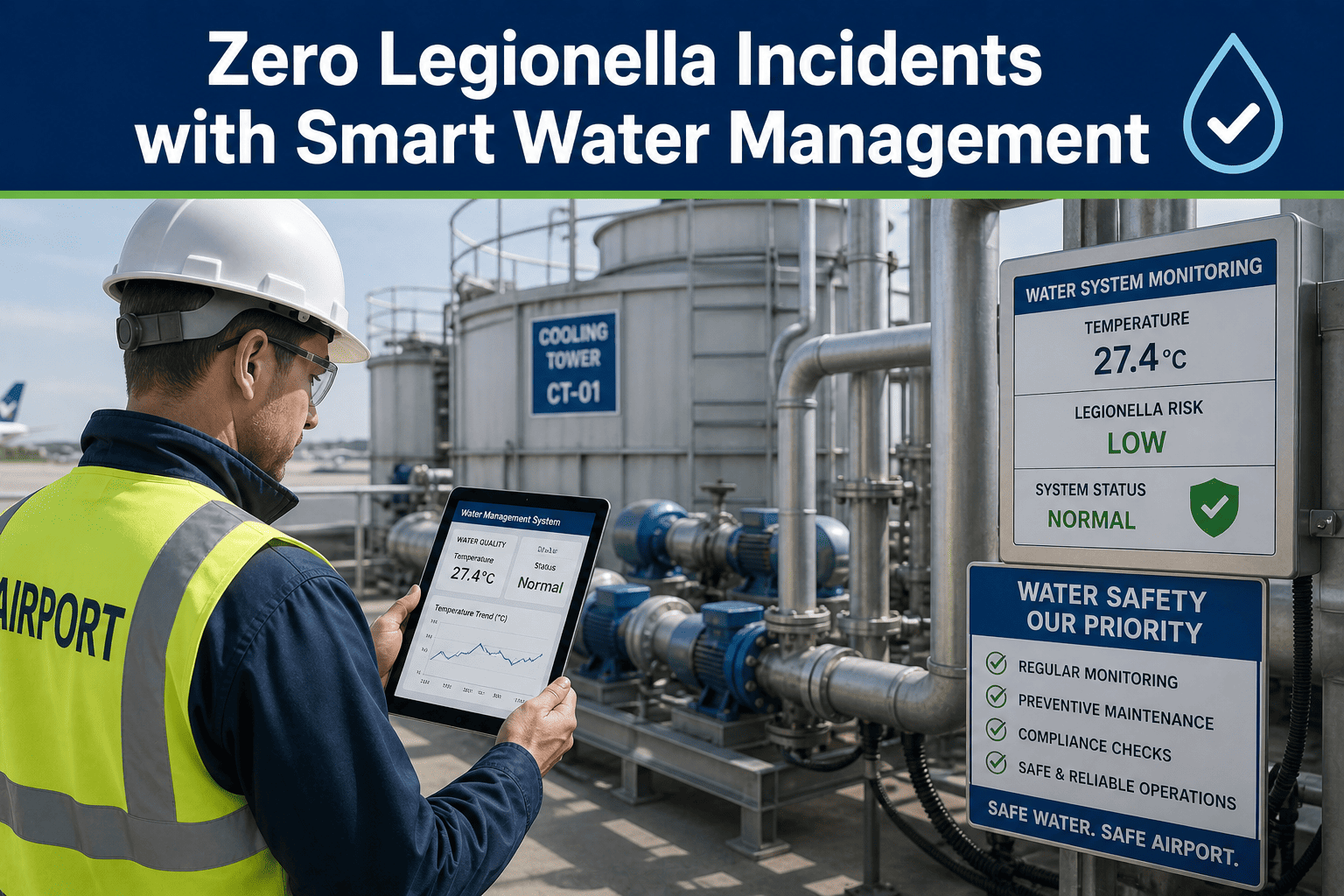
Legionella pneumophila colonises in water systems where temperatures fall between 25–45°C, flow is low, biofilm is present, and stagnation occurs. Airports create ideal conditions for all four factors — particularly in remote gate restrooms, rarely used showers in international transit areas, and cooling tower systems serving perimeter HVAC plants. A single Legionnaires' disease outbreak at an airport creates regulatory intervention, legal liability, and reputational damage of an order of magnitude greater than any preventive maintenance program cost. Start a free trial and configure your Legionella water management program in Oxmaint, or book a demo to walk through a live WMP compliance workflow.
Risk Factor
Water Temperature in Growth Zone
Hot water below 60°C at generation and cold water above 20°C at point of use creates colonisation conditions. Temperature loggers on calorifiers and cold water tanks flag deviations immediately when integrated with Oxmaint.
Risk Factor
Dead Legs and Low-Flow Zones
Redundant pipe sections, capped outlets, and low-use fixtures in remote areas accumulate stagnant water with no turnover. Weekly flushing work orders auto-assigned to specific fixture groups eliminate this risk with documented evidence.
Risk Factor
Cooling Tower Aerosol Generation
Cooling towers produce aerosols that travel across airside and terminal approaches. Biocide dosing efficacy, drift eliminator condition, and basin sediment removal are the three highest-priority controls — all trackable in Oxmaint with timestamped records.
Risk Factor
Biofilm Accumulation in Distribution Pipework
Pipe materials, scale, corrosion, and organic material support biofilm that protects Legionella from biocide treatment. Periodic chlorination, pipe condition monitoring, and scale inhibitor programs reduce biofilm risk across the distribution network.
Results Airports Achieve with Structured Plumbing Maintenance
35%
Reduction in Reactive Plumbing Spend
Airports replacing spreadsheet-based tracking with CMMS-driven preventive schedules typically reduce emergency plumbing call-outs by one-third within 18 months.
100%
Backflow Certification On-Time Rate
Automated compliance scheduling with advance alerts eliminates missed backflow test deadlines — zero water authority non-compliance notices in the first year of deployment.
4.2x
Drain Maintenance Cost Reduction
Scheduled drain jetting based on traffic zone loading cuts per-event costs from $3,400 (reactive) to under $850 (planned) across terminal drain networks.
78%
Faster Audit Response Time
Facilities using Oxmaint generate water authority compliance reports in under 20 minutes versus 2–4 weeks for records retrieval from paper-based systems.
Frequently Asked Questions
How does Oxmaint handle Legionella water management plan compliance across multiple terminals?
Oxmaint maps each asset in your water management plan — cooling towers, calorifiers, low-use fixtures, and risk points — into a structured asset registry. Flushing schedules, temperature logging tasks, biocide dosing records, and sampling events are all generated as work orders automatically against each asset. Compliance rate dashboards show completion status across every terminal in real time. You can generate a full WMP compliance report for any audit within minutes.
Start a free trial to configure your water management program today.
What backflow prevention assets does the CMMS track and what compliance records does it generate?
Oxmaint registers every backflow prevention assembly — RPZ valves, double check valves, and vacuum breakers — with location, installation date, test due date, and assigned licensed tester. Annual test work orders are generated automatically. When testing is complete, the certified tester's report is attached to the asset record with timestamp and signature. Water authority compliance registers are exportable on demand — no manual record assembly required.
Can Oxmaint manage plumbing maintenance across a multi-terminal airport campus?
Yes — Oxmaint's asset hierarchy (Portfolio > Property > System > Asset > Component) maps directly to airport campus structures. Each terminal is a property, each plumbing system is a system layer, and individual assets sit beneath it. Portfolio-level dashboards show compliance status, open work orders, and asset condition across all terminals simultaneously. Directors of Facilities see the full picture; terminal managers see their zone.
Book a demo to see how multi-terminal portfolio management works.
How does CMMS-driven plumbing maintenance reduce emergency repair costs at airports?
Emergency plumbing costs at airports are driven by three avoidable scenarios: missed preventive service allowing degradation to failure, no asset history causing technicians to spend extra time diagnosing before acting, and no contractor coordination structure leading to higher reactive call-out rates. Oxmaint eliminates all three — preventive schedules prevent failures, full asset history cuts diagnostic time, and contractor work order management maintains preferred supplier relationships at planned rates rather than emergency rates.
Airport Water Infrastructure
Compliance Gaps in Airport Plumbing Are Not Inspectable — Until an Incident Forces Inspection
Oxmaint gives airport facility teams a structured, auditable system for every water asset across every terminal — from backflow certification scheduling to Legionella management to drain maintenance planning. Stop managing plumbing compliance from memory and spreadsheets.