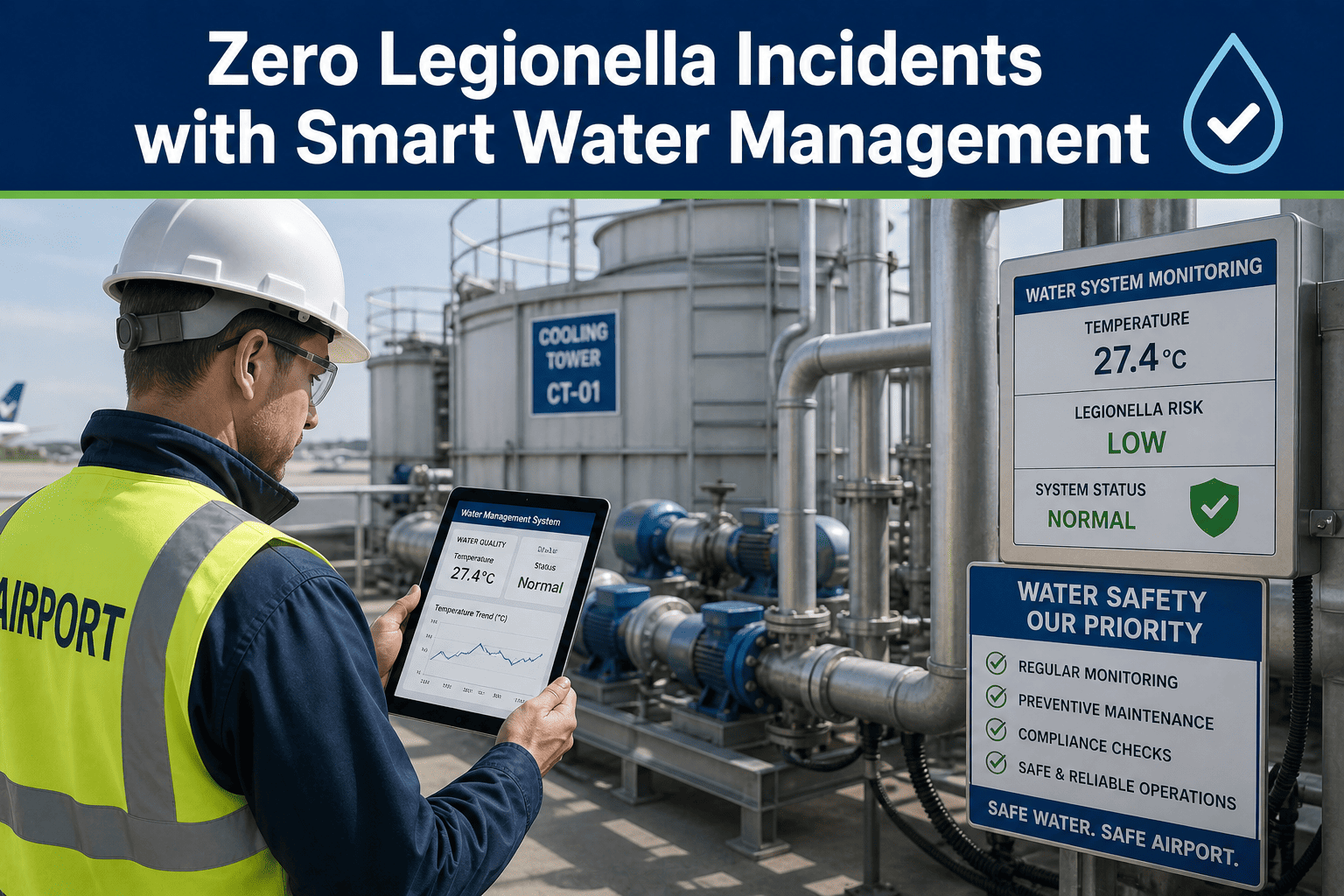
A single Legionella outbreak at an airport can shut down terminals, trigger health department investigations, and expose the facility to lawsuits exceeding $10 million. One international airport eliminated this risk entirely by achieving zero Legionella incidents across a 2.4 million square foot terminal complex using a CMMS to automate flushing schedules, log temperature monitoring, and track compliance with ASHRAE 188 protocols. The system managed 847 water fixtures, 12 cooling towers, and 34 domestic hot water risers with full audit trails and automated alerts when any parameter drifted outside safe operating bands. Book a demo to see how OxMaint tracks water safety compliance.
Track Every Faucet, Cooling Tower, and Water Riser Before Bacteria Grows
OxMaint automates water system maintenance with digital flushing logs, temperature monitoring workflows, biocide dosing records, and ASHRAE 188 compliance reporting. Stop relying on paper logs and manual checks that miss the early warnings Legionella needs to colonize your facility.
847
Fixtures Tracked
Faucets, showers, and water outlets across terminals and concourses
Zero
Legionella Incidents
No positive cultures or health department actions across three-year period
100%
ASHRAE 188 Compliance
Full documentation and audit readiness maintained continuously
12
Cooling Towers Monitored
Biocide dosing, blowdown cycles, and temperature logs automated
Why Airport Water Systems Are High-Risk Legionella Environments
Airports combine everything Legionella bacteria need to thrive: large building water systems with miles of piping, low-use fixtures in gate holdrooms that sit stagnant for hours, tepid water temperatures in long horizontal runs, and biofilm accumulation in cooling towers serving massive HVAC loads. Add inconsistent flushing protocols, incomplete temperature monitoring, and paper-based compliance logs, and you have the exact conditions that led to outbreaks at healthcare facilities and hotels. The airport in this case study recognized the risk and built a water management program that turns every flush, every temperature reading, and every biocide dose into a timestamped, auditable CMMS record. Start a free trial to build your water safety program.
Stagnant Water in Low-Use Fixtures
Gate holdroom faucets and employee locker room showers can sit unused for 8-12 hours between flights, allowing water to reach 77-108°F—ideal growth temperatures for Legionella.
Tepid Water Zones in Long Pipe Runs
Terminal buildings span thousands of feet with dead-leg branches, where hot water cools below 124°F and cold water warms above 68°F, creating colonization zones.
Cooling Tower Biofilm and Drift
HVAC cooling towers operating 24/7 accumulate biofilm on fill media and create aerosol drift that can reach public areas if biocide treatment lapses.
Incomplete Flushing Records
Manual paper logs of weekly flushing are incomplete, unsigned, or fabricated after the fact, leaving no proof of compliance during health inspections.
The Airport's Water Management Program Structure
The facilities team implemented a four-layer CMMS program aligned with ASHRAE 188 and CDC guidelines: automated fixture flushing schedules, continuous temperature monitoring at critical control points, cooling tower biocide dosing logs, and quarterly Legionella testing with full sample traceability. Every water outlet was assigned an asset ID, every maintenance task generated a timestamped work order, and every temperature excursion triggered an automatic alert to the water safety team.
Layer 1
Automated Flushing Schedules
Weekly flushing work orders auto-generated for 847 fixtures, with mobile completion requiring tech signature, timestamp, and visual confirmation of water flow and temperature.
Layer 2
Temperature Monitoring Workflows
Daily temperature checks at water heater outlets, recirculation returns, and fixture endpoints logged in CMMS with alerts triggered when hot water drops below 124°F or cold water rises above 68°F.
Layer 3
Cooling Tower Biocide & Blowdown Tracking
Chemical treatment logs, conductivity readings, cycles of concentration, and blowdown events recorded per tower asset, with automatic dosing pump calibration reminders.
Layer 4
Legionella Testing & Lab Results
Quarterly water samples logged by sample point ID, lab results uploaded to CMMS, and corrective actions triggered automatically if any culture returns positive.
Paper Logs vs CMMS Water Safety Tracking
Flushing logs signed weekly, often completed retroactively
Temperature checks recorded in binders with missing data
Cooling tower chemical doses estimated from pump run time
Lab results filed separately from maintenance records
No alerts when temperatures drift into danger zones
Compliance reports assembled manually for health inspections
Flushing work orders require real-time mobile completion with GPS timestamp
Temperature readings captured digitally with trend graphs and alerts
Chemical usage tracked by batch number, dose rate, and tower ID
Lab results linked to sample point assets with full traceability
Automatic alerts sent when any parameter breaches safe limits
Audit-ready compliance exports generated in seconds on demand
Critical Water Safety Metrics Tracked in Real Time
Hot Water Supply Temperature
Target: ≥140°F at heater outlet
Legionella cannot survive sustained exposure above 140°F. Any drop below 124°F at fixtures creates colonization risk.
CMMS Action: Alert triggered, escalation to engineering within 2 hours
Cold Water Supply Temperature
Target: ≤68°F at all endpoints
Cold water warming above 68°F allows bacterial growth, especially in summer or buildings with poor insulation.
CMMS Action: Investigate insulation failure, check recirculation crossover
Fixture Flushing Frequency
Target: Weekly minimum for low-use outlets
Stagnant water allows biofilm formation and bacterial amplification in dead-end branches.
CMMS Action: Auto-generate work order, require mobile completion with photo
Cooling Tower Biocide Residual
Target: 2-5 ppm free oxidizer
Insufficient biocide allows biofilm growth on tower fill media and creates aerosol Legionella risk.
CMMS Action: Log residual reading, flag low readings for pump calibration check
Legionella Culture Results
Target: <10 CFU/mL or non-detect
Any positive culture indicates colonization and requires immediate corrective action per ASHRAE 188.
CMMS Action: Trigger superheating protocol, hyperchlorination, or UV installation
Work Order Completion Rate
Target: 100% on-time completion
Missed flushing or temperature checks create gaps in the water management program and audit liability.
CMMS Action: Escalation to facilities manager if tasks overdue >24 hours
Three-Year Water Safety Results
156
Quarterly Tests
Legionella cultures across all sample points over 3-year program
8,847
Flushing Events
Completed work orders with digital signatures and timestamps
100%
Audit Pass Rate
Health department inspections with zero findings or corrective actions
$0
Outbreak Costs
No illness, investigations, remediation, or legal exposure from Legionella
Frequently Asked Questions
How does a CMMS prevent Legionella growth in airport water systems?
By automating the tasks that keep water systems outside Legionella's growth envelope: scheduled flushing to eliminate stagnation, temperature monitoring to catch hot water cooling or cold water warming, and biocide dosing logs that prove continuous chemical treatment. Every task generates a timestamped record that proves compliance during audits.
Start a free trial to automate your water safety program.
Can OxMaint track hundreds of individual water fixtures across multiple terminals?
Yes. Each fixture gets a unique asset ID with location, fixture type, and flushing frequency. The system auto-generates weekly work orders, tracks completion via mobile app, and flags any missed tasks before stagnation occurs.
Book a demo to see fixture tracking in action.
Does OxMaint integrate with temperature sensors and chemical dosing systems?
Yes. The platform connects to BMS, SCADA, and IoT temperature sensors to capture real-time readings, and logs chemical dosing pump runtime, batch numbers, and residual test results per cooling tower asset. Manual readings can be entered via mobile forms when sensors aren't available.
What ASHRAE 188 compliance reports does OxMaint generate?
Complete water management program documentation including flushing logs by date and location, temperature trend graphs with excursion flags, biocide treatment records, Legionella lab results with corrective actions, and hazard analysis reports ready for health department review.
Your Passengers Expect Safe Water. Prove You're Delivering It.
OxMaint gives airport facilities teams a single platform to automate fixture flushing, monitor water temperatures, track cooling tower chemistry, and maintain ASHRAE 188 compliance with audit-ready documentation. Stop gambling with paper logs. Start tracking water safety the way you track every other critical system.