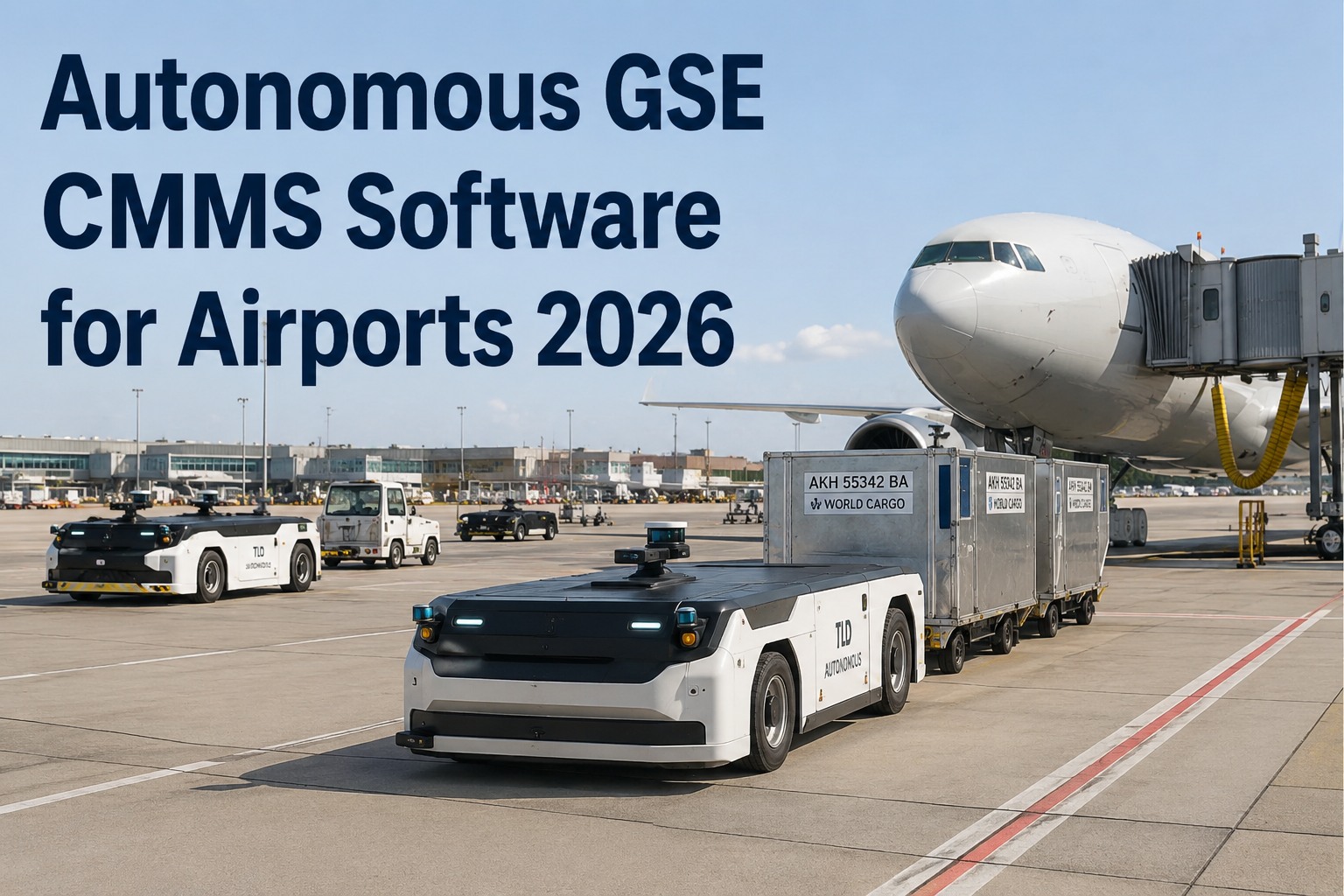
Autonomous ground support equipment is where airport ramp operations are actually reinventing themselves. The market has grown from $4.8B in 2025 to a projected $11.6B by 2034 at a 10.3% CAGR, and the operational logic is unambiguous: a single narrowbody turnaround runs 25-40 minutes, involves 10-20 pieces of coordinated GSE (baggage tractors, belt loaders, catering trucks, ground power units, pushback tugs, PCA units, deicers, potable water, lav service), and a delay costs airlines thousands of dollars per minute in crew duty, passenger compensation, and knock-on cancellations across the network. Autonomous GSE — self-driving baggage tugs, sensor-guided cargo loaders, supervised pushback tractors on LiDAR/vision/GPS stacks — cuts labour cost up to 35% per turn cycle, holds consistent speeds regardless of shift fatigue, and delivers well-maintained fleet operational efficiency gains around 30%. But the mixed autonomous + conventional fleet creates a new maintenance category: cycle-based PMs, battery health monitoring, sensor calibration schedules, telematics-driven work orders, and airside-safe mobile execution — all rolled up against turnaround time (TAT) outcomes and airline-attributable delay codes. Below is the working guide — the autonomy maturity ladder, the GSE fleet inventory per turn, the four-stage deployment timeline, and the mobile-first CMMS architecture that keeps driverless tugs, dollies, and PCA units airside-ready at hub scale. Start free or book a demo.
Aviation · Airside · Autonomous GSE · IATA GAD · 2026
Autonomous GSE CMMS Software for Airports 2026
The autonomy maturity ladder, the GSE fleet inventory per aircraft turn, the four-stage deployment timeline, and the mobile-first CMMS architecture that keeps driverless tugs, dollies, PCA units, and belt loaders airside-ready at hub scale.
-
$11.6B
projected autonomous GSE market by 2034 (10.3% CAGR)
-
25–40 min
narrowbody turnaround window — every minute pays
-
10–20 pcs
of GSE coordinated on every single aircraft turn
-
-35%
labour cost per turn cycle with autonomous GSE
The Autonomy Maturity Ladder
Four Stages — Not Every GSE Type Is Ready for Full Autonomy Yet
Autonomous GSE is not one thing. Below is the working ladder of autonomy maturity — from operator-assist safety systems to fully autonomous missions — with what actually deploys at each level and where the CMMS needs to plug in.
Safety Systems & Sensor Assist
Collision-avoidance sensors, proximity warnings, blind-spot cameras, speed governors. Human operator drives; system prevents accidents. Baseline for all next-gen GSE.
Assisted Docking & Positioning
System takes over final-approach positioning at aircraft or dock — belt loader docking to cargo door, GPU alignment, PCA hose positioning. Operator supervises, system executes precision.
Supervised Automation
Vehicle drives itself on pre-programmed routes with human supervisor on-site or remote. Autonomous baggage tractor makes gate-to-BHS runs on LiDAR + GPS + vision stack. Current operational deployment tier at major hubs.
Fully Autonomous Missions
No on-site human. Vehicle receives mission, executes gate approach, docks, charges, returns. Currently in trial for baggage tugs and pushback at select airports. Full-fleet L4 target date is 2050 per Royal Schiphol Group plan.
The Fleet on Every Turn
10-20 Pieces of GSE Coordinated Per Aircraft — All Under Maintenance
A single narrowbody turn involves this fleet of coordinated equipment — each with its own PM cadence (hours or cycles), sensor calibration, battery health, and reliability signature. Autonomous versions add the LiDAR/vision/GPS stack on top.
Baggage Tractor
Autonomous variant: LiDAR + GPS route-following, gate-to-BHS. Cycle-based PM every 500-1,000 tows.
Belt Loader
Assisted-docking variant available. Hydraulic PM by hours. Belt wear inspection every 250 cycles.
Pushback Tug / Tractor
Supervised-autonomous L3 emerging. Highest-consequence GSE — direct aircraft contact. PM tied to hours + tow count.
Ground Power Unit (GPU)
400 Hz output verification quarterly. Auto-plug systems adding L2 assisted-docking maturity.
Pre-Conditioned Air (PCA)
Compressor + hose inspection cycles. Fixed installations require quarterly duct-pressure verification.
Cargo Loader
High-lift platform hydraulic + safety-interlock cycles. Robotic variants on trial. Load-test annual.
The Delay-Code Economics
GSE Failure Is an Airline-Attributable Delay Code. TAT Discipline Is Revenue Discipline.
A single GSE breakdown during a 30-minute turn window cascades into airline delay codes, gate slot reassignment, and downstream cancellations across the network. Airports that operate well-maintained fleets deliver operational efficiency gains around 30% and defensibly reduce attributable delay claims. Cycle-based PMs on autonomous units, battery health monitoring, and telematics-triggered work orders on out-of-tolerance sensor readings are the operating discipline. Oxmaint runs the loop end-to-end.
The 21-Day Deployment Timeline
From First Sensor to High-Confidence Predictive Coverage
A typical mid-size airport with 80-150 daily movements can be fully instrumented and operationally live in 21 days. Below is the working phase timeline — install to steady state.
Sensor Install & Data Feed
Clamped-on IoT sensors deployed across GSE fleet without voiding OEM warranties. Telematics data starts flowing within 72 hours of install. AODB and FIDS integrated via REST API or SITA/AIDX feed.
Asset Register & PM Templates
Full GSE fleet loaded into asset register with autonomy tier per unit. Cycle-based and hours-based PM templates configured per equipment class. Airline-attributable delay-code mapping established.
Ramp Team Onboarding & Go-Live
Ramp technicians onboarded to mobile app. Work order execution moves from paper to digital. Full-fleet operational visibility live. Baseline reliability KPIs established for TAT correlation.
AI High-Confidence Predictive Coverage
AI models reach high-confidence predictive accuracy — trained on gate assignments, seasonal turn patterns, and fleet degradation signatures. Predictive work orders flowing on battery health, sensor drift, hydraulic degradation.
Built for Airside Ops & Ground Handling
How Oxmaint Runs the Autonomous GSE Programme End to End
-
Autonomy-Tier Register
L1-L4 Maturity Tagged Per Unit
Every GSE unit tagged with autonomy tier (L1 assist / L2 docking / L3 supervised / L4 fully autonomous). PM templates and sensor-monitoring cadence auto-configured per tier — L3 units get sensor calibration and route-map validation on top of standard hydraulic and battery PMs.
-
Cycle + Hours PMs
Dual-Trigger Scheduling for GSE
GSE degrades on both hours (engine, hydraulic) and cycles (tow count, dock count, dispense count). Dual-trigger PM scheduling fires whichever comes first — accurate for high-utilisation hub airports where cycles outrun calendar.
-
Telematics Ingestion
IoT + LiDAR + GPS Data to Work Orders
Sensor data streams from GSE telematics — battery state-of-charge, hydraulic pressure, LiDAR calibration drift, GPS accuracy. Threshold breach auto-generates work order with recommended action and priority.
-
Airside-Safe Mobile
Offline Mode + Ramp-Ready Interface
Ramp technicians work on mobile with offline mode — cellular dead zones on the apron do not stop work order execution. QR asset tags on every unit for one-scan identification. Photo capture per WO for evidence trail.
-
TAT + Delay Code Reporting
Reliability Tied to Turnaround Outcomes
Equipment reliability KPIs (MTBF, MTTR, availability) correlated with TAT and airline-attributable delay codes. Board-ready reports show reliability gains translating to defensible reduction in attributable claims.
-
Free Forever Plan
Pilot One Ramp Zone First
Cloud-based, mobile-first. Load one ramp zone's GSE fleet — 15-25 units typically — run cycle-based PMs and telematics-triggered WOs for 30 days, then scale to full airside operations.
Frequently Asked
Autonomous GSE CMMS Questions
Which GSE types are actually deployed as fully autonomous today?
Baggage tractors on pre-programmed gate-to-BHS routes are the most mature — operational at multiple major hubs at L3 supervised autonomy. Pushback tugs are progressing from trial to early operational deployment, with L2 assisted docking widely available and L3 supervised on newer models. Cargo loaders and belt loaders have L2 assisted-docking widely deployed with robotic full-loading systems in trials. Full L4 across the fleet is a 2040-2050 horizon — near-term the mixed fleet (conventional + autonomous) is the operating reality. Start free and configure per-unit autonomy tagging today.
How is maintenance different for autonomous vs conventional GSE?
Autonomous units add three new maintenance categories on top of standard GSE: sensor stack calibration (LiDAR calibration drift check every 500-1,000 cycles, vision system cleaning and validation, GPS accuracy verification), battery health management (deeper cycle analytics for lithium-ion packs than diesel required), and route-map / software update version control tracked per unit with change-control workflow. The CMMS needs to schedule and enforce all three — otherwise the autonomy stack degrades silently until a mission fails.
Why cycle-based PMs and not calendar-based?
GSE at a hub airport can run 3-5x the cycles of a regional airport unit in the same calendar period. Calendar-based PMs either over-maintain low-utilisation units (waste) or under-maintain hub-utilisation units (breakdown risk). Cycle-based (tow count, dock count, engine hours) matches PM intervals to actual asset stress. Best practice: dual-trigger PMs fire whichever hits first — hours or cycles — so seasonal variation and utilisation swing both get covered. Book a demo to see dual-trigger PM configuration.
Can this integrate with our AODB / FIDS / airline ops systems?
Yes. Standard integration via REST API or SITA/AIDX data feeds for AODB (Airport Operational Database) and FIDS (Flight Information Display System). Flight schedule changes propagate to ground-crew work order priorities within 90 seconds of a schedule revision — turn plans re-shuffle automatically without manual re-planning. Airline ops systems for delay code attribution integrate via REST API for closed-loop reliability-to-TAT reporting.
Is there a free plan to pilot one ramp zone?
Yes. Oxmaint offers a free forever plan — enough to load one ramp zone's GSE fleet (15-25 units typically), tag each unit with its autonomy tier, configure cycle-based PMs, and pilot the mobile execution workflow for 30 days before scaling to full airside. Cloud-based, mobile-first, offline-capable — no server procurement to start. Sign up and pilot on one ramp zone today.
L1-L4 Autonomy · Cycle + Hours PMs · Telematics-Driven · TAT-Correlated
Every Minute of TAT Is Revenue. Every Autonomous Unit Adds Sensor Discipline. The CMMS Runs Both.
The autonomy maturity ladder tagged per unit. Cycle and hours PMs firing on whichever hits first. Telematics ingestion turning sensor drift into work orders before the mission fails. Reliability outcomes correlated to airline-attributable delay codes. Oxmaint runs the mixed autonomous + conventional GSE fleet as one operational programme, live on mobile, on the ramp, at hub scale.