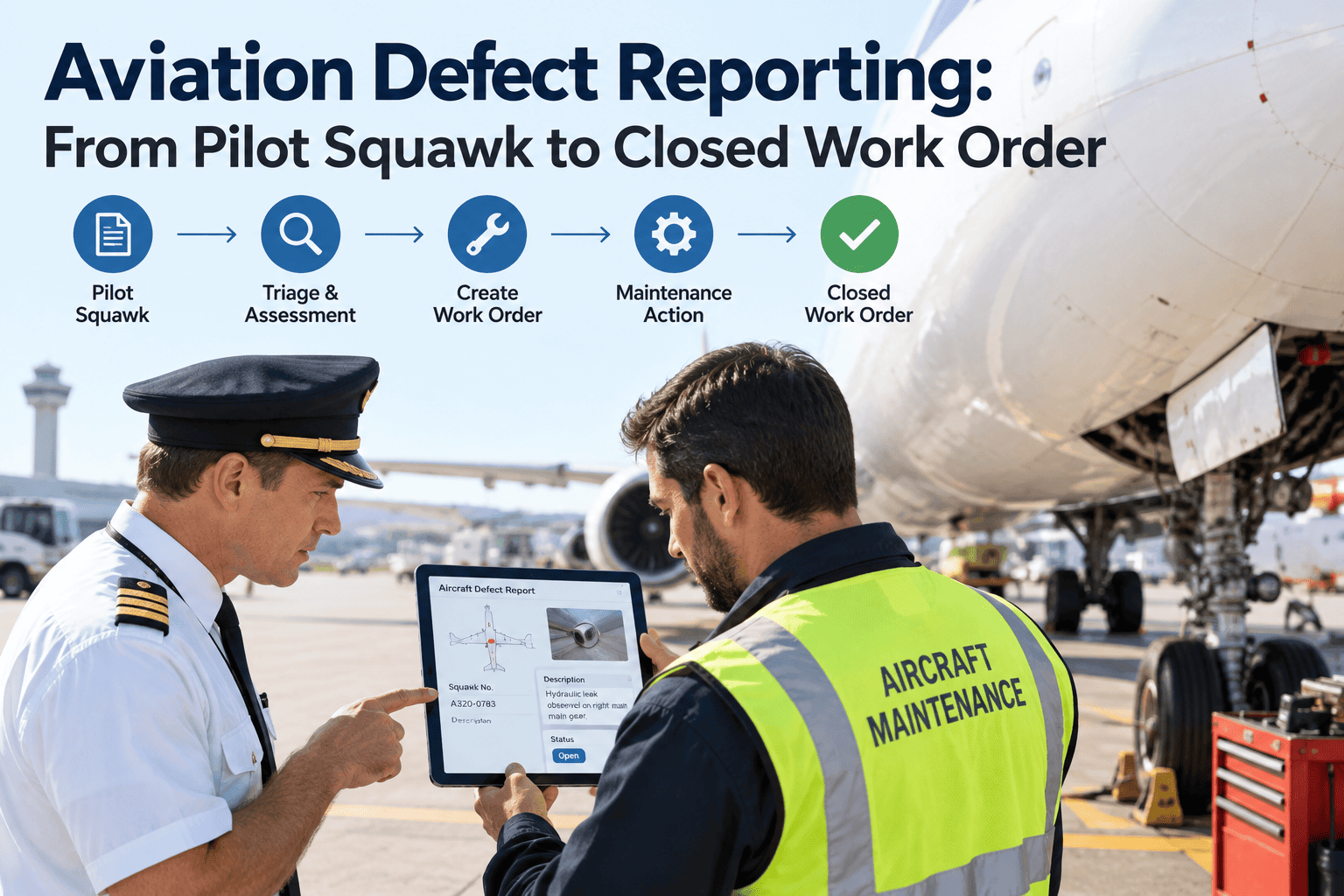
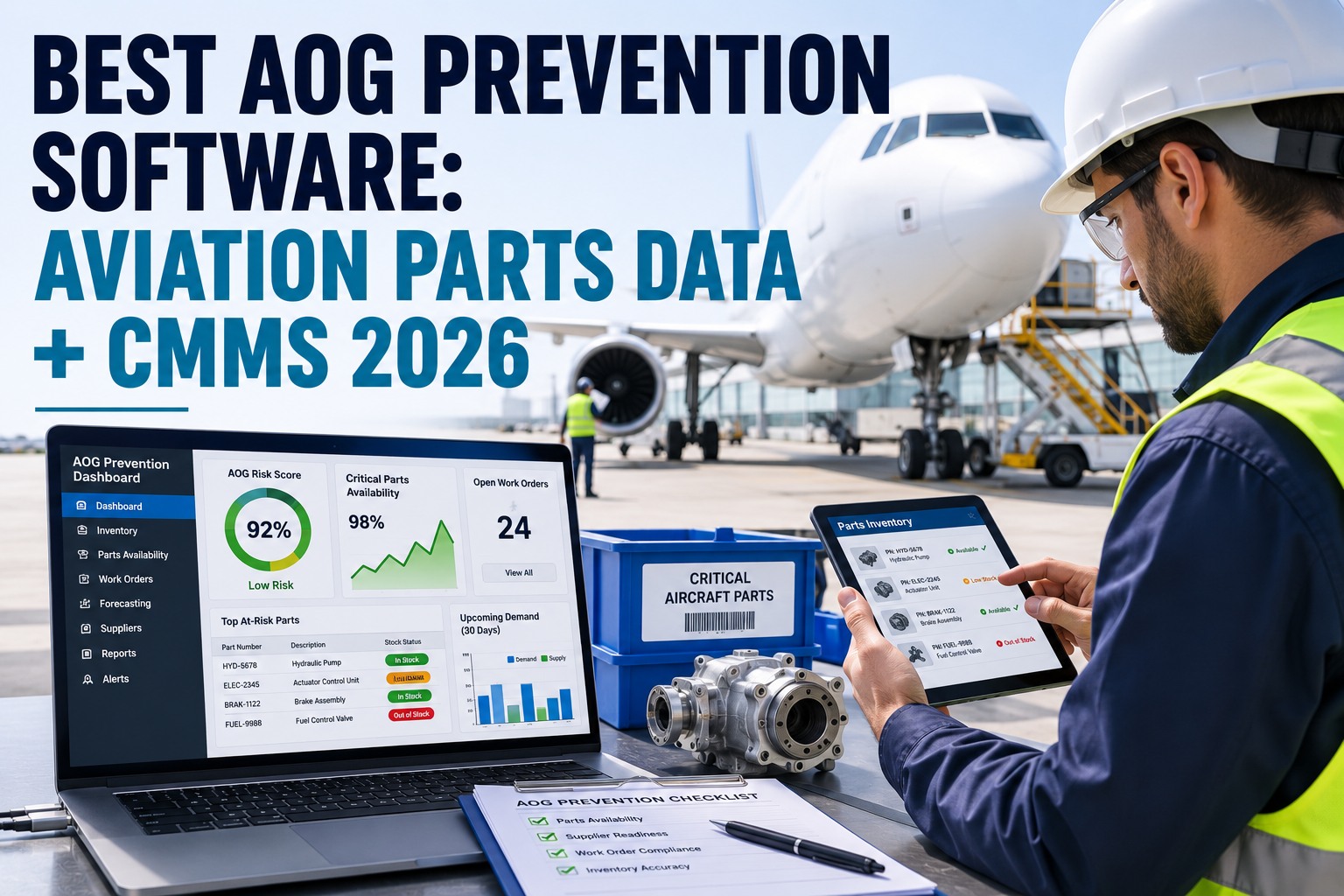
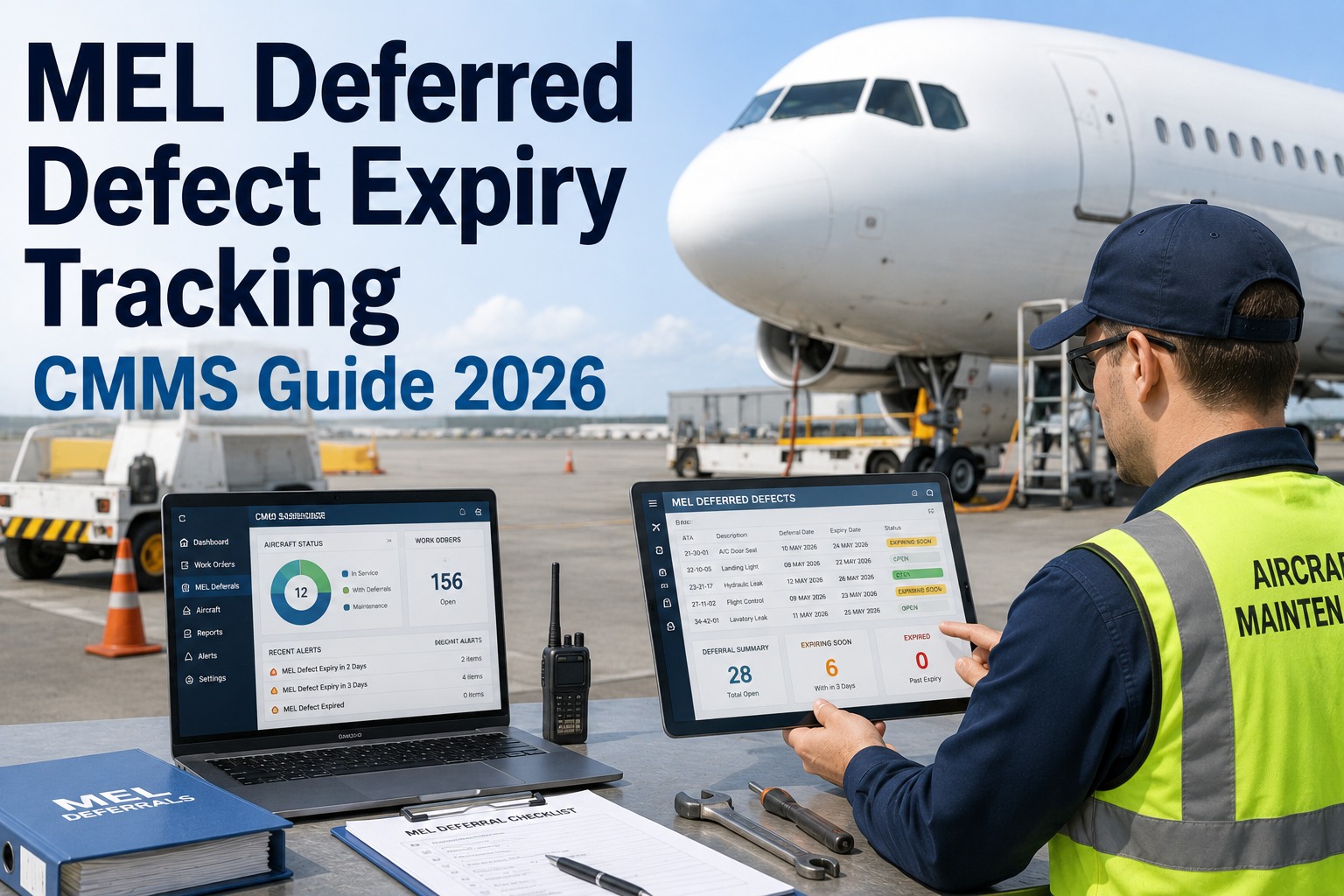
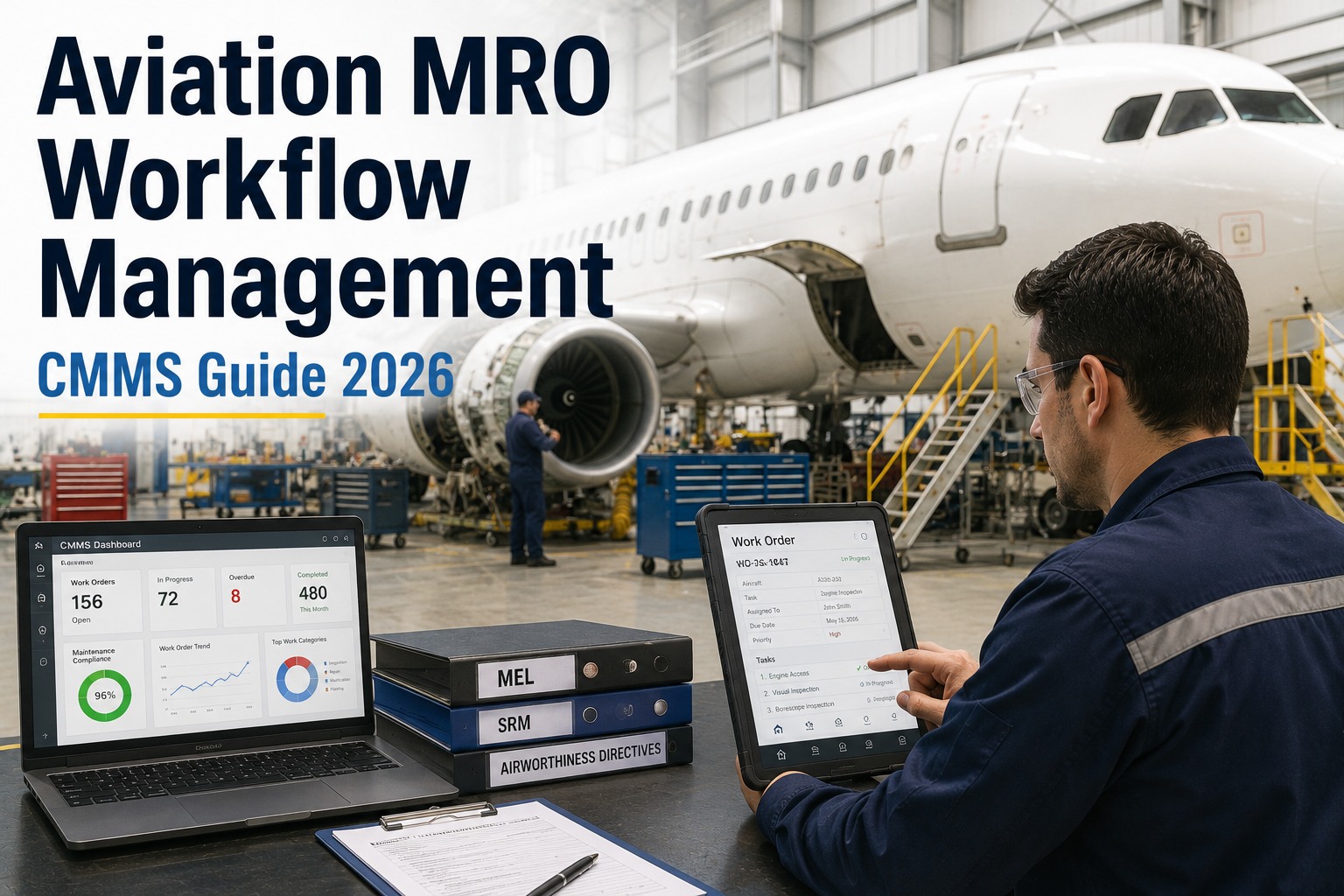
Every pilot squawk is the moment an aircraft's dispatch clock starts ticking. OxMaint AI-powered CMMS / Maintenance Management Software catches it at the tech-log entry and carries it through MEL / CDL triage, category-timed rectification and a signed release to service — one auditable record from pilot to CRS. Paper loops lose squawks between shifts, miss MEL clocks and never trend repeats. This guide walks the pilot-squawk-to-closed-work-order workflow in OxMaint — or book a live walkthrough.
Aviation MRO · Squawk → Inspection → Work Order → Release to Service
Turn Every Pilot Squawk Into an Actioned, Time-Bound Work Order.
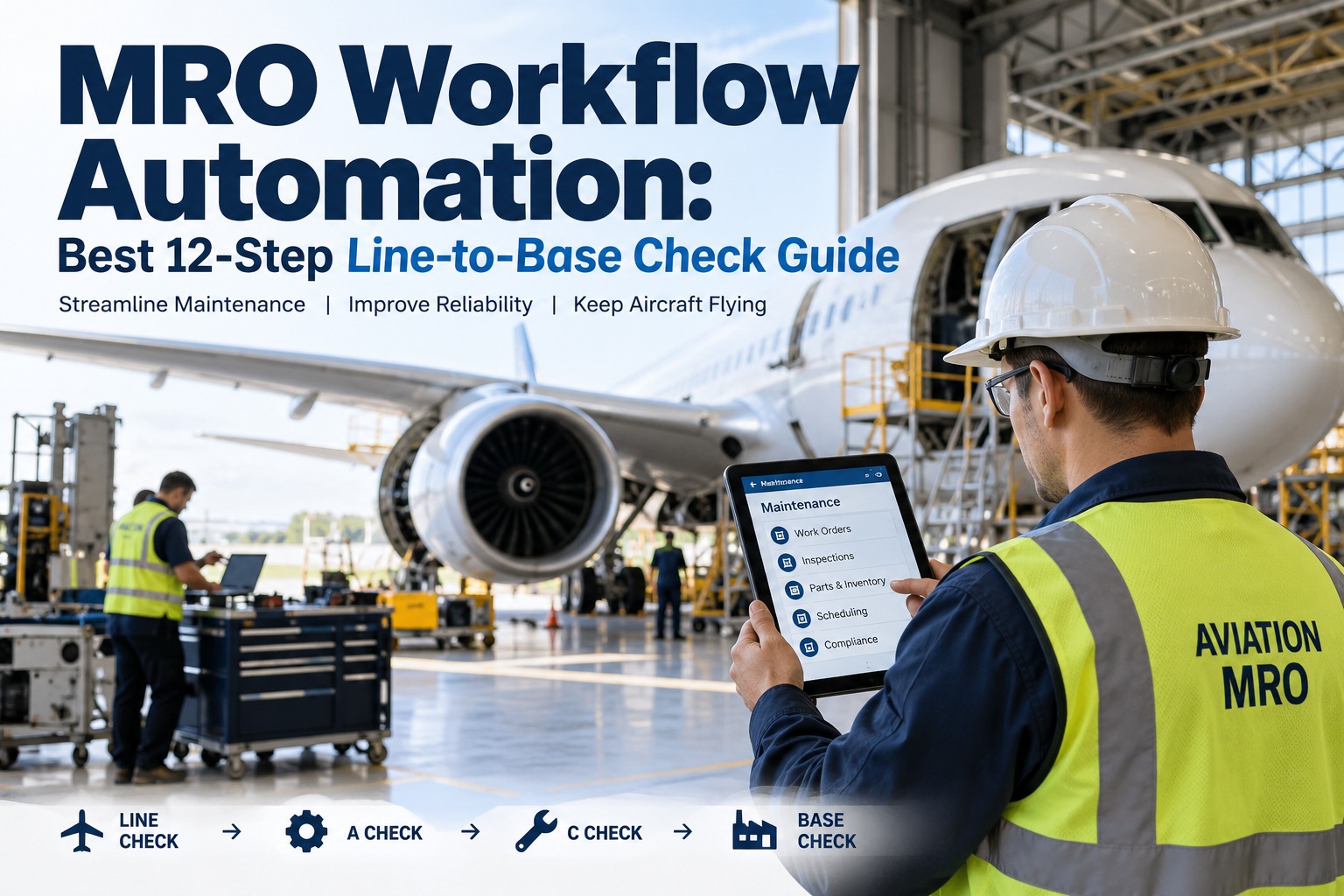
Paper tech logs lose squawks between shifts and miss MEL clocks. OxMaint AI-powered CMMS connects the aviation defect workflow end-to-end — squawks and inspections in, MEL / CDL triage, work orders out, PM schedules updated from what the fleet is actually telling you. Live A/B/C/D clocks keep every deferred item on one dashboard so nothing drifts past its deadline.
Squawks & Inspections In
MEL / CDL Triage
Work Orders Out
PM & Predictive Alerts
7 Stages
pilot squawk to signed CRS in OxMaint
4 Categories
MEL A / B (3d) / C (10d) / D (120d) clocks
1 Record
squawk, MEL, WO, parts, CRS together
Live View
deferred defect dashboard per fleet
Why the Squawk-to-Closure Loop Fails on Paper
Most airworthiness findings don't come from missed inspections — they come from broken record links. A defect entered on paper at 22:40, transcribed to the wrong tail, deferred verbally between shifts, closed without a CRS signature. OxMaint AI removes those failure modes structurally: the next stage cannot open until the previous stage's evidence is captured.
01
Lost Between Shifts
Paper: late-night squawk never reaches the register. OxMaint: time-stamped, tail-tagged, visible to the next shift the moment the pilot saves it.
02
MEL Mis-Applied
Paper: engineer picks a similar-looking entry. OxMaint: structured lookup enforces the exact MEL entry with (O) / (M) procedures attached.
03
Clock Runs Out Quietly
Paper: a Category B rolls to day 4 unnoticed. OxMaint: the countdown runs live with breach alerts before the deadline.
04
Repeats Never Trended
Paper: same snag written up six times as fresh defects. OxMaint: short codes auto-link repeats per tail and per ATA chapter.
The 7-Stage Loop OxMaint Runs
Each stage is a control point OxMaint enforces in sequence. A squawk cannot skip triage. An MEL deferral cannot exist without a category and countdown. A WO cannot close without CRS evidence attached.
01
Pilot Squawk — Digital Tech Log
Pilot enters the defect on tablet or phone. OxMaint auto-tags ATA chapter, tail, phase of flight, hobbs and stores photo evidence at source.
ATA CHTail #PhotoHobbs
02
Triage & Duplicate Check
OxMaint surfaces the squawk to maintenance control and cross-references it against prior entries on the same ATA chapter for the same tail — repeats flag immediately.
GENUINEINTERMITTENTDUPLICATE
03
MEL / CDL Assessment
OxMaint loads the approved MEL per fleet, enforces exact-entry selection, surfaces (O) / (M) procedures and validates provisos before a deferral is written.
MEL REF(O) / (M)PROVISOS
04
Deferred Register — Clock On
OxMaint assigns Cat A/B/C/D, calculates rectify-by excluding the day of discovery, requires placard confirmation and runs a cumulative-effect check against every other open MEL item on the tail.
CAT A/B/C/DRECTIFY BYPLACARD
05
Work Order — Plan & Stage
OxMaint opens the WO from the squawk in one click, matches a licensed engineer (B1 / B2), reserves parts and flags long-lead items before the clock forces an extension.
TASK CARDB1 / B2 LICPART RSVD
06
Execution on the Aircraft
Engineer works the WO on mobile with AMM refs and prior history in-hand. Photos, torque, test results, serials and time captured live — offline-capable, syncs on return.
AMM REFTORQUEPART S/N
07
CRS — Release to Service
OxMaint requires the functional-test result before close, then captures the licensed engineer's e-signature. Squawk, deferral, WO and CRS are now one audit-ready record.
FUNC TESTCRS SIGNAUDIT LOCK
MEL Rectification Categories — Clocks OxMaint Runs Live
Every deferred item carries one of four MEL categories. OxMaint runs each countdown live, excludes the day of discovery, and alerts before breach.
A
Category A
Per MEL Entry
Interval specified per entry — before next flight, a set number of flight hours, or a defined window. Not operator-extendable.
B
Category B
3 Calendar Days
72 hours, excluding the day of discovery. OxMaint drives the extension workflow with authority-notification hooks where authorised.
C
Category C
10 Calendar Days
240 hours, excluding the day of discovery. The most common line-defer category — shortest clocks bubble to the top of the queue.
D
Category D
120 Calendar Days
2,880 hours, excluding the day of discovery. OxMaint flags long-lead parts against the clock. Not operator-extendable.
A Squawk Without Its Clock Is a Dispatch Waiting to Fail an Audit.
Move the pilot-to-CRS loop into OxMaint — one record, categorised, time-bound, evidence-locked.
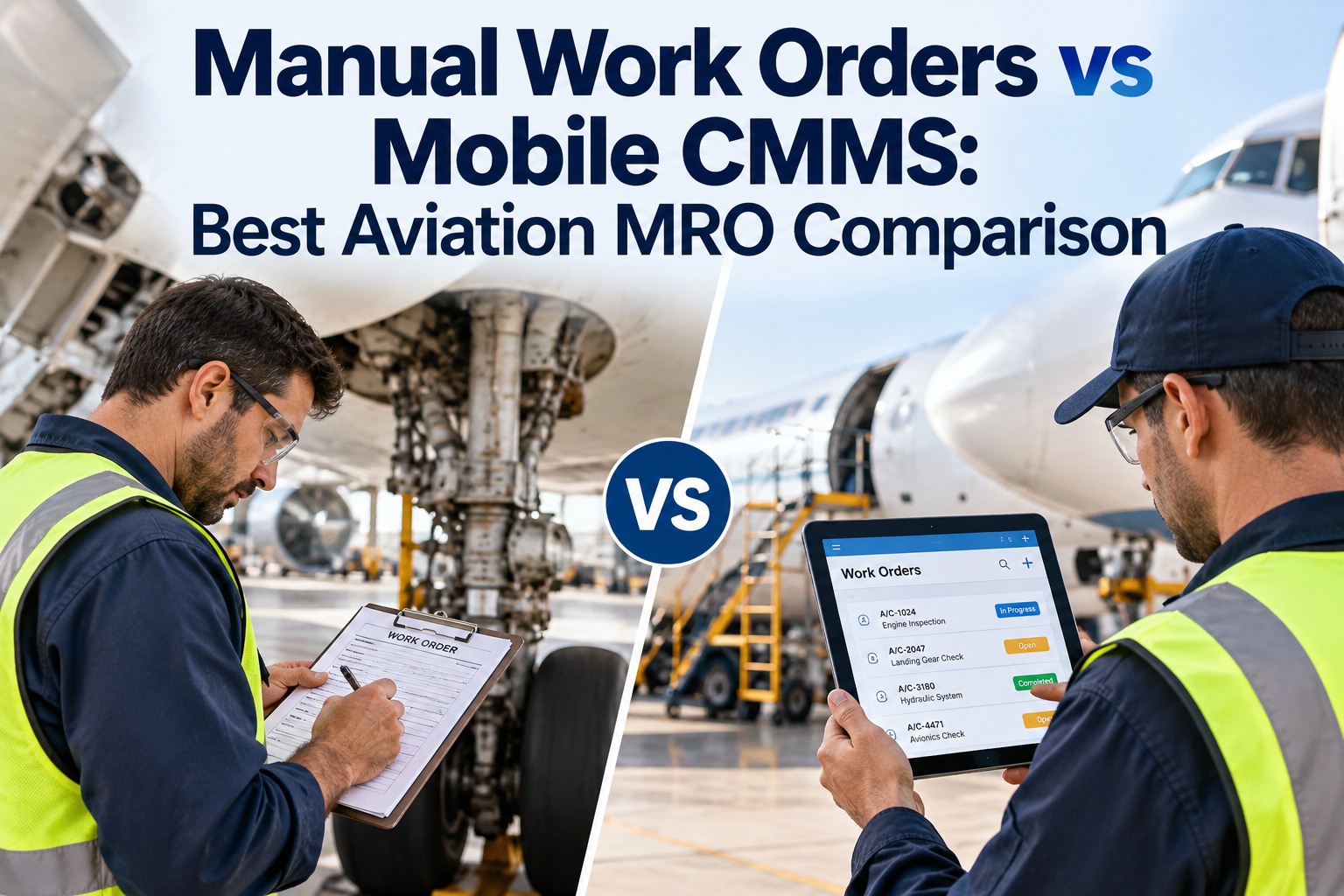
Paper Tech Log vs OxMaint
The gap isn't speed — it's traceability. Every failure mode below is one auditors have cited on more than one operator.
| Stage | Paper Tech Log | OxMaint |
| Squawk Capture |
Handwritten, transcribed later |
Tablet entry auto-tagged with ATA, photo, hobbs |
| Duplicate Check |
Human memory across shifts |
Auto-linked to prior squawks on same ATA |
| MEL Assessment |
Paper MEL, wrong-entry risk |
Structured lookup, exact entry enforced |
| Category Clock |
Date on defer sheet |
Live countdown with breach alerts |
| Cumulative Effect |
Manual scan |
Auto cross-check per tail |
| WO Execution |
Notes on task-card back |
AMM refs, torque, serials captured live |
| CRS |
Ink stamp, filed |
Licence-verified e-sign locked to WO |
| Repeat Trend |
Found at A-check, if at all |
Short-code trending on dashboard |
OxMaint Deferred Defect Dashboard — Live Fleet View
One board — tail, ATA, category, days remaining. Maintenance control sees the full dispatch picture and works the shortest clocks first.
OxMaint · Deferred Defect Register · Fleet · Live
| Tail | Type | ATA | Squawk | Cat | Days Left | Status |
| N-4471 |
A320 |
34-11 |
Capt PFD intermittent flicker |
C |
7 |
On Track |
| N-2214 |
A320 |
21-52 |
Pack 2 fault on ground |
B |
1 |
Working |
| N-3358 |
B737-800 |
32-42 |
Nose wheel steering transient |
A |
0 |
Before Next Flight |
| N-8802 |
B737-800 |
25-24 |
Reading light 14C u/s |
D |
96 |
On Track |
| N-4471 |
A320 |
33-42 |
Landing light L u/s (day-VFR) |
C |
3 |
Parts ETA D+2 |
| N-5519 |
ATR-72 |
36-11 |
Bleed leak L eng transient |
B |
2 |
Booked Tonight |
Defect KPIs OxMaint Rolls Up
Dispatch Reliability
Departures on schedule as % of scheduled — the leading indicator that squawks and deferrals are under control.
Mean Time to Rectify
Hours from squawk open to CRS-signed close, broken down by ATA chapter and MEL category.
Deferred Backlog
Open MEL items by category and tail, bucketed <24h / <72h / <7d remaining.
Repeat Snag Rate
Same ATA, same tail, rolling window — trended by short code so engineering can act on the pattern.
MEL Overrun
Items closed after the clock expired, per 1,000 deferrals. Alerts are designed to keep it at zero.
Squawk-to-WO Cycle
Minutes from pilot entry in the tech log to WO opened and engineer assigned.
What OxMaint Gives an Aviation MRO Team
Digital Tech Log
Pilot squawks captured at source with ATA, phase, photo, hobbs and tail auto-tagged.
Structured MEL Lookup
Approved MEL loaded per fleet, exact-entry enforced, (O) / (M) surfaced, provisos validated.
Live Category Clocks
A / B / C / D countdowns from day of discovery, with breach alerts and B/C extension workflow.
Cumulative-Effect Check
Auto cross-check against every other open MEL item on the same tail before deferral is accepted.
CRS Workflow
Licence-verified e-signature locked to the WO and the original squawk — audit chain closes in one action.
Repeat-Snag Trending
Short codes roll up per tail, per ATA, per fleet — repeats surface as a pattern, not a series of one-offs.
FAQs
Q. How does OxMaint treat a squawk vs a work order?
The squawk is the raw report; the WO is the scoped, engineer-assigned task that rectifies it. OxMaint holds both on one record.
See the squawk-to-WO link live.
Q. Does OxMaint support MEL categories out of the box?
Q. Can pilots enter squawks offline?
Yes — the OxMaint tech-log app caches entries and photos locally and syncs on return. The record's timestamp is the moment of entry, not the sync.
Try offline squawk capture free.
Q. How does OxMaint handle repeat snags?
Every entry carries a short code. Repeats on the same ATA and tail auto-link and roll up on the reliability dashboard for engineering to action.
Walk through the reliability rollup.
Q. Is the digital CRS auditor-ready?
CRS is captured as a licence-verified e-signature locked to the WO, squawk and functional-test evidence, with a full trail. Format is configurable to the operator's authority.
Configure your CRS format.
Every Squawk. Every Category. Every CRS. One Platform.
Move your aviation defect reporting onto OxMaint — 7 stages, 4 MEL clocks, one auditable record.