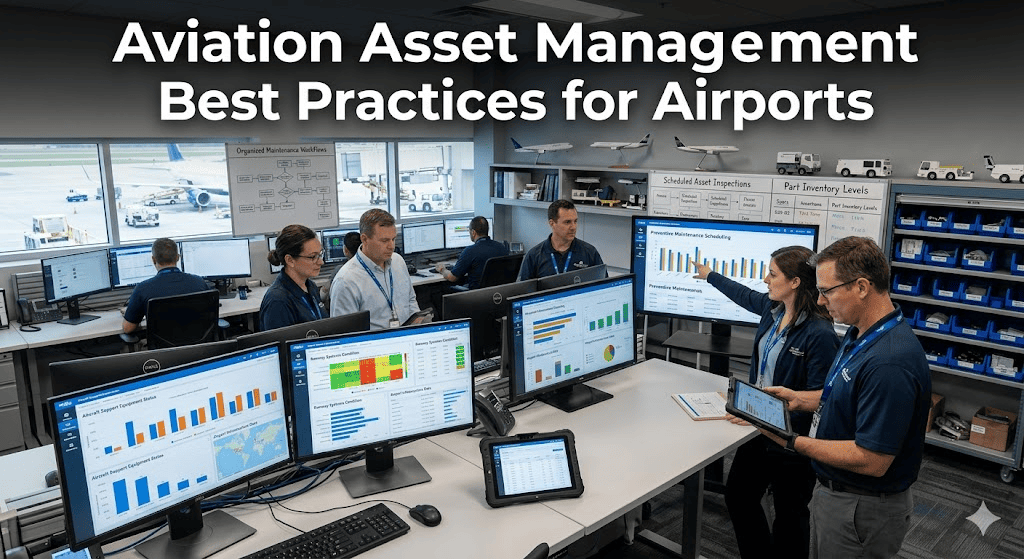
An Aircraft-on-Ground event costs airlines $10,000 to $150,000 per hour. Maintenance-related disruptions drain major carriers $100–$200 million annually. Yet one-third of small-fleet operators still manage maintenance with spreadsheets. The aviation industry carried 9.8 billion passengers in 2025 and will grow 3–4% again in 2026—but that growth is colliding with aging fleets (average aircraft age now exceeds 15 years), workforce shortages, a $11 billion supply chain crisis, and expanding regulatory mandates from every major authority. This isn't a guide about theory. It's a practical framework for aviation professionals who need to connect operations, safety, compliance, and maintenance into a system that actually performs under pressure—and stops bleeding money from preventable failures.
$11B+
Supply Chain Crisis
Aircraft delivery backlogs hit 17,000+. Titanium lead times doubled to 52 weeks. Parts shortages delaying critical repairs across the industry.
15+ Years
Fleet Age Record
Average aircraft age is the highest ever recorded. Older fleets require more maintenance, specialized parts, and stricter compliance monitoring.
Critical
Workforce Shortage
Skilled technician retirements outpace new entries. Longer MRO turnaround times and rising labor costs—now 28% of airline operating expenses.
SMS Mandate
Expanding Regulations
FAA expanded SMS to Part 135 and Part 21. ICAO Annex 19 Amendment 2 applicable November 2026. EASA mandates SMS for Part 145 MRO organizations.
These forces converge on one point: you cannot manage modern aviation operations with disconnected, manual systems
The organizations pulling ahead in 2026 share one thing in common—they've replaced fragmented tools with connected platforms that let maintenance, safety, compliance, and operations share data in real time. Aviation teams ready to make that shift can sign up for a centralized aviation maintenance platform that connects every operational pillar in one system.
Operations & Safety: The Non-Negotiable Foundation
Aviation operations management and safety management are inseparable. Every operational decision—flight scheduling, crew assignment, ground handling, fuel planning—carries safety implications. And every safety gap—unreported hazards, missed inspections, undocumented risks—eventually becomes an operational crisis. The FAA's Safety Management System framework makes this connection explicit: SMS isn't a standalone compliance exercise, it's supposed to be woven into how organizations actually operate. Yet the reality on the ground tells a different story.
Fleet Utilization
Maximize aircraft availability through coordinated scheduling, maintenance windows, and disruption recovery
Crew & Resource Planning
Align certified personnel, tooling, and hangar slots with maintenance demand and flight schedules
Ground Operations
Turnaround management, fuel optimization, and GSE (ground support equipment) maintenance coordination
Disruption Management
Real-time rescheduling when AOG events, weather, or crew issues impact planned operations
Hazard Identification
Proactive reporting systems that capture risks before they become incidents or accidents
Risk Assessment & Mitigation
Structured evaluation of probability and severity, with documented controls and accountability
Safety Assurance
Continuous monitoring through KPIs, audits, trend analysis, and management-of-change processes
Safety Culture & Promotion
Training, communication, and non-punitive reporting that makes safety everyone's responsibility
The FAA's expanded SMS final rule now requires Part 135 operators and Part 21 certificate holders to implement SMS—not just Part 121 airlines. ICAO's Amendment 2 to Annex 19, adopted June 2025, becomes applicable in November 2026. EASA mandated SMS for Part 145 maintenance organizations starting March 2025. The regulatory trajectory is clear: every aviation organization touching aircraft will need documented, systematic safety management. And that systematic approach needs a digital backbone—because regulators aren't just asking for policies, they're asking for evidence that those policies work. Teams navigating these requirements can book a demo to see compliance-ready safety and maintenance workflows designed for aviation regulatory standards.
Aviation Maintenance Planning: The $150K-Per-Hour Problem
A grounded wide-body aircraft costs approximately $150,000 per day in lost revenue. An AOG event on a narrowbody can run $10,000 to $150,000 per hour depending on route and aircraft type. Unplanned removals and replacements cost 30–50% more than planned maintenance due to emergency logistics and sourcing. The financial case for moving from reactive to predictive maintenance isn't abstract—it's measured in real losses that compound across every AOG event, every schedule disruption, every emergency parts shipment. The question is how mature your maintenance operation actually is.
Work Orders: Paper-based or email-driven
Parts: Manual counts, frequent AOG stockouts
Compliance: Scramble before every audit
Cost Profile: Highest — emergency repairs dominate budget
33% of small-fleet operators are still at this level
Work Orders: CMMS-generated, PM-scheduled
Parts: Min/max levels with automated reorder alerts
Compliance: Documented records, accessible audit trails
Cost Profile: 30% fewer unplanned events, planned interventions
Where most CMMS adopters operate — solid foundation
Work Orders: Auto-triggered by sensor data & AI analytics
Parts: AI-forecasted demand, strategic pooling agreements
Compliance: Continuous monitoring with automated alerts
Cost Profile: 25–40% efficiency gain, lowest lifecycle cost
Only 6% of MRO organizations have scaled to this level
Here's the critical insight: you can't leap from Level 1 to Level 3. Predictive maintenance requires historical data—failure patterns, component lifecycles, operating condition records—that only exist if you've been capturing them consistently in a digital system. The path to predictive starts with digitizing your core processes today. Aviation organizations building that foundation can start a free trial to digitize work orders and maintenance tracking and begin generating the data that predictive capabilities need.
Stop Losing Revenue to Preventable AOG Events
See how aviation maintenance teams use OXmaint to automate PM scheduling, build compliance-ready audit trails, and cut unplanned downtime with structured work order management.
Digital Transformation: The 6% Problem and How to Solve It
The gap between digital ambition and digital reality in aviation is stark. While 50% of MRO organizations have launched digital pilot programs, only 6% have scaled those initiatives across their operations. The CMMS market is growing at 10.4% CAGR, projected to reach $5.37 billion by 2035, and U.S. aerospace AI spending will hit $5.8 billion by 2029. The money is flowing, but the execution is lagging. The organizations that successfully scale digital transformation follow a specific sequence—and the ones that fail almost always skip Phase 1.
The most expensive mistake in aviation digital transformation is investing in Phase 3 technology before building Phase 1 discipline. AI can't predict failures if there's no structured failure data to learn from. IoT sensors generate noise, not insight, without a CMMS to contextualize readings against maintenance histories and asset profiles. Start with the foundation. Aviation operations ready to begin Phase 1 can sign up for digital maintenance management designed for aviation and start building the data infrastructure that makes everything else possible.
Regulatory Compliance: The 2026 Mandate Tracker
Regulatory compliance in aviation has always been demanding, but 2026 brings a convergence of new mandates that raises the bar across every aviation segment. From expanded SMS requirements to sustainability mandates and emissions reporting, the documentation burden alone is enough to overwhelm organizations still relying on manual processes. Here's what's active and what's coming.
FAA
SMS Expansion — Part 135 & Part 21
Part 21 certificate holders required to implement SMS by December 2025. Part 135 operators and §91.147 air tour operators must submit compliance statements within 24 months of the final rule.
Active Now
ICAO
Annex 19 Amendment 2 — Broadened Safety Standards
Adopted by ICAO Council June 2025. Effective November 2025, applicable to all member states November 2026. Expands safety management requirements with updated standards and recommended practices.
Nov 2026
EASA
Part 21 & Part 145 SMS Implementation
Design, production, and maintenance organizations must have SMS implemented as of March 2025. Incorporates ICAO Annex 19 SARPs into EU aviation domain requirements.
Active Now
EU/Global
RefuelEU SAF + ETS + CORSIA Mandates
EU 2% SAF blend active, ETS free allowances fully phased out by 2026. CORSIA compliance costs expected to reach $1.7B. Singapore's SAF levy starts April 2026 for flights from October 2026.
2026
The documentation demands of these combined mandates—safety policies, hazard registers, risk assessments, audit trails, corrective actions, training records, compliance reports—create an enormous administrative burden. Organizations managing this with manual processes are spending more time documenting compliance than actually improving safety. A CMMS with built-in compliance workflows automates the evidence trail, so your team can focus on the safety outcomes that regulations are actually designed to achieve.
Expert Perspective: What Actually Moves the Needle
Everyone in aviation talks about digital transformation, but the organizations actually achieving results in 2026 aren't the ones chasing the most advanced technology. They're the ones that got the fundamentals right first. I've seen MRO shops with million-dollar sensor arrays still struggling with basic scheduling because they never built the digital backbone to process what those sensors report. And I've seen regional operators with a solid CMMS outperform larger competitors because every work order, every inspection, every parts movement is tracked and searchable. The real competitive advantage isn't AI—it's operational discipline amplified by the right platform. AI becomes powerful later, but only if you've been capturing clean data all along.
Predictive maintenance reduces unscheduled repairs by 30–40% and lowers total repair costs by 20–25%—but it requires a data foundation first
Workforce shortages make every hour of technician time more valuable—automated scheduling and digital work orders eliminate wasted effort
68% of U.S. enterprises have increased CMMS budgets—organizations not investing now are falling behind an industry-wide standard
Your Aviation Management Action Plan for 2026
The aviation industry in 2026 won't slow down to let anyone catch up. Fleet ages are climbing, workforce pipelines are thinning, regulatory mandates are expanding, and supply chain instability is the new normal. The organizations that thrive will be the ones that stopped treating maintenance, safety, compliance, and operations as separate problems to solve with separate tools—and started managing them as one connected system. The CMMS market is growing at 10.4% CAGR for a reason: the industry has realized that digital operational discipline isn't a nice-to-have, it's the baseline for survival. Whether you're running an MRO facility, managing airport operations, or overseeing an airline fleet, the first step is the same—replace fragmented, manual processes with a connected platform that turns every maintenance action, every inspection, every compliance record into structured, searchable, actionable intelligence. That step is available today, and the cost of waiting gets higher with every AOG event your current system fails to prevent.
Ready to Build Your Digital Aviation Operations Foundation?
Join aviation teams using OXmaint to digitize maintenance workflows, automate compliance documentation, cut unplanned downtime, and build the operational backbone for predictive excellence.
Frequently Asked Questions
What is aviation management and why does it matter in 2026?
Aviation management is the coordinated oversight of airline operations, airport management, aircraft maintenance (MRO), safety systems, and regulatory compliance. It matters critically in 2026 because of converging pressures: supply chain disruptions costing airlines over $11 billion annually, average aircraft age exceeding 15 years (requiring more maintenance), expanding SMS mandates from the FAA, ICAO, and EASA, and severe workforce shortages driving labor costs to 28% of airline operating expenses. Effective aviation management connects these areas through integrated digital systems rather than managing them in silos with disconnected tools.
What are the new SMS requirements for aviation organizations in 2026?
The FAA's expanded SMS final rule extends Safety Management System requirements beyond Part 121 airlines to include Part 135 operators, §91.147 air tour operators, and Part 21 certificate holders (design and manufacturing). Part 21 holders had a December 2025 implementation deadline. ICAO's Amendment 2 to Annex 19, adopted June 2025, becomes applicable to all member states in November 2026. EASA mandated SMS for Part 21 (design/production) and Part 145 (maintenance) organizations as of March 2025. All three regulatory bodies require documented safety policies, risk management processes, safety assurance monitoring, and safety promotion programs.
How much does unplanned aircraft maintenance actually cost?
The costs are substantial and multilayered. An Aircraft-on-Ground event can cost $10,000 to $150,000 per hour depending on aircraft type and route, with grounded wide-body aircraft losing approximately $150,000 per day in revenue alone. Unplanned removals and replacements cost 30–50% more than planned maintenance due to emergency logistics and parts sourcing. At the airline level, maintenance-related disruptions cost major carriers $100–$200 million annually when factoring in passenger compensation, schedule cascading, and crew rescheduling. Organizations implementing predictive maintenance reduce unscheduled repairs by 30–40% and lower total repair costs by 20–25%.
Why do most aviation digital transformation initiatives fail to scale?
While 50% of MRO organizations have launched digital pilot programs, only 6% have scaled those initiatives across their operations. The primary reason is skipping foundational steps. Organizations invest in advanced technology like AI analytics or IoT sensor arrays before building the digital backbone—consistent CMMS-based maintenance records, structured work order processes, and centralized asset tracking—that those advanced tools need to function. Without clean historical data from Phase 1 (digitization), Phase 3 technologies (AI/predictive) have nothing meaningful to analyze. Successful digital transformation follows a sequential model: digitize core processes first, integrate systems second, then optimize with analytics.
How does a CMMS specifically benefit aviation and MRO operations?
A CMMS provides aviation-specific benefits across four areas. For maintenance planning, it automates work order generation, PM scheduling, and airworthiness tracking—eliminating the human-dependent gaps that cause missed inspections. For compliance, it creates automated audit trails, documentation management, and regulatory reporting that satisfy FAA, ICAO, and EASA requirements. For inventory management, it tracks parts lifecycle, automates reorder alerts, and reduces AOG-causing stockouts. For operational intelligence, it captures failure patterns, component performance data, and maintenance histories that enable the transition from reactive to predictive strategies. Organizations using CMMS report 25–40% improvement in maintenance efficiency and significant reductions in unplanned downtime.