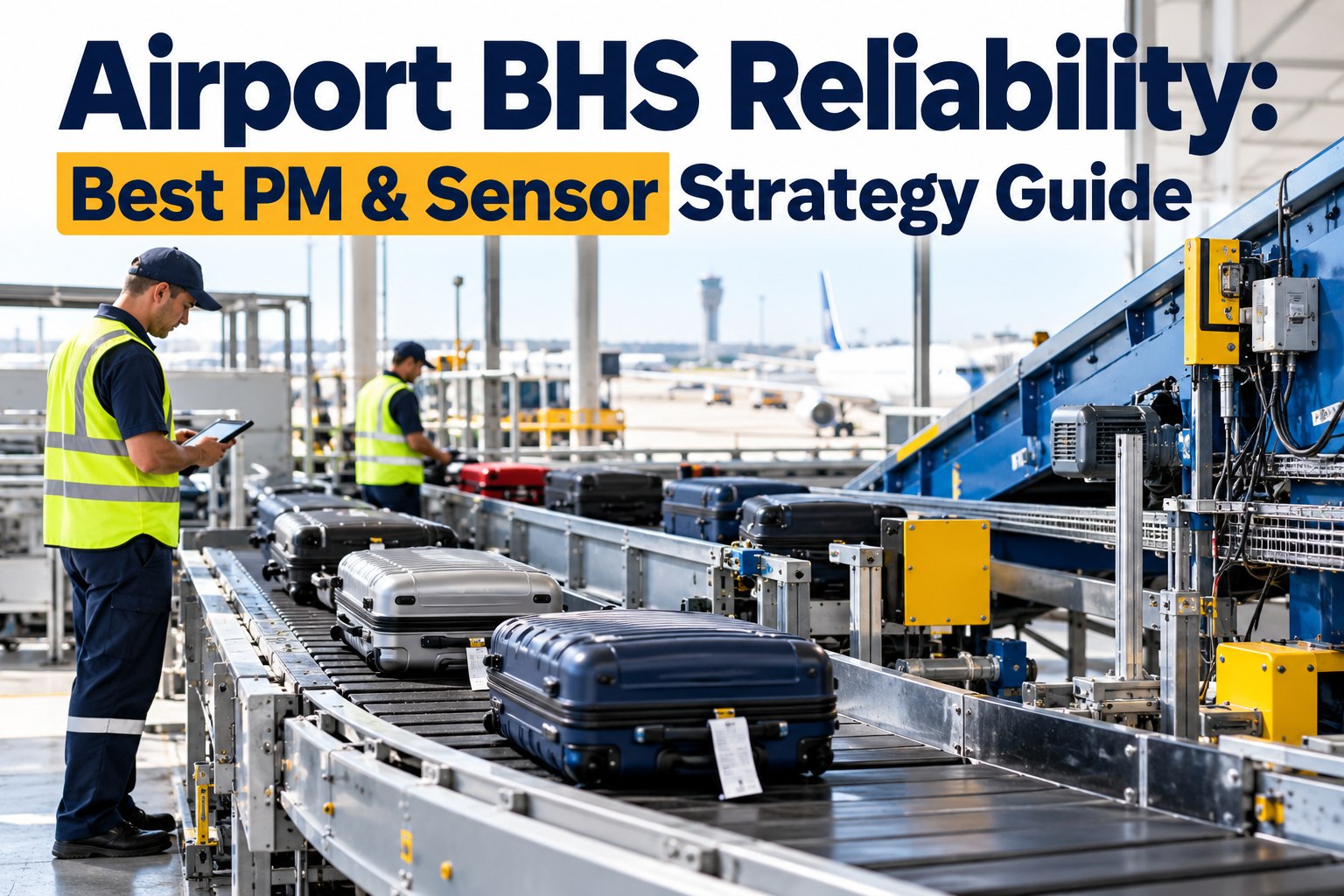
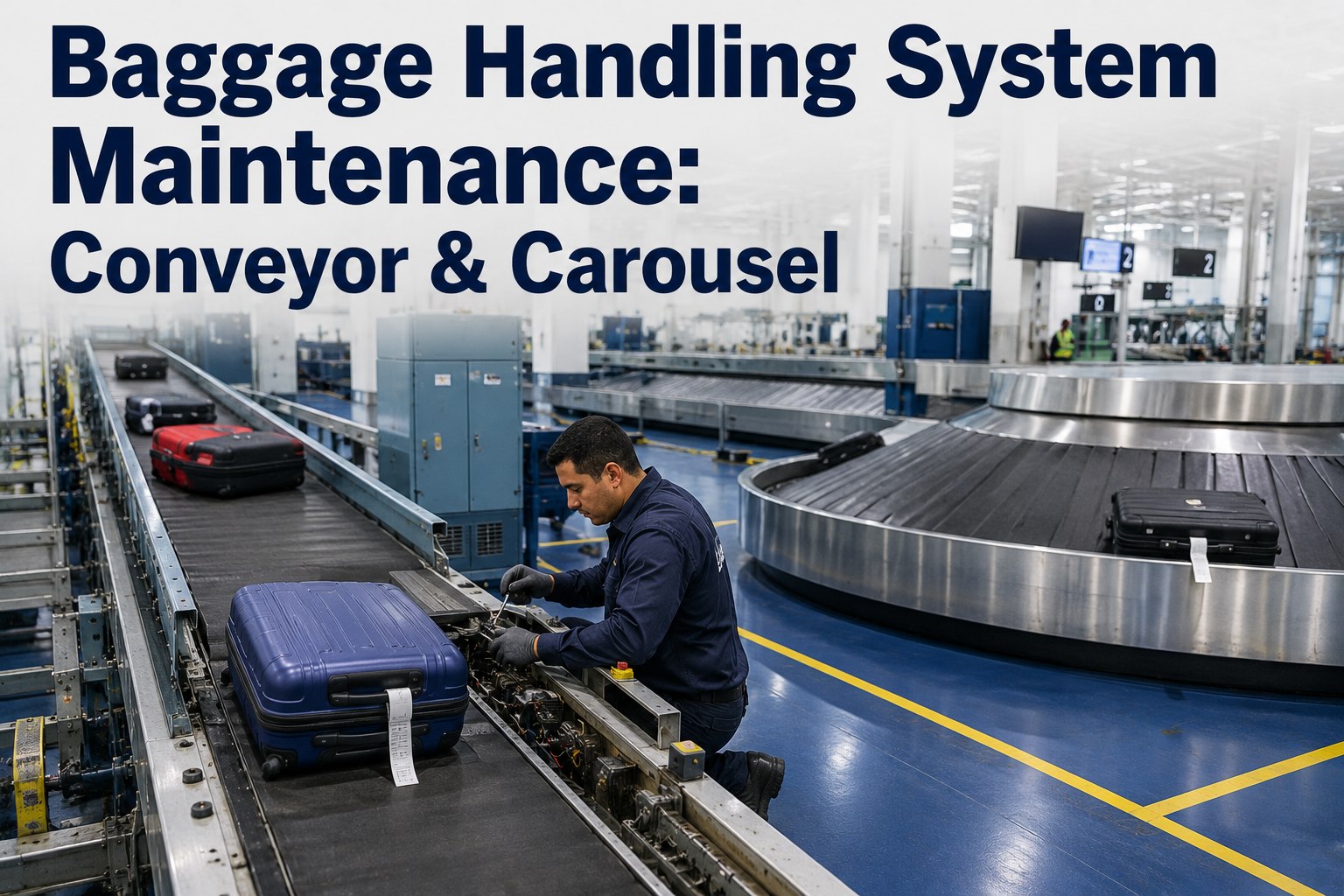
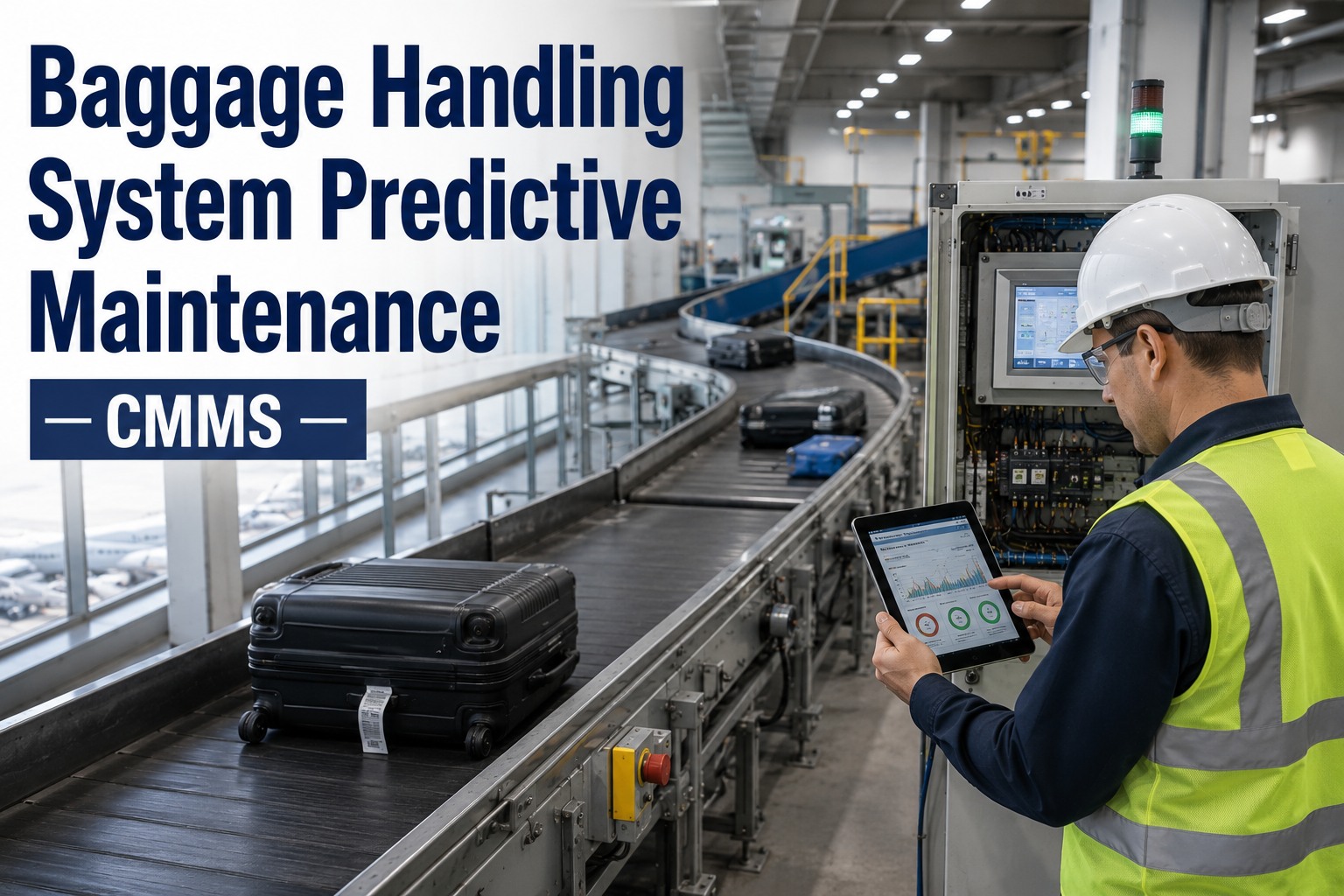
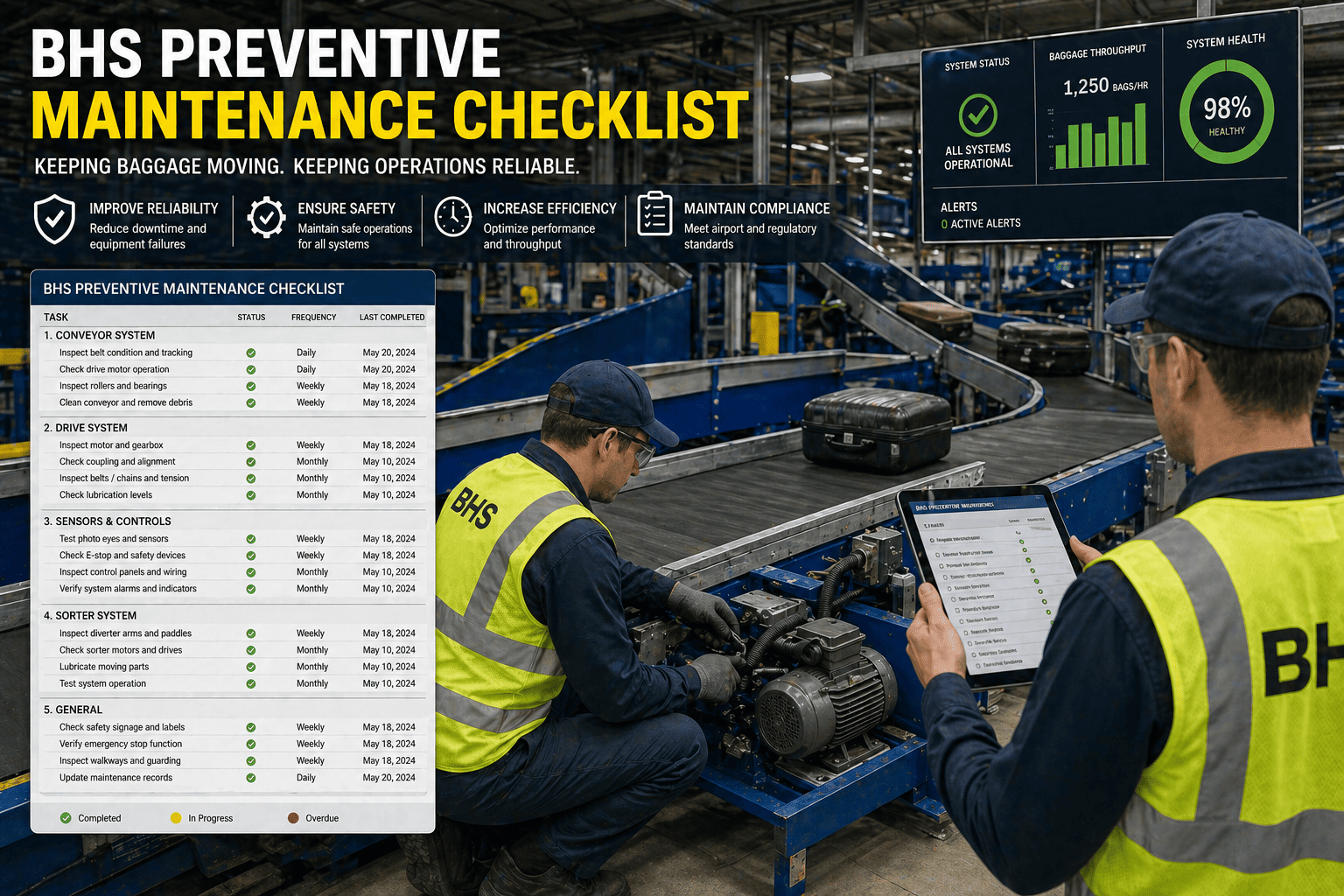
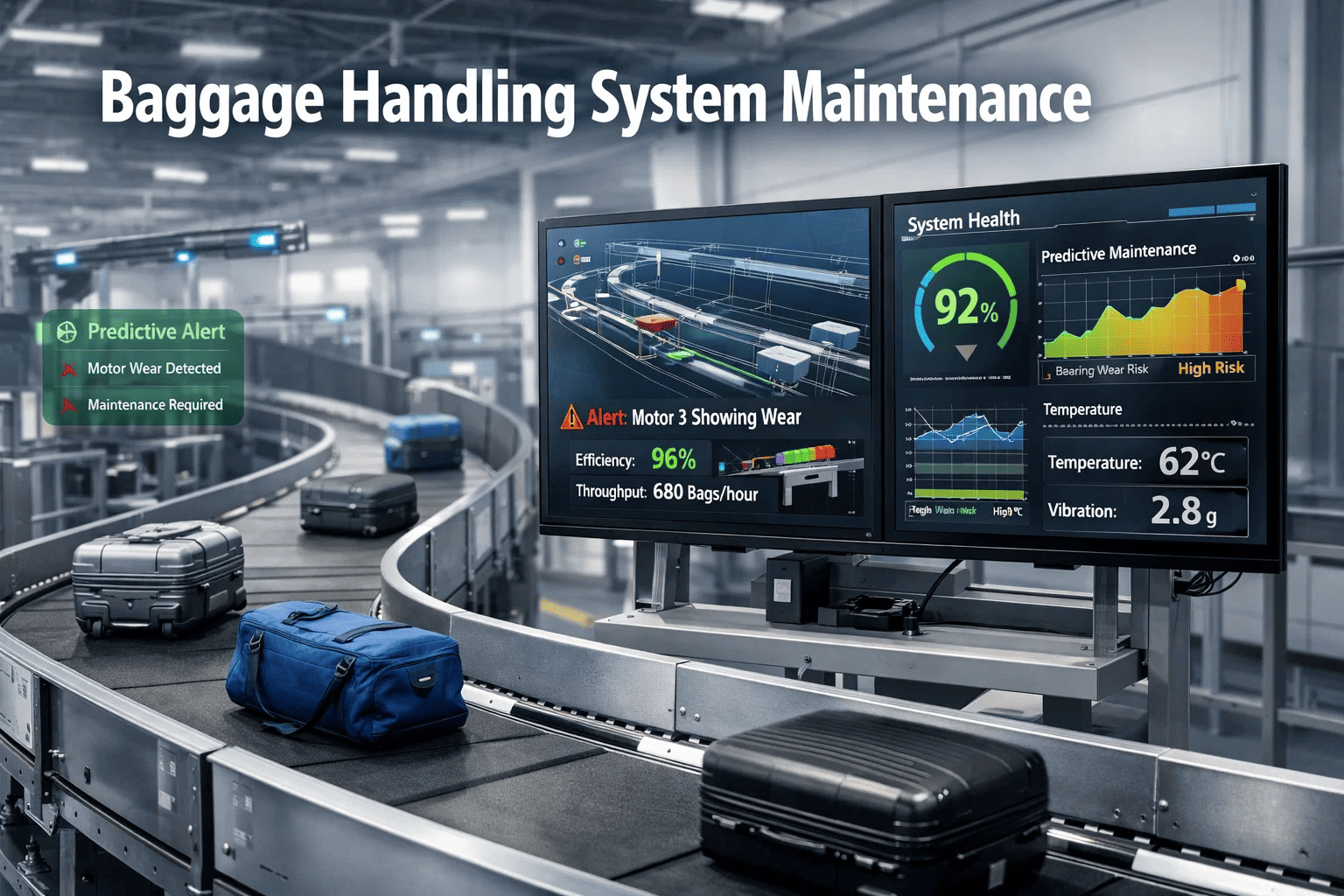
A baggage handling system is a kilometres-long machine with a single job: get every bag to the right place before its flight closes. When one diverter sticks or one scanner goes offline, bags back up, a sortation loop stalls, and within minutes the problem isn't one conveyor — it's missed connections across a whole concourse. Reliability here isn't a maintenance nicety; it's the difference between an on-time departure bank and a hall full of mishandled bags. This guide takes the reliability-engineering view: using RCM to put maintenance where failures actually hurt, PM and condition monitoring to prevent them, and KPIs to prove it's working. OXMAINT AI — the AI-powered maintenance management software — is where the strategy, the work and the numbers come together.
Aviation · Baggage Handling System · RCM · PM & KPI Reliability Guide · 2026
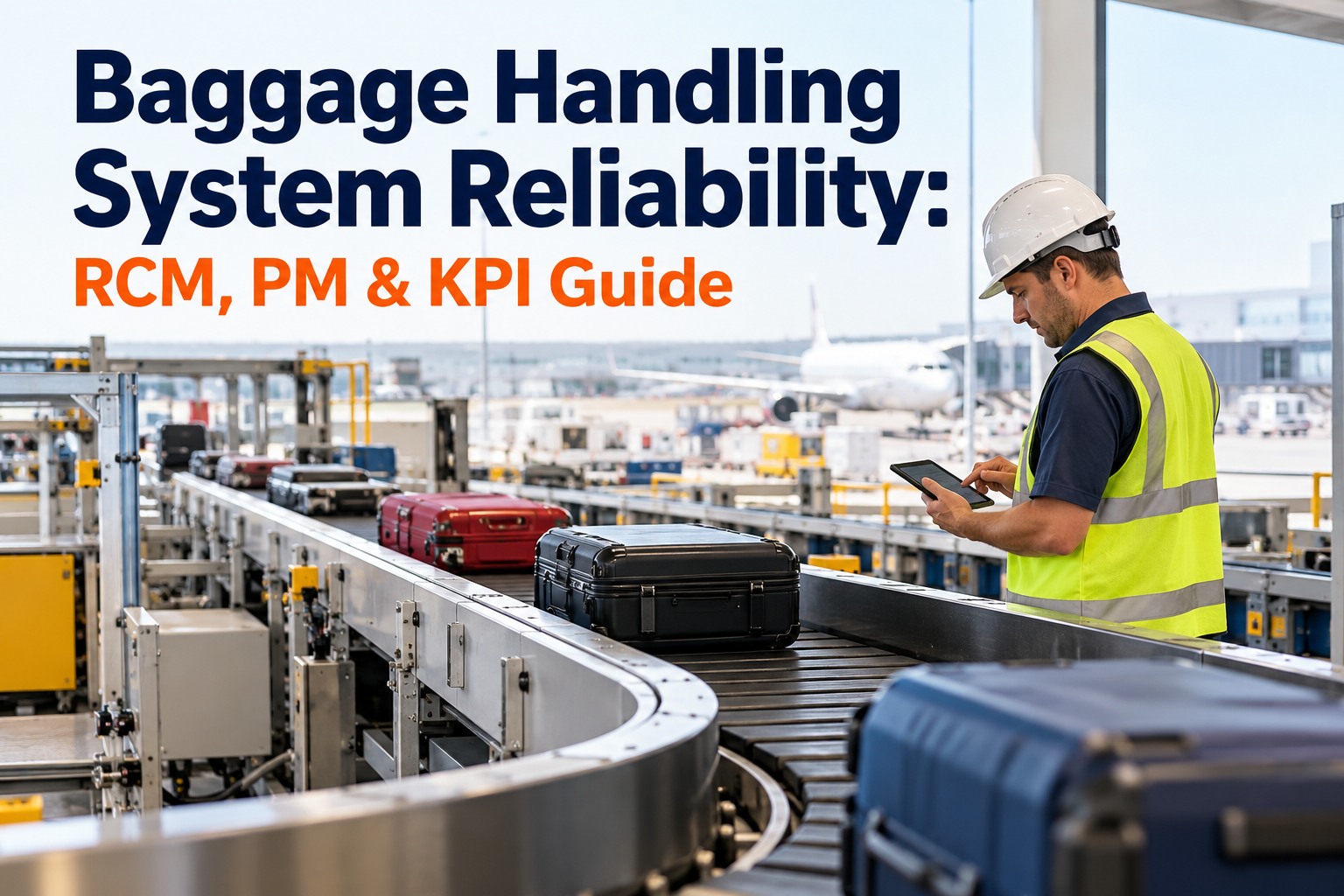
Baggage Handling System Reliability: RCM, PM & KPI Guide
Put maintenance where failures hurt most with RCM, prevent them with PM and condition monitoring, and prove it with the right KPIs. The OXMAINT AI maintenance management software ties the strategy to the work orders and the reliability numbers.
RCM
PM
Condition
KPIs
One jam cascades
a single stuck point backs up bags across a whole loop
RCM-led
effort aimed by failure consequence, not spread evenly
Measured
availability, MTBF, read rate and mishandling tracked
No slack at peak
the departure bank won't wait for a repair to finish
Why BHS Reliability Is an Airport-Wide Issue
A baggage system failure never stays local — it radiates out into flights, passengers and cost. That's what makes reliability a priority far beyond the maintenance team; book a demo to see BHS reliability managed in OXMAINT AI.
Failures cascade
One stuck diverter or stalled motor backs bags up through a whole sortation loop in minutes, not hours.
Mishandled bags cost
Every bag that misses its flight carries a rebooking, delivery and goodwill cost — and a dented reputation.
Passengers feel it
A baggage hall backing up is the last impression a traveller takes home — reliability is service, not just uptime.
Peaks have no slack
At a departure bank the system runs flat out — there's no spare capacity to absorb a failure until it clears.
Step 1 — RCM: Aim Maintenance Where It Matters
Reliability-Centred Maintenance asks a sharper question than "what should we service?" — it asks "how does each part fail, what happens when it does, and what's the right way to manage that?" For a BHS, that stops effort being spread evenly and points it at the failures that stop bags. Here's the failure-mode view by subsystem; start free and build RCM strategies in OXMAINT AI.
Belt conveyors
Fails byBelt wear, misalignment, roller and bearing failure
ConsequenceJams, torn bags, a stalled line
StrategyCondition monitoring plus scheduled belt and roller PM
Diverters & sorters
Fails byActuator, pneumatic or alignment failure
ConsequenceMissorted bags, a blocked divert point
StrategyPM on actuators, air system checks, alignment
Motors, drives & gearboxes
Fails byBearing wear, overheating, drive faults
ConsequenceA dead section, an unplanned stop
StrategyVibration and temperature monitoring, trended
Scanners & screening
Fails byOptics fouling, calibration drift, faults
ConsequenceLow read rate, manual encode, slowdown
StrategyCleaning, calibration and read-rate checks on plan
Controls, PLC & sensors
Fails byPhoto-eye fouling, comms and sensor faults
ConsequenceFalse stops, tracking loss, phantom jams
StrategySensor cleaning, inspection, comms checks
Carousels & make-up
Fails byDrive wear, slat and plate damage
ConsequenceReclaim or make-up out of service
StrategyScheduled drive and surface PM, inspection
Step 2 — PM & Condition Monitoring: Prevent the Failures
RCM decides the strategy; PM and condition monitoring carry it out. The mix matters — time-based tasks for foreseeable wear, condition-based monitoring for the high-consequence assets where you want warning, not a schedule. Book a demo to see PM and monitoring in OXMAINT AI.
Scheduled PM
Belt tracking, roller and bearing checks, actuator service, lubrication and sensor cleaning on set intervals for foreseeable wear.
Condition monitoring
Vibration, temperature and motor-load sensing on critical drives, so a developing bearing or drive fault surfaces as a trend.
Inspection rounds
Structured walk-downs of belts, diverters and photo-eyes, capturing the early signs a line is drifting toward a jam.
Spares readiness
Critical spares — motors, belts, actuators, sensors — on the shelf, so a failure at peak doesn't wait on a part.
You Can't Improve Reliability You Don't Measure.
RCM and PM move the needle, but only KPIs tell you by how much — and where to aim next. The OXMAINT AI maintenance management software builds availability, MTBF, MTTR and mishandling numbers from the work orders and asset data, so reliability becomes a figure you can trend, not a feeling.
Step 3 — The KPIs That Prove Reliability
These are the measures that tell you whether the strategy is working — track them per system and over time, not as one-off snapshots. The arrow shows the direction of better; start free and track these per asset in OXMAINT AI.
System availability↑
The share of scheduled time the system is able to run — the headline reliability number.
MTBF↑
Mean time between failures — longer means the system runs further between breakdowns.
MTTR↓
Mean time to repair — shorter means you recover a failure faster when it happens.
Throughput vs design↑
Bags per hour against the system's design rate — a fall signals creeping degradation.
Auto read rate↑
The share of bags read automatically by scanners — low read rate forces manual encode and delay.
Mishandled bag rate↓
Bags missorted or missed per thousand — the outcome reliability ultimately protects.
Jam frequency↓
Jams per period or per thousand bags — a rising rate points straight to a maintenance gap.
Time to clear a jam↓
How fast a jam is cleared once it happens — the measure of response, spares and access.
How OXMAINT AI Runs BHS Reliability
RCM, PM and KPIs only work as one loop when the strategy, the work and the data live in one system. Here's what the OXMAINT AI maintenance management software brings; start free and run the whole loop in OXMAINT AI.
Asset & strategy register
Every conveyor, diverter, scanner and drive on record with its RCM strategy, so maintenance matches consequence.
PM scheduling
Time- and usage-based tasks per asset on their own cadence, so foreseeable wear is handled before it fails.
Condition monitoring
Vibration, temperature and load readings pulled in on critical drives, so warning comes as a trend, not a stop.
Auto work orders
A due task or an out-of-range reading raises a work order with the asset and finding, routed by priority.
Reliability KPIs
Availability, MTBF, MTTR and jam rate computed from the data, so reliability is trended, not estimated.
Spares management
Critical BHS spares tracked with reorder points, so a peak-hour failure doesn't wait on a part.
“
We were doing plenty of maintenance, but it was spread evenly across the whole system — the same attention on a low-consequence spur as on the main sortation loop. Taking an RCM view changed where the effort went: condition monitoring on the critical drives and divert points, lighter PM where a failure didn't stop bags. Then we actually tracked availability and jam frequency instead of guessing. Within two peak seasons the big cascading stoppages were rare, and when something did fail we cleared it far faster because the spares and the data were there.
BHS Reliability Engineer · International Airport
Frequently Asked Questions
What is RCM for a baggage handling system?
Reliability-Centred Maintenance analyses how each part of the BHS fails, what happens when it does, and the right way to manage that risk — then assigns condition monitoring, scheduled PM or run-to-failure accordingly. It concentrates effort on the high-consequence assets that stop bags, instead of spreading it evenly.
Start free and build RCM strategies.
What are the most important BHS reliability KPIs?
System availability is the headline, supported by MTBF and MTTR for how often it fails and how fast you recover, throughput against design, auto read rate, mishandled-bag rate, jam frequency, and time to clear a jam. Tracked together and over time, they show whether the maintenance strategy is actually improving reliability.
How does condition monitoring help BHS uptime?
By giving warning instead of a schedule. Vibration, temperature and motor-load sensing on critical drives and divert points surfaces a developing bearing or drive fault as a trend, so it's fixed in a planned window rather than failing at a departure peak. It's the right strategy for the high-consequence assets RCM flags.
Book a demo to see it.
Why do baggage system failures cause so much disruption?
Because the system has little spare capacity at peak and everything is connected. A single stuck diverter or stalled motor backs bags up through the loop feeding it, and at a busy departure bank there's no slack to absorb the backlog — so a local fault becomes missed bags across multiple flights within minutes.
How does a CMMS improve BHS reliability?
It holds each asset with its RCM strategy, schedules time- and usage-based PM, pulls in condition-monitoring readings, turns due tasks and alerts into work orders automatically, manages critical spares, and computes the reliability KPIs from the data — joining strategy, work and measurement into one loop so reliability can be managed and proven, not just hoped for.
Aim the Maintenance, Prevent the Failures, Prove the Reliability.
Run baggage handling reliability as one loop with the OXMAINT AI maintenance management software — RCM strategies per asset, scheduled PM and condition monitoring, automatic work orders, spares management, and the KPIs that show it's working. Turn a system that fails at the worst moment into one you can trust at peak.