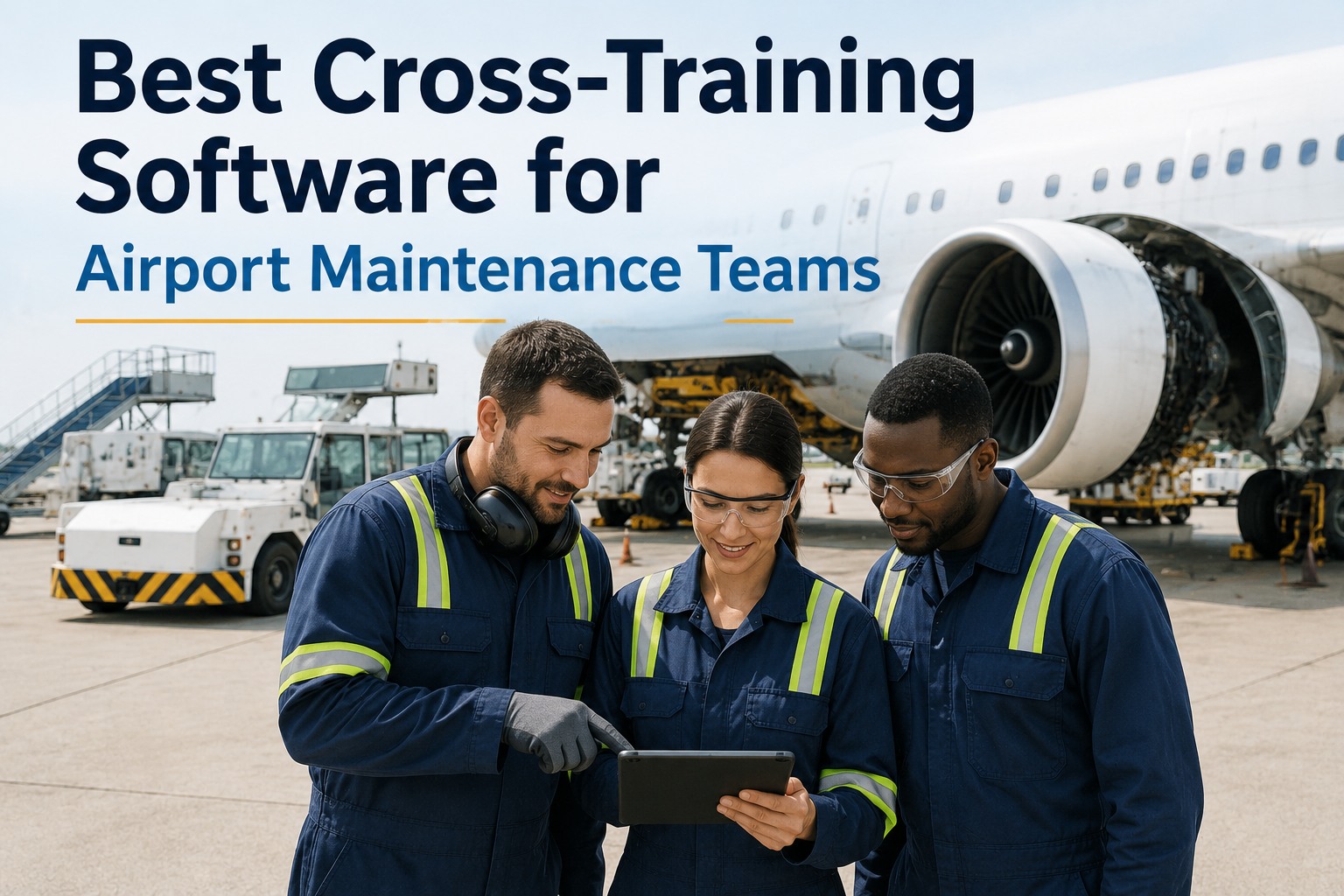
An airport's maintenance coverage often rests on a single sentence nobody wants to say out loud: "only Dave knows the baggage system." When Dave is on shift, the operation runs. When Dave is on vacation, out sick, or retires with twenty years of un-mapped knowledge in his head, a baggage jam at peak becomes a crisis instead of a callout. That's the difference cross-training makes — between an airport maintenance team that operates as a controlled discipline and one that drifts into constant firefighting around a handful of irreplaceable people. The tool that makes it controlled is the skills matrix: a live map of who can work what asset, at what verified proficiency, and where the dangerous single-point-of-failure gaps are. This guide covers cross-training for airport maintenance teams: why single-skill coverage is a risk, how the skills matrix and proficiency levels work, how to prioritize gaps by asset criticality, and how a CMMS turns cross-training into a managed program instead of tribal knowledge. Book a free coverage-gap review for your airport.
When Only One Tech Knows the Asset, You Don't Have Coverage — You Have a Risk
Cross-training is the line between a controlled maintenance discipline and constant firefighting around irreplaceable people.
2 min
Qualified techs per critical asset category — the coverage standard
4 levels
Proficiency scale: Awareness, Assisted, Independent, Expert
40%
Training-time cut when a matrix drives targeted development
<10%
Retention after 30 days from classroom-only training
The Single-Point-of-Failure Problem
Every airport maintenance team has them: asset categories where one person holds all the working knowledge. It feels fine until that person is unavailable — and then the gap is exposed at the worst possible moment, on the assets that matter most.
The Knowledge Silo
One technician holds all the expertise on the baggage system, the jet bridges, or the airfield lighting. Coverage looks fine on paper — until absence, vacation, or turnover removes them.
The Retiring Expert
A veteran retires and takes decades of asset-specific knowledge that was never mapped, verified, or transferred — because there was no system for doing so. The gap is permanent.
The 2 AM Failure
A critical asset fails off-shift and the only qualified tech isn't on. Repair waits for a callback or limps along — the exact scenario cross-training exists to eliminate.
The industry standard is clear: at least two independently qualified technicians per critical asset category, one per shift where possible. Single-source skill coverage is an unacceptable downtime risk during absences, vacations, and turnover — and on an airport's critical assets, that downtime cascades into delays.
The Skills Matrix · Who Can Work What
The skills matrix turns tacit, in-someone's-head knowledge into an explicit, auditable map. Technicians are the rows; airport asset categories are the columns; each cell holds a verified proficiency level. At a glance, it shows exactly where coverage is strong and where it's dangerously thin.
Technician
Baggage
Jet Bridge
HVAC
Airfield Ltg
Tech A
Expert
Assisted
Gap
Aware
Tech B
Gap
Independent
Expert
Gap
Tech C
Assisted
Gap
Assisted
Independent
Reading the matrix: baggage leans entirely on Tech A, and airfield lighting has just one independent tech — both single points of failure. HVAC, with two capable techs, is well covered. The gaps are now visible, rankable, and fixable.
The Four Proficiency Levels
A name in a box isn't enough — cross-training needs verified proficiency, not a checkmark. A four-level scale makes "can work this asset" precise, so coverage claims mean something and development has clear targets.
1
Awareness
Understands the asset and basic concepts but can't yet work on it unsupervised. The starting point of any cross-training path.
2
Assisted
Can perform tasks under supervision of a qualified technician. Building hands-on competence but not yet a coverage source.
3
Independent
Works the asset alone to standard. This is the level that counts as real coverage — the target for a second qualified tech.
4
Expert / Trainer
Masters the asset and can train and verify others — the person who turns tacit knowledge into transferable capability.
Map Your Coverage Gaps in 30 Minutes
Working session with our aviation team — bring your team and asset list. We'll build a skills matrix, surface the single-point-of-failure gaps against asset criticality, and show how OxMaint matches assignments to verified competency.
Prioritizing Gaps · Not All Are Equal
A skills matrix will surface dozens of gaps, and chasing all of them equally wastes training budget. The discipline is cross-referencing each gap against asset criticality and failure history — so the training goes where a gap actually threatens the operation.
FIX FIRST
Gap on a Critical, Frequently-Failing Asset
Single-tech coverage on baggage, jet bridges, or airfield lighting — high-consequence assets that fail often. These gaps threaten operations directly and get immediate cross-training.
PLAN NEXT
Gap on a Critical but Reliable Asset
Thin coverage on a high-consequence asset that rarely fails. Real risk, less urgent — schedule development into the normal training calendar.
MONITOR
Gap on a Low-Consequence Asset
Single-source coverage on an asset with redundancy or a tolerable outage. Note it, but don't spend scarce training hours here first.
Running Cross-Training as a Program
Cross-training only sticks when it's a managed cycle, not a good intention. Four moves turn it from ad-hoc shadowing into a controlled discipline that actually closes gaps and keeps them closed.
01
Map & Verify Current Skills
Build the matrix from real, assessed proficiency — not job titles or assumptions. A verified baseline is the only honest starting point for coverage decisions.
02
Target the Priority Gaps
Pair a gap on a critical asset with an Expert-level trainer and a learner, with defined tasks. Blended hands-on work beats classroom-only, which fades below 10% retention in a month.
03
Verify the New Level
Sign off progression only when the tech genuinely works to standard — moving Assisted to Independent means they now count as real, countable coverage.
04
Keep the Matrix Live
Update on every hire, departure, and certification — and track expiry dates. A stale matrix hides new single points of failure as the team changes.
How OxMaint Runs Cross-Training as a Controlled Program
OxMaint gives airport operations the tools to run cross-training as a managed discipline — structured assets, technician skill profiles tied to the work, PM and assignment automation, and reporting leadership can act on, from one dashboard on desktop or mobile.
Map
Live Skills Matrix
Hold each technician's verified proficiency per asset category in one live matrix — the who-can-work-what map, always current across hires and departures.
Detect
Automatic Gap Flags
Surface single-point-of-failure gaps automatically by cross-referencing skills against asset criticality and downtime history — priority gaps first.
Match
Competency-Based Assignment
Connect skill profiles to the asset registry, PM schedule, and work orders so every job is assigned to a verified-competent tech — no unqualified guesswork.
Develop
Targeted Training Tasks
Assign training against specific gaps, pairing learners with expert trainers — targeted development that cuts training time versus generic programs.
Track
Certification & Expiry
Track proficiency sign-offs and certification expiry dates, so compliance and coverage stay current and nothing lapses unnoticed.
Report
Coverage Dashboards
Give leadership a live view of coverage depth and gap closure per asset category — the reporting that makes workforce risk actionable.
Build Coverage That Survives Turnover
Turn one tech into multi-asset coverage, close the single-point-of-failure gaps, and give the airport a maintenance operating system that outlasts any individual. See how OxMaint runs cross-training as a controlled program. Free forever plan available.
Frequently Asked Questions
What is cross-training for airport maintenance teams?
It's the practice of teaching technicians to work on asset categories beyond their primary specialty, so the team has more than one qualified person for each system — baggage handling, jet bridges, HVAC, airfield lighting, escalators, and ground support equipment. The goal is coverage depth: eliminating the single points of failure where only one person can service a critical asset. Done as a structured program built on a skills matrix, it turns airport maintenance from firefighting around irreplaceable individuals into a controlled discipline.
Book a review.
What is a maintenance skills matrix?
It's a table that maps technicians against asset categories and skills, with each cell showing that person's verified proficiency level. Technicians are the rows, asset categories the columns, and the cells hold a level such as Awareness, Assisted, Independent, or Expert. It converts tacit, individual knowledge into an explicit, auditable, organisation-wide map that shows exactly who can do what, at what proficiency, and where the critical capability gaps are — before they become operational vulnerabilities. It's the foundation of any structured cross-training program.
How many technicians should be qualified per critical asset?
Industry best practice is at least two independently qualified technicians per critical asset category, ideally one per shift. Single-source skill coverage — only one person who can service a critical asset — creates unacceptable downtime risk during absences, vacations, and turnover, and on an airport's critical assets that downtime cascades into flight delays. Two independent, Independent-level techs per critical category is the baseline a cross-training program should target first.
Start free.
How do you prioritize which skill gaps to close first?
By cross-referencing each gap against asset criticality and failure history. A gap will exist on many assets, but the ones that matter are single-tech coverage on high-criticality, frequently-failing assets — those threaten operations directly and deserve immediate cross-training. A gap on a critical but reliable asset is real risk but less urgent, and a gap on a low-consequence or redundant asset can simply be monitored. This targeting is what keeps training budget focused on the gaps that actually reduce operational risk rather than spreading it thin.
How does OxMaint support cross-training?
OxMaint holds a live skills matrix of each technician's verified proficiency per asset category, automatically surfaces single-point-of-failure gaps by cross-referencing skills against asset criticality and downtime history, and connects skill profiles to the asset registry, PM schedule, and work orders so jobs are assigned to verified-competent techs. It lets you assign targeted training against specific gaps, track proficiency sign-offs and certification expiry, and give leadership live coverage dashboards per asset category. That turns cross-training into a controlled, auditable program that survives turnover. A free forever plan is available.