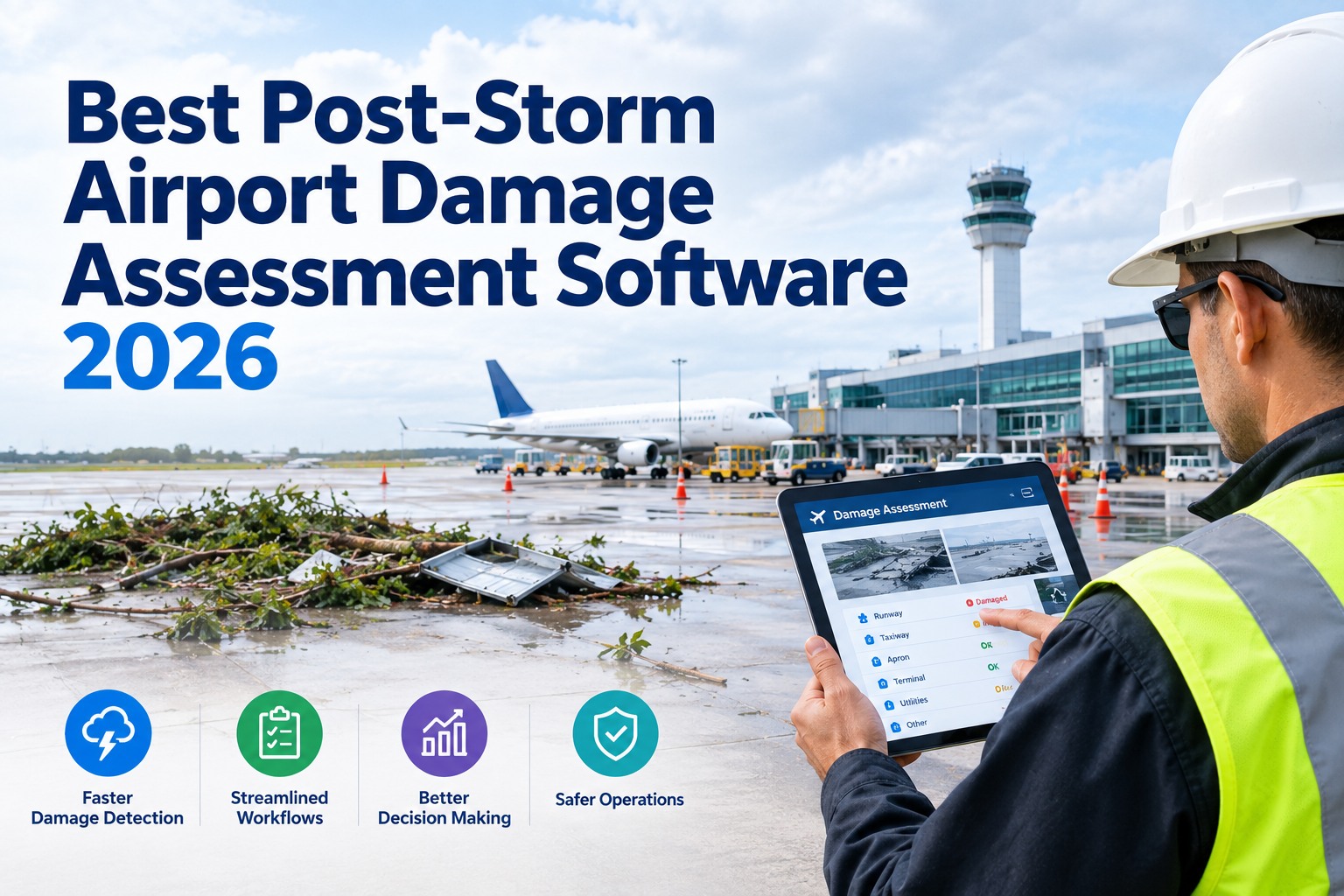
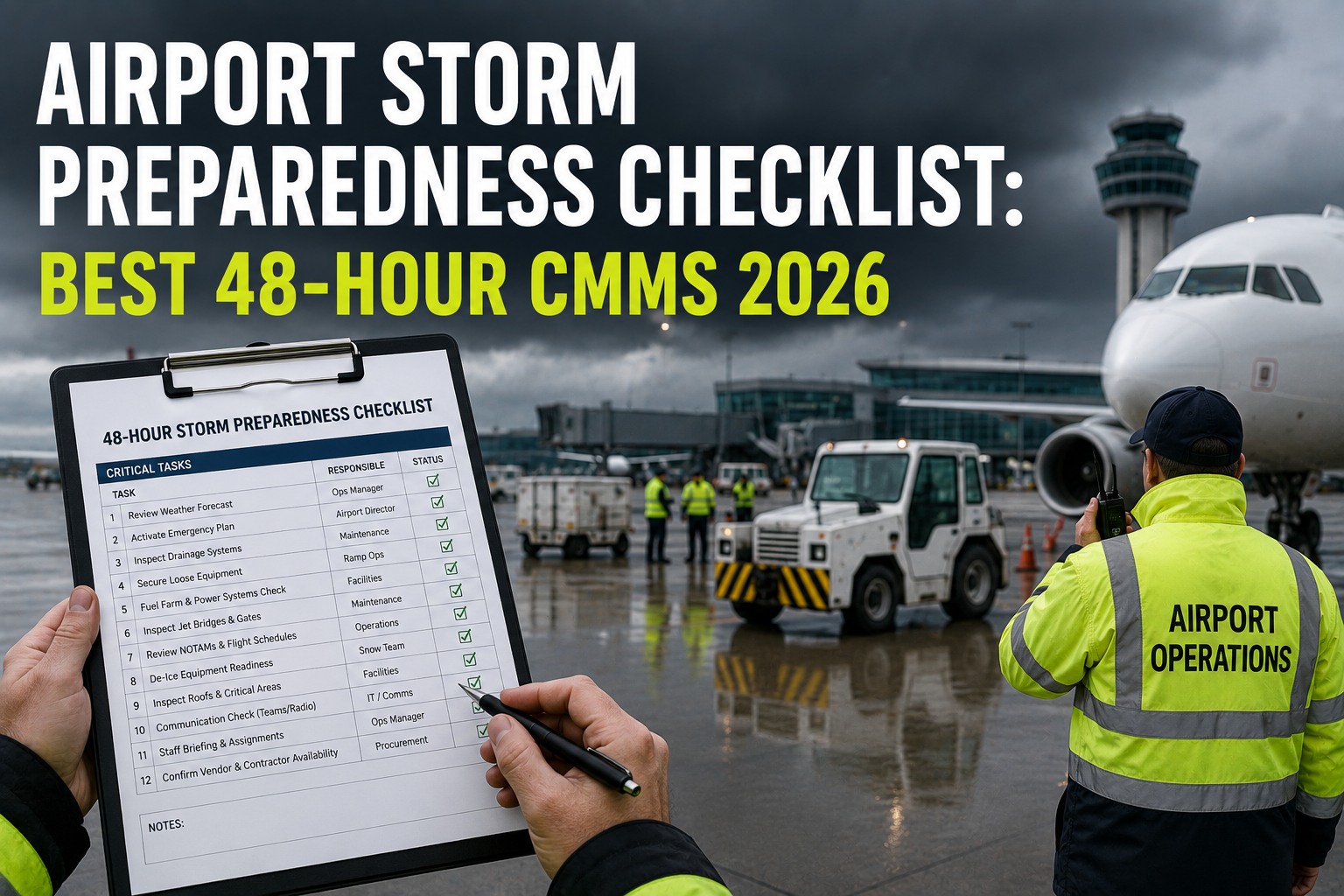
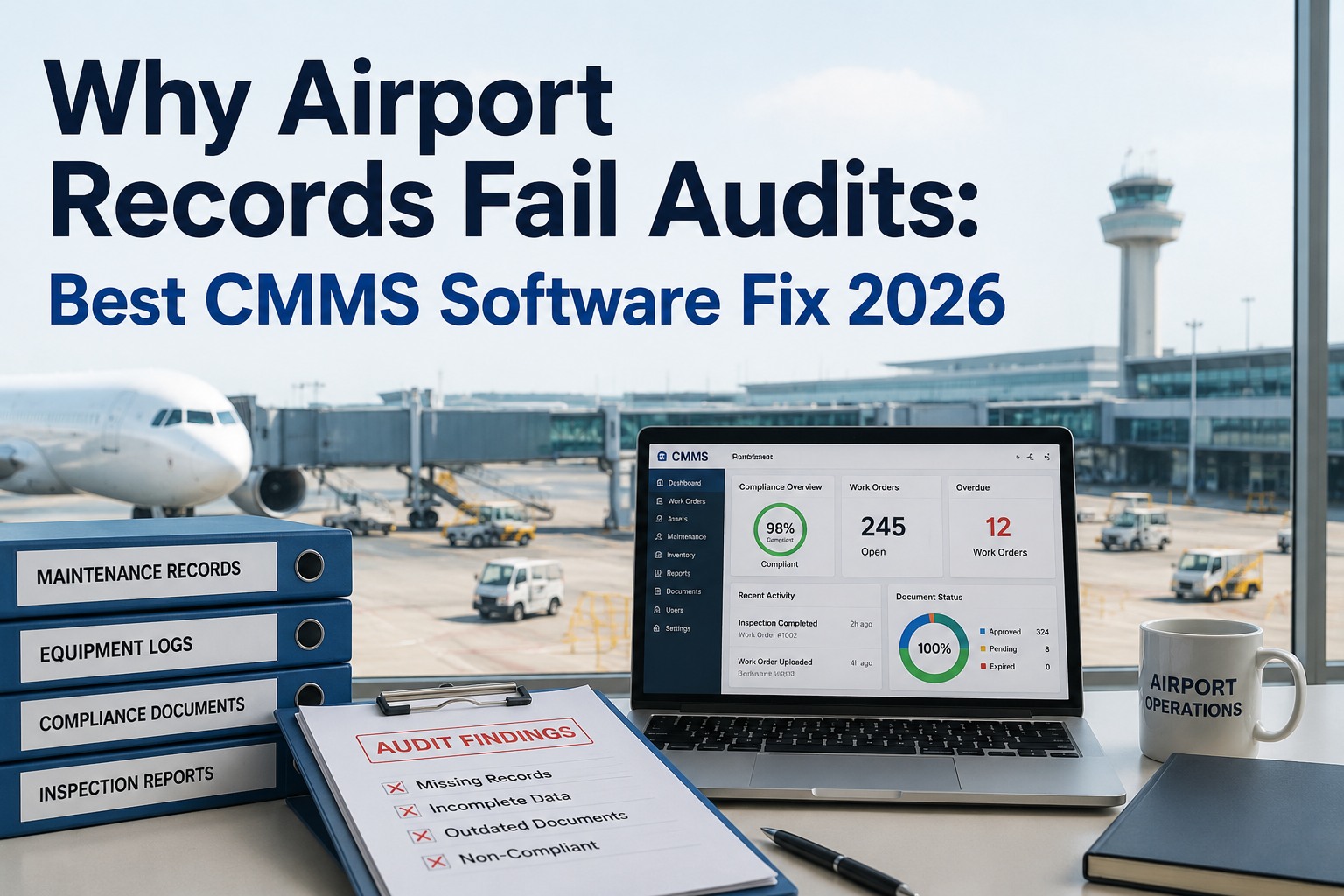
When a storm clears, the clock starts on two races at once: reopening the airfield safely, and building a damage record solid enough to survive an insurance adjuster and a FEMA reviewer. The airports that win both races don't have more crews — they have structured capture. A verbal radio report or a photo with no GPS stamp can't attach to the asset that failed, and a claim built on memory is a claim at risk before the 60-day federal reporting window even closes. This 2026 guide breaks down what separates the best post-storm airport damage assessment software from a generic work-order tool, the capabilities that actually speed reopening and protect reimbursement, and where OxMaint's maintenance management software fits. Start free or book a demo.
Aviation · Disaster Recovery · Buyer's Guide · CMMS 2026
Best Post-Storm Airport Damage Assessment Software 2026
The platforms that speed reopening and protect claims all do one thing: turn a chaotic post-storm walk into structured, asset-linked, timestamped evidence. Here's how to evaluate them — and what a top platform must deliver.
60 days
common window to identify & report storm damage for federal assistance
72 hrs
documenting damage this fast markedly accelerates insurance claims
12 mo
minimum Part 139 record retention; 3 yr recommended for audits
Before reopen
safety deficiencies must be fixed — or a restricting NOTAM issued
Why "Any CMMS" Fails the Post-Storm Test
Generic work-order tools were built for planned maintenance on a normal day — not for fifty simultaneous findings across a flooded airfield with the connection down. Post-storm assessment has its own failure modes, and a platform that doesn't design for them turns a recovery into a reconstruction weeks later, when memory has faded and the claim is due. Sign up free and OxMaint captures each finding as structured, asset-linked data the moment the inspector sees it.
Memory-Based Reports
A report written back at the office leans on what the damage "looked like" — no timestamp, no coordinate, nothing that attaches to the asset that failed.
Connection-Dependent Apps
Legacy field tools need a live signal to work — and a storm is exactly when the signal disappears. Capture has to work offline and sync later.
Unstructured Findings
One report flags a valve, another skips coordinates entirely. Mismatched records can't be ranked, so the highest-consequence repair waits behind noise.
Claim-Blind Data
Findings that don't map to funding categories or carry photo evidence put reimbursement at risk before the reporting window even closes.
The 2026 Evaluation Scorecard
Cut through vendor decks with the seven capabilities that actually decide whether a platform speeds reopening and protects the claim. Score any tool against these before you buy — the best post-storm platforms clear all seven; a repurposed work-order system clears two or three. Book a demo to score OxMaint against your own criteria.
01
Offline Mobile Capture
Works with no signal, syncs on reconnect — because the network is down exactly when you need it most.
Must-have
02
GPS + Timestamp on Every Finding
Each photo and note auto-tagged with location and time — the evidence adjusters and reviewers require.
Must-have
03
Asset-Linked Records
Findings attach to a specific asset in the register — not a loose photo roll — so damage maps to what actually failed.
Must-have
04
Severity-Based Prioritization
Structured input lets the platform rank repairs by consequence, so safety-critical work leads the recovery.
Must-have
05
NOTAM & Reopen Workflow
Ties a finding to a restricting NOTAM and won't close a work order until the area passes re-inspection.
High-value
06
Claim-Ready Export
One-click package of asset, photos, cost category and timeline that maps cleanly to insurance and federal funding formats.
High-value
07
Audit-Ready Retention
Timestamped records held to Part 139 retention rules and producible on demand for FAA, insurer and FEMA review.
High-value
The Claim Is Won or Lost in the First Walk of the Airfield.
Structured field input tied to a specific asset is what stands up to federal review — a phone call relayed hours later never can. OxMaint gives every inspector the same offline form, auto-stamps location and time, links each finding to the asset, and assembles a prioritized repair list and a claim-ready package before the recovery meeting even starts.
Three Tiers of Tooling — and Where Each Falls Short
The market sorts into three broad categories. Most airports start at the left and feel the pain of it at their first federal review. Here's the honest trade-off across the tiers. Sign up free to skip straight to a purpose-built program.
Tier 1
Paper & Radio
Clipboards, verbal reports, a shared photo folder. Zero setup — and zero structure. No coordinates, no asset link, no defensible trail.
Fails claims & audits
Tier 2
Generic CMMS / Forms App
A work-order tool or form builder repurposed for storms. Captures data, but doesn't understand NOTAMs, PCI, funding categories or reopen gates.
Partial — gaps at review
Tier 3
Purpose-Built Airport CMMS
Structured assets, offline GPS capture, severity ranking, NOTAM-linked reopen workflow and claim-ready export in one program.
Speeds reopen, protects claim
Generic Work-Order Tool vs. OxMaint for Post-Storm Recovery
Here's the side-by-side that matters once the weather clears — where a repurposed tool leaves gaps and where a purpose-built program closes them. Start free and stand up your post-storm workflow before the next event, not during it.
Why OxMaint Earns the Pick for 2026
OxMaint runs post-storm assessment as a controlled program, not a scramble — structured assets, offline mobile capture, severity ranking and reporting leadership can act on, all in the same system that runs everyday maintenance. Here's the concrete mapping to the scorecard above. Book a demo to see it on your airfield.
Offline Structured Capture
Every inspector works the same form with no signal; findings sync the moment connection returns — no data lost to the outage.
GPS & Timestamp Evidence
Location and time auto-attached to every photo and note — the asset-level proof insurers and federal reviewers require.
Asset Register Backbone
Damage attaches to the actual asset that failed, so the record maps to repair scope, cost category and history in one place.
Severity-Ranked Recovery
Structured input produces a prioritized repair list so safety-critical work leads and the airfield reopens sooner.
NOTAM-Linked Reopen Gate
A work order won't close until re-inspection passes and the restriction clears — no area reopens while officially deficient.
Claim & Audit Export
One package of assets, photos, timeline and cost categories, retained to Part 139 rules and ready for insurer or FEMA review.
Use this scorecard plus OxMaint to sharpen the airport's post-storm program, reopen the airfield faster and safer, and protect every dollar of insurance and disaster reimbursement with a record that holds up. Try OxMaint free or book a demo to see it on your airport.
"
After the last hurricane we spent three weeks rebuilding a damage record from radio notes and a shared photo folder, and the adjuster still kicked half of it back because nothing tied a photo to an asset or a time. We moved onto OxMaint before this season: crews now capture every finding offline with GPS and a timestamp, linked to the asset, and the system hands us a ranked repair list and a claim package the same day. The airfield reopened faster because we knew exactly what was safety-critical, and the insurance and FEMA submissions went in clean the first time. That difference is worth more than the software costs many times over.
Airport Operations Director · Coastal Regional Airport
Frequently Asked Questions
What makes software "best" for post-storm airport damage assessment?
Offline structured capture with GPS and timestamps, findings linked to specific assets, severity-based prioritization, a NOTAM-linked reopen workflow, and claim-ready export. A tool that clears all of these speeds reopening and protects reimbursement.
Why won't a generic CMMS do the job?
Generic tools capture work orders but don't understand NOTAM triggers, reopen gates, or the funding-category and evidence formats claims require — and most fail the moment the network drops mid-storm.
How does documentation affect insurance and FEMA claims?
Reviewers want asset-level records with photos, GPS and timestamps mapped to cost categories. Reports built on memory or missing coordinates put reimbursement at risk — and reporting windows can be as short as 60 days.
Can the same platform handle reopening and the claim?
Yes — that's the point of a purpose-built airport CMMS. The same structured findings drive the prioritized reopen sequence and the claim package, so one capture serves both races.
How fast can OxMaint be ready for a storm?
Set up your asset register and inspection forms before the season and crews can capture from day one.
Sign up free to stand it up now, not during the next event.
Reopen Faster. Document Once. Protect Every Claim.
OxMaint turns the post-storm airfield walk into structured, asset-linked, timestamped evidence — offline capture, severity ranking, NOTAM-linked reopen gates and claim-ready export in one program — so recovery is controlled and reimbursement is defensible. Start free — no credit card, unlimited users, forever. Or book a demo.