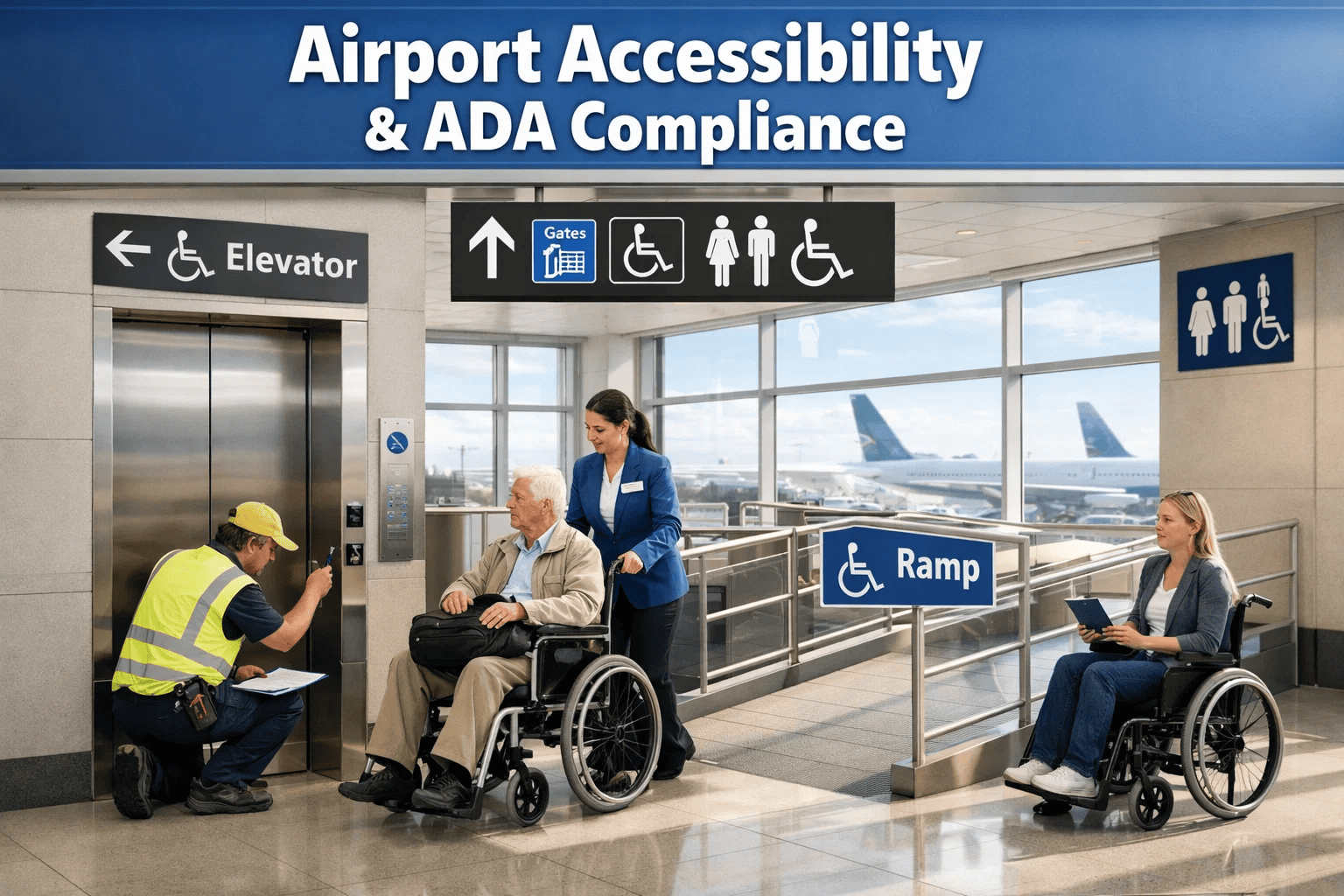
Airport accessibility compliance is not a checkbox exercise — it is a daily operational responsibility that covers hundreds of physical assets across every terminal, gate, restroom, parking facility, and ground transportation zone. The Americans with Disabilities Act, UK Equality Act, and equivalent frameworks in Australia, Canada, and the EU require airports to maintain accessible facilities in continuous working condition, not just install them once and forget them. When an elevator serving a gate area goes out of service and stays down for 72 hours, that is not just an inconvenience — it is a potential legal violation with financial penalty exposure and a public relations incident that travels fast. Start your free Oxmaint trial and build your airport accessibility maintenance programme today — or book a live demo to see how CMMS tracks ADA compliance across every terminal and gate area.
Airport Accessibility & ADA Compliance: Facility Maintenance That Protects Every Passenger
How airport facility managers can use CMMS to maintain elevators, accessible restrooms, wayfinding systems, and mobility infrastructure — and demonstrate continuous ADA compliance through audit-ready records.
What Airport ADA Compliance Actually Requires from Your Maintenance Team
ADA compliance at an airport is not achieved once during a renovation project — it is maintained continuously through structured inspection and repair programmes. Title II (public airports) and Title III (private operators) of the ADA impose obligations not just to install accessible features but to keep them in working order. This means elevator uptime SLAs, accessible restroom equipment integrity checks, hearing loop system functionality testing, accessible parking space marking maintenance, and tactile paving continuity inspections — all on documented, repeatable schedules. In the UK, the Equality Act 2010 and CAA guidance add additional layers. In Australia, Disability Discrimination Act compliance for airports is monitored by the Australian Human Rights Commission. Across all jurisdictions, the common thread is the same: documentation of routine inspection and prompt repair is your primary legal defence. Start a free trial of Oxmaint to build a CMMS-driven accessibility inspection programme — or book a demo to see the accessibility compliance dashboard in action.
The Eight Accessibility Asset Categories Every Airport Must Maintain
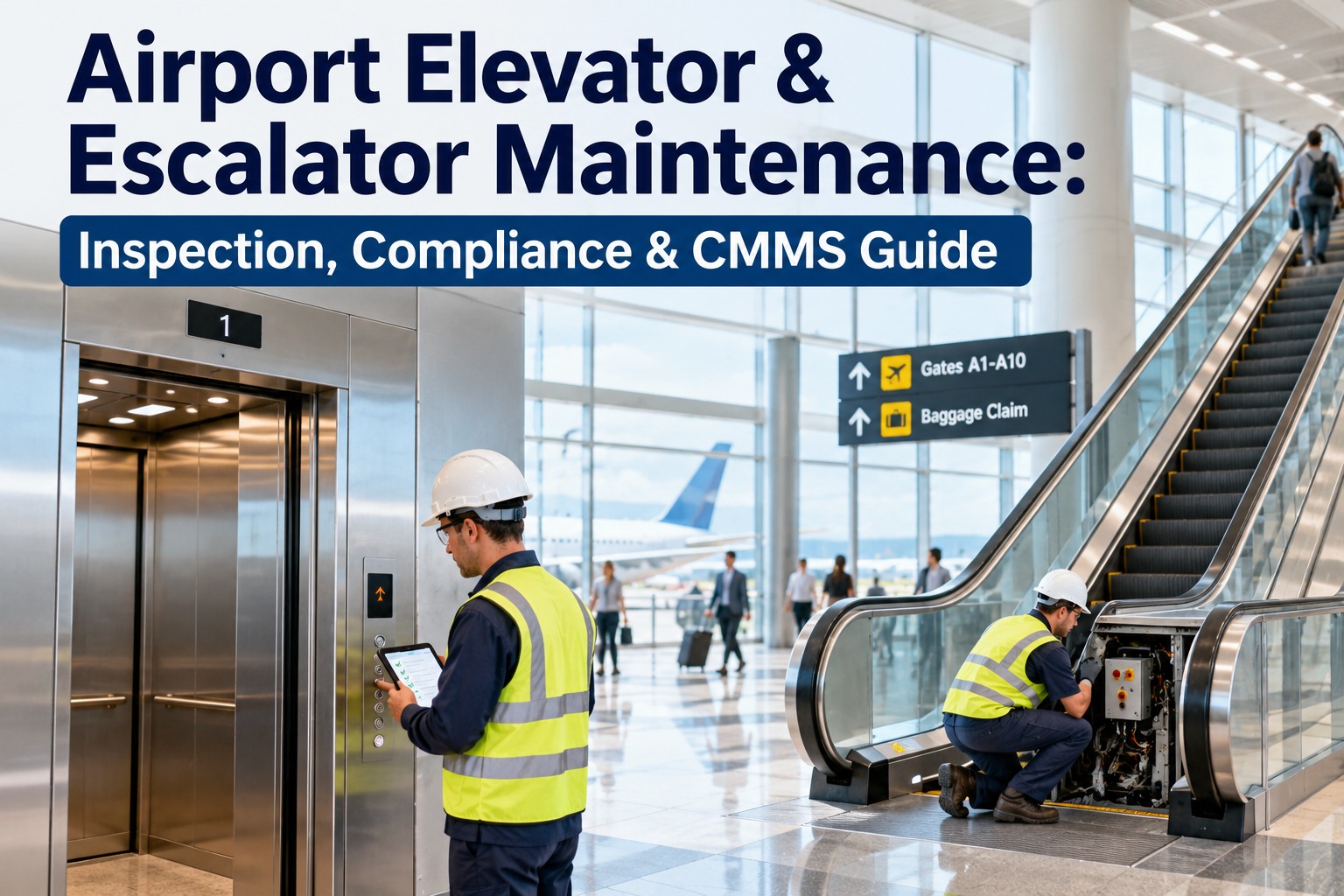
Required uptime: 98%+ per ADA program access standards. PM cycle: monthly functional test, quarterly load test, annual certification. Every outage must be documented with repair timeline and alternative access provided.
Grab bar integrity, door force compliance (max 5 lbs per ADA), sink height, accessible stall dimensions, and emergency call functionality — all require documented inspection on defined intervals, not just reactive repair.
Level boarding surfaces, accessible gate seating quantity, priority boarding area floor condition, and hearing loop coverage at gate agent podiums all require periodic inspection and documented maintenance history.
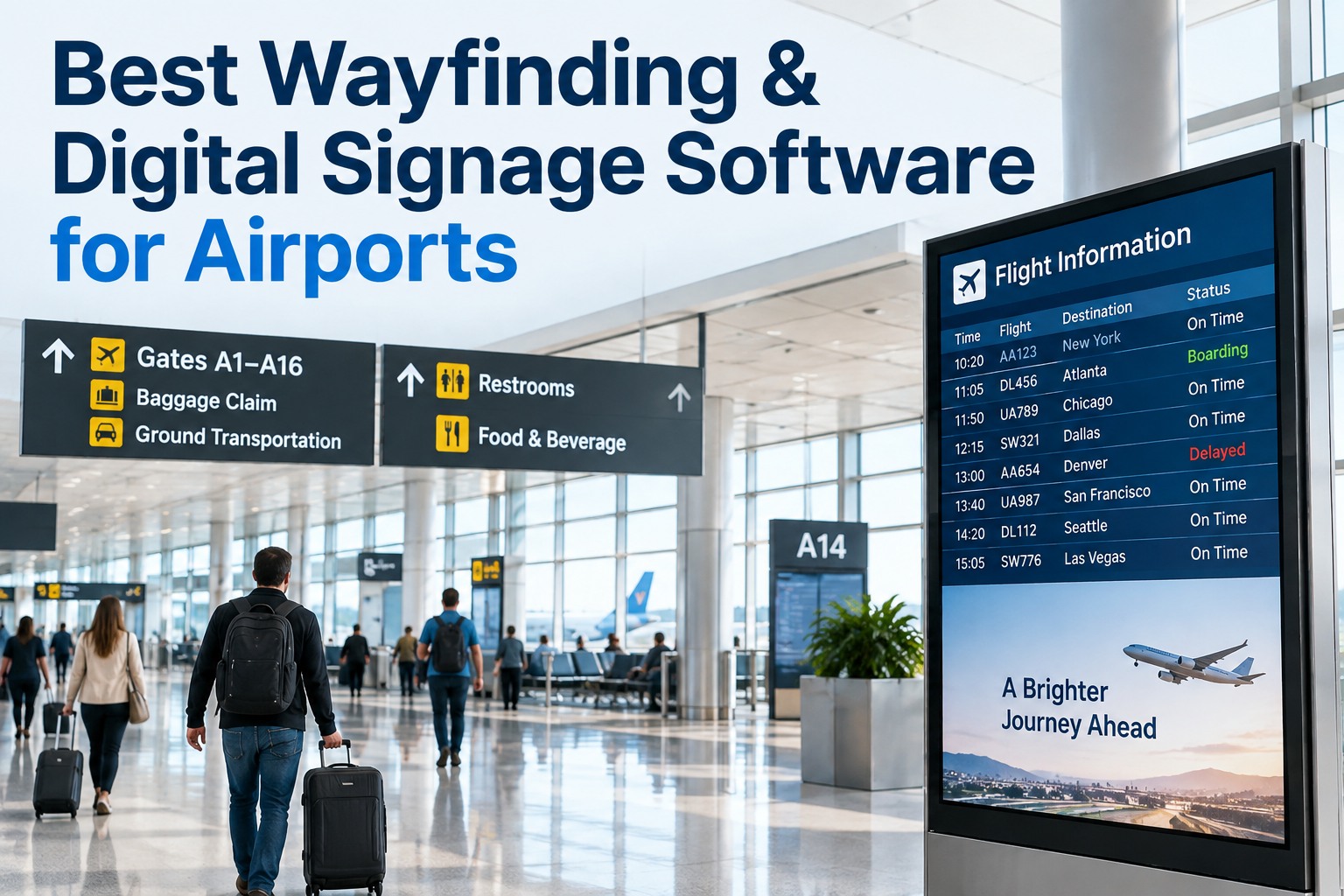
Tactile signage, Braille accuracy, sign mounting heights, colour contrast ratios, and audio wayfinding system functionality. Signage must be inspected after any construction work that changes paths of travel.
Van-accessible spaces with 8-foot access aisles, surface marking clarity, slope compliance (max 1:48), and signage condition — all degrade over time and require scheduled inspection and re-striping before violations occur.
Telecoil-compatible induction loops at check-in counters, gate agent areas, information desks, and security lanes require annual field strength testing and documented performance certification for ADA compliance.
Increasingly required at major airports, sensory rooms for passengers with autism and anxiety disorders require cleanliness inspection, equipment functionality checks (lighting controls, sound dampening), and availability tracking.
Detectable warning surfaces at curbs, escalator approaches, and hazard transitions — and tactile walking surface indicators (TWSIs) on paths of travel — degrade through foot traffic and require inspection after 12 months of high use.
Build Your Airport Accessibility Compliance Programme in Oxmaint
Register every accessibility asset, set inspection intervals from ADA and local compliance requirements, capture digital evidence on mobile, and generate compliance audit reports in minutes. Oxmaint turns your accessibility obligations into a structured, audit-ready maintenance programme.
The Real Cost of Reactive Accessibility Maintenance
Average settlement cost per ADA violation complaint reaching litigation — compared to under $2,000 for a proactive inspection and repair programme per asset annually
Average time to restore elevator service at airports without CMMS-managed contractor work order tracking — vs. 18 hours with structured dispatch and parts pre-staging
Reduction in accessibility-related complaints at airports with formal PM inspection cycles vs. those relying solely on passenger reports and reactive maintenance
Time to generate a complete accessibility maintenance compliance report in Oxmaint vs. 3–5 days assembling paper records across multiple departments for a DOT audit
Oxmaint for Airport Accessibility Compliance: What the Platform Delivers
Register every lift, accessible restroom, hearing loop, tactile surface, and sensory room with asset ID, location, installation date, compliance standard reference, and condition score — fully searchable by terminal and zone.
Build inspection schedules mapped directly to ADA, Equality Act, or local authority requirements. Monthly elevator functional tests, quarterly grab bar checks, annual hearing loop certifications — all auto-triggered with escalation on overdue items.
Technicians complete accessibility checks on mobile with photo capture, pass/fail criteria, digital signature, and GPS location stamp. Results stored directly to the asset record — no transcription, no paper filing.
Passenger accessibility complaints or staff-reported issues convert immediately to work orders with priority classification. Oxmaint tracks response time, completion time, and root cause — creating a complete corrective action audit trail.
Lift maintenance contractors, hearing loop service providers, and accessibility equipment specialists receive work orders in Oxmaint, complete digital job records, and submit completion sign-off — all attached to the asset history.
Generate complete inspection and maintenance history for any accessibility asset, zone, or terminal — with date-stamped records, technician signatures, and corrective actions — formatted for DOT, CAA, or internal audit submission.
Frequently Asked Questions
What are the required inspection frequencies for airport elevators under ADA?
ADA does not specify exact inspection frequencies but requires elevators to be maintained in operable working condition. State elevator safety codes (which vary by US state) typically require annual or biennial third-party certification, while the airport's own program access obligations require keeping elevators operational and repairing outages promptly. ASME A17.1 is the applicable safety code for elevator maintenance. Oxmaint customers typically set monthly functional tests and quarterly full inspections as their internal programme standard. Start a free trial to build your elevator PM schedule today.
How do we demonstrate ADA compliance if we receive a complaint or DOT audit?
The strongest defence against an ADA complaint is a documented record showing: the asset was on a regular inspection schedule, inspections were completed as scheduled, any defects found were repaired within a defined timeframe, and the pattern of maintenance is consistent. Oxmaint produces this evidence automatically — every work order, inspection result, repair action, and sign-off is time-stamped and attached to the asset record. A compliance report covering any date range can be exported in under 10 minutes. Book a demo to see the compliance report generation workflow.
Can Oxmaint track temporary accessibility issues — like a spill blocking a tactile path?
Yes. Oxmaint supports ad-hoc work orders for reactive and reported issues alongside its scheduled PM programme. A staff member or supervisor can raise a work order from a mobile device when a tactile path is obstructed, an accessible restroom stall is inoperative, or a ramp surface is damaged. The work order captures location, issue description, and photo evidence — and the response and resolution are recorded against the asset history, creating a complete corrective action record. Start a free trial to see reactive and PM workflows together.
Does Oxmaint work for airports in the UK and Australia, not just the US?
Oxmaint is used by facility teams across the US, UK, Australia, UAE, Canada, and Germany. The compliance standards differ — UK airports follow the Equality Act 2010 and CAA guidance; Australian airports follow the Disability Discrimination Act and airport-specific access plans — but the underlying maintenance programme structure is the same: asset registry, inspection schedules, digital records, and compliance reporting. Oxmaint's PM schedule builder lets you configure intervals and inspection criteria from any standard. Book a demo to see how compliance schedules are configured for non-US standards.
Every Inaccessible Asset Is a Liability. Oxmaint Helps You Stay Ahead of It.
Oxmaint gives airport accessibility and facility teams a structured, audit-ready maintenance programme for every ADA-critical asset — from elevators and restrooms to hearing loops and tactile surfaces. No paper. No spreadsheets. Compliance evidence always ready when you need it.