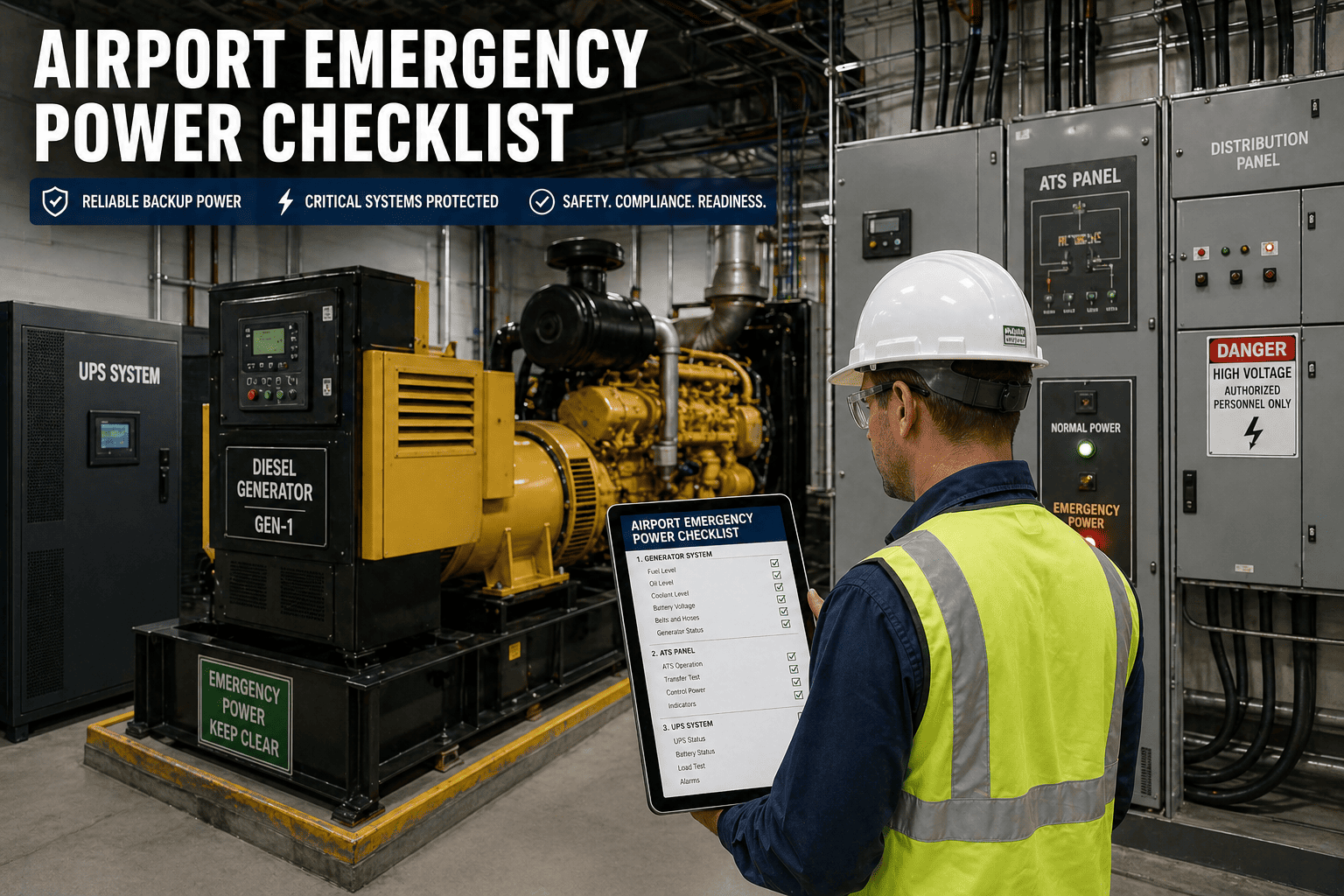
An airport that loses power does not just go dark — it loses runway lighting, navigation aids, baggage handling, security screening, and passenger information systems simultaneously. FAA Part 139 requires certificated airports to maintain emergency power systems capable of restoring critical loads within 10 seconds of utility failure. Yet 34% of generator failures occur during actual emergencies because the unit was not tested under load conditions that match real-world demand. This checklist structures diesel generator, UPS, and ATS maintenance into a digital workflow that ensures your backup power performs when the primary feed fails. Book a demo to see how Oxmaint automates emergency power testing schedules across your airport infrastructure.
10 sec
maximum transfer time for critical airport loads per FAA Part 139 requirements
34%
of generator failures occur during actual emergencies due to inadequate testing
$1.2M
average cost per hour of airport operations disruption from power failure
99.99%
power availability target for critical airport infrastructure systems
Emergency Power System Components
Airport emergency power involves four interdependent systems. A failure in any one compromises the entire backup chain. Structured CMMS-based maintenance ensures each component is tested, documented, and ready. Want to map your entire power infrastructure digitally? Start a free trial and build your emergency power asset hierarchy in Oxmaint.
Primary
Diesel Generators
Standby generators must start, synchronize, and accept load within 10 seconds. Monthly no-load tests verify starting reliability, but only annual load bank testing at 75-100% rated capacity confirms the unit can actually power critical systems under real conditions.
Transfer
ATS Switches
Automatic Transfer Switches sense utility failure and transfer loads to generator power. Testing must verify both transfer-to-generator and retransfer-to-utility sequences. A stuck ATS during an outage leaves the generator running with no connected load.
Bridge Power
UPS Systems
Uninterruptible Power Supplies bridge the gap between utility failure and generator startup. UPS battery health degrades over time — capacity testing every 6 months prevents the silent failure where batteries cannot sustain load for the rated duration.
Storage
Battery Banks
Battery systems for UPS and generator starting circuits require individual cell testing, electrolyte monitoring, and connection torque verification. A single weak cell in a string can compromise the entire bank under load conditions.
Never Discover a Power System Failure During an Actual Emergency
Oxmaint schedules generator load tests, ATS transfer verifications, UPS battery checks, and fuel quality sampling automatically — with digital records that prove compliance to FAA and NFPA auditors.
Emergency Power Inspection Checklist by System
Diesel Generator
Engine oil level and condition — sample for contamination per OEM schedule
Coolant level, concentration, and hose condition — test antifreeze protection
Fuel level, filter condition, and fuel quality — water and microbial testing quarterly
Battery starting system — voltage, electrolyte, terminal condition, and load test
Monthly no-load exercise — verify start time under 10 seconds
Annual load bank test — 75-100% rated capacity for minimum 2 hours
ATS & Switchgear
Transfer-to-generator test — verify sensing, switching, and load acceptance
Retransfer-to-utility test — confirm clean transfer back after generator cooldown
Contact condition — inspect for pitting, arcing damage, and proper alignment
Control logic — verify voltage and frequency sensing thresholds are calibrated
Manual bypass operation — test manual override for maintenance scenarios
Annual thermographic scan — detect hot spots indicating loose connections
UPS Systems
Input/output voltage and frequency — verify within specification under load
Battery runtime test — confirm rated backup duration under actual load
Capacitor condition — inspect for bulging, leaking, or discoloration
Fan and filter maintenance — clean or replace to prevent thermal shutdown
Bypass operation — verify static and manual bypass transfer cleanly
Alarm and monitoring — test all alarm conditions and remote notification
Battery Maintenance
Individual cell voltage — identify weak cells before they compromise the string
Electrolyte specific gravity — for flooded cells, trend readings over time
Connection torque — verify all inter-cell and terminal connections are tight
Impedance testing — annual test to predict remaining battery life
Physical inspection — corrosion, case swelling, electrolyte leaks, vent condition
Room ventilation — verify hydrogen gas ventilation meets code requirements
Manual Testing vs. CMMS-Managed Power Maintenance
| Dimension | Manual Approach | With Oxmaint CMMS |
|---|
| Test scheduling | Calendar reminders, often missed or deferred | Auto-scheduled with escalation alerts on overdue tests |
| Test records | Paper logs filed in electrical rooms | Digital records with readings, photos, and signatures |
| Trending | No historical analysis of readings | Automated trending of voltage, runtime, and fuel consumption |
| Compliance proof | Days assembling records for FAA audit | Instant retrieval — complete audit trail on demand |
| Fuel management | Manual dipstick checks, no quality testing | Automated fuel level tracking with quality test scheduling |
| System reliability | Unknown until actual emergency | Verified through documented load testing at rated capacity |
Impact of Structured Power System Maintenance
99.99%
Power Availability
Structured testing and maintenance achieves near-perfect availability for critical airport systems.
66%
Fewer Generator Failures
Regular load testing and fuel quality management eliminates the failures that only surface during real emergencies.
100%
NFPA 110 Compliance
Automated test scheduling with digital documentation meets every NFPA 110 maintenance requirement.
$1.2M/hr
Disruption Cost Avoided
Every hour of prevented power disruption protects operations worth over $1.2M in direct costs.
Emergency power reliability is not optional — it is the foundation every other airport system depends on. The cost of a single undetected generator failure during a real outage dwarfs the annual investment in structured testing and maintenance. Protect your operations and prove your compliance — book a demo to see emergency power workflows in Oxmaint, or start a free trial to deploy automated test schedules today.
How often should airport generators be load tested?
NFPA 110 requires monthly exercising under load and annual testing at full rated capacity for a minimum of 2 hours. Monthly tests should run at minimum 30% load to prevent wet-stacking. Oxmaint schedules both automatically and tracks load readings over time to identify degradation trends.
Start a free trial to set up generator test schedules.What causes generator failure during actual emergencies?
The top three causes are fuel quality degradation (water and microbial contamination), battery starting system failure, and cooling system issues. All three are preventable with structured preventive maintenance — quarterly fuel sampling, monthly battery testing, and coolant analysis.
Book a demo to see fuel quality tracking in Oxmaint.How does UPS battery capacity degrade over time?
UPS batteries lose capacity gradually — typically 20% over the first 3 years and accelerating thereafter. Without regular runtime testing, the degradation is invisible until the battery fails to sustain load during an outage. Oxmaint tracks battery impedance and runtime test results to predict replacement timing before failure occurs.
What documentation does FAA Part 139 require for emergency power?
FAA Part 139 requires documented evidence that emergency power systems are tested and maintained per NFPA 110 and the Airport Certification Manual. This includes test records, maintenance logs, fuel quality reports, and technician qualifications. Oxmaint stores everything digitally with timestamps.
Start a free trial to see audit-ready power system documentation.
Your Backup Power Must Work the One Time It Matters Most.
Oxmaint automates generator load testing, ATS transfer verification, UPS battery health checks, and fuel quality monitoring — with digital records that prove every test happened, every reading was captured, and every system is ready.
Generator Load TestingATS Transfer VerificationUPS Battery TrackingNFPA 110 Compliance