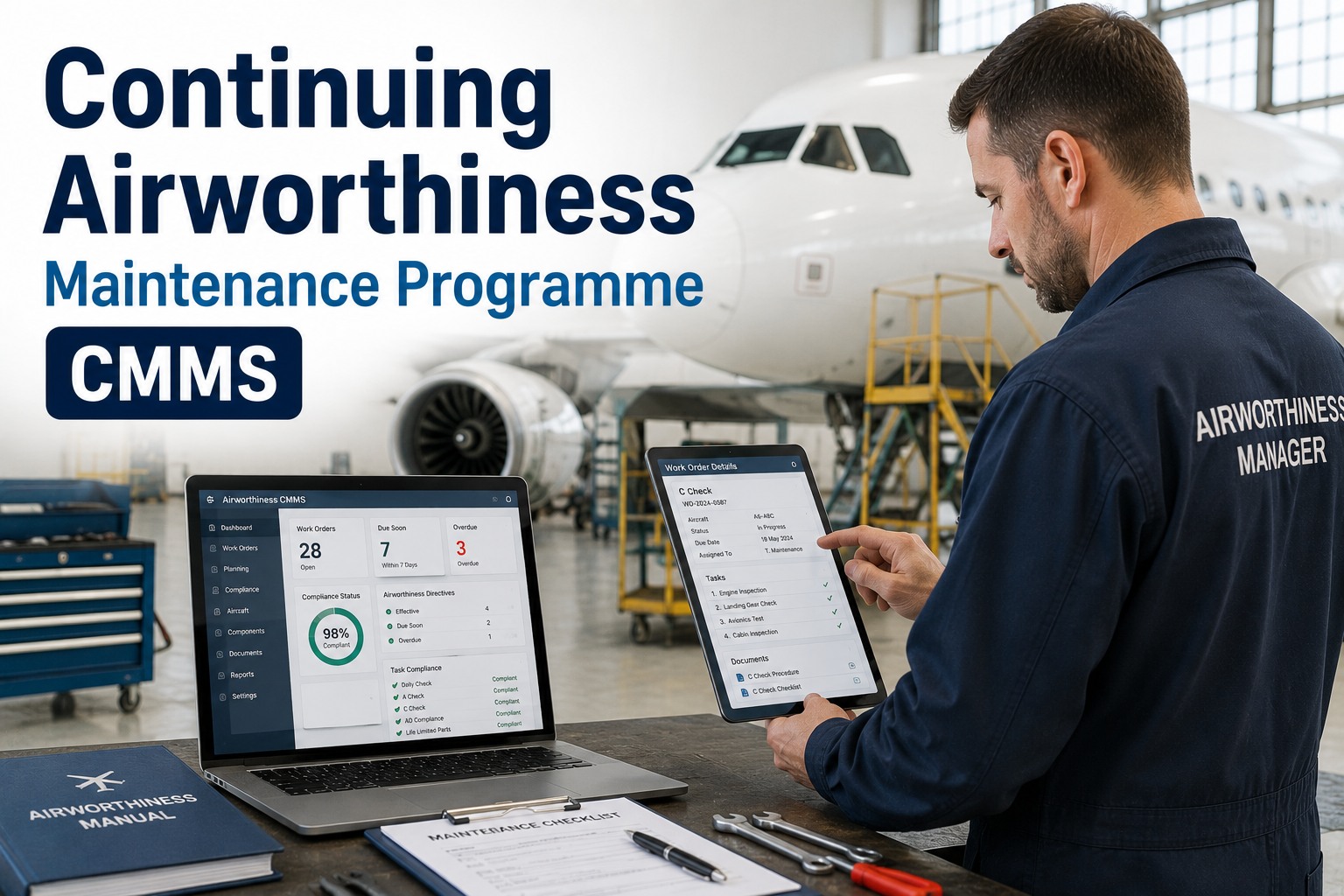
Continuing airworthiness management (CAMO) compliance is the discipline that keeps every aircraft legally airworthy by tying each maintenance action, record and directive to an approved, auditable system. Under EASA Part-CAMO and Part-M, an operator that cannot produce complete continuing airworthiness records on demand risks losing its approval — and grounding its fleet. This guide walks compliance officers through CAME documentation, reliability programme evidence, AD/SB control, maintenance programme approval and record-keeping that satisfies both EASA and national CAA expectations. If your team is still tracking airworthiness directives in spreadsheets, a digital system like OxMaint can centralise every record — Start Free Trial and see the difference in days.
Can your CAMO records survive a surprise EASA audit tomorrow?
One missing AD sign-off or an expired maintenance programme revision can suspend your approval. Here is how leading airworthiness management organisations keep every aircraft audit-ready, every day.
What does continuing airworthiness management actually require?
EASA Part-CAMO approval rests on five pillars — miss one and your organisation's approval is exposed. Roughly 40% of CAMO audit findings trace back to incomplete records or outdated programme revisions.
1. CAME Documentation
Your Continuing Airworthiness Management Exposition is the contract with the authority. It must describe procedures, responsibilities and the management system — and every procedure in it must match what your team actually does. A CAME that says one thing while technicians do another is a guaranteed finding.
2. Maintenance Programme Approval
Each aircraft must follow an approved maintenance programme (AMP) based on the MPD, operator experience and reliability data. Revisions need authority approval before tasks fall due — a late revision means tasks become non-compliant retroactively.
3. AD & SB Compliance Control
Airworthiness Directives are mandatory; Service Bulletins often feed the AMP. You need a live register showing every applicable AD, its compliance status, the method used and the sign-off. Auditors sample ADs first — a single overdue AD is a Level 1 finding.
4. Reliability Programme Evidence
For larger aircraft, a reliability programme monitors defect rates, unscheduled removals and pilot reports against alert levels. You must show the data, the analysis and the corrective actions taken — not just a chart, but the decisions it drove.
5. Records & Traceability
Every task, component change, defect rectification and flight-hour cycle count must be recorded and retained — typically until 2 years after the aircraft is permanently withdrawn. Records must be retrievable within hours, not weeks.
The Cost of Getting It Wrong
A suspended CAMO approval grounds aircraft at $10K–$150K per day per airframe in lost revenue, lease penalties and repositioning. Remediation audits add $25K–$80K in consultant and authority fees.
How a 12-aircraft operator fixed CAMO compliance in 90 days
A regional operator running 12 turboprops faced 14 audit findings — 3 of them Level 1 — after a CAA ramp inspection flagged AD tracking gaps.
Digitise the Record Base
Scanned 4 years of paper work packs, loaded every aircraft's utilisation, component history and AD status into a central register. Found 2 ADs with missing sign-offs — corrected before the follow-up audit.
Rebuild the AMP & AD Workflow
Reconciled the maintenance programme against the latest MPD revision, set automated alerts 60/30/7 days before every task and AD due date, and assigned a single owner per directive.
Stand Up Reliability Reporting
Configured monthly reliability dashboards — defect rate per 1,000 FH, unscheduled removals, recurring defects — with alert levels that trigger documented corrective actions.
Pass the Follow-Up Audit
The CAA closed all 14 findings. Record retrieval time dropped from 3 days to under 2 hours. The operator estimates $180K saved in avoided grounding and consultant costs.
Which CAMO records do EASA and CAA auditors check first?
Auditors sample the same five record families on almost every visit. If any of these take more than a few hours to produce, your system is the problem.
| Record Family | What the Auditor Wants | Retention | Common Finding |
|---|---|---|---|
| AD Compliance Register | Status, method, date, sign-off for every applicable AD | Life of aircraft | Missing embodiment record |
| Maintenance Programme | Current approved revision + task compliance history | Until superseded + 2 yrs | Outdated MPD baseline |
| Component / LLP Tracking | Life-limited part hours, cycles, back-to-birth trace | Life of part + 2 yrs | Incomplete back-to-birth |
| Defect & Rectification Log | Every defect, deferral (MEL), and corrective action | 2 yrs min | Open defects without action |
| Reliability Reports | Data, alert levels, analysis, corrective decisions | Programme duration | Charts without actions |
How OxMaint keeps your CAMO programme audit-ready
OxMaint's AI-powered CMMS gives continuing airworthiness teams a single system of record — replacing spreadsheets, shared drives and paper work packs.
AD & Directive Tracking
Live AD/SB register with automated due-date alerts at 60/30/7 days. Cut directive research time by 70% and eliminate overdue-AD findings.
Maintenance Programme Control
Digital AMP with revision history, task forecasting and utilisation-based scheduling. Keep every aircraft's programme current — no retroactive non-compliance.
Instant Record Retrieval
Every work order, component change and sign-off is searchable in seconds. Produce a full aircraft record pack in under 2 hours — not 3 days.
Reliability Dashboards
Automated reliability reporting — defect rates, unscheduled removals, recurring issues — with alert levels that trigger tracked corrective actions. Show auditors decisions, not just charts.
See OxMaint on your fleet — book a 30-minute demo
We will walk through AD tracking, maintenance programme control and audit-ready reporting using your aircraft types.
Continuing airworthiness management — FAQs
What is continuing airworthiness management (CAMO)?
CAMO is the approved organisation responsible for keeping an aircraft airworthy between scheduled maintenance — managing the maintenance programme, AD/SB compliance, records and reliability monitoring under EASA Part-CAMO or an equivalent national framework.
What is the difference between Part-M and Part-CAMO?
Part-M originally governed continuing airworthiness for all aircraft; Part-CAMO was introduced to give continuing airworthiness management organisations their own dedicated approval with a management-system approach, including safety risk management and compliance monitoring requirements.
How long must CAMO records be retained?
Most continuing airworthiness records must be kept until at least 2 years after the aircraft is permanently withdrawn from service. AD compliance and life-limited part records follow the aircraft or component for life. Digital systems like OxMaint make long-term retention and instant retrieval practical.
What triggers a CAMO audit finding?
The most common triggers are overdue or unsigned ADs, an out-of-date maintenance programme revision, incomplete component back-to-birth traceability, and reliability data with no documented corrective actions. Level 1 findings — anything affecting immediate safety — can suspend your approval.
Can software replace a paper-based CAMO system?
Yes — EASA accepts electronic records provided they are secure, backed up and retrievable. A CMMS built for airworthiness management replaces paper work packs with searchable digital records, automated alerts and audit-ready reports. Book a Demo to see how it maps to your CAME procedures.
Make your next CAMO audit the easiest one yet
Centralise ADs, maintenance programmes, records and reliability data in one system built for continuing airworthiness compliance.
Free 14-day trial · No credit card · Set up in under an hour