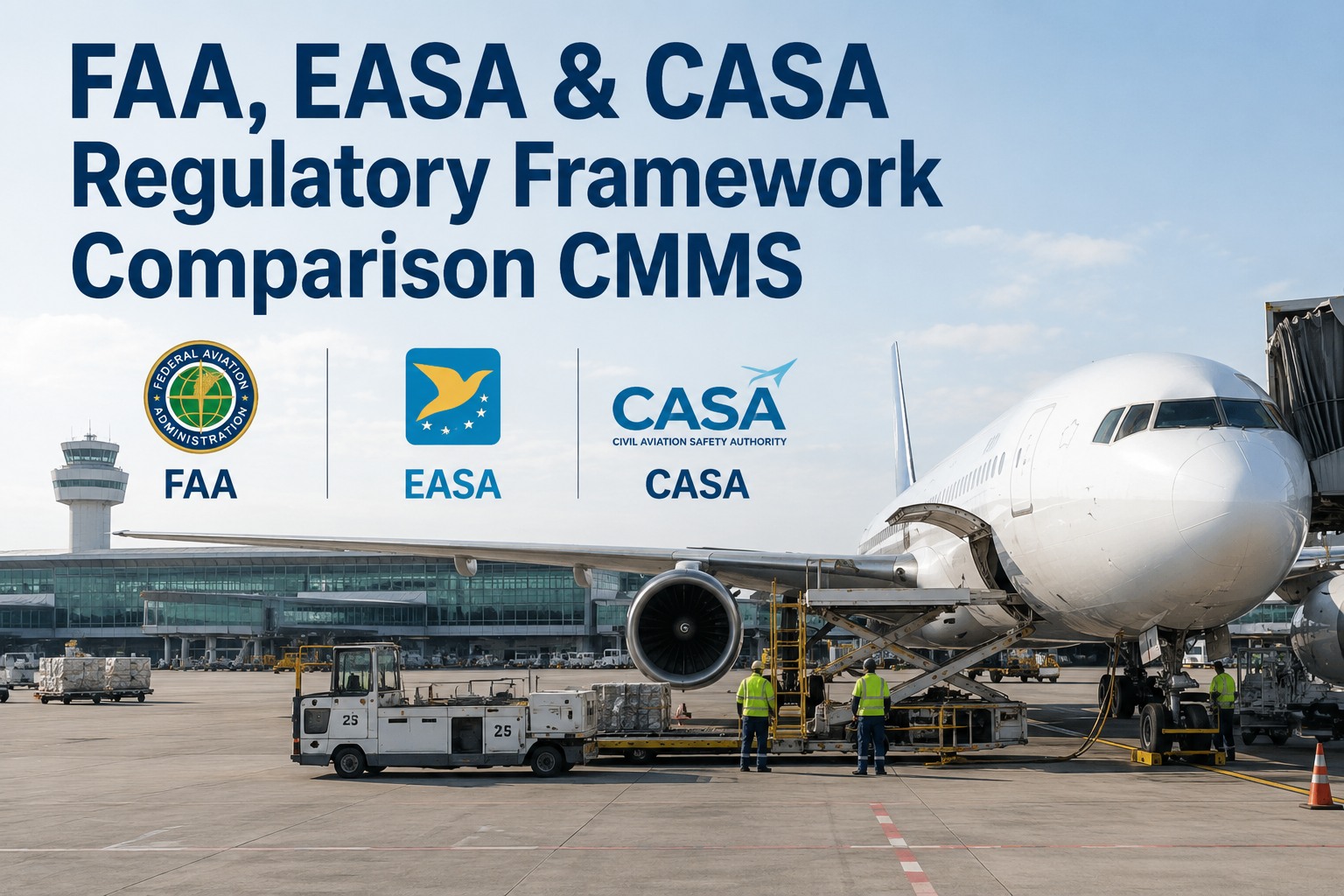
A mixed-fleet MRO doesn't have one records problem — it has two, and they disagree on the shape of the answer. EASA Part 145 wants organisational approval, quality-system evidence and CRS entries tied to certifying staff numbers. FAA 14 CFR Part 43 wants return-to-service records tied to A&P/IA credentials in a very different format. Every airframe that touches both regimes needs the same event captured twice — or captured once and mapped to both. This guide walks the mapping using OXMAINT AI, the AI-powered CMMS for dual-regulator MROs.
One Maintenance Event. Two Regulators. One Record System.
OXMAINT AI, the AI-powered CMMS/maintenance management software, connects the full workflow on one platform — inspections and defects in, work orders assigned to certifying staff, and every record captured once and mapped to both EASA Part 145 and FAA Part 43 field sets.
The Regulatory Frame — Same Work, Different Language
Both regimes want to know who did the work, on what, when, and to what standard. They just ask in different words with different attached authority. OXMAINT AI holds one record and formats the output for each. Sign up free and set up dual-format capture in OXMAINT AI.
- Approval held by the organisation, not the individual
- Certifying Staff (CS) named under the approval
- Certificate of Release to Service (CRS) closes the task
- Quality system + safety management required
- Part 66 licence tied to CS authorisation
- Individual mechanic (A&P) or IA authority
- Repair Stations approved under Part 145 (US)
- Return to Service (RTS) entry closes the task
- Maintenance record content spec in §43.9 / §43.11
- Signature + certificate number + date required
The 7-Field Shared Record Set
Underneath the terminology, both regimes need the same seven pieces of evidence for every task. OXMAINT AI captures them once at the point of work — every downstream export inherits the same source. Book a demo to see one record produce both formats.
The Field-by-Field Mapping Table
The mapping isn't complicated — but it has to be consistent. Every EASA field has a Part 43 counterpart, and every audit needs to trace back to the same source event. OXMAINT AI ships this mapping as a default template. Start free and use the default mapping in OXMAINT AI.
| Shared Field | EASA Part 145 | FAA 14 CFR Part 43 |
|---|---|---|
| Approval authority | Part 145 approval no. | Repair Station cert / A&P cert no. |
| Signatory role | Certifying Staff (Part 66) | A&P mechanic / IA / Rep Stn |
| Task standard | AMM, CMM, EASA AD, SB | AMM, CMM, FAA AD, SB |
| Closure statement | CRS: "Certifies that the work specified…" | RTS: signature + cert no. + date |
| Life-limited parts | EASA Form 1 / dual-release Form 1 | FAA 8130-3 / dual-release 8130-3 |
| Defects deferred | MEL/CDL applied · deferred defect log | MEL/CDL applied · discrepancy record |
| Quality system | MOE required · audit trail | RSM/RSQM required · audit trail |
One Event. Two Regulators. Zero Double Entry.
OXMAINT AI captures the work once and formats it for CRS or RTS on demand — so a mixed-fleet MRO stops paying the tax of duplicate records.
Who Can Sign What — Roles & Authority
Signatory authority is where dual-regulator MROs stumble most often. An A&P alone can't sign a CRS. A Part 66 CS can't sign a US RTS on a Part 43 airframe. OXMAINT AI ties every certifying signature to the correct role and blocks the wrong one. Book a demo to see role-gated signatures live.
The Dual-Release Workflow — When One Form Isn't Enough
A component leaving an MRO for both EASA and FAA jurisdictions often needs a dual-release Form 1 / 8130-3. OXMAINT AI holds the release history against the part and generates the correct release document based on destination. Sign up free and set up dual releases in OXMAINT AI.
The Audit Test — What Each Regulator Asks For
The mapping only matters if it survives an audit. Each regulator has a different question set — OXMAINT AI's audit portal answers both from the same source records. Book a demo to see the audit portal live.
What OXMAINT AI Gives a Dual-Regulator MRO
Built for the mixed-fleet reality — one platform behind both regulators, one record behind both audits, one workflow that stops the double-entry tax. Start free and configure your dual-format capture in OXMAINT AI.
We used to keep two records for every task on our dual-registered airframes — one in the CRS binder, one in the RTS log. When they diverged (as they always did), the auditor found it. Moving to one source with two outputs eliminated the divergence entirely. The last EASA audit and the last FAA audit both drew from the same records.
Frequently Asked Questions
Capture the Work Once. Answer Both Regulators.
Move your MRO records onto OXMAINT AI — one 7-field capture, dual-format output, role-gated signatures and a scoped audit portal for each regime.