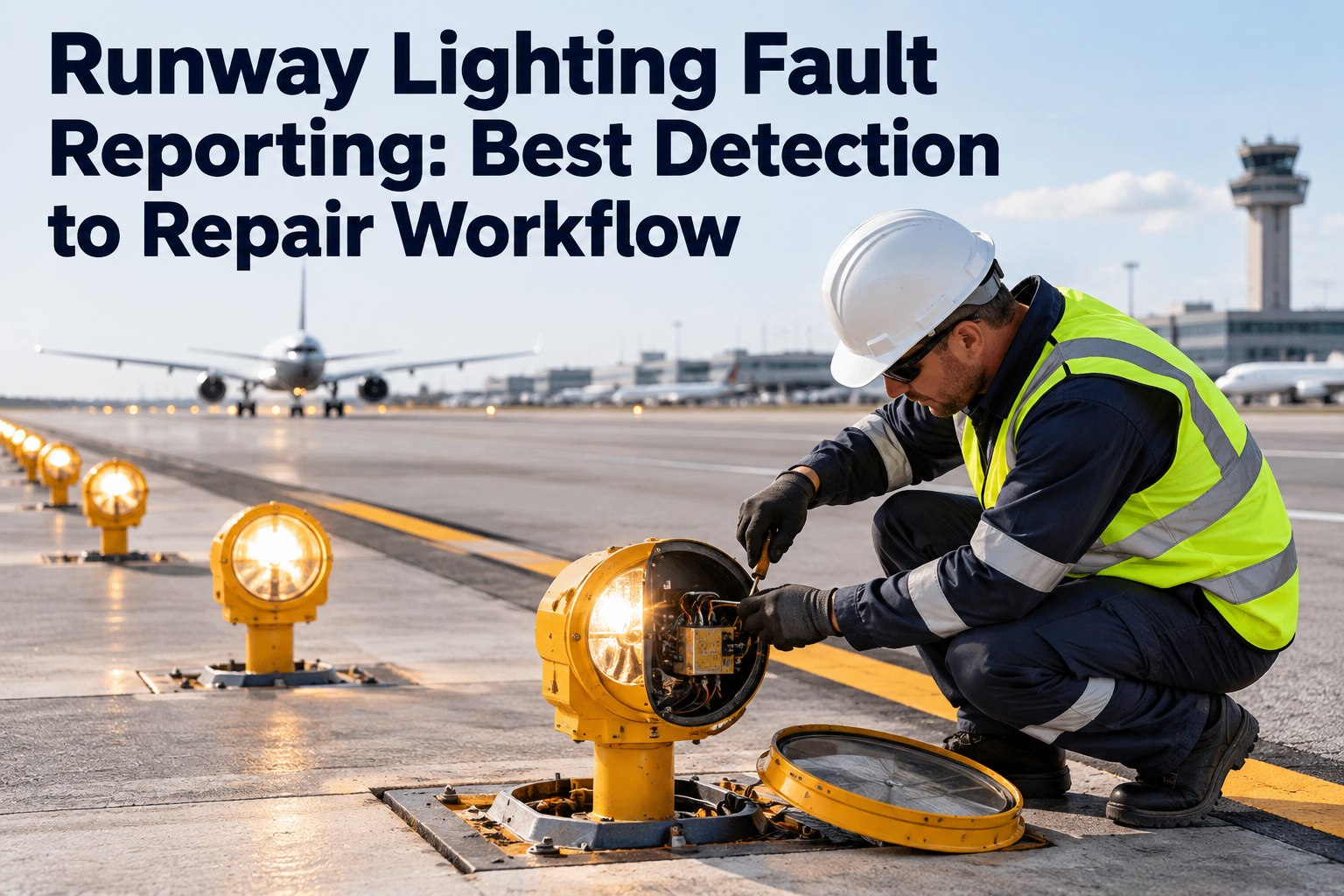
A runway edge light fails mid-rotation. A cable fault trips a circuit under an active runway. The clock starts immediately — an aircraft movement area with a defect isn't a maintenance ticket you get to next shift, it's an operational restriction that ripples straight into the tower, the airline schedule, and the regulator's inbox. Emergency airfield work under an active NOTAM lives or dies on coordination: the right permit, the right escort, the right tools staged, clean comms with ATC, and closeout evidence a regulator will accept. This playbook lays out that sequence, and shows how OXMAINT AI, the AI-powered CMMS, links every step to a defensible record.
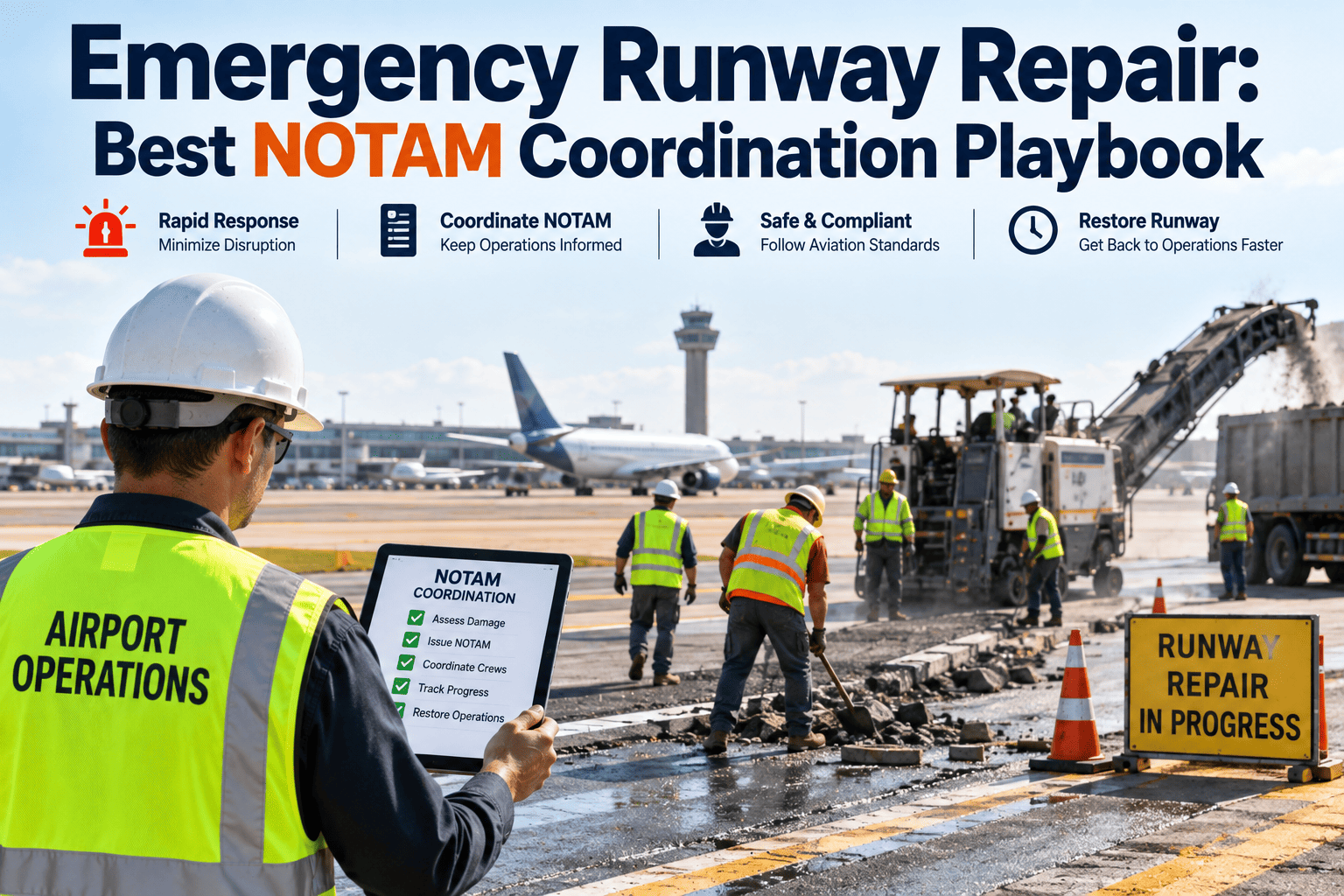
Emergency Runway Repair: Best NOTAM Coordination Playbook
Under an active NOTAM, the repair is only half the job — the other half is proving it was done safely, in coordination, and to standard. OXMAINT AI ties the whole emergency chain to one record: the permit to work, the escort and airside access, the tooling, the ATC comms log, and the closeout evidence — so the crew moves fast and the airfield still has a clean audit trail when the runway reopens.
Why Airfield Emergencies Are Different
A defect on a movement area isn't just an equipment problem — it's a live safety and operational one. The work happens inside an active aerodrome, under ATC control, against a running flight schedule, with a regulator who will later ask exactly what was done and how. Speed matters, but uncoordinated speed on a runway is how a repair becomes an incident. The playbook exists to move fast and stay coordinated. Start free and put the playbook on one system.
The Coordination Playbook — Five Phases
From the moment the defect is confirmed to the moment the runway reopens, the work moves through five coordinated phases. Skip or rush one and either the crew is exposed on the airfield or the evidence is incomplete at closeout. Book a demo to map this to your aerodrome.
The Repair Reopens the Runway. The Evidence Keeps It Open.
A perfectly executed airfield repair with no record is a problem waiting for the next audit. OXMAINT AI captures the permit, escort, comms, tests, and photos against the work order as the crew goes — so the evidence is built during the job, not reconstructed after it.
What Goes on the Record — and Why
Closeout evidence isn't paperwork for its own sake — each item answers a question a regulator or safety review will ask. OXMAINT AI captures them against the work order as the job runs. Start free and capture evidence as you go.
| Evidence item | The question it answers |
|---|---|
| Permit to work | Was the work authorized, with the hazards controlled before entry? |
| Escort & access log | Who was airside, under whose escort, and when? |
| ATC comms log | Was every movement-area entry coordinated and cleared? |
| Repair record | What was the defect, and exactly what was done to fix it? |
| Test / verification | Was the asset confirmed serviceable to standard before reopening? |
| Photos & timestamps | Can the whole sequence be reconstructed and defended later? |
What OXMAINT AI Runs During the Response
The crew executes the playbook. OXMAINT AI keeps it coordinated and captured — so speed never costs the audit trail. Start free and run the response on one system.
Ad Hoc Response vs. Playbook + CMMS
| What matters | Ad hoc scramble | Playbook + OXMAINT AI |
|---|---|---|
| Permit to work | On paper, filed loosely | Linked to the work order |
| Airside escort/access | Arranged verbally | Assigned and logged |
| ATC coordination | Radio only, no record | Logged against the job |
| Tooling & spares | Found short mid-repair | Verified before entry |
| Closeout evidence | Reconstructed after | Captured during the job |
| Regulator readiness | A scramble at audit | Already on the record |
Frequently Asked Questions
Move Fast on the Runway. Keep the Audit Trail Clean.
Link the permit, escort, ATC comms, tooling, and closeout evidence to one emergency work order — so the crew reopens the runway quickly and the airfield can prove every step to the regulator.