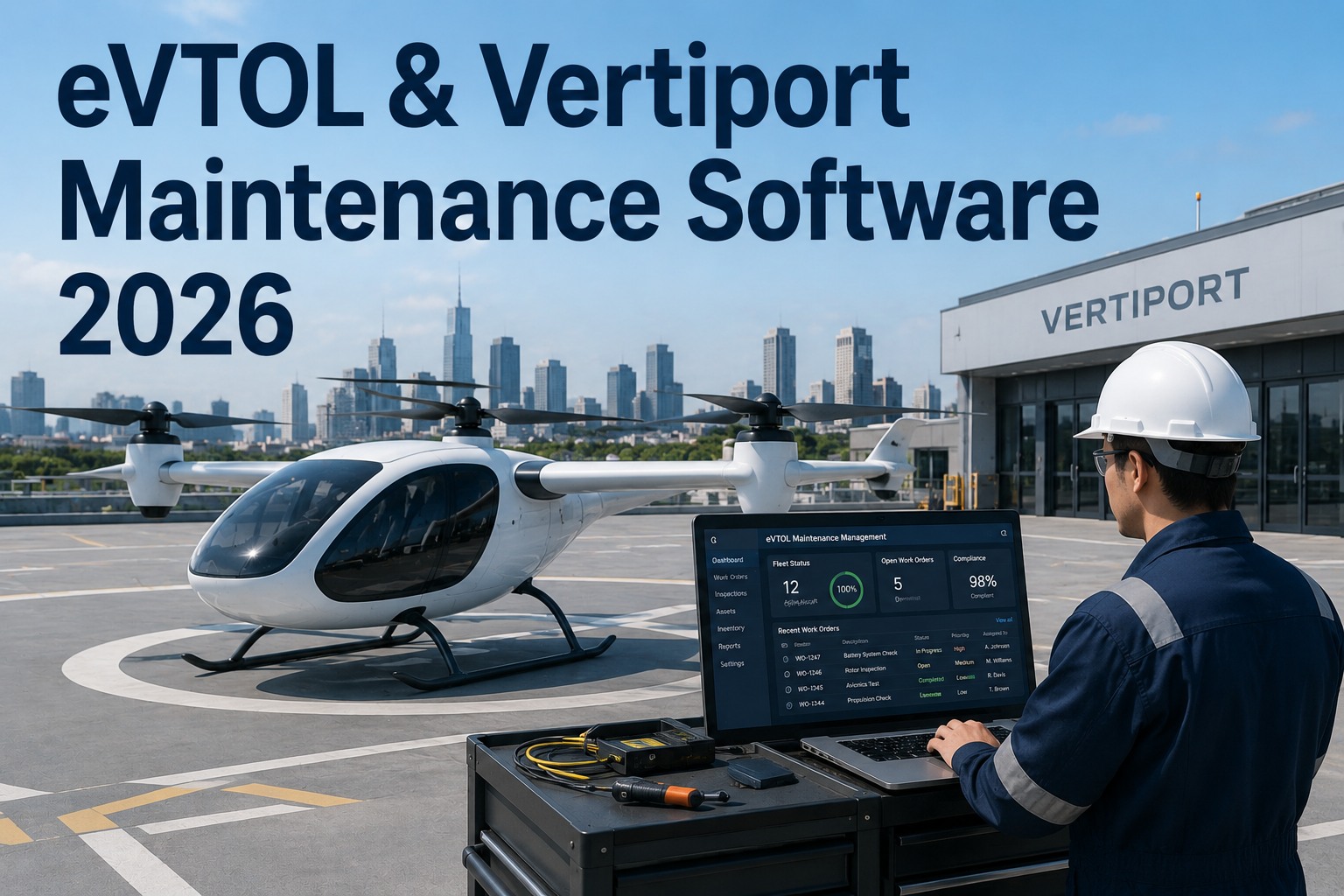
The air taxi gets the headlines, but advanced air mobility actually starts on the ground — with charging, vertiports, and the maintenance systems that keep an electric aircraft turning around in minutes instead of hours. And here's the uncomfortable truth for airport operators in 2026: infrastructure is the least mature part of the whole ecosystem. The aircraft are approaching certification, but the vertiports, megawatt charging, battery-health systems, and the maintenance discipline to run them are still being built. Airports moving early — colocating vertiports with existing FBOs, adapting helipads, standing up charging — are discovering that a new asset class needs a maintenance operating system from day one, not bolted on after the first incident. This guide covers what eVTOL and vertiport maintenance software has to handle in 2026: the new asset classes, the regulatory baseline, the turnaround-driven maintenance model, and how a CMMS becomes the backbone of a vertiport that scales. Book a free vertiport-readiness session for your site.
The Aircraft Is Ready Before the Ground Is
Infrastructure — charging, vertiports, maintenance — is the least mature part of AAM.
$0.5–2M
Charging-equipment cost per vertiport, before land, construction, and grid upgrades
EB 105A
FAA interim vertiport design guidance — full Advisory Circular still forthcoming
MW-class
DC fast-charging (SAE J3271/MCS) emerging as the turnaround standard
~30% CAGR
Projected vertiport-market growth through the early 2030s
Five New Asset Classes a Vertiport CMMS Must Track
A vertiport isn't a smaller airport — it's a different machine. The maintenance program has to model asset classes that don't exist in a conventional airfield register. Miss any one and the reliability data has a hole in it.
Charging Systems
Megawatt-class DC fast-chargers and connectors under constant high-power cycling — the single asset everything else depends on for rapid turnaround.
Energy Storage & Micro-Grid
Battery buffers and micro-grids that shield the local grid from megawatt demand spikes — with their own state-of-health and thermal-management maintenance needs.
FATO / TLOF Landing Surfaces
Final approach and touchdown areas, lighting, and markings per EB 105A — inspected on a cadence the design guidance and downwash loads demand.
Maintenance & Hangar Facilities
Inspection bays, ground support equipment, and passenger handling areas — often colocated with an existing FBO, each with its own PM schedule.
Safety, Fire & Emergency Systems
Electric aircraft carry battery-specific fire and hazmat risks that conventional airfield systems weren't designed for — rapid passenger evacuation procedures, thermal-runaway response, and specialized suppression all become tracked, inspected, drilled assets in the maintenance program.
Why the Maintenance Model Is Different
Electric aircraft and megawatt charging break the assumptions a conventional airport maintenance program is built on. Three shifts define the eVTOL model — and each is a reason paper and spreadsheets can't keep up.
SHIFT 01
Turnaround-Driven, Not Schedule-Driven
The business case lives or dies on rapid turnaround. Charging, inspection, and dispatch all compress into minutes — so maintenance has to be pre-staged and condition-triggered, not queued for a monthly window.
SHIFT 02
Electrical, Not Mechanical
Far fewer moving parts, but a whole new failure surface: battery state-of-health, charger power electronics, thermal management, and grid interaction — monitored continuously, not checked by hand.
SHIFT 03
Evolving Standards, Living Baseline
EB 105A is interim guidance, with a full Advisory Circular still ahead. The maintenance program has to document to a standards-constrained but moving baseline — and adapt as it firms up.
See a Vertiport Asset Model in 30 Minutes
Working session with our aviation team — bring your vertiport plans or existing airfield assets. We'll map the charging, energy, landing-surface, and safety asset classes into a structured hierarchy and show how OxMaint runs PM, inspection, and IoT triggers across them.
What "Best" Means for eVTOL & Vertiport CMMS in 2026
Most CMMS platforms were built for mechanical assets on monthly schedules. A vertiport-ready platform has to handle continuous electrical monitoring, rapid turnaround, and an evolving regulatory baseline. Here's the evaluation frame.
Legacy Airfield CMMS
Mechanical assets on fixed calendar PM
Manual inspection rounds, paper capture
No high-power charging or battery-health model
Static schedules that assume slow turnaround
Reporting built for annual airfield audits
Vertiport-Ready CMMS
New asset classes in a structured hierarchy
Mobile execution with photo capture and e-sign
IoT integration for chargers, energy, thermal
Condition-triggered work orders for turnaround
Reporting that adapts as EB 105A firms up
The Vertiport Maintenance Loop · Sensor to Dispatch
A vertiport that scales runs maintenance as a continuous loop, not a periodic chore. Every asset feeds condition data; every threshold breach becomes an action; every action stays documented against the asset.
1
Monitor Continuously. IoT sensors on chargers, energy storage, and thermal systems stream condition data into the CMMS — the parameters that fail fastest, watched constantly.
2
Trigger on Threshold. A charger fault, a battery-health drop, or a thermal alert auto-generates a prioritized work order — before it takes a landing pad or charger out of service.
3
Execute on Mobile. Technicians complete the work order with mandatory fields, photo capture, and e-sign — the pre-staged fix that protects the turnaround window.
4
Log & Report. Every action logs against the asset, terminal, or team — building the audit trail and reliability data that leadership and regulators can act on.
How OxMaint Becomes the Vertiport Operating System
OxMaint is the operating system airports use for exactly this kind of program — asset hierarchies mapped to the real operation, PM and inspection automation, mobile technician execution, IoT integration, and reporting that turns maintenance data into decisions, built to survive leadership changes and the next decade of growth.
Assets
New-Class Hierarchies
Charging, energy storage, landing surfaces, and safety systems modeled as structured assets — the register a vertiport needs from day one.
IoT
Continuous Condition Data
Sensor feeds from chargers, batteries, and thermal systems convert into prioritized work orders automatically — the electrical failure surface watched in real time.
PM
Automated Inspections
EB 105A-aligned landing-surface, lighting, and facility inspections auto-generate on cadence — nothing skipped as operations ramp.
Mobile
Turnaround-Speed Execution
Technicians execute on mobile with mandatory fields, photo capture, and e-sign — pre-staged work that protects the minutes-long turnaround.
Trail
Audit-Ready History
Every action logged against the asset, terminal, or team — a defensible record for a standards baseline that's still firming up.
Scale
One Pad to a Network
Run a single showcase vertiport or a multi-site network from one dashboard — a system that scales as AAM does.
Build the Ground Before the Aircraft Arrives
The airports that win AAM are standing up the maintenance operating system now. See how OxMaint models vertiport assets, runs IoT-triggered work orders, and keeps an audit-ready trail as standards evolve. Free forever plan available.
Frequently Asked Questions
What is eVTOL and vertiport maintenance software?
It's a CMMS configured for the asset classes and operating model of advanced air mobility infrastructure — megawatt charging systems, energy storage and micro-grids, FATO/TLOF landing surfaces, maintenance and hangar facilities, and battery-specific safety systems. Unlike a conventional airfield CMMS built for mechanical assets on monthly schedules, a vertiport-ready platform handles continuous electrical condition monitoring, condition-triggered work orders for rapid turnaround, and documentation against an evolving regulatory baseline. It's the operating system that lets a vertiport run reliably and scale as operations grow.
Book a vertiport-readiness session.
What regulations govern vertiport design and maintenance?
In the U.S., the current primary reference is FAA Engineering Brief 105A, Vertiport Design, published as supplemental guidance to the AC 150/5390-2D heliport design document. EB 105A classifies vertiports as a heliport subclass and is explicitly an interim, living document — it's expected to be superseded by an updated heliport Advisory Circular. Existing FAA regulations on new takeoff and landing facilities, including Part 157 construction notification, also apply. The practical takeaway for operators is to treat EB 105A as a standards-constrained but evolving baseline, and to build a maintenance program that can document to it and adapt as it firms up.
Why is charging the most critical vertiport asset?
Because the entire eVTOL business case depends on rapid turnaround, and turnaround depends on charging. Megawatt-class DC fast-charging is emerging as the standard, drawing on grid capacity that may not exist at desired locations — which is why energy storage and micro-grids often sit alongside the chargers to buffer demand spikes. That makes charging and energy infrastructure the assets under the most stress and the most consequential to keep healthy. Continuous condition monitoring on chargers, connectors, and battery buffers is what prevents a charger fault from cascading into grounded aircraft and missed schedules.
Sign up free to model your charging assets.
Can airports use existing infrastructure for eVTOL?
Partly, and that's the pragmatic path most early operators are taking. Initial AAM operations are leveraging existing airports, heliports, and helipads with modifications, and many vertiports are colocated with existing FBOs to reuse operational support, security, and passenger-handling infrastructure. But existing helipads were designed for lower-frequency operations and typically lack the charging capacity, throughput, and battery-specific safety systems eVTOL needs. So even an adapted site adds new asset classes to the maintenance program — which is exactly why a structured CMMS matters from the first modification, not after scale-up.
Does OxMaint support vertiport and AAM operations?
Yes. OxMaint models the new asset classes a vertiport needs — charging systems, energy storage, landing surfaces, hangar facilities, and safety systems — in a structured hierarchy, integrates IoT condition data from chargers and batteries into prioritized work orders, automates EB 105A-aligned inspections, supports turnaround-speed mobile execution with photo capture and e-signatures, and logs a full audit trail against the asset, terminal, or team. Whether you run one showcase pad or a multi-site network, it gives the airport a maintenance operating system that survives leadership change, workforce turnover, and a decade of growth. A free forever plan is available to trial the full workflow.