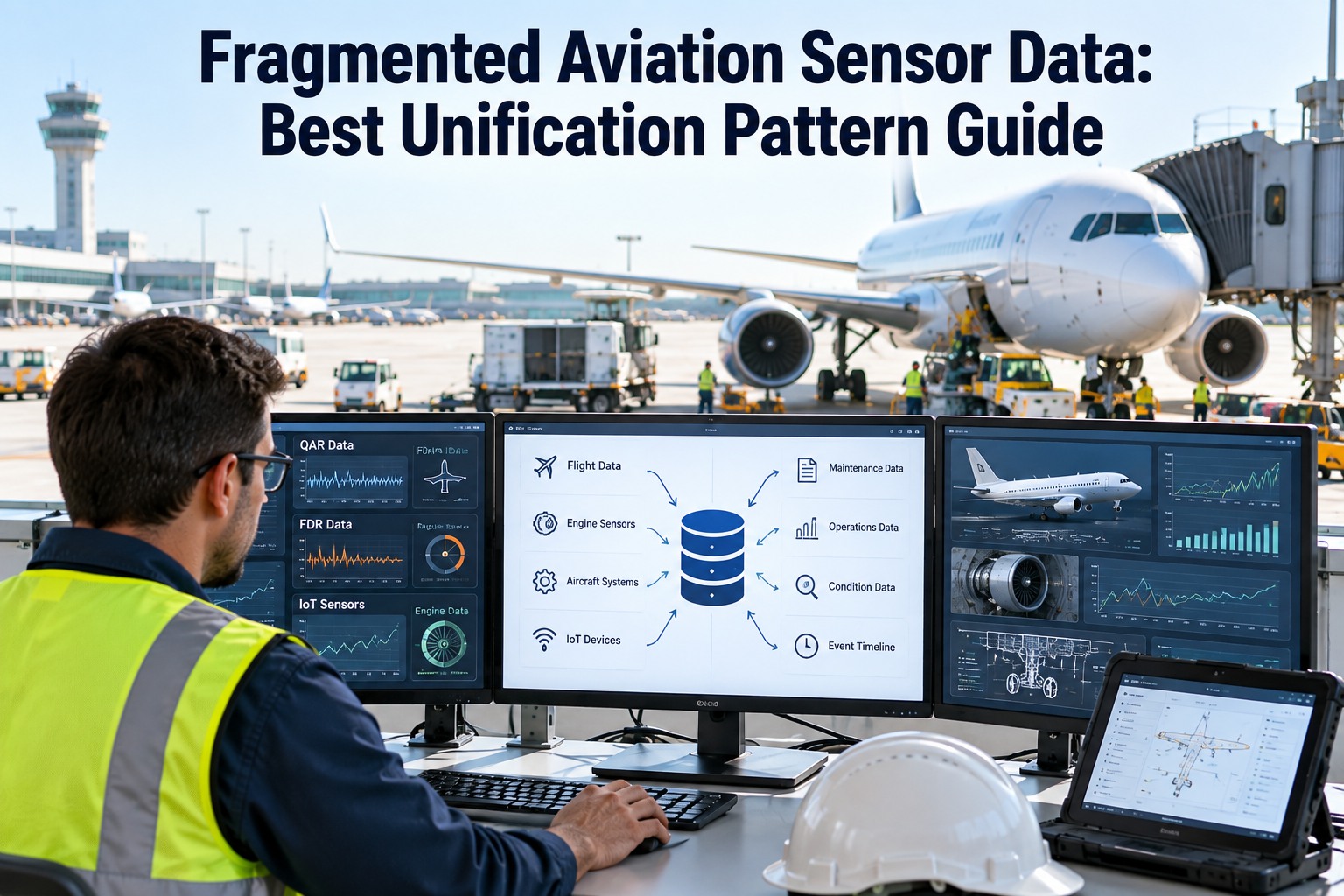
An engineer chasing an intermittent fault has to open five systems: the QAR download, the engine health monitor, the IoT condition feed, the inspection reports and the work-order history — then correlate them by hand, hoping the timestamps line up. That manual stitching is why alerts get ignored, patterns get missed, and failures are caught after the fact instead of 300 hours before. The fix isn't more sensors; it's one timeline. OXMAINT AI is AI-powered maintenance management software (CMMS) that anchors every sensor reading, alert and maintenance event to a single per-tail timeline — the unified record an AI model can actually learn from. Book a demo to see fragmented data become one story.
Aviation MRO · Sensor Data Unification
Five Data Silos, One Aircraft — Give It One Timeline
Aviation drowns in data and starves for insight because the streams never meet: QAR, engine EHM, IoT sensors, inspections and CMMS records all live apart. OXMAINT AI unifies them onto a single timeline per asset — same tail, same clock — so an engineer, and a predictive model, sees the whole story instead of five fragments.
- 1Collect every stream
- 2Align to one asset
- 3Build one timeline
- 4Feed the model
The streams to merge
QAR / FDRpost-flight flight data
Engine EHMEGT, vibration signals
IoT sensorsstructure, hydraulics, gear
CMMSwork orders, inspections, parts
Different formats, different clocks — until a common asset ID and timestamp bring them together.
What Fragmentation Actually Costs
Siloed data doesn't just slow engineers down — it actively hides the signal. These are the three failures that follow when the streams stay apart. Start a free trial to end the manual correlation.
Alert overload
Without context from other streams, false positives pile up — and engineers start dismissing warnings that matter.
Late detection
Calendar-based maintenance ignores actual condition, so a fault surfaces at inspection instead of hundreds of hours earlier.
Missed patterns
Fleet-level insight — like short-haul cycles accumulating fatigue faster — stays invisible when data never joins up.
The Unification Pattern, Layer by Layer
Merging aviation data isn't one step — it's a pipeline from the sensor on the airframe to the model that predicts failure. Here's the pattern OXMAINT AI plugs into. Book a demo to see the pipeline.
1
Perceive
Thousands of sensor points per aircraft plus engine and flight-data streams generate the raw signals.
2
Filter at the edge
Onboard concentrators reduce noise and bandwidth before anything is transmitted to the ground.
3
Connect & ingest
Standard interfaces — REST, GraphQL, OPC-UA, MQTT — carry structured and unstructured data into one platform.
4
Align to the asset
Every reading and record is keyed to a common asset ID and timestamp — the join that makes a timeline possible.
5
Act
Models read the unified timeline and push work orders, part requests and engineering notifications back to the CMMS.
Four-layer architecture and interface standards per aviation IoT-health-monitoring guidance (perception, edge, connectivity, application; REST/GraphQL/OPC-UA/MQTT). Source: OxMaint aviation IoT architecture guide.
See Every Signal on One Line
See how OXMAINT AI lands QAR, engine, IoT and maintenance events on a single per-tail timeline — so the correlation an engineer does by hand happens automatically.
One Asset, One Timeline: Why It Changes Everything
The unification pattern produces one thing that matters most: a single chronological record per aircraft where every stream lines up. That's what a model — and an engineer — can finally reason over. Start a free trial to build the timeline.
QARExceedance logged post-flight
EHMEGT trending up over cycles
IoTVibration signature shifts
CMMSWork order raised & closed
On one timeline, an EGT drift, a vibration shift and a QAR exceedance that looked unrelated in five systems become one connected story — the pattern a model detects hundreds of hours before threshold.
What a Unified Timeline Unlocks
Once the data joins up, the payoff isn't abstract — it's faster detection, cleaner alerts and automation that actually works. These are the gains. Book a demo to see them on your fleet.
Earlier detection
Condition-based signals surface a developing fault long before a calendar check would.
Fewer false alerts
Cross-stream context filters the noise, so the warnings that remain are trusted.
Fault-to-work-order
A confirmed signal becomes a work order, part request and notification automatically.
Fleet-level insight
Patterns across tails and cycles become visible once every asset shares a structure.
Outcomes reflect unified-data predictive-maintenance guidance (earlier detection windows, reduced false positives, automated fault-to-work-order). Actual results depend on your data and models. Source: OxMaint aviation IoT guide.
How OXMAINT AI Unifies the Data
OXMAINT AI is maintenance management software that acts as the event layer — landing every sensor alert and maintenance record on one asset timeline, then turning model outputs back into work orders. Start a free trial to connect your first stream.
-
1
Ingest
Take QAR, engine, IoT and inspection data over standard interfaces into one platform.
-
2
Align
Key every reading and record to a common asset ID and timestamp per tail.
-
3
Timeline
Assemble one chronological record per aircraft that a model can learn from.
-
4
Automate
Turn a model's prediction into a work order, part request and engineering note.
Frequently Asked Questions
Why is aviation sensor data so fragmented?
Each source — QAR/FDR, engine EHM, IoT sensors, inspections, CMMS — was built for its own purpose and stored separately, forcing engineers to correlate by hand.
Start a free trial to join them.
What makes a unified timeline work?
A common asset ID and aligned timestamps, so every reading and record from every stream sits on the same chronological line for one aircraft.
Book a demo to see it.
Do I need to replace my existing systems?
No — the pattern ingests from your existing sources over standard interfaces like REST, OPC-UA and MQTT, and lands the events in one place rather than ripping anything out.
Start a free trial to connect them.
How does unified data improve prediction?
Models trained on one aligned timeline see cross-stream patterns a single feed can't, extending detection windows and cutting false positives.
Book a demo to explore it.
Where does the CMMS fit in the pipeline?
It's the event layer and the destination — maintenance records join the timeline, and the model's outputs come back as work orders, part requests and notifications.
Start a free trial to close the loop.
Turn Five Fragments Into One Story per Aircraft
Unify QAR, engine, IoT and maintenance data onto a single per-tail timeline — the record your engineers and your models can finally trust, on one platform.