A baggage carousel motor starts drawing 12% more power than usual. Three weeks later, it fails during the morning rush—stranding 2,400 bags and cascading delays across 47 flights. The repair costs $80,000. But the real damage? Passenger complaints that echo across social media for months. This scenario plays out at airports worldwide, yet it's entirely preventable. The motor was broadcasting its distress signal for weeks. The problem wasn't the equipment—it was that nobody was listening.
Predictive maintenance powered by IoT sensors and AI analytics changes this equation completely. Instead of waiting for failures, smart airports now detect problems weeks before they happen. A vibration pattern shifts by millimeters. Temperature readings drift upward. Power consumption creeps higher. Each signal tells a story—if you have the technology to hear it. The global IoT in aviation market reached $1.59 billion in 2024 and is growing at 21.7% CAGR, with aircraft health and predictive maintenance applications valued at $426 million. Forward-thinking airport operations teams are already capturing these benefits—schedule a demo to see how Oxmaint brings predictive intelligence to your maintenance operations.
The Predictive Maintenance Revolution
IoT + AI transforming airport operations worldwide
$9.5B
Aviation predictive maintenance market by 2034
35-50%
Reduction in unplanned maintenance events
92-98%
AI accuracy in detecting failures 30-90 days early
12-18 mo
Typical ROI achievement timeline
How Predictive Maintenance Actually Works
Traditional maintenance follows two flawed approaches: reactive (fix it when it breaks) or preventive (replace parts on a schedule regardless of condition). Both waste money. Reactive maintenance costs 3-5x more than planned repairs and causes operational chaos. Preventive maintenance replaces perfectly functional components simply because a calendar says so. Predictive maintenance takes a fundamentally different approach—it monitors actual equipment condition in real-time and uses AI to forecast exactly when intervention is needed.
The Predictive Maintenance Intelligence Cycle
1
Sense
IoT sensors continuously capture vibration, temperature, pressure, current draw, and acoustic signatures from critical equipment
2
Stream
Edge computing processes data locally for immediate anomaly detection while streaming to cloud platforms for deeper analysis
3
Analyze
Machine learning algorithms compare patterns against historical baselines and failure signatures to identify degradation trends
4
Predict
AI calculates Remaining Useful Life (RUL) for components and generates maintenance recommendations with confidence scores
5
Act
CMMS automatically generates work orders, schedules technicians, and orders parts—all before the failure occurs
The technology stack combines Industrial IoT sensors with cloud analytics platforms and integrated maintenance management systems. Research shows AI-assisted predictive maintenance can lower maintenance expenses by 20-30%, increase equipment availability by 15-25%, and reduce unplanned maintenance events by 35-50%. Advanced anomaly detection algorithms now achieve 92-98% accuracy in spotting potential component failures 30 to 90 days before they happen. Ready to bring this intelligence to your airport? Start your free Oxmaint trial and connect your first assets within minutes.
Critical Airport Systems for Predictive Monitoring
Not all airport equipment benefits equally from predictive maintenance. The highest-value targets share common characteristics: they're operationally critical, expensive to repair, and generate detectable degradation signatures before failure. McKinsey research confirms that airports should start with systems where breakdowns cause the most disruption—typically baggage handling and passenger lifts—then expand gradually.
High Priority
Baggage Handling Systems
Key Sensors:
Vibration, motor current, belt tension, temperature
Failure Impact:
Missed connections, manual sorting, airline penalties
Proven Results:
33% reduction in parts consumption at leading airports
High Priority
HVAC & Climate Control
Key Sensors:
Compressor vibration, refrigerant pressure, airflow rate
Failure Impact:
Passenger discomfort, retail revenue loss, health complaints
Proven Results:
Up to 30% energy reduction with optimized maintenance
High Priority
Escalators & Elevators
Key Sensors:
Motor vibration, speed variation, door sensor timing
Failure Impact:
Accessibility issues, passenger flow bottlenecks, safety risk
Proven Results:
40-60% fewer unexpected breakdowns reported
Medium Priority
Ground Support Equipment
Key Sensors:
Engine diagnostics, hydraulic pressure, battery health
Failure Impact:
Aircraft turnaround delays, ramp congestion
Proven Results:
Reduced emergency repairs and improved fleet utilization
Medium Priority
Runway & Airfield Lighting
Key Sensors:
Current monitoring, lumen output, circuit integrity
Failure Impact:
Runway closures, NOTAMs, flight diversions
Proven Results:
Proactive lamp replacement before luminosity drops
Medium Priority
Passenger Boarding Bridges
Key Sensors:
Hydraulic pressure, leveling sensors, drive motor current
Failure Impact:
Gate reassignments, boarding delays, passenger complaints
Proven Results:
Hydraulic leak detection days before visible symptoms
The IoT Sensor Technology Stack
Effective predictive maintenance requires the right sensors capturing the right data at the right frequency. Modern Industrial IoT sensors have become remarkably affordable—typically $0.10-$0.80 per unit—making comprehensive monitoring economically viable even for smaller airports. The key is matching sensor types to the failure modes you're trying to detect.
Essential Sensor Types for Airport Predictive Maintenance
Vibration Sensors
Detect bearing wear, imbalance, misalignment in rotating equipment. Critical for motors, conveyors, and HVAC compressors.
3-axis accelerometers | 0.1-10kHz range
Temperature Sensors
Monitor thermal anomalies indicating friction, electrical faults, or cooling system degradation.
RTD or thermocouple | ±0.1°C accuracy
Current Sensors
Track motor load patterns to identify mechanical binding, phase imbalance, or insulation breakdown.
Hall effect or CT | Real-time waveform
Pressure Sensors
Monitor hydraulic systems, pneumatic actuators, and refrigerant circuits for leak detection.
Piezoelectric | 0.25% FSO accuracy
Acoustic Sensors
Ultrasonic detection of air leaks, electrical arcing, and early-stage mechanical wear.
Ultrasonic 20-100kHz | dB measurement
Speed/Position Sensors
Track conveyor belt speed, escalator step timing, and door cycle times for deviation detection.
Encoder or proximity | ms resolution
Data connectivity options range from wired industrial protocols (Modbus, Profinet) to wireless solutions (LoRaWAN, NB-IoT, WiFi). Edge computing gateways process data locally for immediate anomaly detection while streaming aggregated data to cloud platforms. This hybrid architecture ensures critical alerts aren't delayed by network latency while enabling deep historical analysis in the cloud. Wondering which sensor configuration fits your facility? Book a consultation with our airport maintenance specialists.
Ready to Predict Equipment Failures Before They Happen?
Join airports worldwide using Oxmaint's AI-powered platform to transform reactive firefighting into proactive maintenance intelligence.
AI and Machine Learning: The Intelligence Layer
Raw sensor data is just noise without intelligence to interpret it. Machine learning algorithms transform continuous data streams into actionable maintenance insights by learning what "normal" looks like for each asset, then flagging deviations that predict impending failure. The most effective systems combine multiple AI approaches—anomaly detection for unknown failure modes, classification for known fault signatures, and regression models for remaining useful life prediction.
AI Techniques Powering Airport Predictive Maintenance
Anomaly Detection
Identifies unusual patterns that deviate from learned baselines—catching problems even when the specific failure mode has never been seen before
Detecting unusual vibration harmonics in a baggage conveyor motor 6 weeks before bearing failure
Classification Models
Categorizes sensor signatures into known fault types based on training data from historical failures
Recognizing the specific current draw pattern that indicates an escalator step chain requiring adjustment
RUL Prediction
Calculates Remaining Useful Life by modeling degradation curves and projecting time to failure threshold
Forecasting that an HVAC compressor will require replacement in 47 ± 5 days based on pressure trend analysis
Digital Twin Simulation
Creates virtual replicas of physical assets to simulate scenarios and optimize maintenance timing
Testing whether delaying a boarding bridge hydraulic service by 2 weeks increases failure risk beyond acceptable thresholds
Industry leaders are already proving these capabilities at scale. Delta's APEX program uses AI-powered predictive maintenance to achieve eight-figure annual savings and won Aviation Week's 2024 Innovation Award. EasyJet avoided 35 technical cancellations in a single month using Airbus's Skywise analytics platform. These aren't pilot programs—they're production systems delivering measurable ROI. The same AI capabilities that optimize aircraft engines can transform airport infrastructure maintenance.
Implementation Blueprint: From Pilot to Production
Successful predictive maintenance implementation follows a proven pattern: start small, prove value quickly, then scale systematically. Airports that try to instrument everything at once typically fail. Those that focus on high-impact systems first build momentum, expertise, and business cases for expansion.
Your 90-Day Predictive Maintenance Roadmap
Days 1-30
Foundation
Audit critical assets and historical failure data
Select 3-5 high-impact pilot systems
Define success metrics and ROI targets
Deploy CMMS platform with IoT integration
Days 31-60
Instrumentation
Install sensors on pilot assets
Configure data collection and transmission
Establish baseline performance profiles
Train maintenance team on new workflows
Days 61-90
Intelligence
Activate AI anomaly detection
Integrate alerts with work order system
Validate predictions against outcomes
Document ROI and plan expansion
Day 90+
Scale
Expand to additional asset categories
Refine AI models with accumulated data
Implement digital twin capabilities
Integrate with enterprise systems
The key success factor is choosing technology that integrates with your existing infrastructure. Equipment-agnostic platforms can monitor assets from multiple manufacturers without requiring equipment replacement. API-driven architectures connect predictive insights to your CMMS, automatically generating work orders when AI detects degradation patterns. This closed-loop integration is what transforms predictions into prevented failures. Want to discuss implementation for your specific environment? Schedule a technical consultation to map out your roadmap.
Measuring ROI: The Business Case for Predictive Maintenance
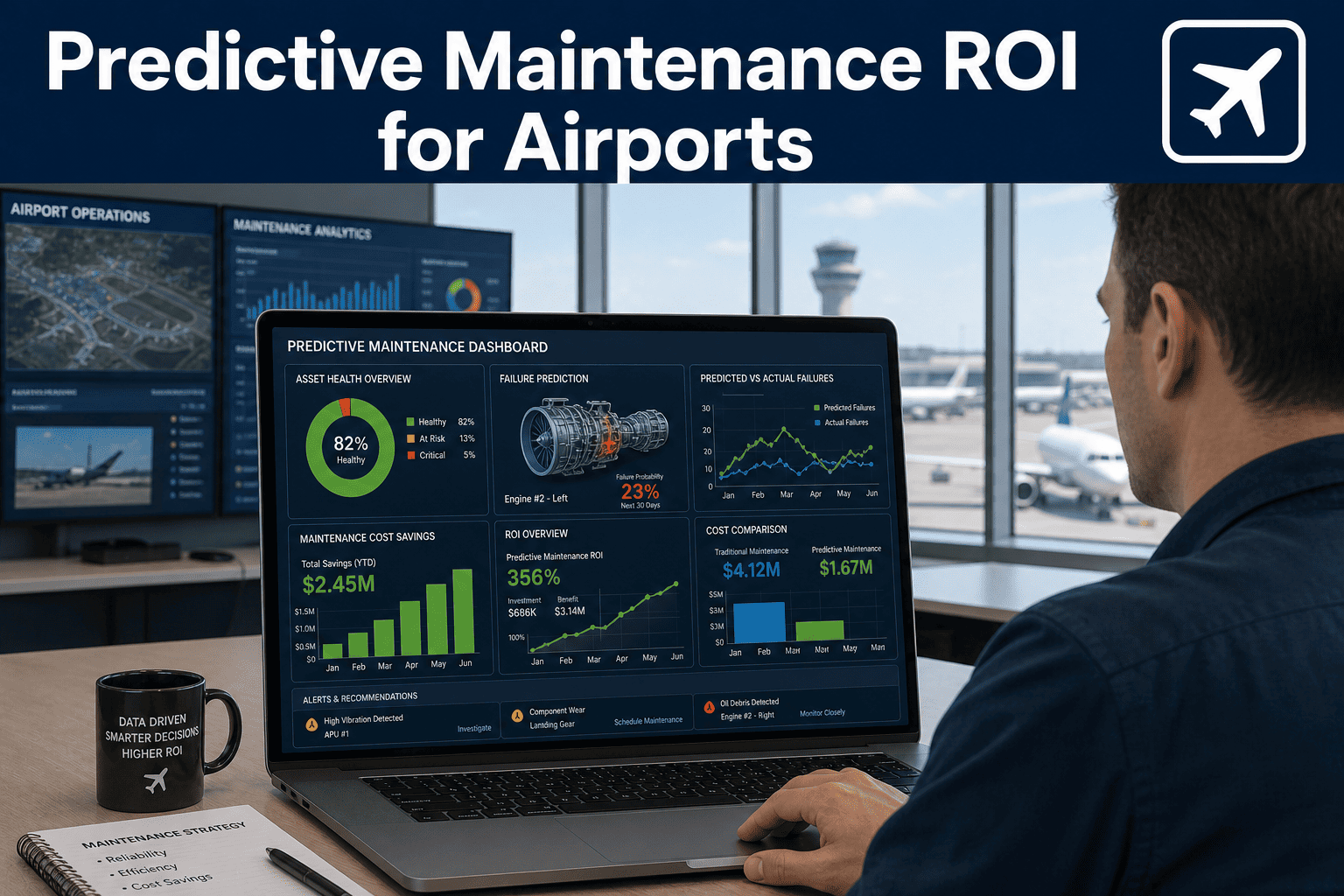
Predictive maintenance delivers returns across multiple dimensions—some immediately quantifiable, others building over time. McKinsey research indicates predictive maintenance can reduce maintenance costs by 18-25% while increasing equipment availability by 5-15%. Most airports see ROI within 12-18 months through reduced emergency repairs, extended asset lifecycles, and improved operational efficiency.
Predictive Maintenance ROI Framework
Direct Cost Savings
20-40%
Reduction in overall maintenance spend
70-90%
Fewer emergency repair callouts
33%
Reduction in spare parts consumption
Operational Improvements
40-60%
Fewer unexpected equipment breakdowns
15-25%
Increase in equipment availability
25-40%
Extended asset lifespan
Strategic Value
Enhanced
Passenger experience and satisfaction
Improved
Airline and tenant relationships
Strengthened
Regulatory compliance posture
One UK airport facility manager reported that predictive analytics flagged unusual power draw patterns in the main baggage hall—a pattern that historically preceded motor failures by 72 hours. Emergency replacement would have cost £80,000 plus passenger delays. Instead, scheduled repair during overnight maintenance window cost a fraction of that amount with zero operational impact. These stories repeat across every airport that implements intelligent maintenance. The question isn't whether predictive maintenance delivers ROI—it's how quickly you can capture it. Create your free Oxmaint account today and start building the business case with your own data.
Transform Your Airport Maintenance Strategy
Stop waiting for equipment to fail. Start predicting problems weeks in advance with Oxmaint's AI-powered predictive maintenance platform.
Frequently Asked Questions
What's the difference between predictive and preventive maintenance?
Preventive maintenance follows fixed schedules—replacing parts every X months regardless of actual condition. Predictive maintenance uses real-time sensor data and AI analytics to determine actual equipment health, triggering maintenance only when degradation patterns indicate it's truly needed. This approach eliminates both premature replacements and unexpected failures, optimizing maintenance spend while maximizing uptime.
How much does airport predictive maintenance implementation cost?
Initial setup costs vary based on facility size and scope, but IoT sensors now cost as little as $0.10-$0.80 per unit. Most airports see positive ROI within 12-18 months through reduced emergency repairs and improved efficiency. Starting with a focused pilot program on high-impact systems (baggage handling, HVAC, elevators) proves value before broader investment.
Can predictive maintenance work with equipment from different manufacturers?
Yes—modern equipment-agnostic platforms can monitor assets from multiple OEMs without requiring equipment replacement. The key is choosing a CMMS platform with open API architecture that integrates diverse sensor data streams into a unified analytics environment. This approach protects existing infrastructure investments while enabling predictive capabilities.
How accurate is AI at predicting equipment failures?
Research shows advanced anomaly detection algorithms achieve 92-98% accuracy in identifying potential component failures 30-90 days before they occur. Accuracy improves over time as machine learning models accumulate operational data specific to your equipment and environment. Even early-stage implementations typically catch the most costly failure modes.
What airport systems should we prioritize for predictive maintenance?
Start with operationally critical systems where failures cause maximum disruption: baggage handling conveyors, passenger elevators and escalators, HVAC systems, and ground support equipment. These assets typically have clear degradation signatures, high repair costs, and significant operational impact when they fail—making ROI easy to demonstrate and quick to achieve.