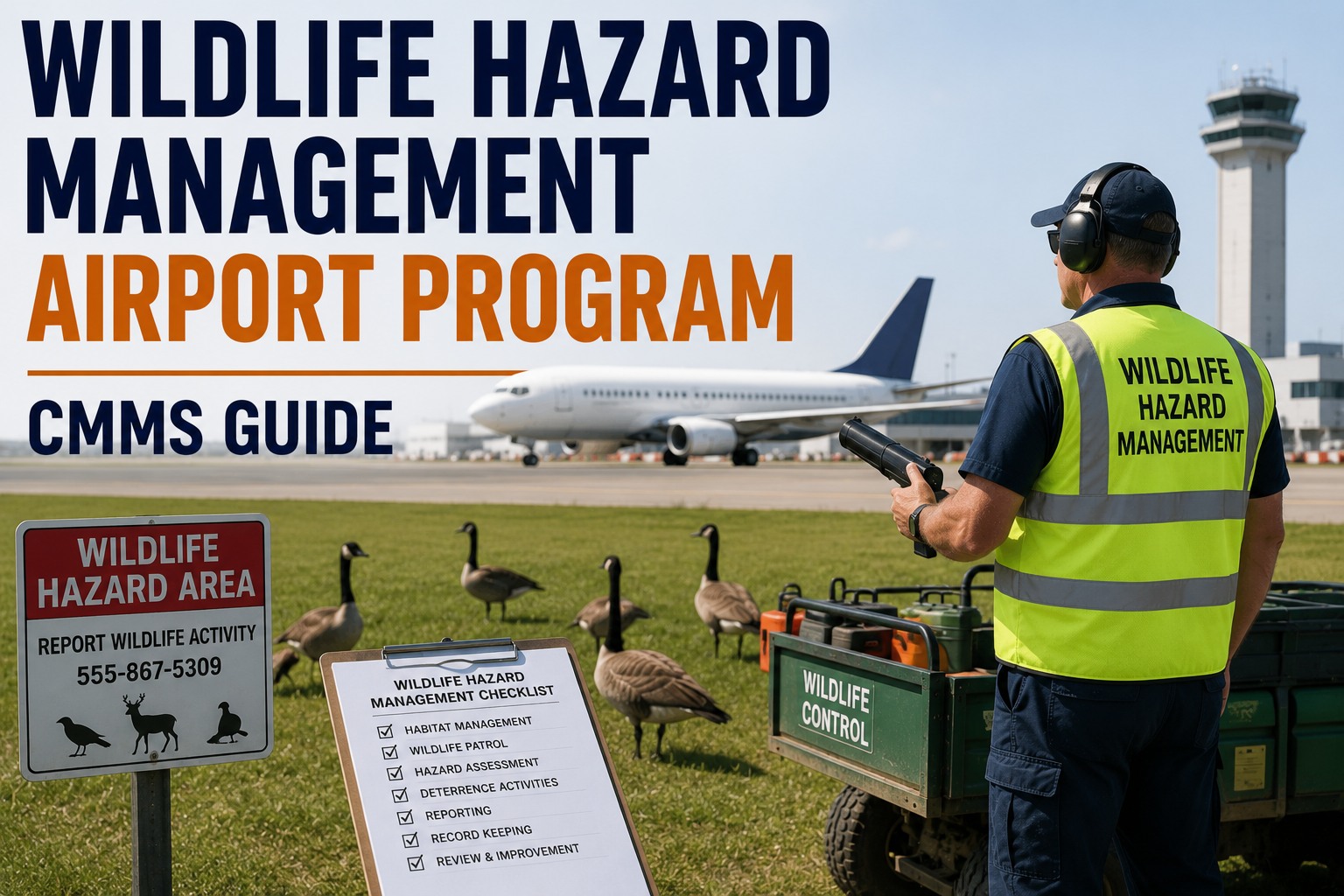
Wildlife strikes cost the global aviation industry over $1 billion annually, with a single serious bird strike on a widebody engine routinely exceeding $5 million in engine damage, AOG time, and passenger disruption. For airport operations and maintenance leaders, the difference between a manageable incident and a catastrophic one comes down to how rigorously your Wildlife Hazard Management Program is documented, tracked, and improved. FAA Advisory Circular 150/5200-38 expects every certificated airport to maintain strike reporting, habitat modification records, and dispersal equipment maintenance in a single, auditable system — and that is precisely where a CMMS built for aviation earns its keep. Explore the guide below, then Start Free Trial to see how oxmaint operationalizes every record in your WHMP.
Is your wildlife hazard program audit-ready — or just audit-hoping?
FAA AC 150/5200-38 expects closed-loop records from strike to deterrent PM in one traceable system. A purpose-built CMMS turns scattered logs, paper strike forms, and missed pyrotechnic inspections into a single auditable wildlife hazard trail — and it pays for itself the first time it prevents one serious engine ingestion event.
Four records every WHMP inspection asks for — and how most airports lose them
A 2024 FAA compliance sampling review found that nearly 60% of Part 139 wildlife hazard findings traced back to missing or unverifiable records — not missing field activity. The activity was happening; the documentation was not surviving the next inspection cycle.
Five modules that close the wildlife hazard loop end-to-end
Each module below maps to an explicit FAA AC 150/5200-38 expectation. A CMMS that ties them together — rather than five spreadsheets — is what transforms a paper WHMP into a live, defensible program.
From spreadsheet chaos to audit-ready WHMP in one annual cycle
A mid-sized Part 139 hub with 18,000 operations per month typically completes full WHMP digitization inside a single annual review window. Here is the realistic month-by-month rollout.
Import the last 24 months of strike logs, existing WHMP, equipment inventory, and habitat maps. Most airports recover 80% of historical records in the first 30 days.
Pyrotechnic launcher inspection, propane cannon fuel cycle, bioacoustic speaker test, and mowing rotations configured as recurring PMs with automated work-order generation.
Operations and ARFF staff begin filing Form 5200-7 from the field. Average reporting latency drops from 14 days to under 24 hours, and NWSD submission completeness exceeds 95%.
Strike heat-maps cross-referenced with deterrent deployment and habitat work orders reveal which zones are over- or under-serviced — guiding the next WHMP update with data, not instinct.
Assessment triggers fire automatically. The inspector packet assembles in a single click — strikes, PMs, habitat logs, training certs — turning a two-day scramble into a 20-minute export.
A 180-asset regional hub: from 11 paper logs to a closed-loop WHMP in one cycle
- Strike reports on paper Form 5200-7, filed in a binder — 11 of 27 strikes in 12 months never made it to the NWSD
- Two propane cannons and one bioacoustic unit out of service at any given time, with no PM visibility
- Habitat modification logged in three separate spreadsheets owned by three different departments
- Annual WHMP review required 36 staff-hours of manual report assembly across two weeks
- 100% of strikes captured digitally; 98% submitted to NWSD within 48 hours, with photo and species metadata
- Dispersal equipment availability above 94% — no cannon or launcher downtime during active wildlife events
- Habitat, deterrent, and strike data unified into one auditable record per airfield zone
- Annual review packet assembles in 22 minutes; staff time redirected from paperwork to active deterrence
What FAA AC 150/5200-38 expects vs what a CMMS delivers
| AC 150/5200-38 Expectation | Typical Manual Reality | CMMS-Enabled WHMP |
|---|---|---|
| Prompt strike reporting to NWSD | Paper forms, 7–30 day lag, ~40% loss rate | Mobile Form 5200-7, auto-submit, under 48 hrs, >95% capture |
| Wildlife hazard assessment every 12 months | Calendar reminder, often missed or backdated | Auto-triggered work order with linked prior-year data |
| Habitat modification documentation | Scattered spreadsheets, no GPS or photo proof | Recurring PMs with coordinates, photos, and sign-off |
| Dispersal equipment readiness | Breakdown-driven, reactive maintenance | Firing-cycle PMs, shelf-life alerts, >90% availability |
| Inspector-ready record packet | 36+ staff-hours, pulled from 4–5 systems | One-click assembly, 15–25 minutes, fully timestamped |
| Training records for WHMP personnel | PDFs in HR, not linked to wildlife activity | Cert expiry alerts tied to dispersal work-order authorization |
Turn next month's FAA review from a two-week scramble into a 20-minute export
Deploy a CMMS that treats every strike, deterrent, and habitat record as part of one auditable wildlife hazard trail.
Wildlife hazard management & CMMS — what airport teams ask first
No. The biologist owns the scientific plan and the Wildlife Hazard Assessment. The CMMS is the operational backbone that executes, documents, and proves the plan is being followed — strike by strike, PM by PM, habitat task by habitat task. It makes the biologist's recommendations auditable rather than aspirational.
Most mid-sized Part 139 airports recover 70–80% of historical strike and habitat records within the first 30 days through a guided import template. You can Start Free Trial and use the built-in strike-import wizard to bring in the last 24 months before your next FAA inspection window.
Yes, when the form is built for the runway — not the office. A mobile-optimized Form 5200-7 with species dropdowns, photo capture, and offline sync takes under 90 seconds to complete, compared to 10+ minutes on paper. Airports see reporting capture rates jump from roughly 60% to over 95% within the first quarter.
Absolutely. Dispersal equipment lives in the asset register with firing-cycle PMs, fuel-level checks, and regulatory shelf-life alerts for pyrotechnics. A failed PM automatically raises a work order and flags the equipment as unavailable, so operations never dispatch a team to a non-functional cannon.
The inspector packet — strikes, NWSD confirmations, deterrent logs, habitat modifications, equipment PMs, and training records — assembles in a single click with full timestamps and photo evidence. Book a Book a Demo session to see the one-click inspector export run on a live airport dataset.
One avoided engine ingestion repays three years of CMMS subscription
Deploy a wildlife hazard management system that turns every strike, deterrent, and habitat record into defensible, audit-ready evidence.
Free 14-day trial · No credit card