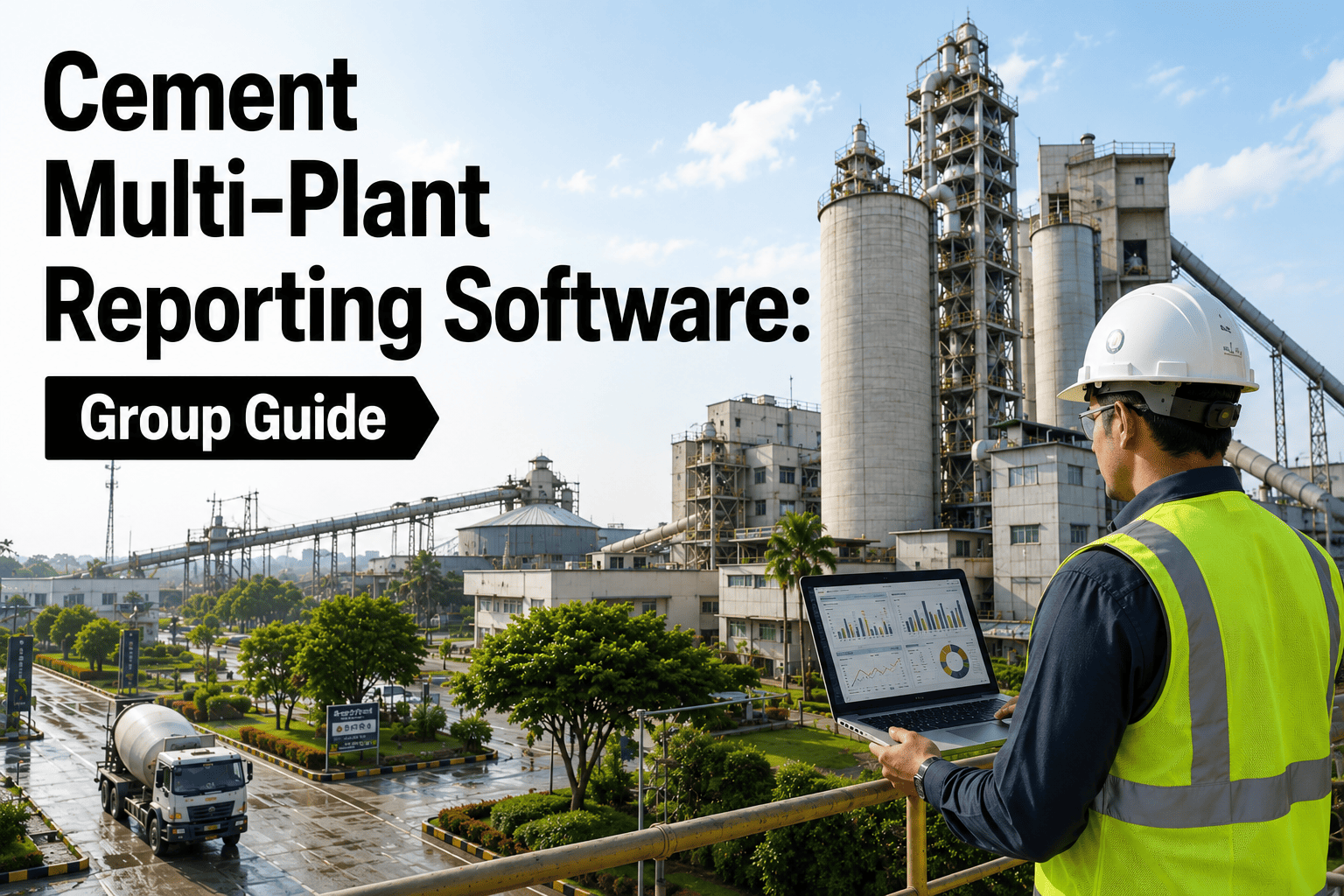
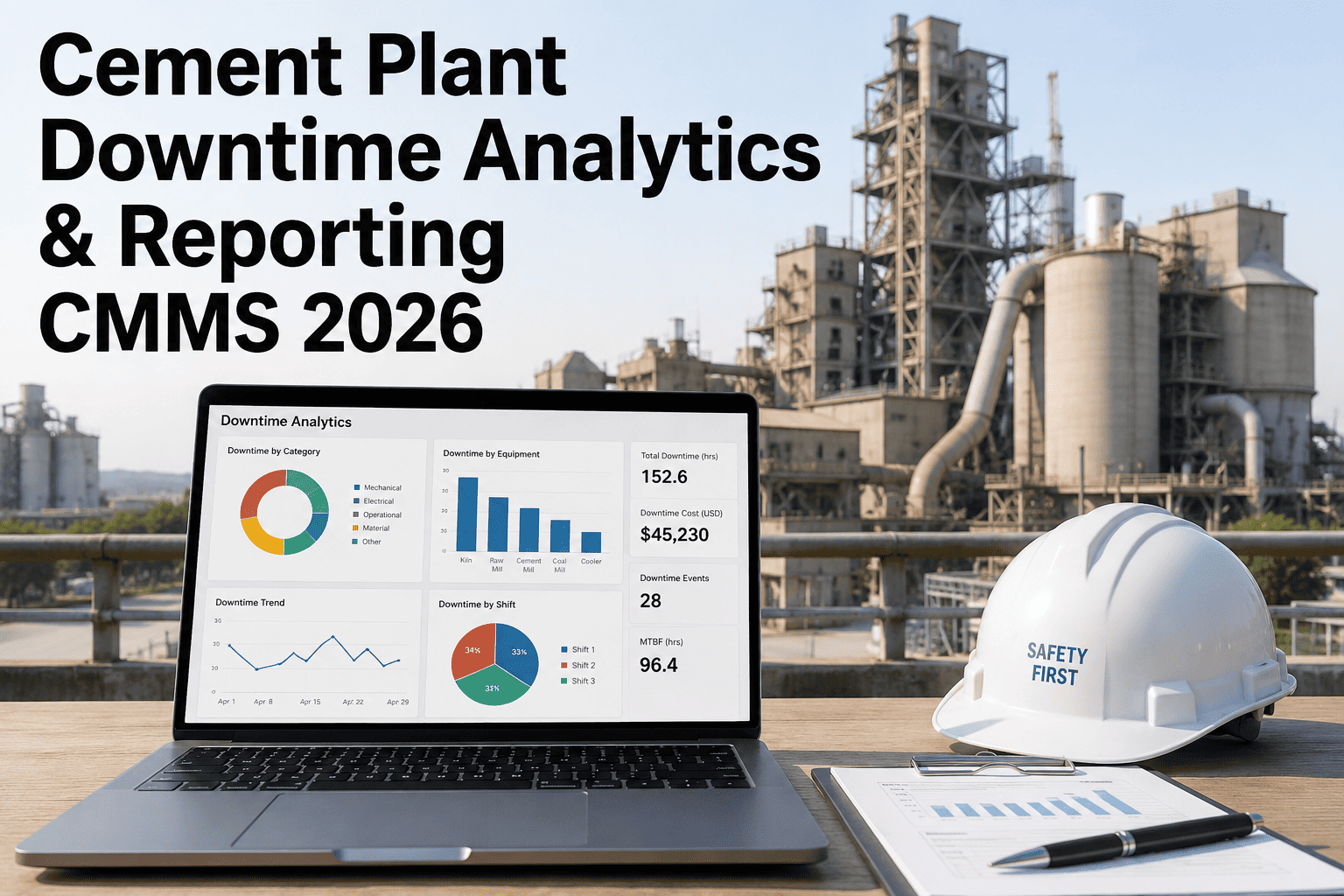
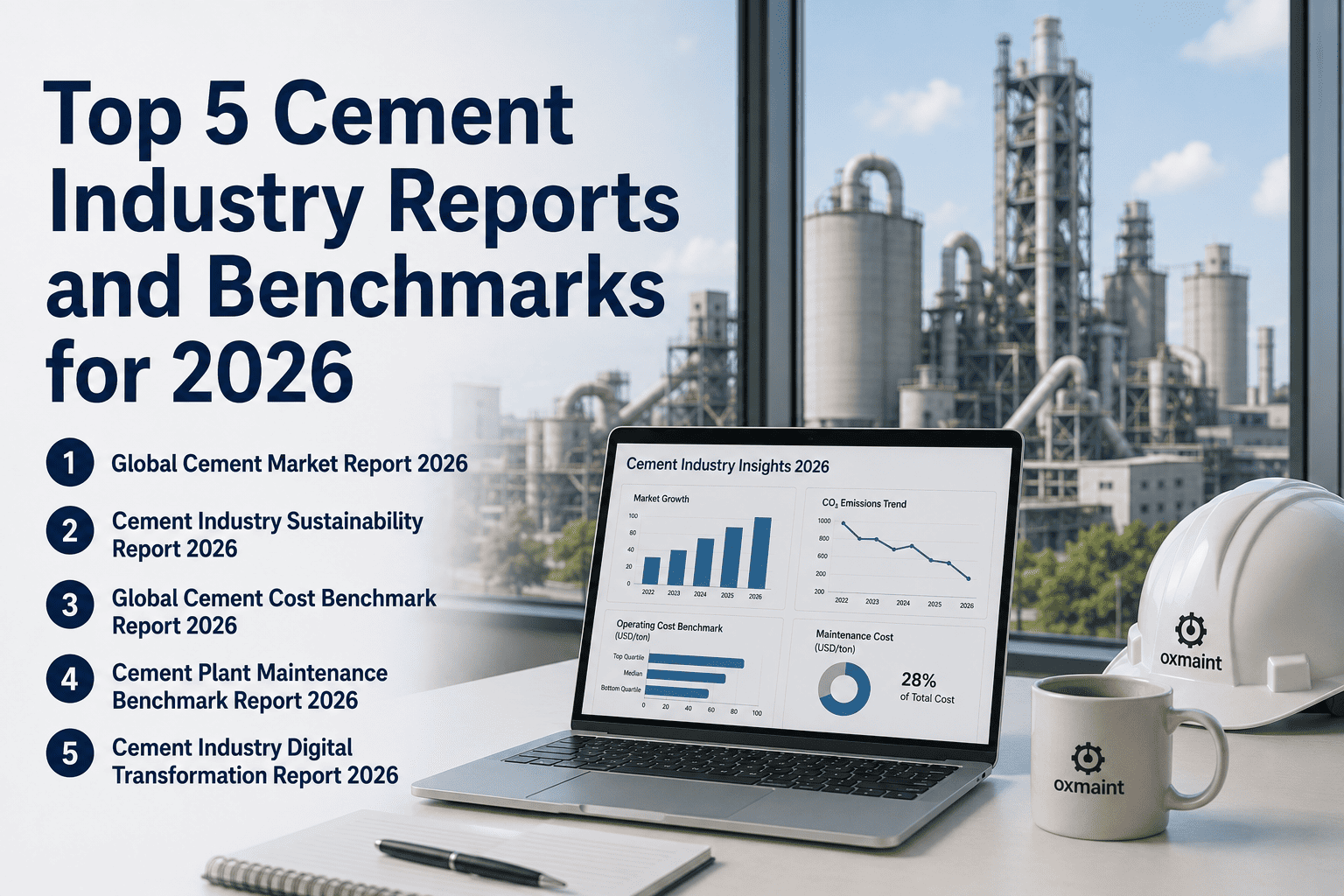
Cement plant maintenance teams in 2026 are drowning in data — kiln temperatures, mill vibration logs, conveyor sensor feeds, work order histories, compliance checklists — yet most plants still spend 15 to 20 hours every week manually compiling this data into reports that are outdated the moment they are printed. Sign in to OxMaint to see how AI-powered CMMS reporting turns your real-time plant data into board-ready KPI dashboards, audit-ready compliance summaries, and shift handover reports generated automatically — or book a demo to walk through a live cement plant reporting configuration built on your actual equipment register.
AI-Powered CMMS Reporting · Cement Industry
Stop Writing Maintenance Reports. Let AI Generate Them.
Cement plants running OxMaint eliminate 15–20 hours of weekly manual reporting. AI pulls live plant data to auto-generate KPI dashboards, compliance summaries, and board reports — accurate, instant, and always inspection-ready.
15–20 hrs
saved per week on manual reporting
40%
reduction in unplanned downtime reported
Real-Time
KPI dashboards — no manual data pull
100%
audit-trail completeness on every report
The Reporting Problem Every Cement Plant Knows
A maintenance manager at a 2-kiln plant typically spends two to three hours every morning pulling numbers from SCADA, spreadsheets, and paper logs to build a daily shift report. Weekly KPI summaries take half a day. Monthly compliance reports for leadership take longer. The problem is not a lack of data — cement plants generate enormous volumes of sensor data, work order records, and inspection logs every single day. The problem is that extracting, formatting, and verifying that data manually is slow, error-prone, and pulls your best engineers away from actual plant reliability work.
01
Data Lives in Silos
SCADA shows process data. The CMMS holds work orders. Calibration records sit in spreadsheets. Shift logs are on paper. No single system connects them — so every report is a manual assembly job across four or five sources.
02
Reports Are Always Stale
By the time a weekly KPI report reaches the plant director, the data in it is five days old. Decisions made on stale reports — on downtime trends, PM compliance, or equipment health — are decisions made with incomplete information.
03
Audit Preparation Takes Days
When an auditor or regulator asks for six months of maintenance compliance records, someone spends two to three days manually pulling records, verifying completeness, and assembling a dossier. This is entirely avoidable.
04
Manual = Inconsistent
Different engineers format reports differently. Definitions of "on-time PM" vary by team. A downtime event classified one way in week one is classified differently in week four. AI-generated reports apply the same logic every time.
OxMaint Generates Your Reports. Your Team Runs the Plant.
AI-powered CMMS reporting built specifically for cement manufacturing — KPI dashboards, compliance summaries, shift reports, and board presentations generated automatically from live plant data.
What AI Report Automation Actually Looks Like in a Cement Plant
OxMaint connects directly to your existing SCADA, DCS, IoT sensors, and work order system. Every data point — kiln uptime, mill vibration alerts, PM completion rates, work order backlog, calibration status — is ingested continuously. When a report is due, AI assembles it from verified live data. No manual data entry. No copy-paste errors. No waiting.
1
Data Ingestion
SCADA, DCS, IoT sensors, work orders, and calibration records feed into OxMaint continuously via OPC-UA, Modbus, and REST API — no manual export required.
2
AI Analysis
Machine learning models classify equipment health, calculate KPIs (MTTR, MTBF, OEE, PM compliance), flag anomalies, and rank asset risk — all in real time.
3
Report Generation
Reports are generated on schedule — daily shift handovers, weekly KPI summaries, monthly board packs, compliance audit logs — or on demand in seconds.
4
Delivery and Action
Reports delivered to the right person — plant director, maintenance manager, auditor — with full drill-down access to underlying work orders, sensor data, and records.
Report Types OxMaint Automates for Cement Plants
Every report type that currently requires manual assembly in your plant can be automated. The following are the highest-impact reporting workflows OxMaint delivers out of the box for cement manufacturing operations.
Daily
Shift Handover Report
Auto-generated at end of each shift: open work orders, completed PMs, equipment health alerts, active breakdowns, and pending actions — formatted for incoming shift team without any manual input from outgoing engineers.
Saves 45 min per shift
Weekly
KPI Performance Dashboard
MTTR, MTBF, OEE, PM compliance rate, work order backlog, emergency vs planned work ratio — calculated from live data and visualised in a consistent format every Monday morning for the maintenance manager.
Saves 4–6 hrs per week
Monthly
Board-Ready Executive Summary
High-level maintenance spend analysis, downtime cost impact, asset reliability trends, and maintenance budget vs actual — formatted for plant director or board presentation without the analyst-hours usually required.
Saves 8–10 hrs per month
On Demand
Compliance Audit Log
Complete maintenance compliance dossier — PM execution records, calibration certificates, work order history, inspection sign-offs — assembled in seconds for any date range. Inspection-ready at all times, not just before audits.
Saves 2–3 days per audit cycle
Predictive
Asset Health Forecast Report
AI-generated remaining useful life estimates for critical cement plant assets — kilns, mills, ID fans, crushers — with recommended maintenance windows and spare parts pre-positioning requirements for the next 4, 8, and 12 weeks.
Prevents emergency shutdowns
Continuous
Energy and Emissions Tracking
kWh consumption per tonne, fuel efficiency trends, CO2 per tonne of clinker — tracked continuously and reported automatically. Supports ESG compliance reporting and sustainability targets without additional data collection effort.
Supports ESG and audit compliance
KPI Benchmarks — What Good Looks Like in Cement Maintenance
Before you can improve maintenance performance, you need to measure it consistently. The table below shows the KPIs OxMaint tracks automatically for cement plants, with industry benchmark ranges to evaluate your current position. Sign in to OxMaint to see your plant's current KPIs calculated from live data.
Scroll to view full table →
| KPI |
Definition |
Industry Average |
Top-Quartile Target |
OxMaint Tracks |
| Kiln Availability |
% of scheduled production time kiln is operational |
91.3% |
96%+ |
Real-time, per shift |
| PM Compliance Rate |
% of planned PMs completed on schedule |
60–70% |
95%+ |
Auto-calculated daily |
| MTTR (Mean Time to Repair) |
Average time from failure detection to restoration |
4.2 hours |
Under 2.5 hours |
Per asset, per failure type |
| MTBF (Mean Time Between Failures) |
Average operating time between unplanned failures |
Varies by asset class |
Trending upward month-on-month |
Per asset register |
| Emergency vs Planned Work Ratio |
% of work orders that are reactive vs scheduled |
55% emergency |
Under 20% emergency |
Weekly trend report |
| OEE (Overall Equipment Effectiveness) |
Availability × Performance × Quality |
65–75% |
85%+ |
Per production line |
| Maintenance Cost per Tonne |
Total maintenance spend ÷ tonnes produced |
Plant-specific baseline |
Declining year-on-year |
Monthly financial report |
Before and After: AI Report Automation in a Cement Plant
The contrast between manual reporting and AI-automated reporting is not incremental — it is structural. The following comparison shows what changes when a cement plant moves from spreadsheet-based manual reporting to OxMaint's AI-generated reporting system.
Maintenance manager spends 2–3 hours daily pulling data from SCADA, spreadsheets, and paper logs
Weekly KPI report takes half a day — and is already outdated when delivered
Audit preparation requires 2–3 days of manual record retrieval and dossier assembly
Different engineers define and calculate KPIs differently — no consistent baseline
Board reports rely on whoever has time to compile them — accuracy varies
Equipment failures surface in reports after they happen — no forward-looking data
Shift handover reports generated automatically at end of every shift — zero manual input
Live KPI dashboard refreshes continuously — plant director sees current numbers, not last week's
Compliance audit log assembled in seconds for any date range — always inspection-ready
AI applies the same definitions and calculations consistently across every report, every period
Monthly board pack generated automatically — no analyst-hours required, no accuracy trade-offs
AI asset health forecast reports surface failure risk 4–12 weeks before the failure occurs
How OxMaint Integrates with Your Existing Cement Plant Systems
AI report automation does not require replacing your existing plant technology. OxMaint connects to the systems you already have — SCADA, DCS, PLCs, IoT sensors, and ERP — through standard industrial protocols. Reporting AI sits on top of your infrastructure and draws on data that is already being generated, with no production disruption during deployment. Book a demo to see the integration architecture configured for your specific plant systems.
Process Data
Siemens SCADA · ABB DCS · Rockwell PLCs · Schneider Systems
OPC-UA · Modbus · PROFINET
Sensor Data
Vibration · Temperature · Current Draw · Pressure · Acoustic
MQTT · REST API · Direct IoT Ingestion
Enterprise Systems
SAP PM · Oracle EAM · Maximo · Custom ERP
REST API · Webhook · Bidirectional Sync
Field Records
Work Orders · Inspection Checklists · Calibration Records · PM Logs
Mobile App · Offline Capture · Auto-Sync
Frequently Asked Questions
How does AI maintenance report automation work in a cement plant?
OxMaint connects to your existing SCADA, DCS, IoT sensors, and work order system through standard industrial protocols (OPC-UA, Modbus, MQTT). The AI continuously ingests plant data — equipment health signals, work order completions, PM records, calibration logs — and applies pre-defined KPI calculations and reporting logic to generate reports automatically on schedule or on demand. Your maintenance team sets the report templates and delivery schedules once; from that point, reports generate without manual intervention.
Sign in to configure your first automated report in OxMaint.
How much time does AI report automation actually save a cement plant maintenance team?
Cement plants using OxMaint's automated reporting typically recover 15 to 20 hours per week that was previously spent on manual data collection, formatting, and report assembly. Daily shift handover reports save 45 minutes per shift. Weekly KPI summaries save 4 to 6 hours. Monthly board reports save 8 to 10 hours. Audit preparation — which previously took 2 to 3 days — is reduced to minutes.
Book a demo to calculate the time savings for your specific reporting workload.
Can OxMaint generate compliance reports for cement plant audits?
Yes. OxMaint maintains a complete, continuously updated audit trail of all maintenance activity — PM execution records, work order histories, calibration certificates, inspection sign-offs, and corrective action records. For any audit or regulatory inspection, a full compliance dossier can be assembled and exported for any date range in seconds. The records are complete, attributable, and formatted for audit review without any manual assembly required. This eliminates the 2 to 3 day audit preparation sprint that most cement plants currently accept as unavoidable.
Sign in to OxMaint to see the compliance reporting module.
Does implementing OxMaint require replacing our existing SCADA or DCS systems?
No. OxMaint integrates with Siemens, ABB, Rockwell, and Schneider SCADA and DCS systems through standard protocols including OPC-UA, Modbus, and PROFINET. The AI reporting layer sits on top of your existing operational technology — consuming data that is already being generated — without any replacement or disruption to proven production control infrastructure. Most cement plants are live with OxMaint's core reporting module within one to two weeks of integration setup.
Book a demo to review the integration architecture for your specific plant systems.
Your Cement Plant Data Is Already There. Let AI Turn It Into Reports.
OxMaint connects to your existing plant systems and generates shift handovers, KPI dashboards, compliance logs, and board reports automatically — saving 15 to 20 hours of manual reporting work every week, from day one.