Every cement plant that submits an ESG report or CDP questionnaire is making claims about its carbon intensity, energy performance, alternative fuel usage, and emissions compliance — and institutional investors, regulators, and rating agencies are now demanding the evidence behind those claims, not just the numbers. A clinker factor of 0.74 stated in an annual sustainability report is meaningless without the kiln operation records, fuel consumption logs, and clinker production data that verify it. An AFR substitution rate of 22 percent means nothing to a CDP reviewer without the fuel handling system maintenance records and quality logs that validate the figure. The maintenance CMMS is the most underutilized source of ESG evidence in the cement industry — yet it holds the operational data that directly underpins Scope 1 emissions calculations, energy performance indicators, and compliance audit trails. Oxmaint connects your maintenance records to your ESG disclosure workflow, transforming the data your maintenance team already captures into auditor-ready sustainability evidence. Start building your CMMS evidence layer in Oxmaint and connect maintenance to sustainability reporting from day one.
20%
CO2 per tonne clinker reduction targeted by cement industry under Paris Agreement commitments by 2030
2025
EU CSRD double-materiality ESG disclosure effective for large cement companies — including maintenance evidence
90%+
Of institutional cement investors now require verified ESG data as a condition of continued investment
0.838
Median tonne CO2 per tonne clinker — industry benchmark against which your plant's Scope 1 is measured
The Three Emissions Scopes — What Cement Plants Must Report
Cement's emissions profile is unique: Scope 1 dominates because calcination of limestone — the conversion of CaCO3 to CaO — releases CO2 as a chemical process, not a combustion by-product. This process emission cannot be eliminated by switching fuels. Understanding which scope covers which emission source is the foundation of a credible CDP response or CSRD disclosure.
Scope 1
Direct Emissions — Dominant for Cement
85–90% of total reported emissions
Process emissions from limestone calcination in the kiln — unavoidable, must be reported per tonne clinker
Fuel combustion emissions from kiln burner — coal, petcoke, AFR blends — calculated from fuel consumption records
On-site mobile equipment — quarry vehicles, loaders, plant transport fleet
CMMS Evidence Required: Fuel consumption work orders, kiln production logs, AFR handling system PM records, clinker production tonnages
Scope 2
Purchased Electricity Emissions
8–12% of total reported emissions
Grid electricity consumed by mills, fans, compressors, and auxiliary equipment
Calculated using market-based (energy certificates) or location-based (grid emission factor) method
Energy efficiency improvements that reduce kWh per tonne directly reduce Scope 2 intensity
CMMS Evidence Required: Submeter kWh records by circuit, energy PM completion records, compressor and mill efficiency trend data
Scope 3
Value Chain Emissions — Growing Requirement
Varies — upstream supply chain primary source
Purchased raw materials — limestone extraction, SCM procurement (fly ash, slag, gypsum)
Logistics — clinker and cement transport to distribution points
Downstream use of cement in concrete — increasingly required by SBTi-aligned reporters
CMMS Evidence Required: Clinker-to-cement ratio records, SCM substitution logs, procurement records for raw material suppliers
Maintenance Data as ESG Evidence
Your CMMS Already Holds the Data Your ESG Report Needs.
Oxmaint generates CSRD, GRI 302/303/305, and CDP-formatted report exports in hours from your maintenance work order history — with underlying records attached as audit documentation. No separate data collection. No manual reconciliation.
Five Key ESG Metrics — and the CMMS Records Behind Each
ESG ratings agencies and CDP reviewers are moving from accepting stated metrics to demanding primary source evidence. The table below maps the five most scrutinized cement ESG indicators to the specific CMMS and operational records that substantiate each one.
Clinker Factor
Ratio of clinker to total cementitious materials in finished cement — lower is better; drives Scope 1 intensity reduction
CMMS Evidence Needed
Kiln production logs per campaign, SCM intake records (fly ash, slag, pozzolan tonnages), cement mill production records showing clinker-to-cement ratio per batch. Oxmaint links these at asset level to generate reportable clinker factor trend data.
AFR Substitution Rate
Percentage of fossil fuel energy replaced by alternative fuels — targets above 20% are a leading industry decarbonisation indicator
CMMS Evidence Needed
AFR handling system PM records per kiln campaign, fuel quality analysis logs linked to work orders, fossil fuel consumption records to calculate displacement ratio. Records must cover the full fuel handling chain from intake to burner feed.
Energy Performance Indicator (EnPI)
Thermal and electrical energy per tonne of clinker or cement — the ISO 50001 core metric and a primary ESG indicator for energy-intensive industry
CMMS Evidence Needed
Submeter kWh records per production circuit (kiln drive, raw mill, cement mill), fuel consumption work orders with energy content data, clinker and cement production tonnages. Trend data showing EnPI improvement over consecutive years strengthens ESG narrative.
Particulate Emission Compliance
Bag filter and ESP inspection records converted to particulate emission compliance metrics — required by EPA, EU ETS, and national regulators
CMMS Evidence Needed
Bag filter PM completion records with differential pressure readings, ESP inspection and cleaning records, CEMS calibration logs, corrective work orders raised from emission exceedance events — all timestamped and linked to the specific stack or emission point.
Water Consumption Intensity
Specific water consumption per tonne of clinker — increasingly required in GRI 303 and CDP Water Security questionnaire responses
CMMS Evidence Needed
Water meter PM and calibration records, cooling tower water consumption logs, water treatment dosing records, effluent discharge sampling results. Closed-loop system PM records demonstrate water efficiency initiatives required by sustainability frameworks.
CDP and CSRD: What Cement Companies Must Disclose in 2026
CDP
CDP Climate Change Questionnaire
Scope 1 absolute emissions (tonne CO2e) with methodology disclosure
Scope 2 emissions — both market-based and location-based required
Emissions intensity metric (tCO2e per tonne cementitious product)
Reduction targets with base year, target year, and progress to date
Climate-related risk and opportunity assessment aligned to TCFD
Oxmaint supports: Scope 1 fuel consumption records, Scope 2 submeter kWh logs, clinker factor trend data for intensity calculation
CSRD
EU Corporate Sustainability Reporting Directive
Double materiality assessment — financial and impact materiality for climate, water, waste
ESRS E1 (climate change) — GHG emissions, transition plans, physical risk
ESRS E2 (pollution) — particulate emissions, stack compliance documentation
ESRS E3 (water) — consumption intensity, discharge quality, closed-loop performance
Third-party limited assurance on disclosed metrics — audit trail mandatory
Oxmaint supports: ESRS E1/E2/E3 metric exports with underlying work order evidence — auditor-ready with no manual preparation
GRI
GRI Standards Reporting
GRI 302 (Energy) — energy consumption within organization, intensity ratio, reduction initiatives
GRI 303 (Water) — withdrawals, discharge, consumption per source and quality
GRI 305 (Emissions) — Scope 1/2/3, emission intensity, reduction from base year
GRI 403 (Health and Safety) — work-related injuries, near misses, safety management
Oxmaint supports: All GRI 302, 303, and 305 metric generation from maintenance work order data and asset PM records
Frequently Asked Questions
Why does maintenance data matter for ESG reporting — isn't this an environmental team function?
Maintenance records are the primary source documents that verify the operational claims in ESG reports. A kiln burning AFR at 22 percent substitution exists only in data — fuel handling PM records, quality logs, and consumption work orders are what make that figure auditable. Poorly maintained equipment also produces higher emissions: a kiln with a fouled pre-heater burns 8 to 12 percent more fuel per tonne of clinker than a well-maintained one.
Connect your maintenance data to ESG reporting in Oxmaint.
What is the clinker factor and how does a CMMS help track it?
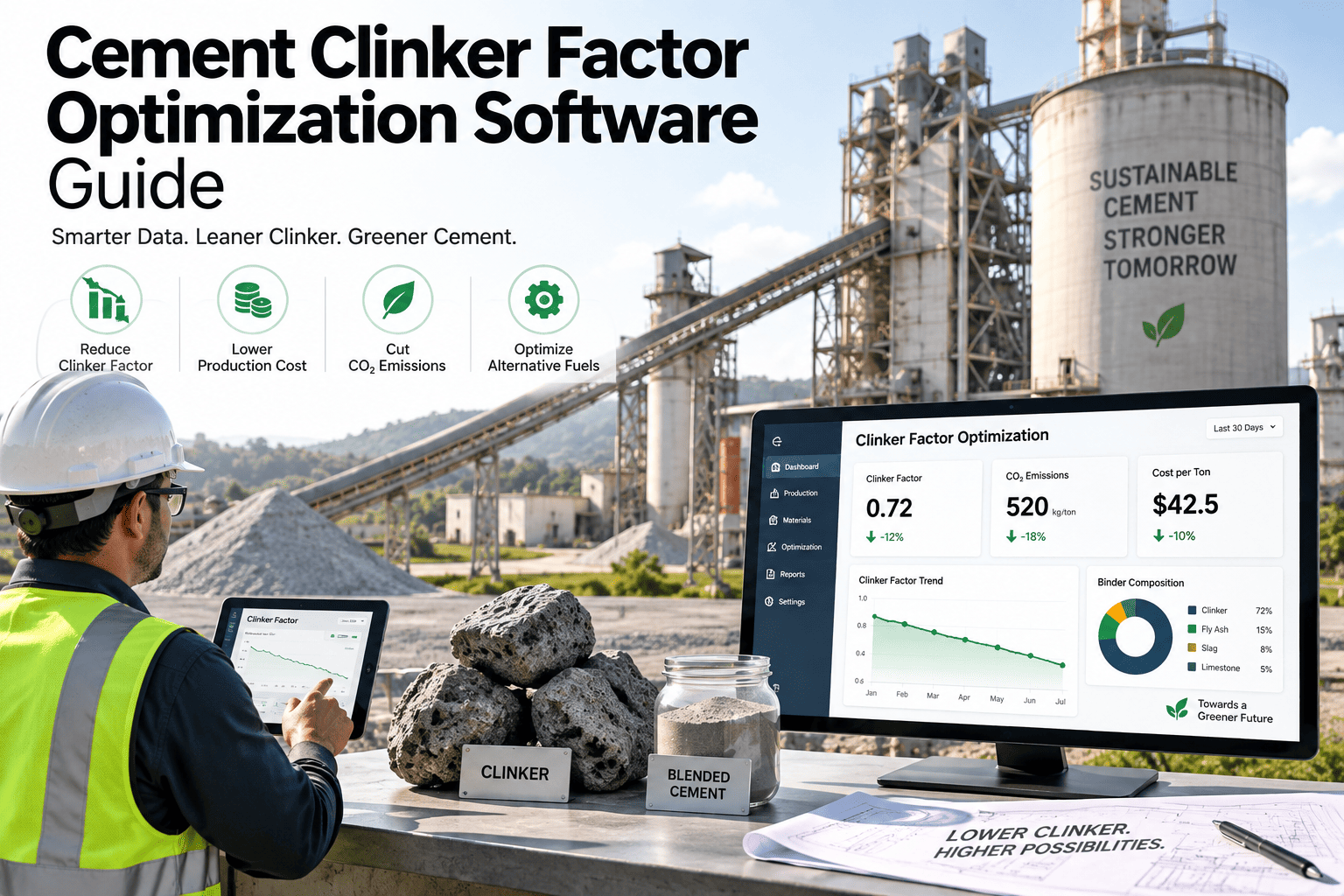
The clinker factor is the ratio of clinker to total cementitious materials in finished cement. Reducing it — by substituting fly ash, slag, or pozzolans — is the most accessible near-term decarbonisation lever for cement companies. Oxmaint tracks clinker production per kiln campaign, SCM intake tonnages, and cement mill production records to generate an auditable clinker factor trend over time — the exact format CDP and CSRD reviewers require.
Does Oxmaint generate ESG report exports in CDP or GRI format?
How does CSRD affect cement companies outside the EU?
CSRD applies to non-EU companies with significant EU operations or revenues — including cement exporters selling into Europe. Additionally, EU-based buyers of cement and concrete products are subject to CSRD and will cascade disclosure requirements down their supply chain. Even plants not directly covered by CSRD are increasingly being asked to provide verified ESG data by their customers. Starting CMMS-backed data collection now builds the evidence base regardless of which framework eventually applies.
What is the SBTi pathway for cement companies and how does maintenance relate to it?
The Science Based Targets initiative requires cement companies to reduce emissions intensity in line with Paris Agreement pathways — typically targeting a 20 percent or greater reduction in tCO2e per tonne cementitious product by 2030 versus a 2020 baseline. Maintenance programs that improve kiln thermal efficiency, reduce fuel consumption through PM, and support AFR substitution directly contribute to SBTi progress. Documented CMMS records provide the evidence of operational improvement that SBTi progress reports require.
Start documenting your efficiency improvements in Oxmaint today.
Oxmaint for Sustainability Teams
Your Kiln Fuel Records, Filter Logs, and Energy Data Are Already Your ESG Evidence.
Oxmaint connects your maintenance work orders to GRI 302/303/305, CDP climate questionnaire, and CSRD ESRS E1/E2/E3 metric exports — turning the data your maintenance team captures every day into audit-ready sustainability disclosures. No separate data collection. No manual reconciliation.