Cement strength is confirmed by testing mortar prisms at set ages, with 28 days as the classic reference. By the time that result arrives, the clinker, gypsum, and additives involved may already be in silos, bags, or trucks. Even faster lab checks such as fineness or chemistry can lag behind a mill that is drifting right now. AI-based quality control tries to shorten that loop by estimating strength from process and lab data early. This guide explains how it works, what it needs, and how equipment reliability tools such as Oxmaint maintenance software protect the data behind it.
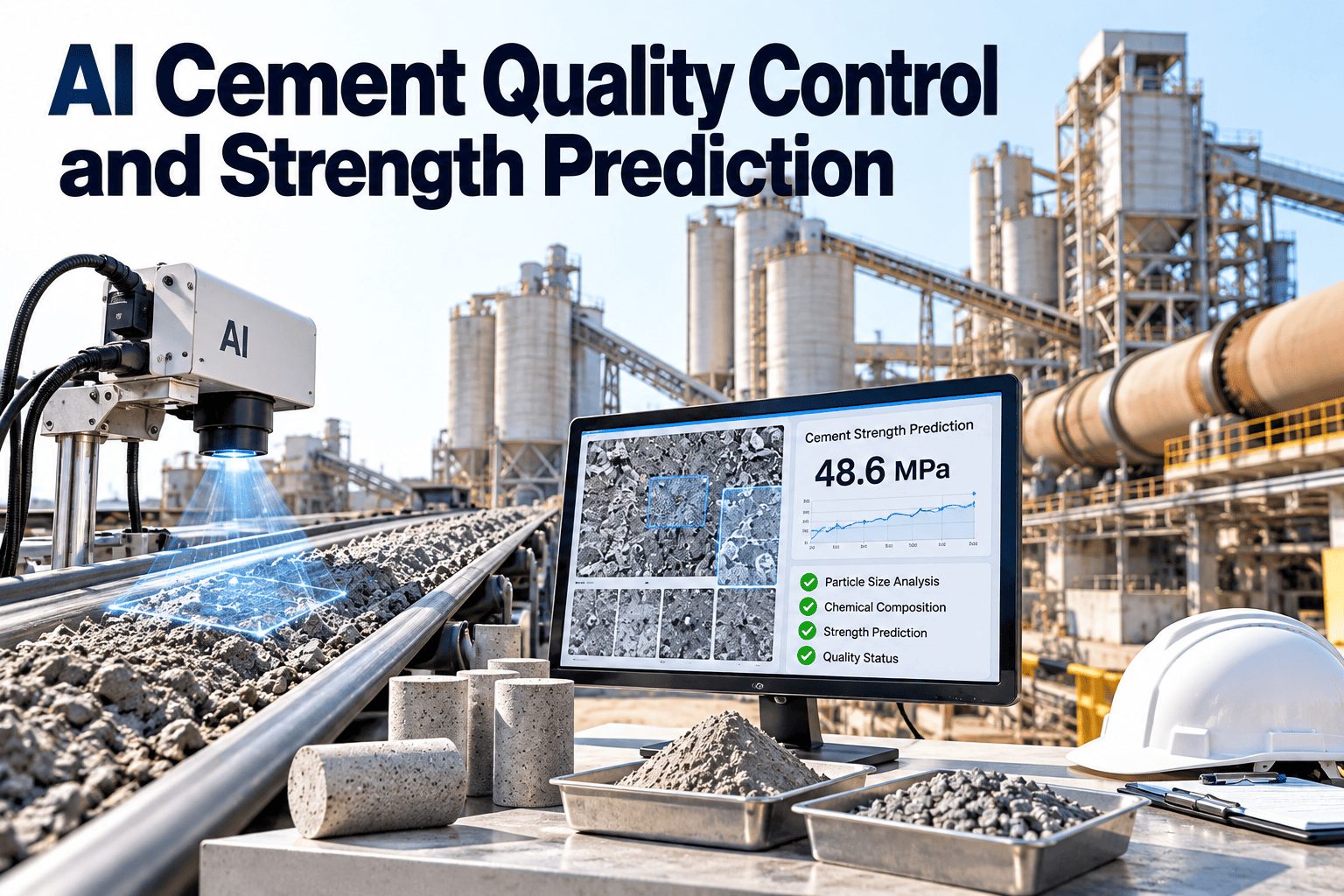
AI Cement Quality Control and Strength Prediction
Reduce the delay between production and lab feedback, and keep quality variation under control with better data and reliable equipment.
Why delayed lab feedback creates quality variation
Operators steer a mill and kiln in real time, but strength confirmation lives on a different clock. The mismatch produces three recurring problems.
Late correction
A drift in fineness, clinker quality, or additive dosage is only recognised after material has moved on.
Safety margins
Without timely feedback, plants may keep extra margin, which can raise clinker factor or grinding cost.
Hard root cause
Days later, it is difficult to link a strength dip to a specific mill, feeder, or shift condition.
What drives cement strength
Strength models learn from variables that plants already record. The table groups typical inputs and what they influence.
| Input group | Examples | Why it matters |
|---|---|---|
| Clinker quality | Phase composition, free lime, cooling history | Sets the strength potential of the cement |
| Grinding | Fineness, particle size distribution, mill outlet temperature | Affects reactivity and early strength |
| Set regulators | Gypsum dosage, sulphate level | Influences setting time and strength development |
| Additions | Limestone, slag, fly ash, dosage stability | Changes composition and later-age strength |
| Lab results | Early-age strength, chemistry, loss on ignition | Provides the ground truth for learning |
| Equipment state | Feeder accuracy, separator performance, sampler condition | Determines how trustworthy the data is |
How an AI strength prediction workflow operates
- 01
Collect
Process values, feed rates, and lab results are gathered with consistent timestamps.
- 02
Clean
Sensor gaps, calibration errors, and sampling mismatches are flagged or removed.
- 03
Learn
A model links inputs to measured strength for each cement type.
- 04
Estimate
New production data produces an early strength estimate with a confidence range.
- 05
Verify
Actual lab results are compared with estimates, and the model is retrained as needed.
Protect the equipment behind your quality data
Keep feeders, mills, samplers, and lab instruments inspected, calibrated, and documented in one system.
Quality control before and after predictive support
Lab-only feedback
- Corrections follow after the fact
- Variation is reviewed in monthly reports
- Deviations are traced by memory and paper logs
- Extra margin is used to feel safe
Lab plus predictive estimates
- Drift is spotted while production continues
- Trends are reviewed daily by shift
- Deviations link to equipment and process records
- Margins can be justified with data
Where maintenance and quality meet
A strength model is only as good as its inputs. Many quality problems begin as maintenance problems.
Quality and maintenance indicators to review together
Strength variability
Spread of results per cement type over time.
Prediction error
Gap between estimated and measured strength.
Lab turnaround
Time from sample collection to reported result.
Calibration compliance
Instruments and feeders calibrated on schedule.
Equipment-related deviations
Quality events linked to a maintenance cause.
Planned work share
Preventive tasks finished versus reactive repairs.
Checklist before starting a prediction project
- Define the target: early strength, 28-day strength, or setting time.
- Confirm sample timing and labelling are consistent.
- Check key sensors and feeders for calibration status.
- Record cement type and material changes with dates.
- Agree who reviews estimates and who can change settings.
- Plan a routine to compare estimates with lab results.
How Oxmaint supports quality-critical equipment
Oxmaint is a maintenance management platform. It supports the reliability and documentation side of quality, not the prediction model itself.
- Asset records for feeders, mills, separators, samplers, and lab instruments
- Preventive schedules for calibration, cleaning, and lubrication
- Mobile inspections with checklists and photos
- Corrective work orders when a quality-critical asset fails
- Compliance records and history for audits
- Reports on overdue tasks, downtime, and recurring faults
Quality and prediction questions
Can AI replace strength testing?
No. Lab tests remain the reference and are needed to train and check any model.
What data is needed first?
Reliable lab results, process data, and cement type records with matching timestamps.
Why involve maintenance?
Worn feeders and uncalibrated instruments create noisy data. Get started to organise calibration and inspections.
Does one model fit all cements?
Usually not. Cement types and compositions often need separate or tuned models.
Can we review a workflow together?
Yes. Book a demo to map quality-critical assets.
Build quality on reliable equipment and clean data
Organise calibration, inspections, and repairs for every asset that influences cement quality.