Cement supply chains face unique pressures: bulk materials with high transport costs, production that can't easily flex to demand changes, customers expecting just-in-time delivery, and thin margins that punish inefficiency. Traditional supply chain management—spreadsheets, experience-based decisions, reactive problem-solving—struggles to optimize across these competing demands. AI transforms this equation by processing vast amounts of data to predict demand, optimize logistics, and coordinate operations across the entire value chain.
Leading cement producers using AI-powered supply chains report 15-25% reductions in logistics costs, 20-40% improvements in delivery reliability, and significant working capital savings from optimized inventory. Intelligent supply chain platforms make these capabilities accessible without massive IT investments.
Why Cement Supply Chains Are Uniquely Complex
Heavy & Low-Value
Cement costs $100-150/ton but weighs a ton. Transport economics dominate—shipping 100km can add 20-30% to cost.
Inflexible Production
Kilns run 24/7. Can't easily ramp up or down. Production planning must look weeks ahead while demand shifts daily.
Perishable Product
Cement has shelf life limits. Stored too long, it absorbs moisture and loses strength. Inventory = risk.
Weather Dependent
Construction activity—and cement demand—swings with weather. Rain stops pours. Winter freezes markets.
Asset Intensive
Trucks, railcars, ships, terminals—capital tied up in logistics assets that must be utilized efficiently.
Multi-Modal
Road, rail, water, pipeline. Each mode has different economics. Optimal routing is a complex puzzle.
AI Applications Across the Cement Supply Chain
AI models analyze historical sales, construction permits, weather forecasts, economic indicators, and seasonal patterns to predict demand at granular levels—by product, region, customer, and time period.
Short-term (1-7 days)Daily dispatch planning, truck scheduling
Medium-term (1-3 months)Production planning, inventory positioning
Long-term (6-18 months)Capacity planning, capital investment
Typical improvement:30-50% reduction in forecast error
Coordinates kiln schedules, cement mill operation, and silo management with predicted demand. Optimizes which products to make when, balancing production efficiency against inventory costs and service levels.
Grade sequencingMinimize changeover costs between cement types
Silo optimizationRight product in right location at right time
Energy schedulingShift production to off-peak electricity periods
Typical improvement:10-20% reduction in production costs
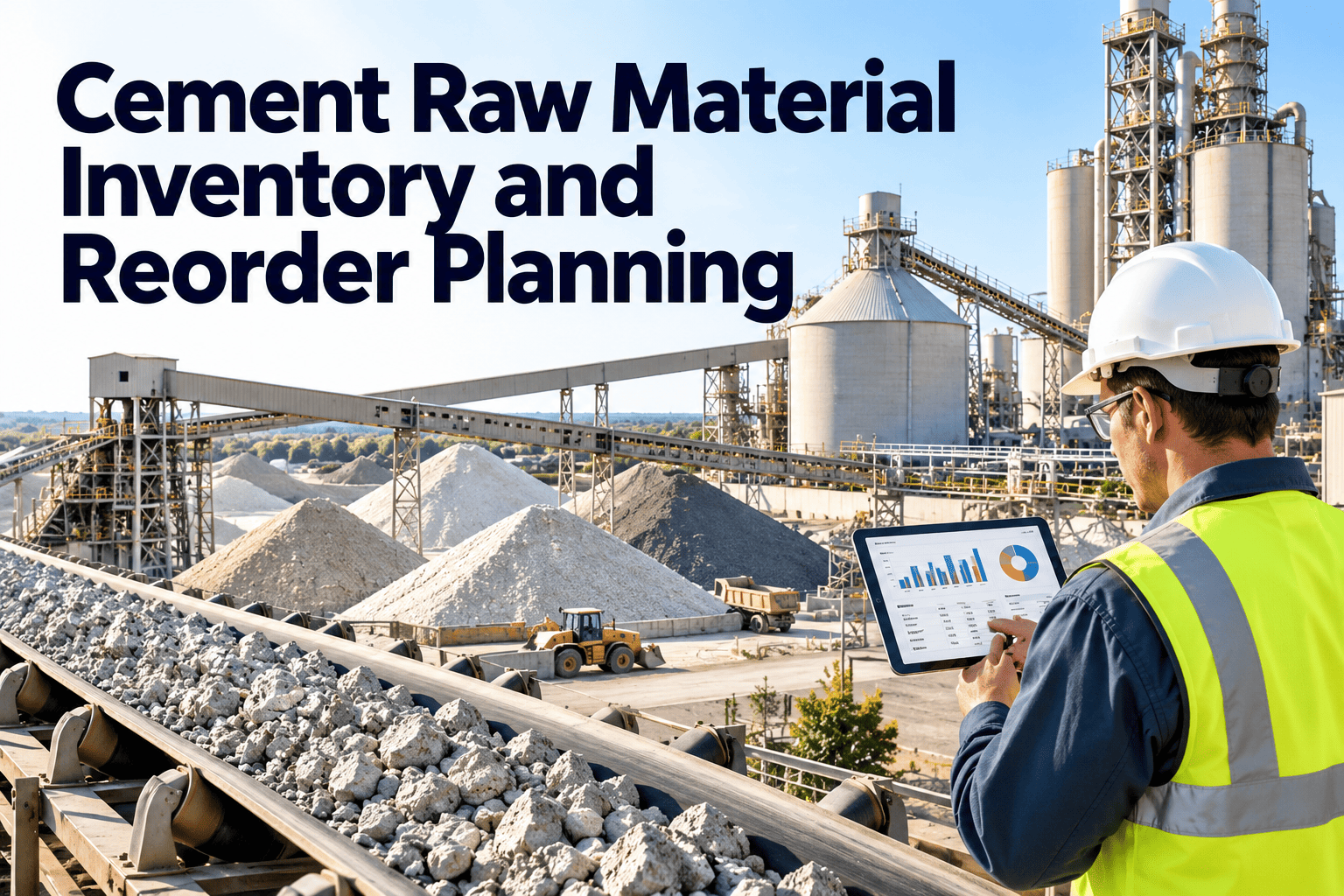
AI determines optimal stock levels across the network—plant silos, distribution terminals, customer sites. Balances service level targets against carrying costs and freshness requirements.
Safety stock calculationDynamic buffers based on demand variability
Network positioningWhere to hold inventory for best coverage
Age managementFIFO enforcement, freshness alerts
Typical improvement:15-25% reduction in working capital
Optimizes routing, scheduling, and mode selection for outbound deliveries. Considers truck capacity, driver hours, customer windows, traffic patterns, and cost per ton-km across transport options.
Route optimizationMinimize distance while meeting time windows
Load consolidationMaximize truck utilization, reduce trips
Mode selectionRoad vs rail vs water based on cost and time
Typical improvement:15-25% reduction in transport costs
AI-powered delivery tracking, accurate ETAs, proactive communication about delays. Self-service portals for order placement and modification. Predictive alerts when customers may need to reorder.
Real-time trackingGPS-based delivery visibility for customers
Smart orderingPredicted needs, one-click replenishment
Exception managementProactive alerts and resolution options
Typical improvement:20-40% improvement in OTIF
Optimize Your Cement Supply Chain
Oxmaint connects demand signals, production systems, and logistics operations—enabling AI-driven decisions across your supply chain.
Data Requirements for AI Supply Chain
Internal Data
Sales history2+ years, by product/customer/location
Order patternsLead times, order sizes, frequencies
Production dataOutput rates, changeovers, constraints
Inventory levelsReal-time across all locations
Logistics costsBy route, mode, carrier
External Data
Weather forecastsShort and medium term
Construction activityPermits, starts, project pipelines
Economic indicatorsGDP, housing starts, infrastructure spend
Traffic patternsReal-time and historical
Fuel pricesFor transport cost modeling
Implementation Approach
1
Foundation
Connect data sources, establish visibility
- Integrate ERP, TMS, WMS systems
- Deploy tracking on fleet
- Build unified data model
- Launch visibility dashboards
Timeline: 2-4 months
2
Analytics
Deploy forecasting and optimization models
- Train demand forecasting AI
- Implement inventory optimization
- Build route optimization
- Create exception alerts
Timeline: 3-6 months
3
Automation
Enable AI-driven decisions and actions
- Automated replenishment triggers
- Dynamic routing adjustments
- Predictive customer alerts
- Self-service customer portal
Timeline: 3-6 months
4
Expansion
Scale and continuously improve
- Extend to all product lines
- Add supplier integration
- Advanced scenario planning
- Continuous model refinement
Timeline: Ongoing
Measuring Supply Chain Performance
Forecast Accuracy
1 - |Actual - Forecast| / Actual
Target: >85%
OTIF (On-Time In-Full)
Orders delivered complete & on-time / Total orders
Target: >95%
Inventory Days
Average inventory / Daily sales
Target: <15 days
Transport Cost/Ton
Total logistics cost / Tons delivered
Target: Minimize
Truck Utilization
Actual load / Maximum capacity
Target: >90%
Perfect Order Rate
Orders without any issues / Total orders
Target: >90%
AI Supply Chain ROI
15-25%
Logistics cost reduction
20-30%
Inventory reduction
30-50%
Better forecast accuracy
Example: A 3 MTPA cement company with $50M annual logistics spend achieves 20% reduction = $10M annual savings. Implementation cost of $1-2M pays back in 2-3 months.
Transform Your Cement Supply Chain
From demand sensing to delivery optimization—Oxmaint brings AI-powered supply chain intelligence to cement manufacturers.
Frequently Asked Questions
How accurate can AI demand forecasting get for cement?
Well-implemented AI achieves 85-92% accuracy at weekly/regional level, compared to 60-70% for traditional methods. Accuracy improves with more data and is highest for stable, repeat customers. Project-based or spot sales remain harder to predict but AI still outperforms manual forecasting.
Can AI handle the seasonality in cement demand?
Yes—seasonality is where AI excels. Models learn patterns from historical data: monsoon slowdowns, winter freezes, construction season peaks. They also incorporate weather forecasts to predict short-term impacts. The key is having 2+ years of history covering seasonal cycles.
How do we integrate AI with existing ERP/TMS systems?
Modern AI platforms connect via APIs and standard data formats. They read data from existing systems (SAP, Oracle, etc.) and can write back recommendations or trigger actions. No need to replace core systems—AI layers on top. Integration typically takes 4-8 weeks for major systems.
What about customers who order unpredictably?
AI handles this through segmentation and probabilistic forecasting. Regular customers get precise forecasts. Irregular customers contribute to a "base demand" pool with uncertainty ranges. The system builds appropriate safety stock for variability rather than trying to predict unpredictable individual orders.
How quickly can we see results?
Visibility and basic analytics: 2-3 months. Measurable forecast improvements: 4-6 months. Full logistics optimization benefits: 6-12 months. Quick wins often come from route optimization and load consolidation, which can show ROI within weeks of deployment.