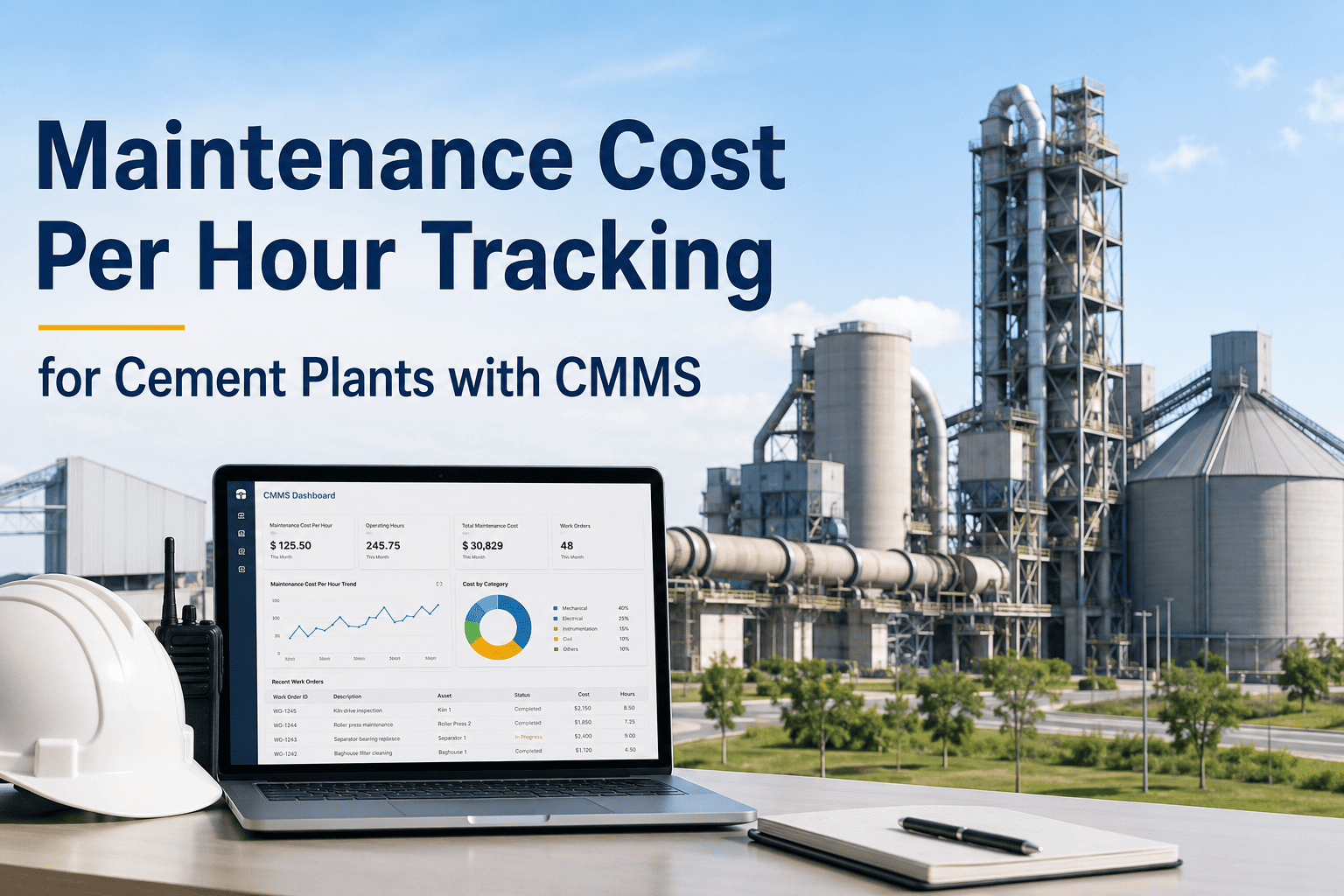
Most cement plant managers know their maintenance budget number — but very few know whether it is competitive. A plant spending $8.50 per tonne on maintenance may look controlled on the balance sheet while sitting in the bottom quartile against global peers, because the real comparison is not absolute spend — it is what that spend buys in kiln availability, PM compliance rate, and emergency repair ratio. Maintenance and operating expenses consume 15–25% of total cement production costs, and 55% of that budget typically drains into reactive emergency repairs that cost 4–6 times more per event than a planned intervention. CMMS-enabled benchmarking closes that visibility gap: it gives plant managers peer-comparison data across every KPI that drives cost position — maintenance cost per tonne, MTBF, MTTR, PM compliance, and planned-to-reactive ratio — so the path from average to top-quartile is measurable, not guesswork. See where your plant sits against global cement benchmarks — start with OxMaint free today. Plants that track 8–12 KPIs monthly with automated CMMS reporting consistently outperform peers by up to 25% in asset uptime, and the productivity gap is visible within the first quarter of implementation. Book a 30-minute benchmarking walkthrough with our cement industry team.
Cement Plant Maintenance Benchmarking with CMMS Data
How does your plant's maintenance cost per tonne, MTBF, PM compliance, and emergency repair ratio stack up against the global top quartile? CMMS benchmarking gives you the peer comparison data to find out — and the specific programs that close the gap.
The Performance Gap Between Top and Bottom Quartile Cement Plants
The difference between a top-quartile and bottom-quartile cement plant is not equipment age or geography — it is maintenance program maturity and the discipline to measure, compare, and act on the data. Without peer benchmarks, there is no pressure to improve and no roadmap for where to start.
A 10-point kiln availability gap at a 3 MTPA plant represents 300,000+ tonnes of lost annual clinker output — recoverable through structured predictive maintenance.
PM compliance below 65% is the single strongest leading indicator of reactive maintenance dominance. Plants below this threshold spend 4–6x more per repair event than those above it.
Industry target for cement plants is above 80% planned work. Plants below 60% are structurally reactive — meaning failures drive the maintenance schedule rather than the maintenance schedule preventing failures.
MTTR is driven by spare parts availability, technician skill routing, and documented repair procedures — all CMMS-managed. A 44% MTTR reduction is achievable within 6 months of full CMMS deployment.
Know Exactly Where Your Plant Sits Against Global Peers
OxMaint calculates your maintenance cost per tonne, PM compliance, planned ratio, MTBF, and MTTR in real time — and benchmarks each metric against cement industry targets. Your first benchmarking dashboard is live within 60 minutes of signup.
The Six Benchmarking KPIs Every Cement Plant Must Track
Top-quartile performers consistently track 8–12 KPIs monthly with automated CMMS reporting. These six form the core benchmarking framework — each a leading or lagging indicator of whether maintenance spend is converting into plant performance or draining into reactive waste.
| KPI | How to Measure | Top Quartile Target | Industry Average | Bottom Quartile | Leading or Lagging |
|---|---|---|---|---|---|
| Maintenance Cost per Tonne ($/t clinker) | Total maintenance spend / clinker produced | $4–6/t | $8–12/t | $16–22/t | Lagging |
| Kiln Availability (%) | Scheduled hours minus unplanned downtime / scheduled hours | 91–94% | 82–87% | 74–80% | Lagging |
| PM Compliance Rate (%) | PM tasks completed on time / total PM tasks scheduled | 88–95% | 68–75% | 48–62% | Leading |
| Planned vs. Reactive Ratio (%) | Planned work orders / total work orders closed | >80% planned | 60–70% planned | 40–55% planned | Leading |
| MTBF — Kiln and Critical Rotating Equipment | Operating hours / number of failures per asset class | 2,800–4,200h | 1,200–2,000h | 600–1,000h | Lagging |
| MTTR — Critical Equipment (hours) | Total repair time / number of repair events | 4–7h | 8–13h | 14–22h | Lagging |
Four Stages of Cement Plant Maintenance Maturity — Where Do You Sit?
Maintenance program maturity is the primary determinant of cost-per-tonne position. Every cement plant sits at one of four stages — and the CMMS data signature at each stage is distinct and measurable.
How OxMaint Turns Maintenance Activity Into Benchmarkable KPI Data
A CMMS without benchmarking capability is a recordkeeping tool. OxMaint connects every work order, asset reading, and maintenance event to the KPI calculations that position your plant against global cement industry benchmarks — automatically and in real time.
Every work order closed in OxMaint feeds the KPI engine automatically — calculating MTBF, MTTR, planned ratio, and PM compliance without manual spreadsheet entry. No data translation step, no reporting lag.
Connect production volume data to OxMaint's cost tracking module. The platform divides total maintenance spend by clinker output continuously — tracking your cost-per-tonne trend against industry benchmark ranges by facility type and production scale.
OxMaint tracks every scheduled PM against its due date — calculating your compliance rate per asset class, plant section, and technician team. Overdue tasks are flagged automatically before they become missed maintenance events that inflate reactive ratios.
OxMaint classifies every work order as planned or reactive at creation. The ratio is visible in real time per shift, per week, and per quarter — with trend lines that show whether your maintenance program is becoming more proactive or slipping toward reactive dominance.
Automatic MTBF calculation from work order closure data for every equipment class — kiln, mill, fans, crushers, and conveyors. Trend lines identify degrading equipment 6–8 weeks before catastrophic failure, giving the maintenance window for a planned intervention.
OxMaint generates maintenance benchmarking reports in one click — showing current KPI position against top-quartile targets, trend trajectory, and the specific improvement actions that close each gap. Report generation time reduced by 89% versus manual monthly reports.
What Cement Plants Achieve After CMMS Benchmarking Implementation
These benchmark improvements are recorded across cement plants that replaced manual and spreadsheet-based maintenance tracking with OxMaint's integrated KPI platform — measured over a 12-month period from implementation date.
We thought our maintenance cost per tonne was average for a plant our size. When OxMaint benchmarked us against peer facilities, we were in the 68th percentile — significantly above the top-quartile threshold. Tracing the root cause, our reactive ratio was 54%. That single metric explained nearly all of the gap. Within 14 months of structured PM compliance improvement, we moved to 79% planned work and dropped our cost per tonne by $3.20.
Cement Maintenance Benchmarking — Common Questions
What is a good maintenance cost per tonne benchmark for a cement plant?
What PM compliance rate should a cement plant target?
How does CMMS data enable maintenance benchmarking?
What is the planned vs. reactive maintenance ratio target for cement plants?
How quickly can a cement plant improve its benchmarking position with CMMS?
Find Out Where Your Plant Sits Against Global Cement Benchmarks — In Under 60 Minutes
OxMaint calculates your maintenance cost per tonne, PM compliance, planned ratio, MTBF, and MTTR automatically — then benchmarks each metric against cement industry top-quartile targets. No manual reporting. No spreadsheets. Just a live view of exactly where you rank and what to fix first.