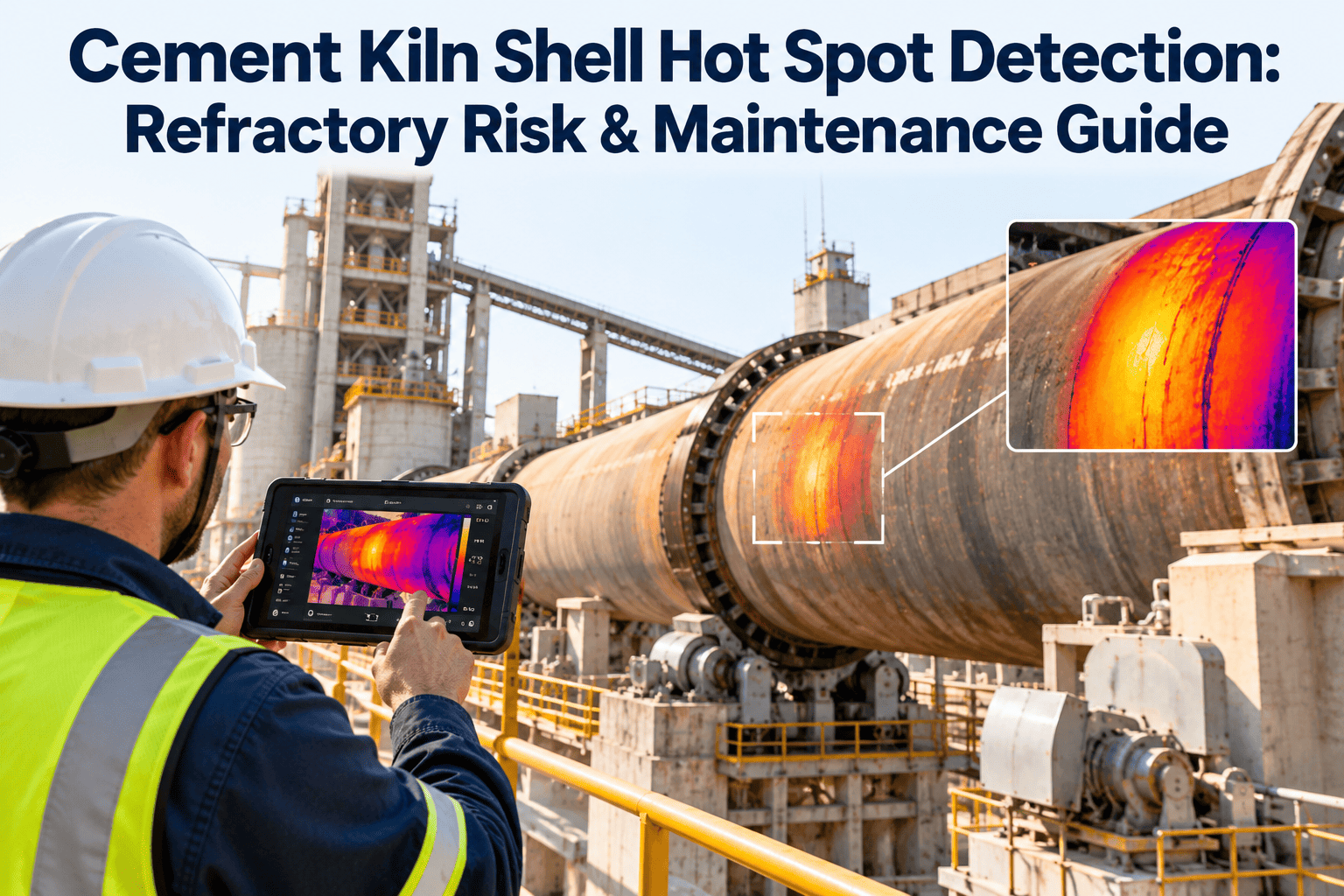
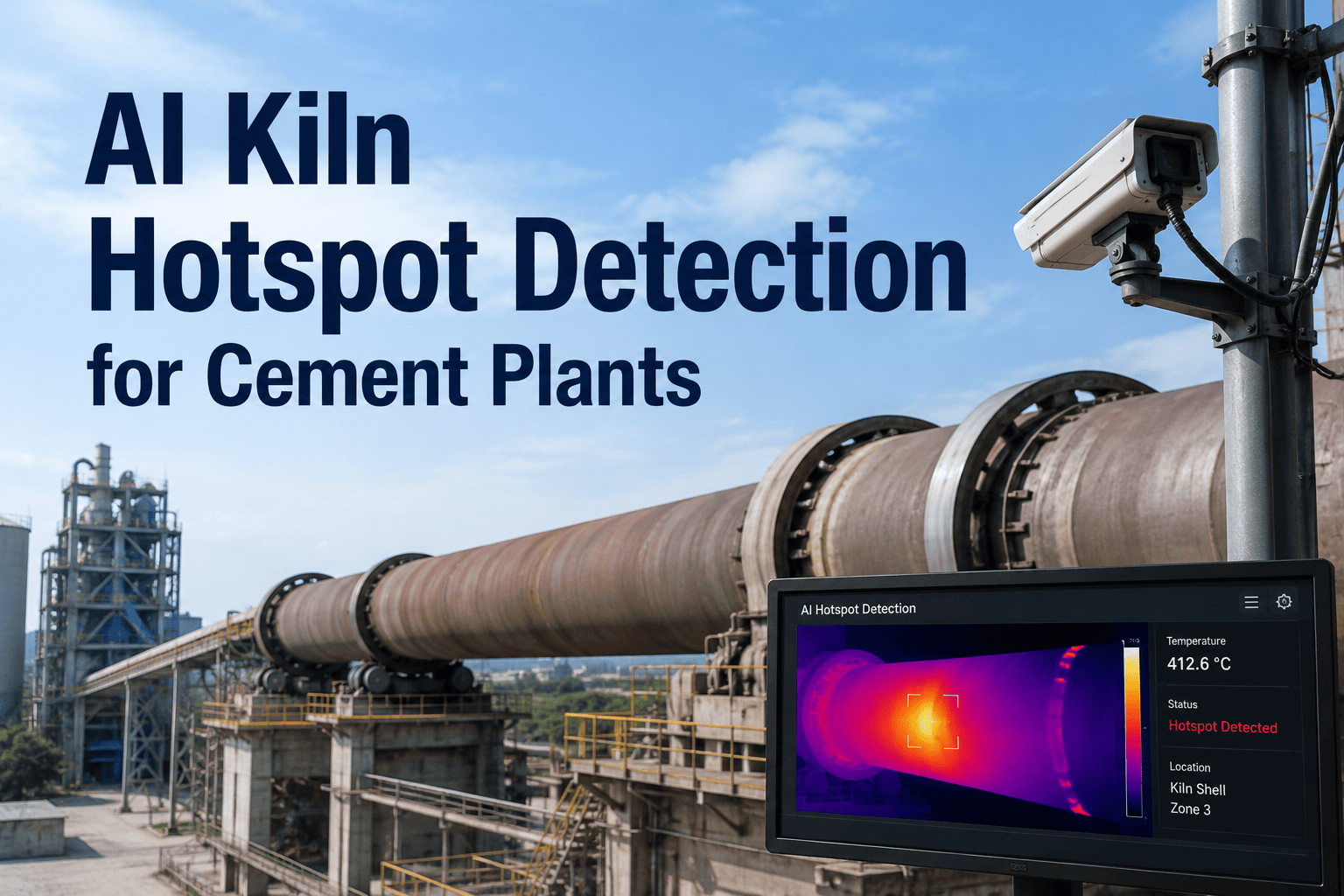
A single undetected kiln shell hotspot can force an emergency shutdown costing $300,000 or more — not counting refractory rebuild labour, delayed shipments, and lost contracts. AI vision cameras mounted along the kiln shell scan surface temperature continuously, detect thermal anomalies weeks before refractory brick failure becomes visible, and push auto-generated work orders directly into your CMMS the moment a threshold is crossed — eliminating the 12–72 hour gap between detection and action that manual patrol inspections create. This is not a pilot technology: cement plants operating on-premise AI inference engines have reduced kiln-related emergency stops by up to 70%.
How Kiln Shell Hotspots Form — and Why They Are Missed
The failure sequence is predictable, but the window to intervene is narrow. Understanding how hotspots develop is the first step to stopping them.
Stage 1 — Refractory Wear (Weeks 1–8)
Refractory brick thins due to thermal cycling, clinker abrasion, and coating loss. No visible sign. Shell surface temperature rises 15–25°C above baseline. Manual IR scanners running once per shift miss this gradual drift entirely.
Stage 2 — Hot Zone Formation (Days 3–14)
Insulation deteriorates in a localised zone. Shell temperature spikes 40–80°C above baseline. Colour change becomes visible to experienced operators on close inspection — but only during daylight and with unobstructed sightlines.
Stage 3 — Critical Hotspot (Hours 6–48)
Shell temperature exceeds 300–350°C. Brick separation imminent. Emergency shutdown risk is high. At this stage, forced outage rather than planned repair is almost certain — with full cost and schedule consequences.
Stage 4 — Shell Deformation or Red Spot
Shell glows red. Brick has failed. Kiln must stop immediately. Refractory rebuild takes 7–14 days minimum. Total event cost including production loss: $800K–$1.5M.
How AI Vision Cameras Catch Hotspots at Stage 1
On-premise AI inference engines process thermal camera frames in real time — no cloud dependency, no latency, no reliance on a technician being present.
Continuous 360° Shell Scanning
Radiometric thermal cameras positioned at fixed intervals along the kiln length capture full-shell temperature maps every 15–30 seconds. Resolution is sufficient to detect 5°C anomalies across a 70-metre shell surface.
Edge Inference — No Cloud Required
Inference runs on local GPU hardware inside the control room. Models flag anomalies in under 2 seconds. Plants in remote locations or with data sovereignty requirements operate fully offline without any performance loss.
Baseline-Relative Temperature Modelling
AI builds a dynamic thermal baseline for each kiln zone, accounting for feed rate, fuel mix, and ambient temperature variation. Alerts trigger only when temperature deviates beyond what operating conditions explain — not every time the kiln runs hot.
Work Order Auto-Generated on Threshold Breach
The moment an anomaly is confirmed, the system writes a structured work order into SAP PM, Maximo, or Fiix — including zone coordinates, temperature delta, trend rate, and recommended inspection urgency. Zero manual steps required.
Eliminate the Detection Gap on Your Kiln
Book a live demo and see how AI vision cameras integrate with your existing CMMS to auto-generate kiln shell work orders — from thermal anomaly to planned repair in minutes.
Case Study: Reducing Emergency Kiln Stops by 68%
Southeast Asian Integrated Cement Plant — 4,500 TPD Kiln Line
2-kiln operation, 6-month AI vision deployment with on-premise inference engine and SAP PM integration
Reduction in emergency kiln stops Year 1
Avoided emergency maintenance costs
Earliest hotspot detection before visible failure
Work orders auto-generated on threshold breach
What Changed
- Deployed 8 radiometric cameras across 2 kilns — 4 cameras per kiln at 20-metre intervals
- On-premise inference server processes 14,400 thermal frames per hour with sub-2-second anomaly detection
- SAP PM integration auto-generates PM orders with priority code, location, and temperature trend graph attachment
- First anomaly detected 11 days before the zone reached Stage 3 — refractory replaced during planned weekend stop instead of emergency shutdown
- Payback period: 4 months from first avoided emergency stop
Technical Specifications: AI Vision Kiln Monitoring
| Parameter | Specification | Why It Matters |
|---|---|---|
| Camera Type | Uncooled radiometric thermal, 640×480 px | Accurate absolute temperature measurement, not just relative heat maps |
| Temperature Range | 0°C to 600°C measurement range | Covers full range from ambient to pre-critical shell temperatures |
| Scan Frequency | Every 15–30 seconds per zone | Captures rapid temperature escalation within the critical detection window |
| Anomaly Detection | 5°C delta from dynamic baseline | Early-stage detection before Stage 2 — weeks of lead time |
| Inference Latency | Under 2 seconds on-premise | Immediate alert with no cloud round-trip dependency |
| CMMS Work Order | Auto-generated within 60 seconds of confirmed anomaly | Eliminates 12–72 hour human notification delay |
| Connectivity | Fully offline capable (on-premise inference) | Operates in remote plants without reliable internet |
Manual IR Patrols vs. AI Vision Cameras
Frequently Asked Questions
Cameras are mounted on fixed structures adjacent to the kiln shell — not on the kiln itself. Installation is completed during normal operations, typically in one working day per kiln. Start a free trial and our team provides installation guidance specific to your kiln geometry.
The AI baseline model learns each kiln's normal thermal profile zone-by-zone, including expected high-temperature areas near the burning and transition zones. Alerts trigger only for deviations beyond what operating conditions predict — not for zones that are normally hot. Book a demo to see zone mapping on a live kiln model.
Auto work order generation integrates with SAP PM, IBM Maximo, Fiix, Infor EAM, and custom platforms via REST API. Work orders include zone ID, temperature delta, trend rate, image attachment, and urgency classification — written directly into your existing PM templates.
No. The inference engine runs on local GPU hardware inside your control room or server room. Plants in remote locations operate the full detection and CMMS integration workflow with zero cloud dependency. Sign up free to review the hardware specification for your kiln line configuration.
Most plants recover the full system cost within 3–6 months — often after a single avoided emergency shutdown event. With kiln emergency stops costing $300K–$1.5M, the ROI case is straightforward. Schedule a consultation to build a plant-specific business case.
Protect Your Kiln. Automate the Response. Eliminate Emergency Stops.
OxMaint's AI vision platform detects kiln shell hotspots weeks early and auto-generates CMMS work orders before failure forces a costly emergency shutdown. Join cement plants worldwide that have made unplanned kiln stops a rare exception.