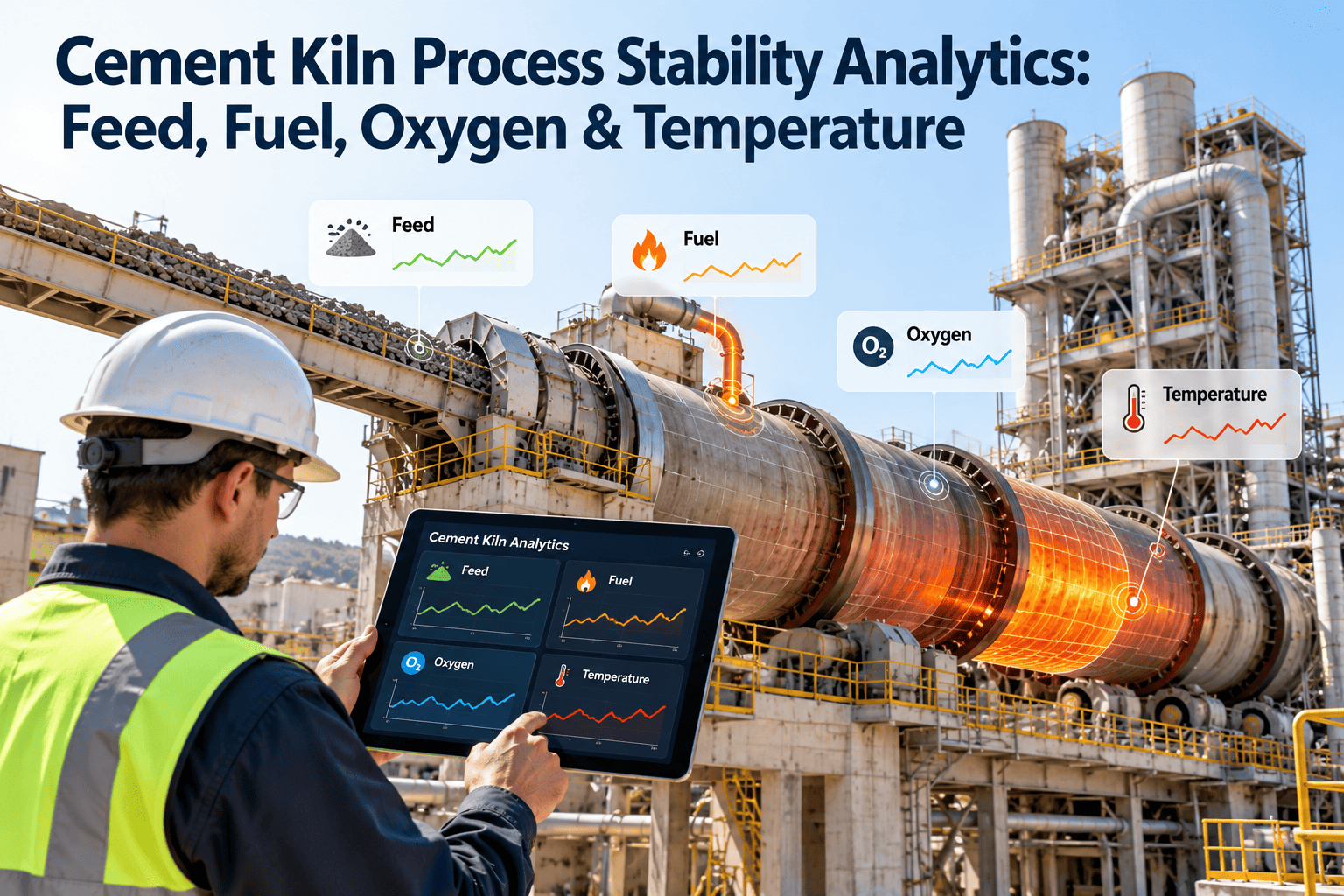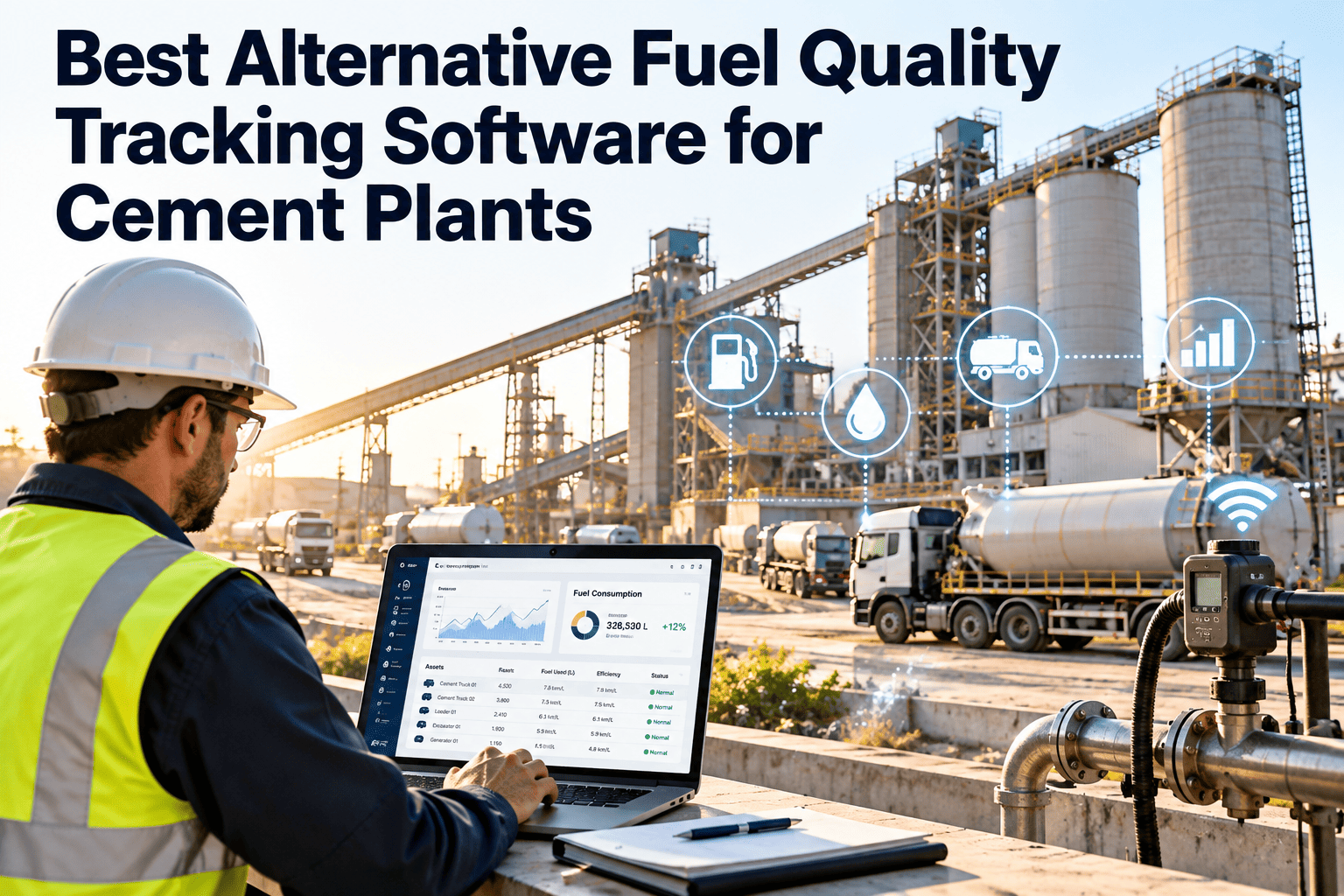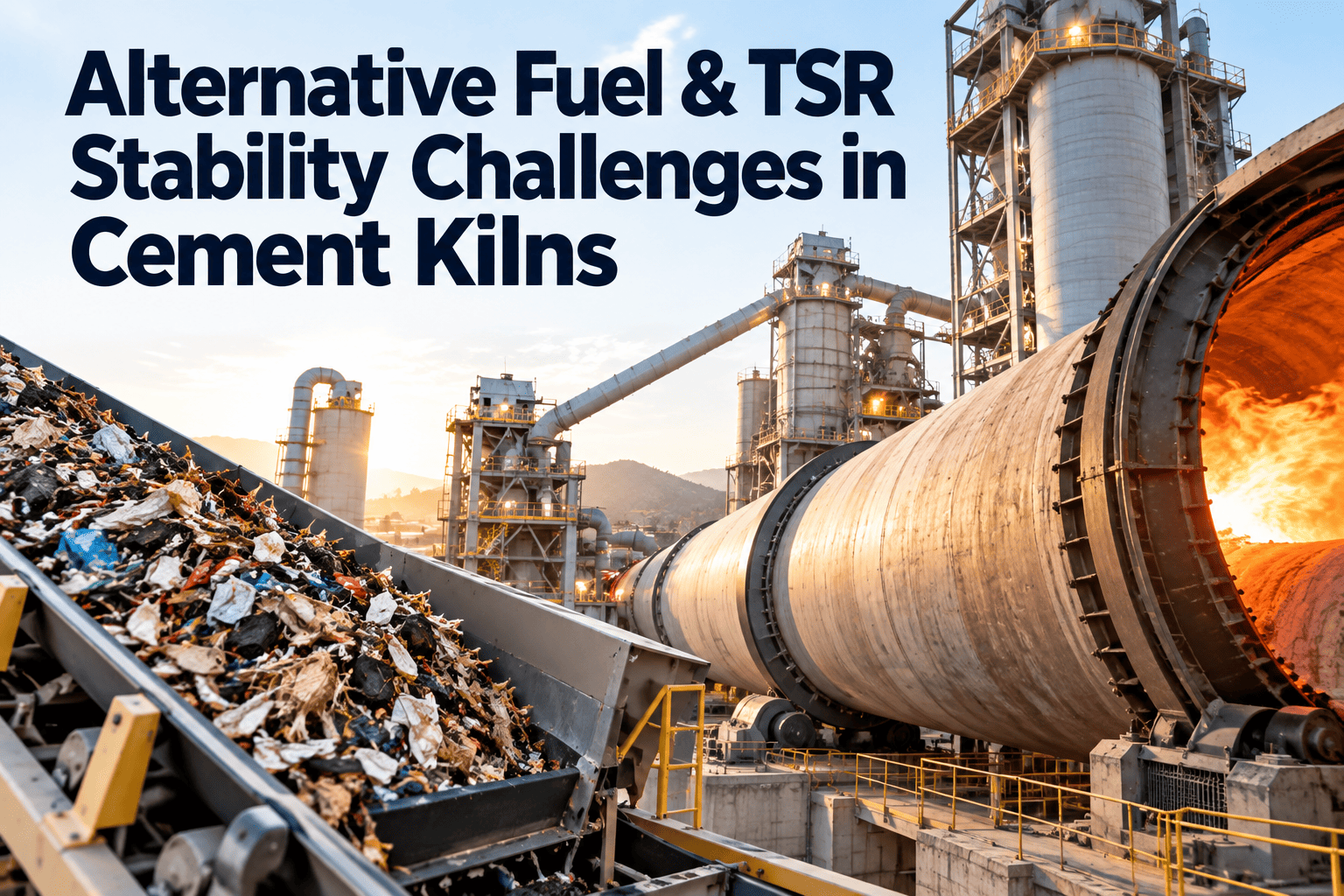
Push thermal substitution rate past 40% and a cement kiln stops behaving like the same kiln. Flame shape shortens or elongates depending on what batch of refuse-derived fuel just hit the calciner, free lime starts drifting shift to shift, and a burning zone that held steady on coal now needs constant operator correction. This is the paradox of alternative fuels: they are essential to decarbonization targets and fuel-cost reduction, but every percentage point of thermal substitution rate added without matching control discipline trades fuel savings for process instability. This guide walks through why AFR quality varies so much more than conventional fuel, what that variability actually does to the kiln, and how plants hold TSR gains without paying for them in coating loss and refractory wear.
Cement · Alternative Fuels & TSR
Alternative Fuel & TSR Stability Challenges in Cement Kilns
Why AFR quality swings destabilize burning zone conditions, what unstable thermal substitution rate costs in coating, NOx, and clinker quality, and how a structured monitoring and maintenance workflow keeps TSR gains from becoming process risk.
Why AFR Behaves Differently
Conventional Fuel vs. Alternative Fuel Variability
Coal arrives as a relatively consistent product from a controlled supply chain. Refuse-derived fuel, tyre-derived fuel, and biomass arrive as a mixed waste stream, and that difference in origin is the entire source of the stability problem.
| Property | Coal / Petcoke | Typical AFR Stream |
|---|---|---|
| Calorific value swing | Narrow, typically ±3–5% | Can vary 20–40% batch to batch |
| Moisture content | Low and stable | Highly variable, weather and source dependent |
| Chlorine / sulfur load | Predictable, low | Can spike sharply with plastics or treated wood content |
| Particle size consistency | Tightly controlled by grinding | Mixed fractions unless pre-processed and screened |
| Feed rate control | Simple, single-stream metering | Multiple streams blended in real time, harder to meter precisely |
Operational Impact
What Instability Actually Does to the Kiln
Unstable AFR feed does not stay contained to the fuel system. Every swing in calorific value or chlorine load propagates directly into burning zone conditions and downstream equipment.
-
Coating Instability
Flame shape changes with fuel swings strip the protective clinker coating, exposing refractory to direct flame impingement.
-
Build-Up & Blockages
Chlorine and sulfur spikes from plastics or treated waste drive volatile cycles that form rings and preheater cyclone blockages.
-
Free Lime Drift
Inconsistent burning zone temperature pushes clinker free lime outside spec, forcing rework or quality holds downstream.
-
NOx and Emissions Swings
Combustion instability moves NOx and CO outside the compliance band, risking excursions that trigger reporting obligations.
How a Bad Batch Propagates
From Fuel Delivery to Process Upset
A single out-of-spec AFR delivery does not cause an immediate upset — it moves through the system on a delay that makes root-cause tracing difficult without a logged fuel record.
- Delivery Received A load arrives with calorific value or moisture outside the contracted spec, often without a real-time lab check before it enters the feed bunker.
- Blended Into Feed The load mixes with existing stock, diluting but not eliminating the variability before it reaches the burner or calciner.
- Burning Zone Reacts Flame shape, free lime, and coating condition shift — often hours after the batch was actually fed, obscuring the cause.
- Downstream Consequence Refractory wear accelerates, clinker quality drifts, or a preheater blockage forms — logged as a maintenance or quality event disconnected from its actual trigger.
Fuel Stream Risk Profiles
Not All Alternative Fuels Carry the Same Risk
Lumping every alternative fuel stream into a single "AFR" category hides the fact that each stream has a distinct risk profile, and a plant blending several needs to manage them differently rather than applying one feed strategy to all.
-
Refuse-Derived Fuel (RDF)
Highest variability in calorific value and moisture; chlorine content depends heavily on plastics fraction and sorting quality upstream.
-
Tyre-Derived Fuel (TDF)
High and consistent calorific value, but steel wire content requires reliable metering to avoid mechanical feed system damage.
-
Biomass
Generally lower chlorine risk, but moisture content swings sharply with weather and storage conditions, affecting drying load.
-
Industrial & Hazardous Waste Streams
Calorific value can be high and stable by contract, but sulfur and heavy metal content require the tightest compositional monitoring.
Compliance Considerations
TSR, Emissions Reporting, and Kiln Stability Are Linked
Regulators increasingly expect cement plants to demonstrate not just a TSR percentage but the emissions performance that came with it. A kiln running unstable combustion to hit a TSR target can trade one compliance metric for another — trading fuel-cost savings for NOx, CO, or dioxin excursions that carry their own reporting and penalty exposure.
This is why the strongest AFR programs track combustion stability indicators — CO spikes, O2 trim consistency, and free lime variance — alongside the TSR figure itself, rather than treating TSR as a standalone success metric disconnected from how the kiln actually ran to achieve it.
The Real Problem
TSR Targets Get Set. Fuel Quality Tracking Rarely Keeps Up.
Most plants chase a thermal substitution rate percentage without a matching discipline for tracking which fuel batch caused which upset. That gap turns every AFR-related failure into a mystery instead of a pattern that could be prevented.
Stabilizing TSR
What Holding TSR Without Instability Actually Requires
Plants that run 40%+ TSR without chronic burning zone instability share a common set of practices — none of them exotic, all of them dependent on consistent execution.
- Pre-processing and blending AFR streams before the feed system, not relying on in-kiln blending to smooth variability
- Logging calorific value, moisture, and chlorine on every delivery against the asset, not just at contract audit time
- Tying feed-system inspections — metering screws, weigh feeders, dosing valves — to a preventive schedule, since mechanical drift compounds fuel-quality drift
- Correlating burning zone upsets against fuel batch records to find recurring bad-actor suppliers or waste streams
- Scheduling coating and refractory inspections at a frequency matched to actual TSR level, not a fixed calendar interval set when the kiln ran on coal
Upstream Solutions
Why Pre-Processing Matters More Than Kiln-Side Control
A common instinct when AFR instability shows up in the kiln is to add more control at the burner or calciner — trim air ratios, adjust flame shape, tighten operator response. That helps, but it treats the symptom rather than the source, because the variability was already baked into the fuel before it reached the feed system.
Plants that hold stable TSR at scale generally invest upstream instead: pre-shredding and screening to remove oversize and metal contamination, blending multiple deliveries before they reach the feed bunker to average out batch-to-batch swings, and rejecting loads that fail a basic moisture or calorific spot check at the gate rather than after they are already committed to the process.
This shifts the burden from constant operator correction — which is reactive, inconsistent across shifts, and fatiguing to sustain — to a controlled input that the kiln can actually be tuned around. It is a capital and process decision as much as a maintenance one, but the maintenance discipline that tracks fuel quality data is what tells a plant whether the pre-processing investment is actually working.
Operational Patterns
Seasonal and Supply-Driven Variability
AFR quality does not vary randomly — it follows patterns tied to weather, waste collection cycles, and supplier mix, and a plant that tracks fuel data long enough starts to see them.
Biomass streams pick up moisture after rain and during wet seasons, directly raising drying load and reducing effective calorific value exactly when a plant may be trying to hold a steady TSR target. RDF composition shifts with regional collection and sorting contracts, sometimes changing chlorine content month to month as a municipality's waste stream mix changes upstream of the plant's control entirely.
Without a fuel batch record that spans enough history to reveal these patterns, each swing looks like a one-off anomaly rather than a predictable seasonal effect a plant could plan around — adjusting blend ratios or building buffer stock ahead of the periods when a given stream typically degrades.
Oxmaint for AFR & TSR Operations
Connecting Fuel Records to Maintenance Reality
-
Fuel Batch Logging
Record calorific value, moisture, and chlorine readings per delivery, linked to the feed system asset that received it.
-
Feed System Preventive Maintenance
Schedule inspection and calibration of weigh feeders, metering screws, and dosing valves on a cycle tuned to actual TSR load.
-
Inspection Checklists
Mobile checklists for coating condition, flame observation, and preheater cyclone build-up, completed at the point of inspection.
-
Corrective Work Orders
Convert a flagged fuel batch or coating anomaly directly into an assigned, trackable work order instead of a verbal handover.
-
Asset History
Build a maintained history per kiln zone and feed line, so recurring instability can be traced back to a supplier or waste stream pattern.
-
Dashboards & Reporting
Roll fuel-quality and maintenance data into shared reporting so TSR targets and process stability are reviewed together, not separately.
Team Coordination
AFR Stability Is a Shared Responsibility, Not One Department's Problem
In many plants, fuel procurement, kiln operations, and maintenance each hold a piece of the AFR stability puzzle without a shared view of the whole. Procurement negotiates supply contracts and spec ranges, operations reacts to whatever arrives at the burner, and maintenance repairs the coating and refractory damage after the fact — three functions solving three separate problems that are actually one problem.
Closing that gap does not require a reorganization. It requires a shared record: fuel quality data logged at receipt, correlated against operational upsets, and visible to whoever is deciding the next contract renewal or feed system upgrade. When a supplier's chlorine spec is consistently missed and that pattern is visible in the same system tracking refractory repair frequency, the conversation with that supplier changes from anecdotal to data-backed.
This shared visibility is also what makes a TSR increase defensible to plant leadership — showing not just the fuel-cost savings targeted, but the maintenance and stability cost actually incurred to get there, so the next TSR step-up is planned with eyes open rather than discovered after the fact.
Frequently Asked
AFR & TSR Stability Questions
What is thermal substitution rate (TSR)?
TSR is the percentage of a kiln's total thermal energy supplied by alternative fuels rather than fossil fuel, commonly targeted between 30% and 60%+ depending on region and plant configuration.
Why does higher TSR increase process instability?
Alternative fuel streams have far wider swings in calorific value, moisture, and chlorine than coal, so as TSR rises, a larger share of total thermal input is inherently less predictable, and the burning zone has to absorb that variability.
Does high TSR shorten refractory life?
It can, primarily through coating instability from flame-shape changes and chemical attack from chlorine and sulfur spikes, but plants with strong fuel-quality tracking and matched inspection frequency largely offset this effect.
How can a plant trace a process upset back to a fuel batch?
Only if fuel delivery data is logged against the feed system asset and timestamped closely enough to correlate with the delayed burning zone response, which is why manual, disconnected fuel logs make root-cause analysis nearly impossible. Sign up for Oxmaint to log AFR batches against feed system assets.
What maintenance changes when TSR increases?
Feed system inspection frequency, coating and refractory checks, and preheater cyclone cleaning all typically need to move to a tighter cycle than a coal-only kiln required. Book a demo to see TSR-matched preventive maintenance scheduling.
Stable Fuel Data · Stable Kiln
Hit Your TSR Target Without Trading Away Process Control
Alternative fuel is not the risk — untracked variability is. Oxmaint gives cement plants one place to log AFR batch quality, schedule feed system and refractory maintenance around real TSR load, and connect every process upset back to the fuel record that caused it.