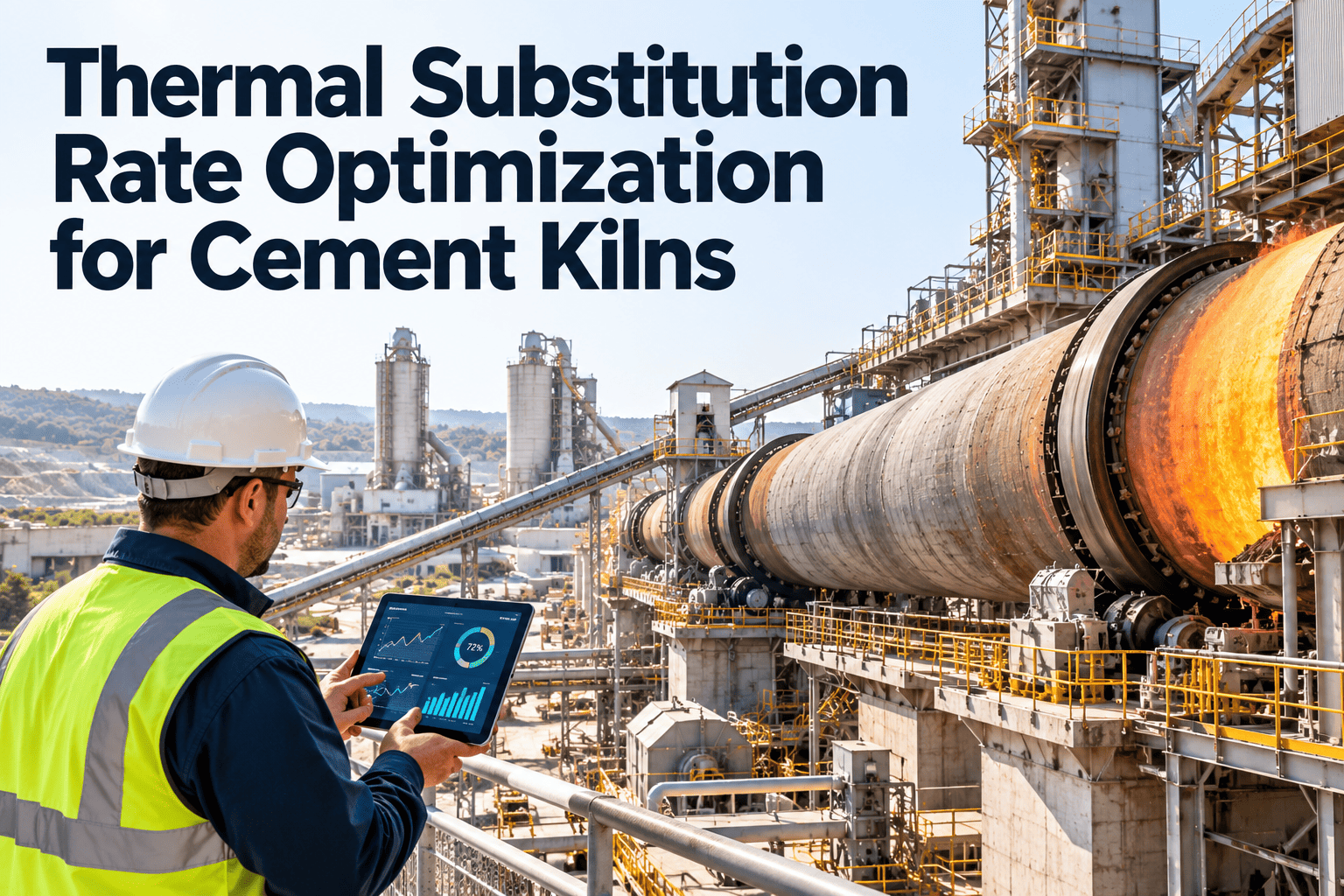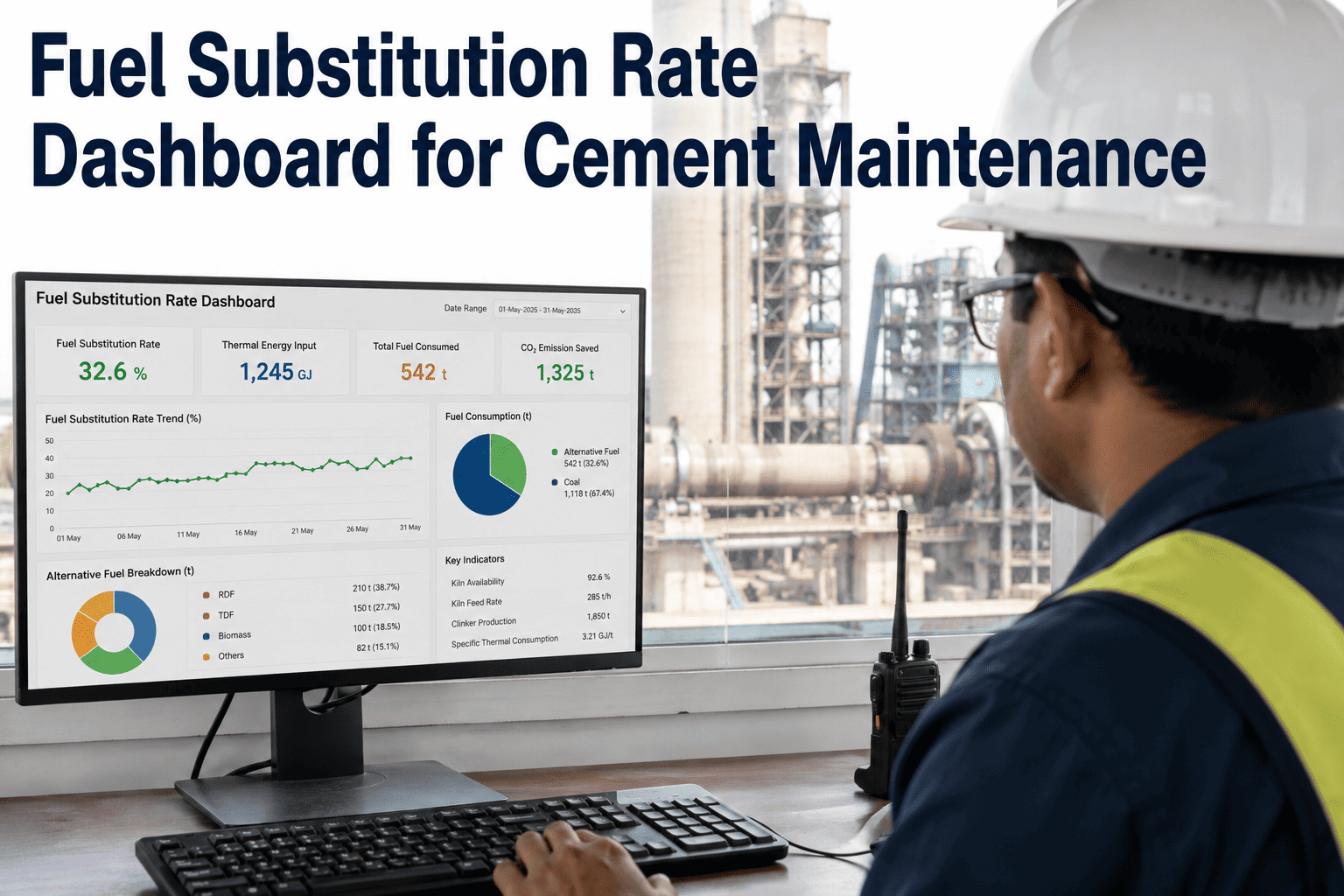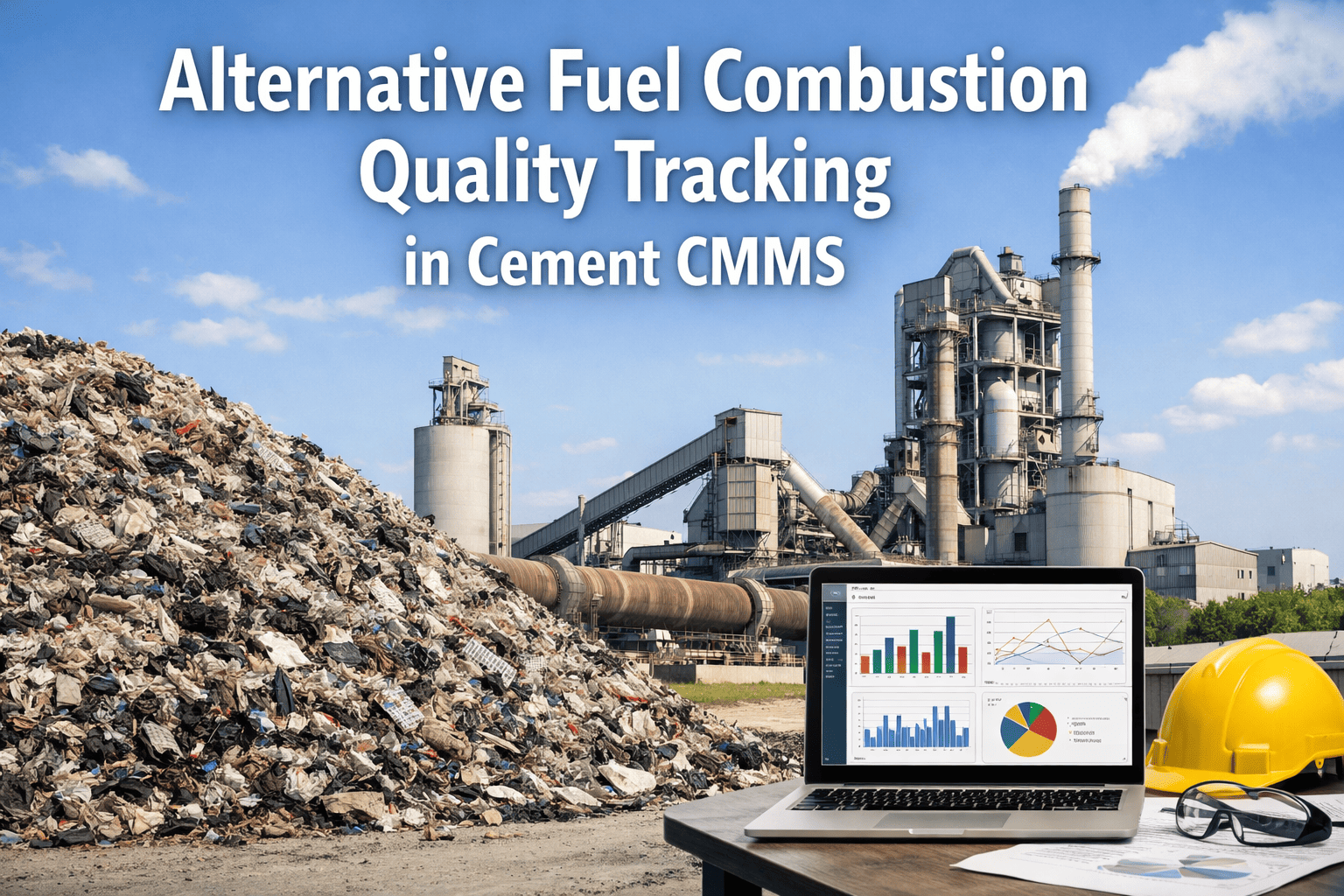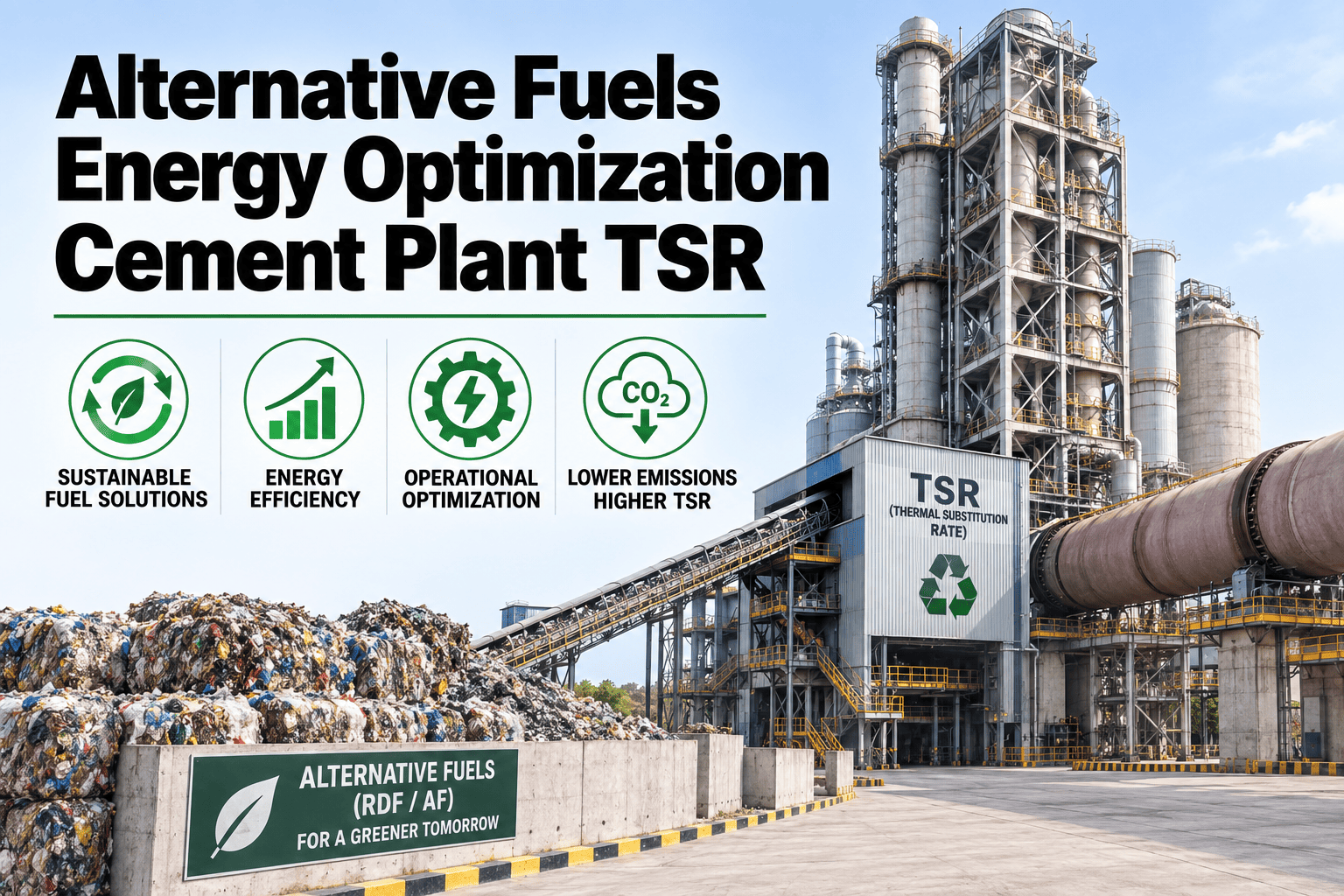
Pushing thermal substitution rate past 40% in a cement plant used to mean trading fuel savings for an unpredictable maintenance bill — worn feed chains, clinker-ring buildup, and dust-system fouling that ate into the kiln's availability. Alternative fuels and refuse-derived fuels cut clinker fuel cost by 20–35%, yet every 10-point TSR jump typically raises unplanned downtime on AFR feed and combustion equipment by 12–18% when reliability is managed on spreadsheets alone. Modern alternative fuels energy optimization ties calorific-value tracking, pre-combustion stability, and dust-system loading to a single maintenance pipeline through CMMS, keeping fuel savings from leaking out as repair cost. A well-configured system pays for itself in 4–7 months for a mid-size kiln line. You can explore the full workflow in a Start Free Trial or read on for the numbers.
AFR Energy Optimization · Cement TSR
Every 10 points of TSR you add can cost 15% more downtime — unless maintenance moves first.
Most cement plants chase thermal substitution rate as a fuel-cost lever and discover, six months in, that AFR feed jams, chlorine-induced ring formation, and dust-circuit fouling have quietly erased half the savings. The fix is not less alternative fuel — it is a CMMS-driven reliability layer around the AFR value chain.
The TSR–Maintenance Paradox
Why alternative fuel savings leak out as repair cost
A kiln moving from 25% to 55% TSR can cut fossil fuel cost by $1.8M–$3.2M per year on a 3,000 tpd line — but the same jump exposes feed, combustion, and dust assets to a harsher duty cycle that traditional PM schedules were never built for.
"We hit 52% TSR in eleven months. The savings looked great until Q4, when feed-plug downtime and a dust-fan failure wiped out a full quarter of fuel gains. The next quarter we put the whole AFR chain under one CMMS workflow — downtime dropped back within six weeks."
— Reliability Lead, 2,800 tpd integrated cement plant, South India
AFR Value Chain · Where Energy Meets Reliability
Four systems that decide whether TSR gains survive
Alternative fuels energy optimization is not a single knob — it is four interlocking asset systems. Each one converts a portion of the fuel saving into maintenance risk if it is not tracked, inspected, and scheduled inside one CMMS pipeline.
AFR feed chain, dosing screws, and pre-processing lines
Variable particle size, moisture swings of 15–45%, and abrasive inorganics triple chain wear and shear-pin failures. CMMS ties condition-based vibration and motor-trend alerts to auto-generated work orders so feed plug risk is caught at the trend level, not the breakdown level.
Burner pipe, riser duct, and clinker ring formation
Chlorine and alkali-rich AFR accelerate ring build-up at the kiln inlet and burner-tip degradation. A CMMS-driven weekly ring-mapping inspection, tied to calorific-value logs, cuts mechanical de-cocking events by up to 40% and protects the 55%+ TSR ceiling.
ESP / baghouse, raw-mill bypass, and ID fan
High-ash AFR loads the dust circuit 1.4–2.1× harder than coal. Without CMMS-scheduled filter pulsing, hopper evacuation, and fan-blade inspection, pressure-drop spikes force kiln derate — the silent TSR killer that never shows up on the fuel P&L.
Online calorific value, chlorine, and moisture lab loop
TSR is only meaningful if the AFR's lower heating value is tracked per batch. When CMMS links lab CV data to burner and feed maintenance triggers, the plant stops burning "phantom TSR" — fuel tons that look substituted on paper but deliver no usable heat.
Worked Example · 3,000 tpd Kiln Line
The math behind a 25% → 55% TSR move
Consider a 3,000 tpd line spending $5.4M/yr on petcoke, targeting a 30-point TSR jump using RDF and biomass at an average 16 MJ/kg lower heating value. The savings are real — but so is the maintenance exposure attached to them.
Net Annual Benefit
Net Benefit = (Fuel Cost Avoided) − (AFR Procurement + Handling) − (Added Maintenance Cost)
With a CMMS-driven AFR reliability layer, added maintenance cost drops from $0.34M to roughly $0.12M — lifting net benefit to $0.89M and protecting the TSR gain against dust-circuit derate. That is the $220K/yr the maintenance function either captures or gives back.
| Reliability Lever | Reactive Baseline | CMMS-Driven | Annual Impact |
|---|---|---|---|
| AFR feed plug downtime | 46 hrs/yr | 11 hrs/yr | +$185K |
| Kiln ring de-cocking events | 7 per yr | 3 per yr | +$96K |
| Dust fan / ESP forced derate | 72 hrs/yr | 18 hrs/yr | +$142K |
| Burner pipe replacement | Every 9 mo | Every 14 mo | +$38K |
| Phantom TSR (low-CV batches) | 6% of TSR | 1.5% of TSR | +$72K |
CMMS TSR Workflow · 90-Day Rollout
From spreadsheet reliability to closed-loop AFR control
A staged 90-day rollout moves a cement plant from spreadsheet-driven AFR maintenance to a closed-loop CMMS workflow where every calorific-value, vibration, and pressure-drop signal generates a scheduled, owner-assigned work order.
Asset register & AFR criticality ranking
Inventory every asset in the AFR value chain — feeders, dosing screws, burner pipe, riser, ESP fields, ID fan — and rank by TSR criticality. Tag each with failure modes tied to AFR type (RDF, tires, biomass, solvents) so inspection frequency matches actual duty, not a generic OEM calendar.
Condition triggers & auto work-order rules
Wire motor current, vibration, hopper level, and lab CV data into CMMS trigger rules. A 12% moisture spike on the RDF line should auto-generate a dosing-screw inspection work order before the plug, not after the kiln trip. This is where 60% of the downtime reduction comes from.
Closed-loop TSR review & PM tuning
Weekly TSR-vs-maintenance cost review inside the CMMS dashboard. PM intervals are tuned to real failure data — not the OEM manual — and AFR suppliers are scored on maintenance impact, not just price per ton. This is where the $220K net-benefit gap closes.
Myth vs. Reality · AFR Maintenance Economics
What cement plants get wrong about TSR-driven maintenance
Five persistent beliefs keep cement plants from capturing the full net benefit of a higher TSR. Each one has a measurable cost attached — and a CMMS-driven countermove.
"Higher TSR is purely a fuel-cost win — maintenance will absorb it."
RealityReactive AFR maintenance typically claws back 20–30% of fuel savings. CMMS-driven reliability caps that leakage below 8%.
"OEM PM schedules are enough — we just follow the manual."
RealityOEM intervals assume coal duty. AFR feed chains wear 3× faster; rigid PM schedules either over-maintain or arrive too late.
"Dust-system fouling is a process issue, not a maintenance one."
RealityPressure-drop trends are a leading indicator of forced derate. CMMS-scheduled pulsing and hopper evacuation prevent the kiln trips that erase TSR.
"We track TSR in the fuel P&L — that's enough visibility."
RealityWithout linking CV data to maintenance triggers, plants burn "phantom TSR" — tons that look substituted but deliver no usable heat. CMMS closes the loop.
Stop letting AFR maintenance eat your TSR savings
Deploy a CMMS-driven reliability layer around your alternative fuel value chain and protect the full $0.89M net benefit of a 55% TSR target.
FAQ · Alternative Fuels Energy Optimization
What cement reliability and process leads ask before deploying
How fast can a CMMS-driven AFR workflow pay for itself on a cement kiln line?
Most 2,500–3,500 tpd lines see payback in 4–7 months. The savings come from three buckets: reduced feed-plug and ring-removal downtime (typically 60% of the gain), lower dust-circuit derate hours (25%), and extended burner-pipe and conveyor-chain life (15%). A 30-point TSR jump usually exposes enough reactive maintenance cost to cover the CMMS deployment within the first quarter.
Does this replace our existing PM schedule, or sit on top of it?
It sits on top, then optimizes. The first 30 days map your current PM calendar into the CMMS unchanged. Over the next 60 days, condition-based triggers and failure-data analytics tune those intervals to actual AFR duty — lengthening some, shortening others. No plant abandons its OEM baselines; the CMMS makes them AFR-aware. You can see the tuning workflow in a Start Free Trial sandbox.
What signals should trigger an AFR maintenance work order automatically?
The four highest-impact triggers are dosing-screw motor-current deviation beyond 15%, hopper level variance indicating bridge risk, ESP pressure-drop trending above baseline by 8%, and lab-reported chlorine above 0.15% on a batch. Each should generate a ranked, owner-assigned work order inside the CMMS — not an alarm that someone has to interpret manually.
Can the CMMS link alternative-fuel calorific value to kiln maintenance?
Yes — and this is where most plants leave money on the table. When lab CV, moisture, and chlorine data flow into the CMMS, low-CV or high-Cl batches can trigger pre-emptive burner inspection, ring-mapping, or dust-hopper evacuation before the kiln feels the effect. Book a Book a Demo session to see the lab-to-work-order loop mapped on a sample kiln line.
What happens to TSR if we ignore the dust-system maintenance impact?
Dust-circuit fouling is the silent TSR killer. A high-ash AFR blend loads the ESP or baghouse 1.4–2.1× harder than coal, and once pressure-drop forces a kiln derate, the plant is effectively burning more fossil fuel to hit the same clinker output — TSR drops on paper while fuel cost rises in reality. CMMS-scheduled pulsing, hopper evacuation, and fan-blade inspection typically recover 50–70% of derate hours within a quarter.
Ready to protect every point of TSR?
Join cement plants using CMMS to keep alternative-fuel savings from leaking into maintenance cost — start your trial or book a guided walkthrough today.
Free 14-day trial · No credit card