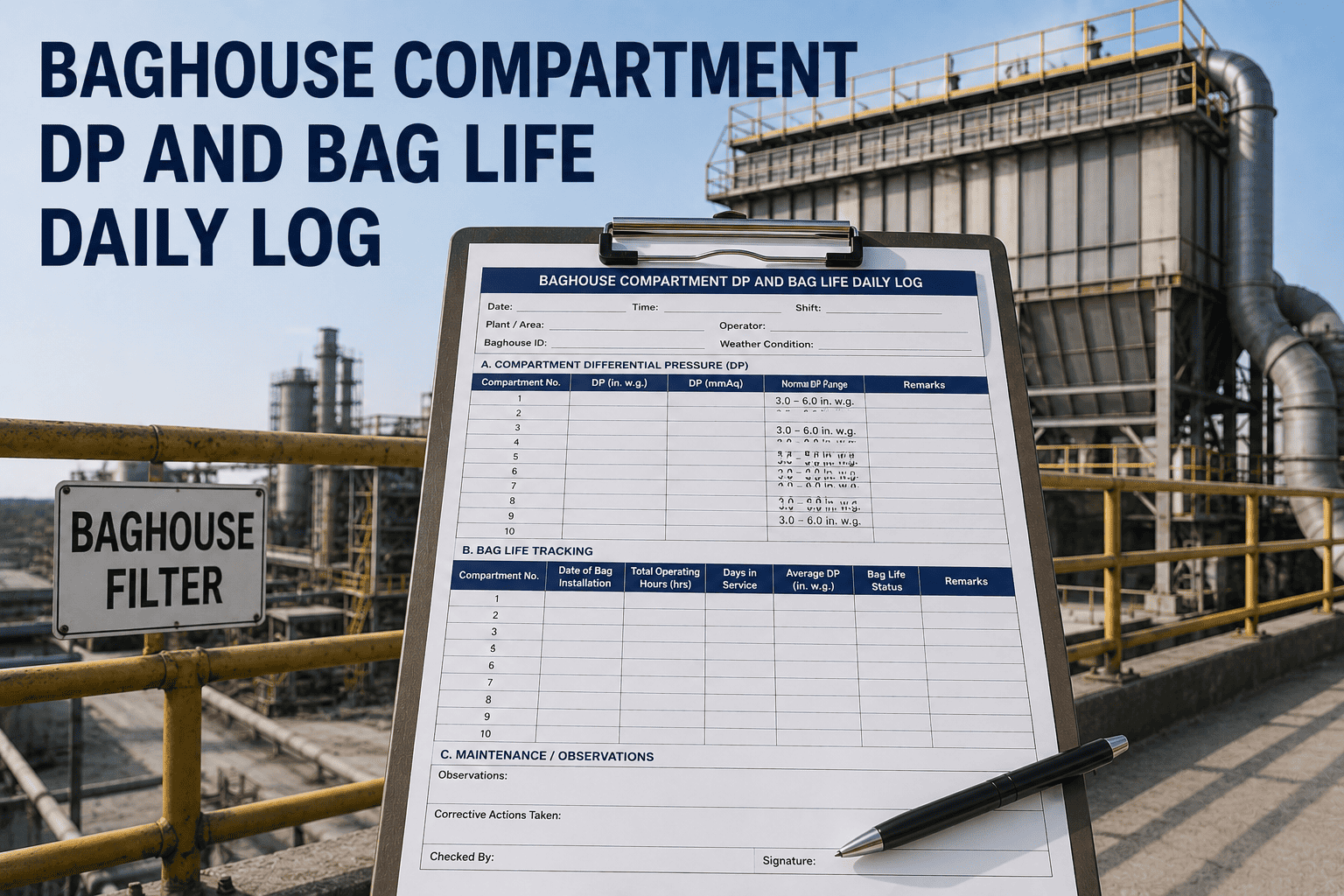
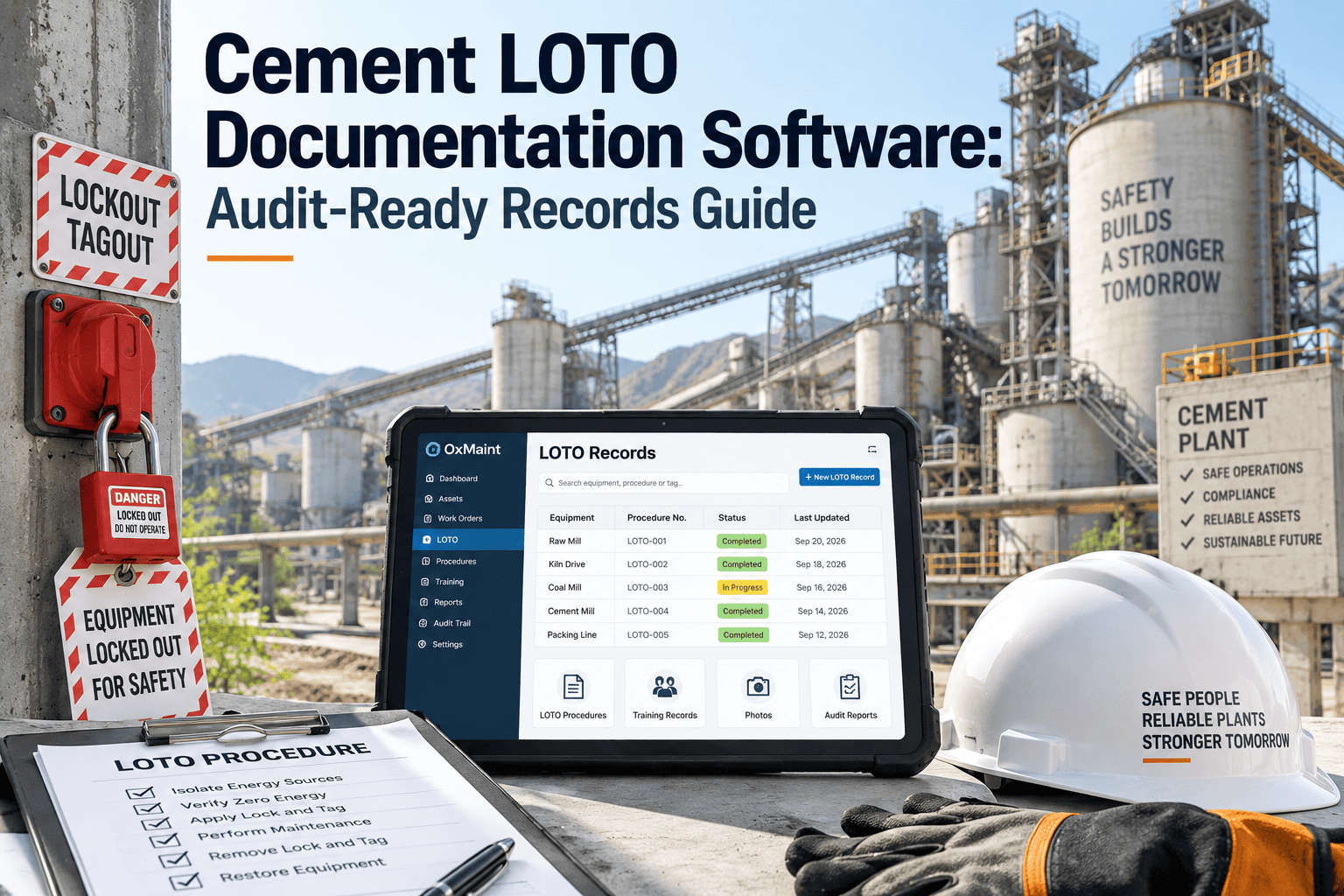
Baghouse failure in a cement plant almost never happens without warning — differential pressure trends upward for days, a hopper bridge forms slowly, a pulse valve loses response shift by shift. The problem is not the equipment; it is the missing daily log. Plants that track DP per compartment, bag life by compartment, and hopper discharge status every shift catch these signals weeks before an emission exceedance or a fan trip forces unplanned downtime. A single avoided bag failure event typically saves $15,000 to $40,000 in emergency replacement cost alone — not counting permit exposure or production interruption. Start logging your baghouse DP and bag life records in OxMaint free — per-compartment DP trending, bag replacement tracking, hopper status, and automated work order generation pre-configured for cement plant dust control. Book a demo to walk through your baghouse assets with an OxMaint specialist.
Differential pressure per compartment, bag life tracking, hopper discharge status, pulse-jet air pressure, and CMMS sign-off — the complete daily record that keeps your baghouse inside permit limits and out of emergency territory.
99.9%
Filtration efficiency achievable — only when DP is logged and bags are tracked by compartment, not averaged
100–200mm WC
Normal operating DP band for a correctly pulsed cement plant baghouse compartment
2–3 yrs
Typical bag service life — cut short to 12 months when DP is unmonitored and hopper bridging goes undetected
30%
Bag life extension achievable when DP-driven cleaning replaces fixed-interval pulse cycles, per industry data
How to Read a Baghouse — Before You Open the Log Sheet
DP Rising
Bags blinding
Dust cake building faster than pulse-jet can clean. Bags approaching end of service life, moisture causing caking, or pulse valves losing effectiveness. Normal response window: same shift.
DP Stable
System healthy
Airflow and cleaning are balanced. Bags performing within design parameters. Log the reading, confirm hopper discharge running, and close the shift.
DP Sudden Drop
Bag failure suspected
A sharp DP drop in a previously high-DP compartment is not a cleaning success — it is a hole in a bag. Investigate before assuming improvement. Check stack opacity immediately.
DP Above 200 mm WC
Urgent action
Sustained above 200 mm WC despite adequate pulse pressure: isolate the compartment for manual cleaning or emergency bag inspection. Fan overload risk within hours.
Daily DP Log — Per Compartment Record
Log every compartment at the start of each shift and again at handover. Two readings per shift, trended over 48 hours, is the minimum to catch blinding drift before it becomes an emission event.
Below 100 mm WC
Possible bag failure or bypass — check stack opacity, isolate and inspect
100–150 mm WC
Normal operating range — log and continue. Pulse cycle balanced.
150–200 mm WC
Advisory — increase pulse frequency. Schedule inspection if trend continues next shift.
Above 200 mm WC
Urgent — isolate compartment, manual cleaning or bag inspection required same shift
Compartment DP Log — Daily Checklist Items
Record inlet-to-outlet DP for every active compartment at shift start — individual compartment readings, not a single unit-average; blinding in one compartment is masked by a unit average reading
Tool: OxMaint mobile form — per-compartment fields pre-configured · Baseline shown alongside each entry field
Assess DP trend direction over prior 48 hours for each compartment — a 15 mm WC per shift rising trend is a warning sign even if the absolute reading is still within the normal band
OxMaint displays 48-hour trend alongside current reading automatically — no manual calculation needed
Confirm pulse-jet manifold air supply pressure within 5.5–7 bar — low compressed air pressure reduces cleaning pulse energy and is the most common cause of unexplained sustained high DP
Log: compressed air pressure bar · Flag if below 5.5 bar — check compressor output and line pressure drop
Check control panel for active DP alarms or solenoid valve fault indicators — any active fault that has not been acknowledged and actioned by the prior shift must be carried forward as an open work order
Log: all active alarms acknowledged / faults carried forward / no faults · Do not clear alarms without investigation
Inspect exhaust stack for visible emissions — any dust plume or visible opacity above the permit baseline is a bag failure indicator requiring immediate compartment isolation and inspection
Permit-level finding: generate urgent work order immediately, notify environmental officer, log timestamp
Confirm compartment isolation valves are open and seated correctly — a partially closed isolation valve mimics high DP blinding and sends maintenance teams in the wrong direction
Verify: all active compartment valves physically confirmed open · Cross-check with DCS damper position indication
OxMaint Tracks Per-Compartment DP, Bag Life, and Hopper Status — Every Shift, Automatically Alerted
Pre-configured for cement plant baghouses. DP baseline per compartment, bag replacement calendar, hopper bridging alerts, and CMMS sign-off — live in 2 weeks.
Compartments are not replaced uniformly. The inlet-side compartment of a kiln ID baghouse may need bags every 18 months while the outlet compartment runs 36 months. Tracking service hours per compartment — not one unit-wide date — is the difference between planned replacement and emergency shutdown.
Inlet Compartments
12–18 months
Highest dust loading and temperature. Alkali-bearing cement dust attacks bag fabric at seam and crown. DP trend accelerates rapidly as bags age past 15 months.
Flag for inspection at 12 months. Replace before 18 months in high-alkali or high-temperature applications.
Mid-Unit Compartments
24–30 months
Moderate dust loading. Bag life is most sensitive to pulse-jet performance — failed solenoid valves in one row cause premature blinding of adjacent bags from overloading.
Inspect bags at 24 months via flashlight from clean side. Replace if crown thinning visible.
Outlet Compartments
30–36 months
Lowest dust loading but most critical for emissions compliance — outlet compartment bag failures go directly to the stack. DP drops here are permit events, not maintenance events.
Inspect at 30 months. Any DP drop must be treated as a bag failure and inspected same shift.
Bag Life Log — Daily and Per-Replacement Fields
Confirm bag installation date is recorded in OxMaint for each compartment — if a compartment lacks an installation date in CMMS, that is a gap to close today, not at the next overhaul
Required fields: compartment ID / bag type and grade / installation date / row count / expected life months
Log current service hours or months against the baseline life for each compartment — OxMaint calculates remaining useful life and triggers an inspection PM work order at configurable lead time before the expected end-of-life date
OxMaint auto-generates bag inspection PM 60 days before calculated replacement date — procurement lead time built in
Record any bag replacement event immediately in OxMaint — compartment ID, number of rows replaced, bag grade used, and replacement reason (planned / DP-triggered / failure); this resets the life counter for that compartment
Replacement reason matters: pattern of failure-triggered replacements flags a systemic problem (moisture, alkali, over-pulsing)
Log cage condition at every bag replacement — corroded, bent, or broken cage wires tear new bag fabric within weeks; replacing bags without checking cages is the most common cause of premature bag failure
Cage condition: good / surface rust only / wire bent / wire broken — replace cage if any wire broken or seam weld cracked
Hopper Discharge — Daily Status Check
A baghouse hopper is not a storage vessel. Dust allowed to accumulate builds a bridge that blocks discharge, forces dust back into the bag section, and can cause hopper overflow that ruins the bags above. Every shift must confirm discharge is running and flowing.
What Causes Hopper Bridging
Cement dust exposed to moisture hardens into immovable bridges — especially common after shutdowns in cold or humid conditions
Discharge conveyor or rotary airlock running but not pulling material — gap between valve and conveyor inlet allows dust to pack
Hopper angle too shallow for the dust's angle of repose — cement kiln dust typically requires 60°+ hopper angles to flow freely
Hopper heater or heat tracing not operating during cold weather — condensation cements dust to hopper wall and initiates bridging
Signs of Bridging to Check Every Shift
Hopper high-level alarm active — dust not discharging at the rate it is collecting, bridge forming at outlet
DP rising despite normal pulse response — when hopper fills to inlet level, dust re-entrains into bags and causes rapid blinding
Discharge conveyor running at normal amps but no material visible at conveyor end — confirm bridge has not formed above rotary valve
Abnormal dust around hopper exterior — a bridged and overflowing hopper can push dust out at seam joints before a high-level alarm fires
Hopper Discharge — Daily Checklist Items
Confirm all rotary airlock valves running and material discharging freely — verify by observing material flow at discharge point or confirming rotary valve motor amperage at normal operating load
Log: all airlocks running / valve stalled on hopper X / material flow confirmed
Confirm screw conveyor or pneumatic transport running and not blocked — check shaft seal condition for dust leakage into bearing housings; cement dust in a bearing housing accelerates failure from weeks to days
Log: conveyor running / seal condition: good / dust at seal / bearing temperature above normal
Check for hopper high-level alarm active on any compartment — high-level alarm with normal DP indicates rapid dust generation event; high-level alarm with rising DP indicates discharge failure causing dust backfill into bags
High-level + rising DP: urgent work order — isolate compartment and clear discharge before bags are overloaded
Verify hopper heating or heat tracing operational in cold weather — inspect heater status panel or confirm hopper skin temperature at any accessible point; bridging from cold-induced condensation is the most common winter baghouse failure
Cold-weather standard: verify heater status every shift when ambient temperature below 10°C
Check hopper exterior for any visible dust accumulation at seam joints or flanges — dust escaping at hopper exterior indicates either overfill or a failed gasket allowing pressurised dust to escape; both require same-shift investigation
Log: no external dust visible / dust at seam location — photograph and log for engineering review
CMMS Daily Sign-Off — Required Fields Before Shift Handover
01
Compartment DP Readings
Inlet-to-outlet DP for every active compartment. Trend direction (rising / stable / falling) vs prior shift. Any compartment outside the 100–200 mm WC band: work order number attached.
02
Pulse-Jet Air Pressure
Manifold pressure reading in bar. Confirmed within 5.5–7 bar range. Any solenoid valve fault active: fault code and compartment reference logged. Pressure below minimum: advisory work order raised.
03
Bag Life Status
Current service months per compartment confirmed in OxMaint. Any compartment within 60 days of scheduled replacement: procurement status confirmed. Any emergency replacement made this shift: reason and compartment logged.
04
Hopper Discharge Status
All rotary airlocks running and discharging. Screw conveyor or pneumatic transport running without obstruction. No hopper high-level alarms active at handover. Hopper heating operational if ambient below 10°C.
05
Emissions and Visual Check
Stack opacity: clear / plume visible. If plume visible: compartment isolated, urgent work order raised, environmental officer notified. Timestamp of observation logged. Housing and duct flange leak check: pass / location flagged.
06
Operator Sign-Off
Operator name and timestamp. All readings entered. Open work orders from prior shift: status updated. Any new urgent findings from this shift: work order number confirmed. Incoming operator verbally briefed on any open issues.
Frequently Asked Questions
What is the normal differential pressure range for a cement plant baghouse, and when should I be concerned?
Normal operating DP for a correctly pulsed cement plant compartment is 100–200 mm WC (approximately 4–8 inches of water column). Readings consistently above 200 mm WC despite adequate pulse air pressure indicate bag blinding requiring same-shift investigation. A sudden drop to below 100 mm WC in a previously high-DP compartment is a bag failure signal — not a cleaning success — and requires immediate stack opacity check. Set up per-compartment DP thresholds in OxMaint free to receive automatic work order generation when any compartment breaches either limit.
How do I calculate and track bag life per compartment in a cement plant baghouse?
Record the installation date, bag grade, and row count for each compartment in CMMS at the time of replacement — not retrospectively. Bag life in cement plant applications ranges from 12 months for inlet compartments on high-alkali kiln lines to 36 months for outlet compartments in clean-gas applications. OxMaint calculates remaining useful life automatically and generates a bag inspection work order 60 days before the scheduled end-of-life date, giving sufficient lead time for procurement. Book a demo to see the bag life tracking module configured for your compartment count.
What causes hopper bridging in a baghouse and how do I detect it during daily rounds?
Hopper bridging in cement plant baghouses is most commonly caused by cement dust moisture absorption during shutdowns, cold hopper walls causing condensation, or discharge conveyor interruptions that allow dust to pack above the rotary valve. During the daily walk, the key indicators are: hopper high-level alarm active, DP rising despite normal pulse response (dust re-entraining into bags from an overfull hopper), and discharge conveyor running at normal amps but no material at the conveyor outlet. Cold-weather operations require hopper heater confirmation every shift when ambient temperature drops below 10°C. Start logging hopper status in OxMaint free to build a bridging event frequency record per compartment.
How does DP-driven pulse cleaning extend bag life compared to fixed-interval cleaning?
Fixed-interval pulse cycles clean on a timer regardless of actual dust cake thickness — this over-pulses clean compartments, which stresses bag fabric and seams unnecessarily, and under-pulses blinding compartments during high-production periods. DP-driven cleaning initiates a pulse only when a compartment reaches its configured high-DP setpoint, extending bag service life by up to 30% in documented cement plant cases. The prerequisite is per-compartment DP logging with thresholds set correctly — which is precisely what the daily log in this checklist establishes. Book a demo to see OxMaint configured for DP-triggered cleaning logic on your baghouse.
Can CMMS software automatically track baghouse DP and generate work orders when thresholds are breached?
Yes — when configured correctly. OxMaint stores the baseline DP band per compartment, trends every shift reading, and generates a work order automatically when any compartment breaches the high or low threshold. The work order pre-fills with the compartment ID, current DP reading, trend over the prior 48 hours, bag installation date, and pulse valve fault history — everything the technician needs to diagnose the issue without accessing four separate systems. Shift sign-off in OxMaint requires all DP readings to be logged before the handover form can be closed, which eliminates the single biggest compliance gap in baghouse operations: readings taken but not recorded. Start free in OxMaint to configure your first baghouse compartment DP alert today.
Stop Managing Your Baghouse on Paper — Switch to a Live DP Log in 2 Weeks
OxMaint pre-configures per-compartment DP baselines, bag life calendars, hopper bridging alerts, pulse-jet pressure monitoring, and shift sign-off workflows. Every reading trended. Every threshold breach actioned. Every bag replacement date tracked automatically.