The primary crusher is the first piece of equipment limestone touches after blasting — and the one with the least tolerance for an unplanned stop. A missed bearing temperature reading, an unlogged motor current spike, or a discharge chute blockage building undetected can halt raw material feed to the entire kiln line within a single shift. One missed inspection on a primary crusher can shut a 5,000 TPD cement line for 12 hours or longer. The daily inspection checklist that follows covers every check a cement plant operator needs to complete before and during each operating shift — bearings, motor current, jaw plate wear, discharge chute, dust suppression, and lubrication — with the CMMS sign-off fields that turn individual readings into a documented trend record. Start logging your crusher inspection readings in OxMaint free — shift-level bearing temps, motor current trending, and auto-generated work orders pre-configured for cement plant primary crushers. Book a demo with an OxMaint cement specialist to walk through your crusher asset setup.
Cement Plant Checklist · Daily Operator Inspection · Primary Crusher
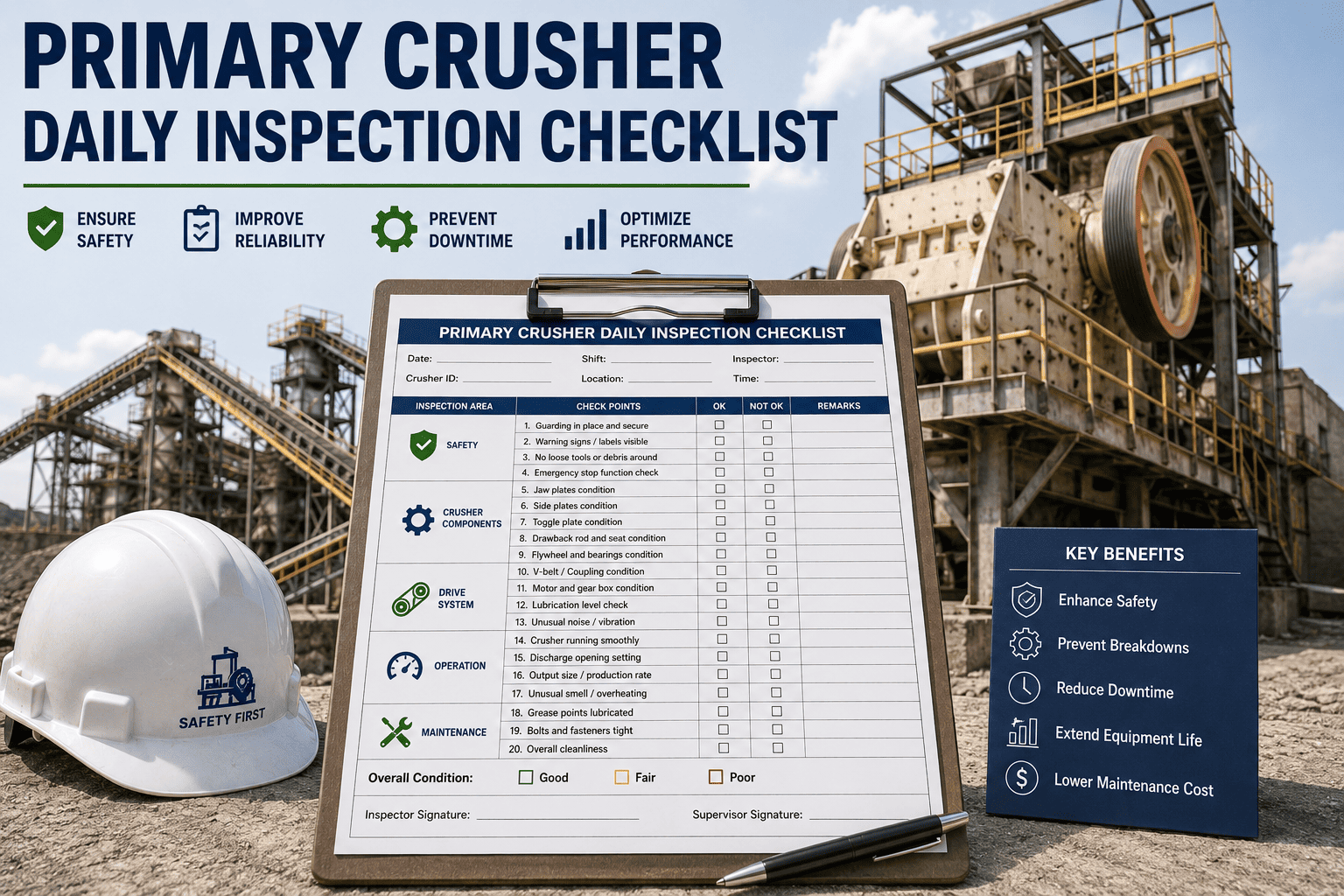
Primary Crusher Daily Inspection Checklist
Bearing temperatures, motor current, jaw plate condition, discharge chute flow, dust suppression, lubrication, and CMMS sign-off — every check your shift operator must complete before raw material enters the crushing chamber.
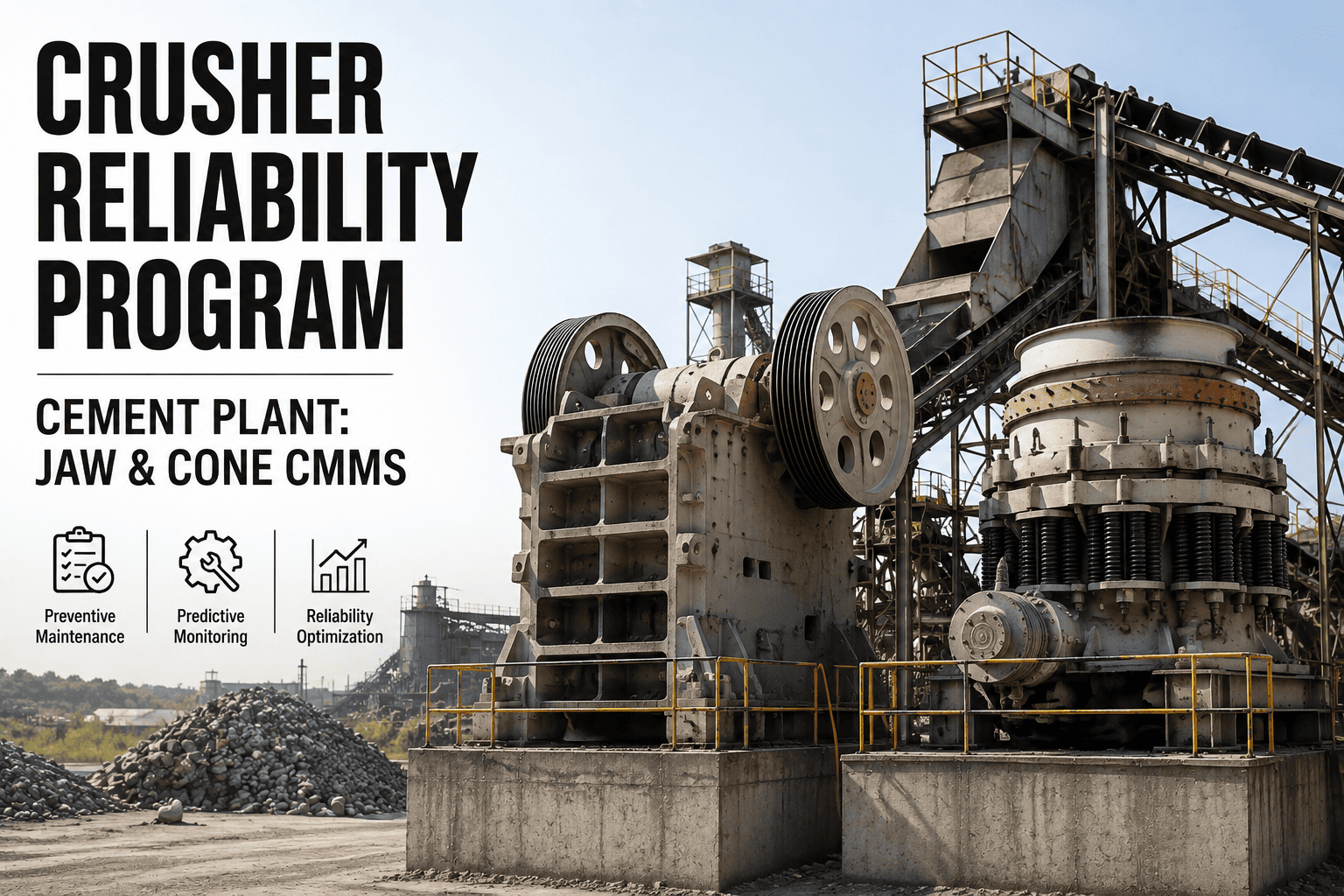
Jaw Crusher
Most common cement primary — toggle plate, eccentric shaft, pitman arm, fixed and swing jaw
Gyratory Crusher
High-capacity lines — spider bearing, mantle, concave segments, eccentric assembly
Impact Crusher
Limestone-only feed — rotor, blow bars, impact plates, rotor bearing assembly
Top 5 Primary Crusher Failure Modes — And What the Daily Inspection Catches
01
Bearing Failure
$75K+ avoided per event
Daily signal: temperature above baseline or unusual coast-down time at shift end
02
Jaw Plate Wear-Out
Emergency replacement 3–5x planned cost
Daily signal: motor current rising at same feed rate; product size coarsening
03
Discharge Chute Blockage
Up to 12 hrs raw feed interruption
Daily signal: conveyor load falling, material pile-up at chute exit visible
04
Toggle Plate Failure (Jaw)
72-hr structural repair if frame damaged
Daily signal: abnormal sound during stroke, motor current spike under load
05
Lubrication Starvation
Accelerates all other failure modes
Daily signal: oil level low, grease nipple not taking charge, oil temp above spec
Pre-Start Inspection — Before Every Shift Startup
Complete every item below before issuing the crusher start command. Pre-start checks catch the overnight changes — lube leaks, debris in the chamber, toggle wear — that run-while-operating checks cannot detect.
Safety and Isolation Verification
Confirm all LOTO tags removed and isolation permits cleared before issuing start — verify with maintenance lead that no work orders are open with active LOTO on this crusher
Responsible: Shift Operator · Tool: OxMaint active work order check · Non-negotiable before start command
Inspect crushing chamber — remove any rocks lodged from prior shift end, check for tramp metal or non-crushable material that may have entered with feed overnight
Tramp metal in chamber at startup: immediate damage risk to jaw plates and toggle — never start with unknown material in chamber
Confirm all guards and covers in place — no access panels open, no guardrails removed, no inspection windows left unlatched from prior maintenance access
Log: all guards confirmed present / guard missing at location — do not start until all guards replaced
Lubrication Pre-Start Check
Check oil level in crusher lubrication system — confirm at correct operating level on sight glass; low oil is the most common root cause of premature bearing failure and must be addressed before start
Log: oil level — correct / low / overfull · If low: top up with correct grade before start, log volume added
Check lubrication oil for contamination — discolouration (milky appearance indicates water ingress, metallic sheen indicates bearing wear particles) requires oil sample to be sent to laboratory before crusher operates
Milky or metallic oil: do not start — create urgent work order, take oil sample, notify maintenance lead
Verify grease nipples on eccentric shaft bearings, pitman arm, and toggle seat are accessible and charged — confirm grease lines are not blocked or kinked; blocked lines cause lubrication starvation within hours of run time
Apply grease charge to each nipple per OEM interval — log if any nipple not taking grease (blocked line: flag for maintenance)
Start lube oil circulation pump and confirm oil flow before issuing crusher start — most crushers require 3–5 minutes of pre-lubrication at startup to build adequate oil film on eccentric shaft bearings
Pre-lube time: per OEM specification · Log: pre-lube duration / oil pressure confirmed / start command issued
Mechanical Pre-Start — Jaw and Toggle
Inspect toggle plate visually — check for cracks, surface deformation, or seat wear; a cracked toggle plate at startup will fail under load and may allow the swing jaw to drop, causing frame damage and converting a short stop to a 72-hour structural repair
Any crack or visible deformation: do not start — create shutdown work order immediately
Check jaw plate profile — fixed and swing jaw plates should be compared against prior shift log; worn plate profile approaching condemn limit (typically 80mm remaining thickness for the order trigger) requires procurement status confirmation
Log: jaw plate condition — good / monitoring (approaching 80mm) / order triggered · Photograph if approaching limit
Check flywheel and V-belt / drive condition — inspect for belt fraying, cracking, or loss of tension; a slipping drive belt at startup shows as low torque output and rising motor temperature at normal amperage
Log: belt condition — good / fraying / tension reduced · Flag belt for replacement before next shift if tension low
Bearing Temperature and Motor Current — Running Checks (Every Shift)
These are the two readings that matter most during operation. Log them at startup, at mid-shift, and at handover. Trend data over 48 hours catches failures days before they happen.
Rotor Bearing Temperature
Below 70°C
Normal — log and continue
70–85°C
Advisory — check lubrication and load; advisory work order
Above 85°C
Critical — reduce load or stop; urgent work order before next reading
Record both drive-end and non-drive-end temperatures separately. A difference greater than 10°C between the two ends indicates uneven loading or lubrication imbalance — flag even if both readings are below 70°C.
Motor Current (Drive Motor Amps)
Within 10% of baseline
Normal — log and continue at current feed rate
10–20% above baseline
Advisory — check feed size and jaw plate wear; reduce feed if sustained
Spike or above 20%
Possible tramp metal or blockage — reduce feed immediately; investigate
Motor current spikes indicate feed size problems, non-crushable material, or discharge chute blockage causing crusher to stall against material. Sudden drop to zero with crusher still running indicates belt slip or coupling failure — stop and inspect.
Running Inspection Items — Log Per Shift
Record bearing temperature at drive-end and non-drive-end at startup, mid-shift, and handover — minimum 3 readings per shift; single-point reading per shift gives no trend information
Tool: OxMaint mobile — bearing temp fields per location, 48-hour trend displayed automatically
Log motor current at the same three time points — note feed rate at each reading so current is contextualised correctly; rising current at reduced feed rate is a more significant warning than rising current at increased throughput
Log: motor amps / feed rate tph / product CSS setting at time of reading
Listen for abnormal sounds during each crusher pass — metallic impacts (tramp metal or loose jaw plate bolt), grinding (bearing deterioration), or irregular rhythm (uneven feed distribution causing intermittent overload)
Log: no abnormal sound / sound type and timing — flag any new sound for investigation within 2 hours
Measure coast-down time at shift end — start stopwatch when crusher power is cut; record the time to full stop with counterweights at lowest point; changes of more than 15 seconds vs prior shift baseline indicate bearing condition change
Getting longer: bearing gaining clearance. Getting shorter: bearing drag or shaft issue — both are pre-failure signals
OxMaint Logs Crusher Bearing Temps, Motor Amps, and Coast-Down Time — All in One Shift Report
Pre-configured for cement plant primary crushers. Baseline values stored per bearing location. Threshold alerts auto-generate work orders. Shift handover requires all readings before sign-off can close.
Discharge Chute and Dust Suppression — Daily Walk Checks
Discharge Chute — Flow Confirmation
Confirm material flow through discharge chute to downstream conveyor — observe at inspection window or by conveyor load reading; no material reaching conveyor within 5 minutes of feed start indicates chute blockage
Log: flow confirmed / partial blockage / full blockage · Blockage: stop feed immediately, do not run crusher against blocked discharge
Check chute liner wear at accessible inspection points — wear liners protect the chute steel from abrasion; thinned liners allow through-wear that creates material spillage and emergency repair conditions
Log condition: good / thinning visible / breakthrough — flag any breakthrough immediately
Check for oversized boulder accumulation at chute entry — limestone boulders that exceed the crusher's maximum feed size can lodge at the chute-to-conveyor transition and cause both chute damage and conveyor belt impact damage
Flag any boulder accumulation — check feed grizzly openings and feeder settings if recurring
Inspect chute flange bolts and seal joints for material leakage — crushed limestone escaping at chute joints creates dust hazards, conveyor belt damage below the chute, and progressive structural corrosion of chute steel
Log: no leakage / leak at location — flag for gasket replacement at next planned stop
Dust Suppression — Shift Check
Confirm dust suppression system operating — water spray nozzles active at crusher feed point and discharge chute; dry fog or chemical suppression system confirmed on per system type
Log: suppression system active / nozzle blocked / system off — dust suppression failure is a permit and health compliance event
Check water supply pressure to spray nozzles — low pressure reduces suppression coverage; a blocked main supply valve or damaged pump is detectable from the pressure gauge before the operator notices dust generation increasing
Log: water pressure at nozzle manifold · Flag if below OEM minimum — blocked nozzles require cleaning or replacement
Inspect crusher enclosure for gaps, open access doors, or missing skirt seals — enclosure integrity is as important as the suppression system for containing respirable dust at the crusher feed point and discharge
Log: enclosure intact / gap at location — flag for sealing before next shift if any opening found
Confirm crusher dust collector (local baghouse or wet scrubber) running and performing — check differential pressure or exhaust flow indicator; a failed local dust collector combined with a blocked suppression nozzle is an immediately reportable air quality event
Log: dust collector running / DP within normal band / fault active — fault: notify environmental officer same shift
Jaw Plate and Wear Part Condition — Daily Visual Assessment
| Wear Part |
What to Observe Daily |
Order Trigger |
Condemn Limit |
Lead Time Required |
| Fixed Jaw Plate |
Profile loss at tooth tips, surface cracking, bolt seat deformation |
80mm remaining thickness |
50mm remaining thickness |
3–4 weeks minimum |
| Swing Jaw Plate |
Asymmetric wear (uneven feed distribution), cracking at plate edge |
80mm remaining thickness |
50mm remaining thickness |
3–4 weeks minimum |
| Toggle Plate |
Surface cracks, seat wear, dimensional change vs baseline measurement |
Any crack visible |
Any crack — immediate shutdown |
1–2 weeks (keep spare on site) |
| Side Liners (Cheek Plates) |
Thinning at upper and lower edges, cracks at plate corners |
50% of original thickness |
30% of original thickness |
2–3 weeks |
| Discharge Chute Liners |
Thin zones visible, through-wear at impact points, liner gaps |
30% remaining liner |
Through-wear visible — immediate |
1–2 weeks |
| Eccentric Shaft Bearings |
Oil condition, temperature trend, coast-down time change |
Temperature above 70°C trend |
Above 85°C or noise developing |
4–6 weeks (critical spare) |
Shift Sign-Off — CMMS Daily Log Fields
01
Pre-Start Safety Confirmation
LOTO cleared, chamber clear, guards in place, lubrication level confirmed, pre-lube cycle completed. Start authorisation signed by shift operator before crusher energised.
02
Bearing Temperature Log
Drive-end and non-drive-end temperature at startup, mid-shift, and handover. Any reading above 70°C: work order number attached. Coast-down time recorded at shift end.
03
Motor Current Record
Amps at startup, mid-shift, handover with feed rate noted at each reading. Any spike above baseline recorded with timestamp. Trend direction: stable / rising / falling.
04
Discharge Chute and Wear Parts
Flow confirmed to downstream conveyor. Chute liner condition: good / monitoring / flagged. Jaw plate condition log updated. Toggle plate: no crack confirmed.
05
Dust Suppression Status
Suppression system: active / fault. Nozzle condition: all clear / blocked nozzle at location. Enclosure integrity: intact / gap at location. Local dust collector: running / fault logged.
06
Operator Sign-Off
All readings entered in OxMaint. Open work orders from prior shift: status updated. Any new findings: work order raised with asset ID and description. Incoming operator briefed verbally.
Frequently Asked Questions
What is the most important daily check on a cement plant primary crusher?
Bearing temperature logging at drive-end and non-drive-end separately is the single most important daily check — bearing failure is the highest-cost failure mode and the one with the longest lead time to prevent. A temperature trend rising 5°C per shift over three shifts is a clear early-warning signal. The second check is motor current: rising amps at unchanged feed rate indicates jaw plate wear, discharge chute restriction, or tramp metal in the feed. Logging both every shift and trending them in OxMaint gives 48–72 hours of advance warning before either becomes a forced stop.
Start logging crusher bearing temps in OxMaint free to build your first trend baseline within one week.
How often should jaw plates be measured and when should replacement be ordered?
Visual assessment should happen every shift and thickness measurement weekly using a profile gauge or caliper at the plate midpoint. The order trigger is 80mm remaining thickness — not the condemn limit of 50mm. The gap between 80mm and 50mm provides the 3–4 week procurement and planning window needed to avoid emergency replacement, which typically costs 3–5 times the planned replacement cost in labour, crane hire, and lost production. A plant that measures weekly and orders at 80mm will never have an emergency jaw plate event.
Book a demo to see how OxMaint tracks jaw plate thickness and auto-generates procurement work orders at the order trigger point.
What does a motor current spike indicate on a primary jaw crusher?
A motor current spike above 20% of baseline during normal feed rate is the primary signal for tramp metal entering the crushing chamber — non-crushable material causes a sudden load spike as the crusher stalls against it. Sustained 10–20% above baseline at unchanged throughput indicates either advancing jaw plate wear (increasing energy needed per tonne), discharge chute restriction forcing material to compress in the chamber, or a bearing beginning to drag. The correct response to any spike above 20% is to reduce feed immediately and investigate before resuming normal throughput.
Start logging motor current in OxMaint to establish a baseline within the first week of use.
How does coast-down time measurement help predict crusher bearing failure?
Coast-down time — the seconds from power cutoff to full stop with counterweights at their lowest point — is a sensitive bearing health indicator that requires no tools and takes under 5 minutes at shift end. A coast-down time lengthening progressively (for example, from 2:25 to 2:45 to 3:00 over three shifts) indicates bearings are gaining clearance — a pre-failure signal. A shortening coast-down time indicates increasing bearing drag or shaft alignment issues. Either direction, logged in OxMaint and compared against the rolling baseline, gives 48–72 hours of warning before the bearing reading enters the critical temperature band.
Book a demo to see coast-down trending configured in OxMaint.
Can a CMMS manage the daily primary crusher inspection log automatically?
Yes — and it must, for the inspection to have any value beyond the individual shift. OxMaint pre-configures per-bearing temperature baselines, motor current thresholds, jaw plate wear stage tracking, and shift sign-off requirements for each crusher asset. When a bearing reading exceeds the advisory threshold, a work order generates automatically with the asset location, current reading, trend over the prior 48 hours, and last lubrication record attached. The shift sign-off form in OxMaint cannot be closed until all required readings are entered — which eliminates the most common gap in crusher maintenance records: readings taken on paper and never entered into a system where they can be trended.
Start free in OxMaint to configure your first crusher daily log today.
Stop Logging Crusher Readings on Paper — Build a Live Trend Record in 2 Weeks
OxMaint pre-configures bearing temperature baselines, motor current thresholds, jaw plate wear stage tracking, coast-down time logging, and shift sign-off for your primary crusher — no IT project, no manual trend calculation, no missed readings at handover.