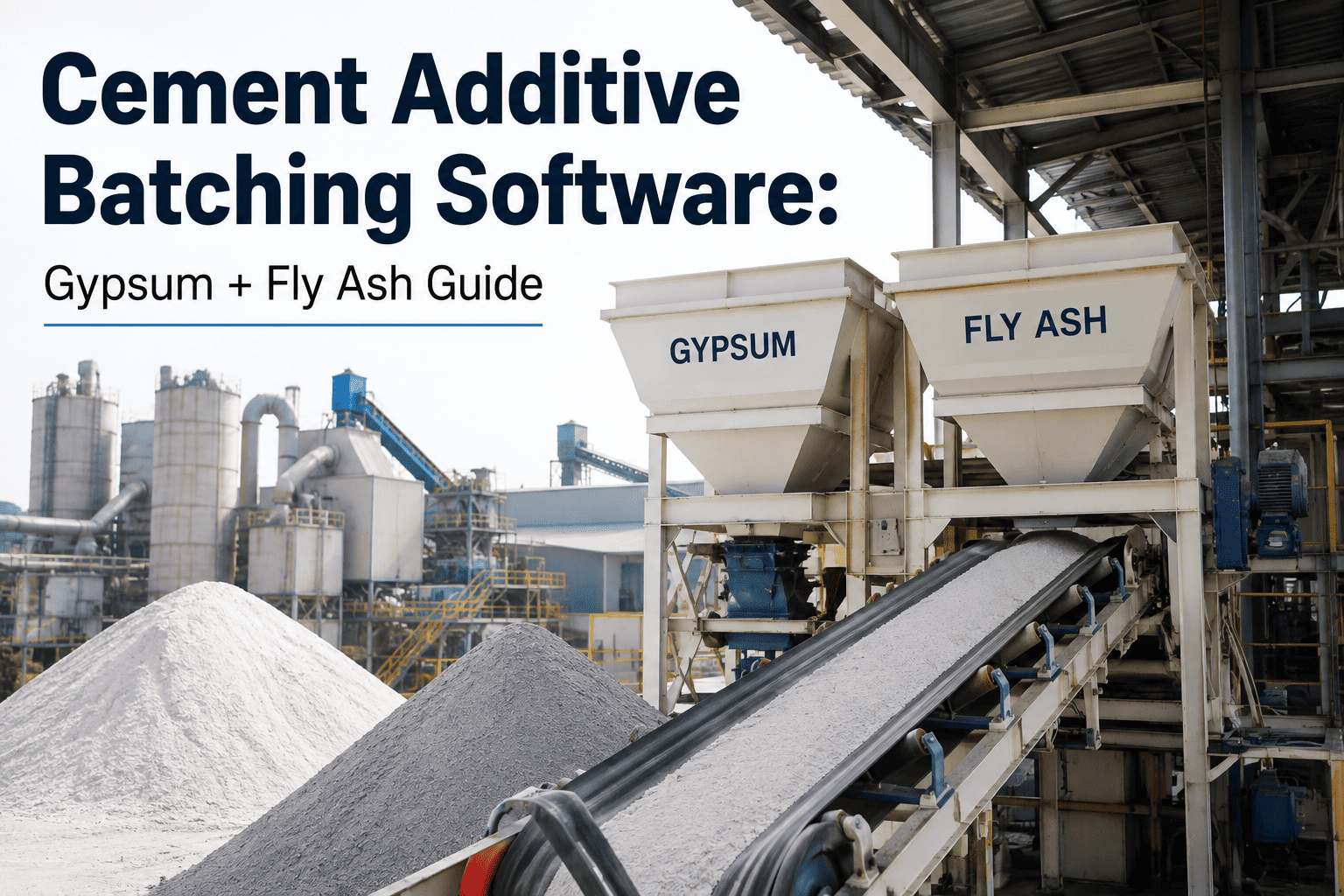
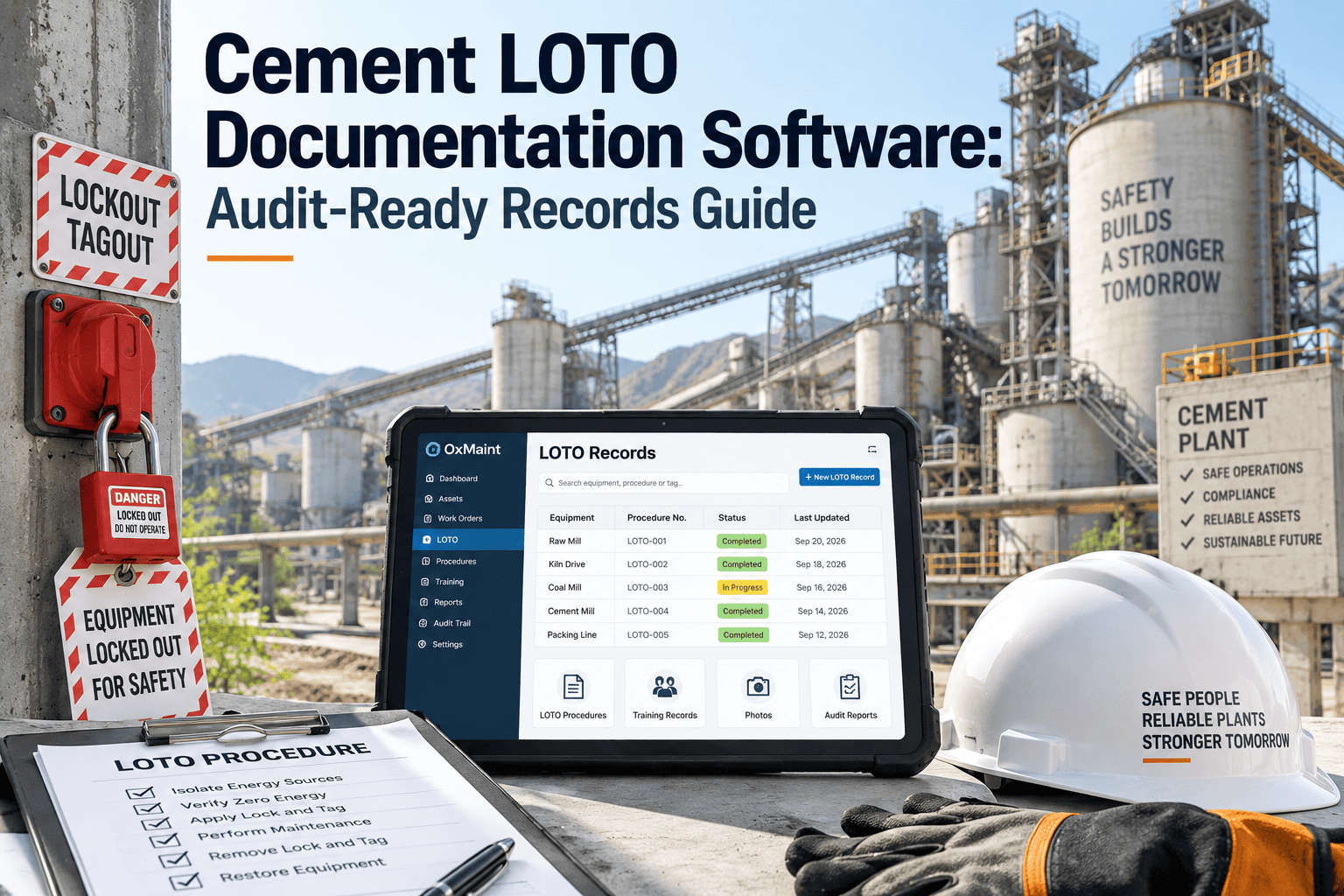
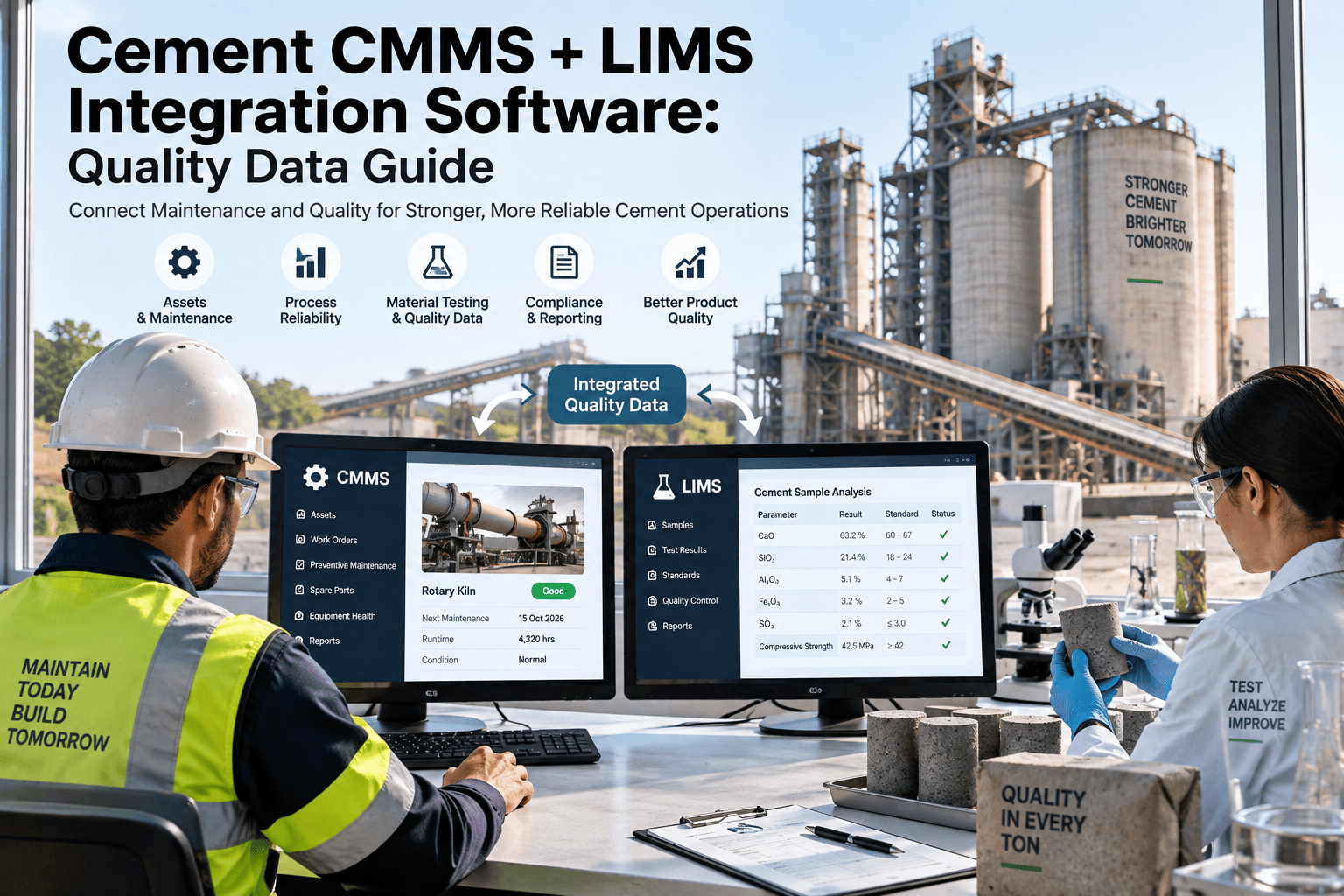
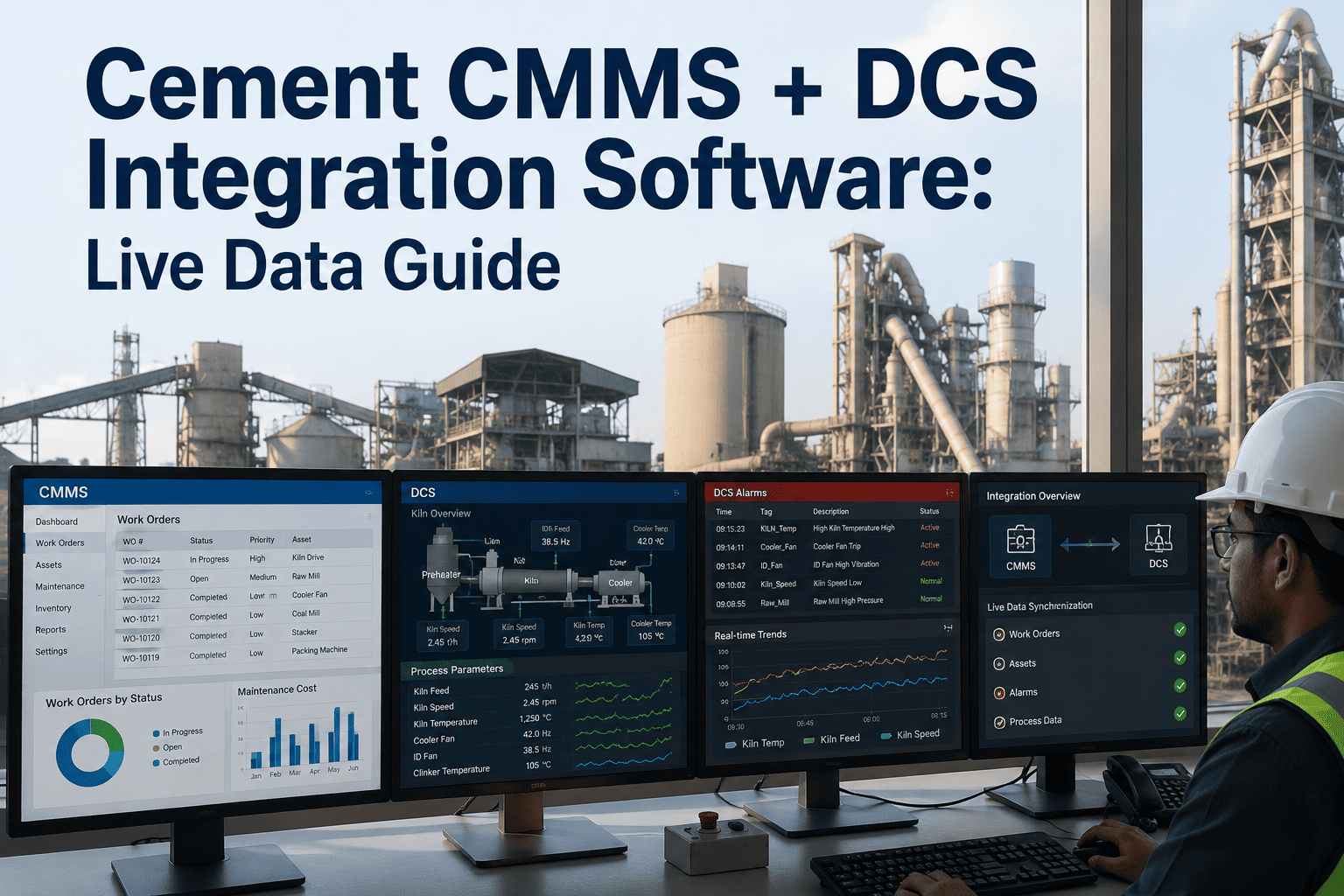
Cement additive batching decides whether every bag of PPC or PSC leaving your plant meets its promised grade, or gets rejected on a construction site three states away. Gypsum controls how fast the cement sets, while fly ash and slag replace a portion of costly clinker and change strength gain, heat of hydration, and long-term durability. Every one of these additives has a narrow dosing band written into IS 1489, IS 455, and ASTM C563 — and a weighfeeder that drifts by even half a percent for a single shift can push a batch outside that band without a single alarm sounding in the control room. This guide breaks down what gypsum, fly ash, and slag batching accuracy actually protects, what happens the moment it slips, and how plants are using OxMaint's CMMS to keep every feeder, silo, and calibration record inside tolerance around the clock.
Cement Additive Batching · Gypsum · Fly Ash · Slag · 2026 Guide
Cement Additive Batching Software: The Gypsum, Fly Ash & Slag Guide Every Plant Runs On
How dosing accuracy on gypsum, fly ash, and slag determines whether your PPC and PSC actually meet IS 1489 and IS 455 — and how CMMS-driven batching discipline keeps every silo, feeder, and calibration record audit-ready, batch after batch.
±0.5%
Typical weighfeeder tolerance needed to keep gypsum dosing inside IS 1489 limits
1.5–2.0%
Optimum SO3 content by cement weight for correct setting time, per ASTM C563 and EN 196-1
15–35%
Fly ash replacement range permitted in PPC under IS 1489 (Part 1)
25–70%
Slag content range permitted in PSC under IS 455, typically 30–45% in Indian plants
Understanding The Additives
The Three Additives That Decide What Actually Comes Out Of Your Mill
Clinker is the expensive, energy-intensive part of cement. Everything blended with it afterward is where cost, strength, and durability get decided — and where the smallest dosing error does the most damage. Gypsum, fly ash, and slag are not interchangeable filler; each one is doing a distinct chemical job, and each one has its own tolerance for error.
Setting Time Control
Gypsum
Added at 3–5% during clinker grinding, gypsum controls the rate at which tricalcium aluminate reacts with water. Too little and the cement flash-sets in the mixer; too much and excess sulfate keeps reacting long after the pour, forming ettringite that expands and cracks cured concrete months later.
Dosing driver: weighfeeder accuracy on the gypsum feed line into the grinding mill
PPC Additive
Fly Ash
Portland Pozzolana Cement blends 15–35% fly ash with clinker and gypsum under IS 1489 (Part 1). Fly ash lowers heat of hydration, reduces shrinkage cracking, and improves long-term pore refinement — but only within the certified band the plant declared for that grade.
Dosing driver: silo level consistency and moisture-adjusted feed rate
Slag (GGBS)
PSC Additive
Portland Slag Cement under IS 455 permits 25–70% ground granulated blast furnace slag, though most Indian plants run 30–45%. Slag improves sulfate and chloride resistance dramatically, which is exactly why underdosing quietly erases the durability claim printed on the bag.
Dosing driver: separate grinding or blending ratio control between clinker and slag streams
Batching Variable
Moisture & Bulk Density
Fly ash and slag bulk density shifts with moisture and storage time. A feeder calibrated for dry material can silently under-deliver or over-deliver by a full percentage point once ambient humidity or silo aeration changes — without any fault code being triggered.
Dosing driver: periodic re-calibration tied to material condition, not just a fixed calendar date
The Cost Of Drift
What Additive Batching Drift Actually Does To A Cement Batch
Batching deviations rarely show up as a dramatic failure on the first bag. They show up three weeks later as a customer complaint, a failed 28-day strength test, or a compliance auditor asking why the declared fly ash percentage does not match the feeder log. Here is what each failure mode actually looks like on the plant floor.
High Impact
Gypsum Underdosing — Flash Or False Set
When SO3 content falls below roughly 1.5% by cement weight, tricalcium aluminate reacts too fast and the mix stiffens within minutes of mixing, ruining placement on site and triggering rejected-load complaints back to the plant.
Rejected batch risk: high once SO3 drops under the ASTM C563 optimum band
High Impact
Gypsum Overdosing — Delayed Cracking
Above roughly 2.0% SO3, excess sulfate keeps forming ettringite long after initial set. Compressive strength testing consistently shows measurable loss and expansion-driven cracking that surfaces weeks or months after the pour.
Strength loss becomes measurable beyond the 1.5–2.0% optimum SO3 band
Medium Impact
Fly Ash Overfeed — Grade Non-Conformance
Pushing fly ash replacement past the IS 1489 declared band drags down early strength and risks failing the 28-day compressive strength requirement for the grade printed on the bag.
Non-conformance risk rises sharply once replacement exceeds the 35% ceiling
Medium Impact
Slag Underfeed — Quiet Durability Loss
Slag content below the IS 455 minimum still produces cement that passes basic strength tests, but the sulfate and chloride resistance the PSC label promises never materializes — a defect that only appears years later in the structure.
Durability performance falls outside PSC claims below the IS 455 minimum
Root Cause
Weighfeeder Calibration Gaps
Feeders drift mechanically over time — belt wear, sensor fatigue, and load cell drift all shift the actual delivered rate away from the setpoint, long before any operator notices a problem on the panel.
Most batching deviations trace back to a calibration cycle that ran overdue
Root Cause
Silo Moisture & Level Variation
Moisture swings and inconsistent silo levels change the bulk density of fly ash and slag, which shifts the actual mass delivered per revolution of a volumetric feeder without changing the displayed setpoint at all.
A 2–3% moisture swing can shift real dosing by a full percentage point
Standards At A Glance
Additive Dosing Standards And Tolerance, Side By Side
Every additive batching program is ultimately being measured against a published standard. Knowing the exact band you are being audited against is the first step to building a documentation trail that survives scrutiny.
| Additive |
Cement Type |
Governing Standard |
Typical Dosage |
Primary Function |
Recommended Batching Tolerance |
| Gypsum |
OPC / PPC / PSC |
IS 269, ASTM C563 |
3–5% (SO3 1.5–2.0%) |
Setting time control |
±0.5% |
| Fly Ash |
PPC |
IS 1489 (Part 1) |
15–35% |
Clinker replacement, lower heat of hydration |
±1.0% |
| Slag (GGBS) |
PSC |
IS 455 |
25–70% (typ. 30–45%) |
Sulfate and chloride resistance |
±1.0% |
| Limestone |
Blended / Composite |
IS 16415 |
Up to 15% |
Clinker factor reduction |
±1.0% |
OxMaint · Additive Batching · Audit Ready
Tolerance Bands Are Only Useful If Someone Is Watching Them Every Shift
Most batching drift is not a chemistry problem — it is a maintenance and monitoring gap. OxMaint turns feeder calibration schedules, silo condition checks, and dosing deviation alerts into one connected system your quality and engineering teams already trust.
The OxMaint Approach
How OxMaint Keeps Every Additive Feed Inside Tolerance
Batching accuracy is not a one-time calibration event — it is the sum of dozens of small maintenance habits repeated correctly, shift after shift, for years. OxMaint turns that discipline into a system instead of a memory.
01
Weighfeeder Calibration Scheduled Automatically
Every gypsum, fly ash, and slag feeder gets a calibration interval tied to actual usage hours, not a generic monthly reminder. When a calibration is due, a work order is generated and assigned before the feeder has a chance to drift out of its declared tolerance band.
Result: no feeder runs past its calibration window unnoticed
02
Real-Time Deviation Alerts Tied To Work Orders
When feed rate data from a connected weighfeeder or PLC drifts outside the tolerance you set for that additive, OxMaint raises an alert and opens a corrective work order in the same moment — instead of the deviation sitting unnoticed in a historian log.
Result: dosing drift gets caught in the same shift it happens, not at the next lab test
03
Batch-Level Digital Logs Replace Paper Registers
Every batch's gypsum, fly ash, and slag dosing is logged automatically with a timestamp and operator ID, replacing the handwritten batching register that is nearly impossible to reconcile during a BIS or ISO 9001 audit.
Result: a complete, exportable dosing history for any batch, any day, in seconds
04
Root Cause Linked Back To Asset Condition
When a deviation does occur, OxMaint connects it to the asset history of the feeder, belt, or sensor involved — so quality teams stop guessing whether a bad batch was a chemistry issue or a worn component, and start fixing the actual cause.
Result: fewer repeat deviations from the same feeder or silo, quarter after quarter
Root Cause Breakdown
Where Additive Batching Deviations Actually Originate
Feeder Calibration Drift
42%
Silo Moisture Variation
27%
Manual Recording Errors
13%
Preventable Root Causes
Over 85% of deviations trace to three maintenance gaps
Calibration discipline, moisture-aware feed adjustment, and digital batch recording together address nearly every recurring source of additive dosing drift identified across plant quality investigations.
What Changes On The Floor
What Plants Report After Standardizing Additive Batching
±0.3%
Average Dosing Variance
Typical variance after digital feeder monitoring replaces manual spot checks and calendar-based calibration.
60 sec
Batch Record Export
Time to pull a complete additive dosing history for any batch during a BIS or ISO audit request.
30%
Fewer Rejected Batches
Reported reduction in quality-hold and rejected batches after calibration discipline is enforced through scheduled work orders.
Zero
Missed Calibration Cycles
Feeder calibration cycles that go unscheduled once intervals are tracked automatically against usage hours.
Beyond Compliance
Why Additive Batching Discipline Pays For Itself Twice
Clinker is the most expensive and most carbon-intensive input in a bag of cement, which is exactly why fly ash and slag exist as substitutes in the first place. Every percentage point of fly ash or slag that a plant can reliably and safely push toward the top of its certified band, without drifting outside IS 1489 or IS 455, is a percentage point of clinker that does not need to be burned that day. Batching accuracy is therefore not only a quality and compliance question — it is a direct lever on raw material cost and kiln fuel consumption. Plants that can prove, batch by batch, that they are holding tight tolerance on gypsum, fly ash, and slag are the same plants that can confidently run closer to the upper end of their permitted additive range without risking a rejected load or a failed strength test. Loose batching discipline pushes plants toward conservative, clinker-heavy blends out of caution, which quietly increases cost per tonne even when every individual batch technically passes. Tightening that discipline through calibration schedules, real-time deviation alerts, and digital batch records turns a compliance safeguard into a measurable margin improvement across a full production year.
Plant Team Questions
Cement Additive Batching — What Quality And Reliability Teams Ask
Why does gypsum dosing accuracy matter more than most other additives?
+
Gypsum's dosing band is narrower than fly ash or slag, and both underdosing and overdosing cause distinct, expensive failures — flash set on one side and delayed cracking from ettringite on the other. Its allowed tolerance under ASTM C563 leaves almost no room for feeder drift, which is why
calibration-linked monitoring matters most on the gypsum feed line specifically.
What's the practical difference between PPC and PSC additive tolerance?
+
PPC's fly ash band under IS 1489 mainly affects early strength and heat of hydration, so deviations show up relatively quickly in standard strength testing. PSC's slag band under IS 455 mainly affects long-term durability claims, which means underdosing can pass every routine test and only fail years later in the field.
Can fly ash or slag replacement percentage change without re-certification?
+
No — the replacement percentage declared for a certified grade is part of what the certification covers, and shifting it materially changes strength development and durability performance. Any deliberate change in blend ratio should trigger fresh testing and documentation before the new batch goes to market.
How much dosing drift is actually enough to fail a batch?
+
There is no single universal number, since it depends on the additive and the grade being produced, but as a working rule gypsum tolerance is the tightest at roughly ±0.5%, while fly ash and slag tolerate closer to ±1.0% before grade conformance becomes a real risk.
What operational event should trigger an immediate batching setup review?
+
A new fly ash or slag source, a change in raw material moisture content, a feeder or belt replacement, or any quality complaint pattern from the same production line should all trigger an immediate review rather than waiting for the next scheduled calibration.
Book a demo to see how that review gets triggered automatically inside OxMaint.
OxMaint · Cement Additive Batching · CMMS
The Plants Producing Consistent PPC And PSC Are The Ones Watching Every Feeder, Every Shift
OxMaint schedules weighfeeder calibration, catches dosing deviations in real time, and keeps a complete digital batching record for gypsum, fly ash, and slag ready for any quality review or compliance audit — without adding a single extra form for your operators to fill out.