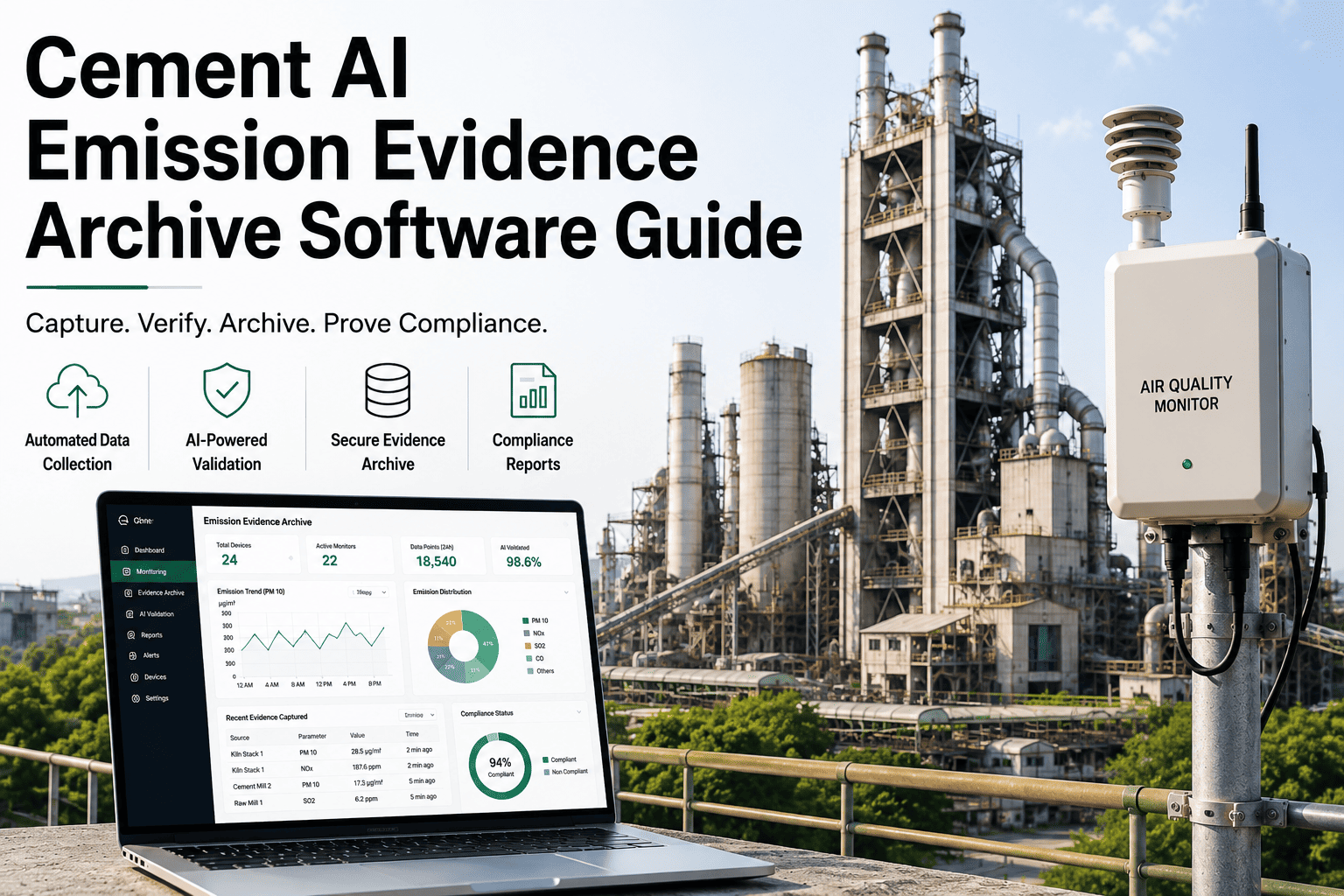
Cement plants now operate under a 3-to-5-year EPA evidence retention window, which means every kiln alert, corrective-action record, and timestamped sensor reading must be retrievable on demand during surprise inspections. OxMaint functions as the cement AI evidence software purpose-built for this exact pressure, consolidating maintenance logs, emission alerts, and audit-grade documentation into a single, searchable archive. Instead of piecing together paper logs and fragmented spreadsheets across raw mills, coolers, and conveyors, reliability and EHS teams get an automated work-order trail tied to each asset and incident. You can Start Free Trial to see how quickly the platform turns scattered evidence into a defensible compliance record.
Cement AI Emission Evidence Archive
Can your plant reconstruct a kiln emission event from 2022 in under ten minutes?
EPA officers and MSHA inspectors expect a complete, timestamped chain of evidence covering 3–5 years of operation. OxMaint archives every AI-triggered alert, corrective work order, and inspection checklist into one retrievable, audit-ready record — so a surprise inspection never becomes a scramble through paper logs.
What Counts as Emission Evidence
Six evidence streams OxMaint captures automatically
A defensible cement AI emission archive is not one document — it is six interlocking streams that prove a plant detected, responded to, and resolved every deviation. OxMaint threads all six through a single asset-level timeline.
Timestamped AI video & sensor alerts
Every AI-detected particulate, temperature, or NOx anomaly on kilns, preheaters, and coolers is locked with an immutable UTC timestamp and linked to the triggering camera or sensor.
Corrective-action work orders
Each alert auto-generates a work order with technician assignment, root-cause notes, parts consumed, and a closed-loop sign-off — the exact chain inspectors look for.
Digital LOTO & permit-to-work records
OSHA 1910.147-compliant lockout/tagout and hot-work permits are stored against the asset and the emission event, proving safe execution of every corrective action.
Inspection checklists & RCA workflows
Routine and event-driven checklists — plus 5-Why and fishbone RCA records — attach directly to the archive, showing that recurrence was addressed, not just the symptom.
IoT & vibration data snapshots
Condition-monitoring readings from raw mills, cement mills, crushers, and conveyors are snapshotted at the moment of alert, preserving the machine-state context.
Compliance-grade exportable reports
One-click evidence bundles map directly to OSHA 1910.147, MSHA, ISO 55000, and internal reliability program requirements — ready for any auditor in minutes.
The Real Cost of Paper Evidence
A 180-asset cement plant loses $42K a year chasing paper
When evidence lives in binders, shared drives, and technician notebooks, retrieval becomes a labour cost — and a legal risk. The numbers below come from typical mid-capacity cement operations before adopting OxMaint.
A single missed corrective-action record during an EPA inspection can trigger penalties that exceed an entire year of OxMaint licensing — which is why plants treat the archive as insurance, not administration.
The OxMaint Evidence Formula
How an AI alert becomes a defensible audit record
Every entry in the OxMaint cement AI emission archive follows the same deterministic path. Nothing is left to memory, and nothing depends on a technician remembering to file paperwork after a 12-hour shift.
Each term is a mandatory block in the archive. Remove one, and the record is flagged as incomplete inside the dashboard — long before an inspector ever asks for it.
Immutable timestamps
Every alert, work order, and sign-off carries a UTC timestamp that cannot be edited — satisfying the chain-of-custody expectation EPA officers apply to electronic records.
Asset-level threading
Evidence is organized by asset — kiln 2, raw mill B, conveyor C-14 — so inspectors can pull the full history of any single piece of equipment in seconds, not hours.
Closed-loop sign-off
No corrective action is considered closed until a supervisor signs off digitally, locking the RCA, parts used, and verification photo into the permanent record.
One-click export bundles
Generate a complete, date-range-filtered evidence bundle for any asset or incident — formatted for OSHA 1910.147, MSHA, or ISO 55000 — in under five minutes.
Paper Archive vs OxMaint Archive
What changes when evidence becomes software
The shift from binders to a cement AI emission archive CMMS is not cosmetic — it changes the speed, completeness, and defensibility of every record an inspector can request.
| Evidence capability | Paper / shared-drive archive | OxMaint AI archive |
|---|---|---|
| Time to reconstruct one event | 8–14 hours across shifts | Under 10 minutes, self-service |
| Record completeness rate | ~69% (31% missing or partial) | 100% — incomplete records are blocked |
| Timestamp integrity | Handwritten, editable, often illegible | Immutable UTC, chain-of-custody compliant |
| LOTO & permit linkage | Separate binder, rarely cross-referenced | Auto-attached to the triggering alert |
| Audit export format | Manual photocopying or PDF stitching | One-click bundle, standards-mapped |
| 3–5 year retention reliability | Degrades with staff turnover & storage moves | Permanent, searchable, asset-filterable |
Plant Voice
Why reliability leaders trust OxMaint with the archive
"During our last EPA inspection we pulled three years of kiln-2 emission evidence in seven minutes. Two years ago that same request took my team a full weekend of binder digging."
"The closed-loop sign-off is what made the difference. Inspectors could see every corrective action had a root cause, a technician, and a verification photo — not just a checkbox."
Take Control of Your Evidence
Turn your next inspection from a fire drill into a five-minute export
Join the cement plants that have replaced paper binders with a searchable, AI-backed emission evidence archive trusted across kilns, mills, and conveyors worldwide.
Frequently Asked Questions
Cement AI emission evidence archive, answered
How long does OxMaint retain cement AI emission evidence?
OxMaint is configured by default to retain all timestamped alerts, corrective-action records, LOTO permits, and inspection checklists for the 3–5 year window EPA and MSHA officers expect. Retention is asset-level, so you can pull the complete history of any kiln, raw mill, or conveyor without rebuilding it from scattered sources. You can Start Free Trial and configure retention to match your plant's specific regulatory exposure.
Does the archive satisfy OSHA 1910.147 and ISO 55000 requirements?
Yes. Every corrective work order generated from an AI alert is tied to a digital LOTO and permit-to-work record compliant with OSHA 1910.147, while the asset lifecycle tracking and reliability reporting map to ISO 55000. The one-click export bundles are pre-formatted so inspectors receive evidence in the structure the standards expect.
Can OxMaint handle evidence across multiple kilns and mills?
Absolutely. The platform threads evidence by asset — kilns, raw mills, cement mills, crushers, coolers, and conveyors each have their own searchable timeline. A multi-line plant can filter by asset, date range, alert type, or technician, then export a complete bundle for any single piece of equipment in minutes.
What happens to evidence if a technician forgets to close a work order?
OxMaint flags any corrective action without a closed-loop sign-off as incomplete inside the dashboard, so supervisors see the gap long before an inspector does. The system sends real-time notifications to the responsible technician and their supervisor, and the record cannot be marked audit-ready until the RCA, parts, and verification are attached.
How quickly can our plant go live with the evidence archive?
Most cement plants are live within 2–4 weeks, depending on the number of assets and existing data sources. OxMaint onboarding includes asset import, IoT and vibration integration, and LOTO template setup. To see the archive configured for your plant's specific kilns and mills, Book a Demo with our cement team.
Your Audit-Ready Archive Starts Now
Stop rebuilding evidence from memory. Start exporting it in minutes.
OxMaint gives cement plants a single source of truth for AI emission evidence — timestamped, asset-linked, and inspector-ready across the full 3–5 year retention window.
Free 14-day trial · No credit card