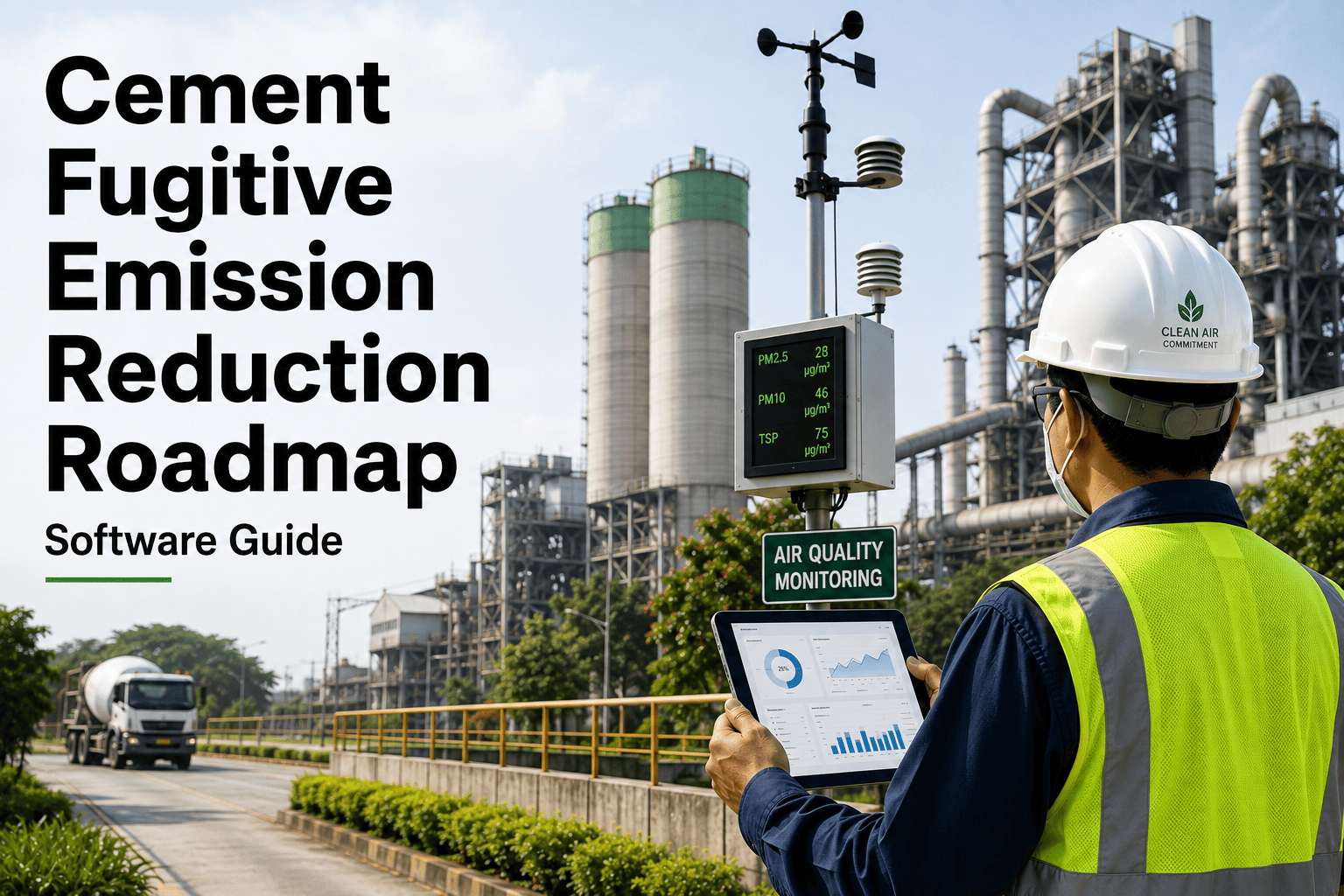
A cement plant does not lose its dust compliance in one dramatic event — it loses it quietly, through hundreds of small leak points that never show up on a stack monitor. Truck haul roads, clinker storage piles, conveyor transfer points, and raw mill vents all release particulate matter outside any controlled duct, which is exactly why regulators classify them separately as fugitive emissions rather than stack emissions. Under 40 CFR Part 63 Subpart LLL, plants must maintain a written operation and maintenance plan for open clinker piles, and MSHA inspectors treat repeat fugitive dust findings as a pattern-of-violation risk rather than an isolated citation. Building a sequenced reduction roadmap — instead of reacting site by site — is what separates plants that pass their next audit from plants that spend the year explaining themselves, and the sequencing itself is something a maintenance platform can help you plan; you can book a demo to walk through how.
Emission Reduction Roadmap · Cement Plant Fugitive Dust
A Sequenced Roadmap for Cutting Fugitive Dust Emissions at Cement Plants
Fugitive dust is not one problem — it is dozens of small leak points across raw material handling, clinker storage, and conveyor transfers that add up to your biggest MSHA and EPA exposure. This guide sequences containment, wet suppression, and process controls into a roadmap you can actually run, plant by plant, quarter by quarter.
60 to 70%
of a typical cement plant's total particulate release is fugitive, not stack-based
5
control measures named under Subpart LLL for open clinker storage piles
90 days
realistic window to sequence a full fugitive-source containment rollout
$60K+
typical single-event penalty range once a fugitive source triggers a formal notice
Where the Dust Actually Comes From
Nine Fugitive Sources That Rarely Show Up on a Stack Report
Stack monitors measure what leaves through a duct. They say nothing about what leaves through a conveyor gap, a haul road, or an open pile. Regulators define fugitive emissions as releases that never pass through a confined air stream — which means every one of the sources below needs its own inspection and maintenance routine, not a shared line item on a compliance checklist.
01
Open Clinker Storage Piles
Wind erosion off an uncovered clinker pile is the single largest named fugitive category under federal cement rules, with five approved control options ranging from partial enclosure to vegetative cover.
Conveyor Transfer Points
02
Every drop point where material falls from one conveyor to another displaces air and pushes fine particulate outward — the highest-frequency leak source on a typical plant walkdown.
03
Raw Material Unloading & Stockpiles
Truck, rail, and barge unloading of limestone, gypsum, and additives generates short, high-concentration dust bursts that standard baghouse capture rarely reaches.
Haul Roads & Yard Traffic
04
Unpaved or poorly watered haul roads re-suspend settled dust with every pass of a loader or haul truck, and are consistently among the top citation categories in site inspections.
05
Kiln and Mill Seal Leaks
Worn kiln inlet seals, mill door gaskets, and duct flange joints leak process gas and fine dust continuously at a rate that is easy to miss between scheduled shutdowns.
Baghouse Bypass & Damper Leaks
06
A bypass damper stuck partially open during a pressure spike sends unfiltered dust straight past the fabric filter — often invisible until a differential-pressure trend is reviewed.
07
Bucket Elevator & Screw Conveyor Housings
Cracked housings and worn seals on vertical material handling equipment leak fine cement and raw meal dust at low velocity, making it hard to detect without a scheduled visual check.
Packing & Loadout Areas
08
Bag filling, bulk loadout spouts, and truck loading chutes release dust at the exact point where product meets open air, right before it leaves the site.
09
Cement Kiln Dust (CKD) Handling
CKD stored or transferred without water contact or enclosure is fine enough to travel well beyond the plant fence line on a windy day, and is treated as its own regulatory category.
The Five-Phase Roadmap
Sequencing Containment, Suppression, and Process Control the Right Way
Plants that attack every source at once usually run out of budget before they run out of leak points. A sequenced roadmap fixes the highest-emission, lowest-cost sources first, builds a defensible paper trail as it goes, and only moves to capital-heavy process controls once the cheaper fixes are locked in.
Phase 1 · Weeks 1-2
Source Mapping & Baseline
Walk every material handling point on the plant and log it as an asset — pile, transfer chute, seal, damper, or road segment. Photograph current condition and record a baseline opacity or visible-emission reading for each one before any work begins.
Phase 2 · Weeks 3-6
Containment & Enclosure
Close gaps first: transfer chute skirting, conveyor covers, partial pile enclosures, and housing repairs on elevators and screw conveyors. This phase is typically the lowest cost per ton of dust prevented on the entire roadmap.
Phase 3 · Weeks 7-10
Wet Suppression & Chemical Treatment
Install or repair water spray and fogging systems on stockpiles and haul roads, and evaluate chemical dust suppressants for areas where water use is limited by climate or drainage constraints.
Phase 4 · Weeks 11-16
Process & Equipment Controls
Address the sources that need capital work — kiln seal replacement, baghouse damper actuator repair, bag changeouts, and ductwork corrections identified during the baseline walk.
Phase 5 · Ongoing
Monitoring & Continuous Compliance
Convert every fixed source into a scheduled inspection with a photo log and a differential-pressure or visible-emission trend, so the next audit is a records pull instead of a scramble.
See the Roadmap Running on a Live Asset Register
OxMaint Turns This Five-Phase Roadmap Into Scheduled Work Orders
Every pile, chute, seal, and damper on the roadmap above becomes a tracked asset with its own inspection schedule, photo history, and control-measure record — the same documentation Subpart LLL and MSHA inspectors ask for during a site visit. A 30-minute walkthrough shows how your plant's specific fugitive sources map onto the platform.
Control Measures by Source
Which Control Method Fits Which Fugitive Source
Regulators do not mandate a single control technology — they require plants to select and document the measure most appropriate for site conditions. The table below maps the roadmap phases to the control options most commonly approved for each source type, so your maintenance team knows exactly what to schedule and when.
| Fugitive Source |
Roadmap Phase |
Primary Control Method |
Documentation Needed |
| Open clinker storage pile |
Phase 2 & 3 |
Partial enclosure, water spray, or vegetative cover |
O&M plan entry with pile location and method selected |
| Conveyor transfer points |
Phase 2 |
Skirting, chute enclosure, drop-height reduction |
Inspection photo before and after enclosure work |
| Haul roads and yard traffic |
Phase 3 |
Water application schedule or chemical suppressant |
Application log with frequency and coverage area |
| Kiln and mill seals |
Phase 4 |
Seal replacement, gasket inspection cycle |
Work order history with part and technician record |
| Baghouse bypass dampers |
Phase 4 |
Actuator repair, differential-pressure monitoring |
Continuous pressure trend tied to the asset record |
| Cement kiln dust handling |
Phase 2 |
Enclosed storage, water contact, or silo transfer |
Storage method description in the O&M plan |
Where Roadmaps Break Down
Five Mistakes That Stall a Fugitive Emission Reduction Project
Most fugitive dust programs do not fail because the engineering was wrong — they fail because the sequencing, ownership, or documentation broke down somewhere between planning and execution. These five patterns show up repeatedly across cement plant compliance reviews.
Pattern 01
Treating every source as equal priority
Without a ranked baseline, teams spend capital on a low-emission source while a high-emission conveyor gap sits untouched for months.
Pattern 02
No fixed inspection owner per source
A control measure that is installed but never re-inspected degrades quietly — a repaired seal or a working water spray needs a recurring check, not a one-time fix.
Pattern 03
Water suppression without measurement
Spraying water on a stockpile without checking whether it actually brings opacity under the permitted limit is a common compliance gap in site audits.
Pattern 04
Paper logs that do not survive an audit
A binder of handwritten spray logs is difficult to reconcile against weather data or shift records when an inspector asks for five years of history.
Pattern 05
Skipping the baseline walk entirely
Jumping straight to capital fixes without a documented baseline makes it impossible to prove improvement later, which weakens your position in any enforcement discussion.
Pattern 06
No link between maintenance and compliance teams
When work orders and O&M plan updates live in separate systems, a completed repair often never makes it into the compliance record an inspector actually reads.
Cost of Inaction vs. Cost of the Roadmap
What a Fugitive Dust Citation Costs Compared to a Sequenced Program
A single fugitive dust citation rarely stays a single event — once an inspector documents one uncontrolled source, follow-up inspections tend to look harder at every other source on the site. The comparison below uses typical figures reported across mid-size cement plant enforcement cases.
Cost of Inaction
Single-event penalty$60,000 - $120,000
Follow-up inspection frequencyQuarterly or tighter
Corrective action plan window30 to 60 days, reactive
Community and permit riskElevated for future expansions
Cost of the Roadmap
Phase 1-3 rollout costLow relative to one penalty
Inspection frequencyScheduled, predictable
Documentation readinessContinuous, audit-ready
Community and permit riskReduced, demonstrable progress
Field Perspective
What Plant EHS and Reliability Leaders Say About Sequencing This Work
Rated 5 / 5
We used to treat every dust complaint as its own fire drill. Once we mapped every pile, chute, and seal as a tracked asset with its own inspection cycle, the same team started closing sources on a schedule instead of reacting to the next complaint. Our follow-up inspections went from tense to routine within two quarters.
RT
Rachel Tran, CIH
EHS Manager, North American Cement Plant · 14 yrs industrial hygiene
Rated 5 / 5
The baseline walk was the part we almost skipped to save time, and it turned out to be the most valuable step. Having a photo and a reading for every source before we touched anything meant we could actually prove the roadmap worked when the next inspection came around, instead of just claiming it did.
DA
Daniel Achebe, CMRP
Reliability Lead, West African Cement Operations · 12 yrs maintenance planning
Rated 4 / 5
Sequencing containment before capital work saved our budget in the first year. We closed a dozen conveyor and chute gaps for a fraction of what one kiln seal replacement would have cost, and it bought us the runway to plan the bigger process fixes properly instead of rushing them.
LP
Lena Petrova, MIAM
Plant Maintenance Director, European Cement Group · 19 yrs plant operations
Frequently Asked Questions
Fugitive Emission Reduction Roadmap — Common Questions
How long does a full five-phase fugitive dust roadmap take for one plant?
Most mid-size plants complete the containment and suppression phases within 90 to 120 days. Process control work in Phase 4 can extend further depending on shutdown scheduling.
Book a demo to map a timeline against your own asset count.
Do we need a written operation and maintenance plan for every fugitive source?
Federal rules specifically require a documented plan for open clinker storage piles, and most site permits extend similar documentation expectations to other major sources. Tracking each source as an asset makes this far easier to maintain.
Can OxMaint track water suppression and chemical treatment schedules?
Yes. Suppression schedules, application logs, and photo evidence attach directly to the source asset, so the record is ready before an inspector asks for it.
Start a free trial to see it against your own site.
What is the difference between fugitive emissions and stack emissions?
Stack emissions pass through a confined duct or vent and are measured directly. Fugitive emissions escape without passing through any controlled point, which is why they need source-level tracking rather than a single stack reading.
Should smaller single-line cement plants follow the same five-phase sequence?
Yes, the same sequence applies at a smaller scale — fewer sources, shorter phases, but the same order of containment before capital work.
Book a demo to see a scaled version for a single-line plant.
Cement Fugitive Emission Reduction Roadmap · OxMaint
Turn This Roadmap Into Scheduled Work at Your Plant
Every pile, chute, seal, and damper in this guide can live as a tracked asset with its own inspection cycle, suppression log, and audit-ready photo history inside OxMaint. Walk through your own fugitive sources with the team that built the platform around this exact roadmap.