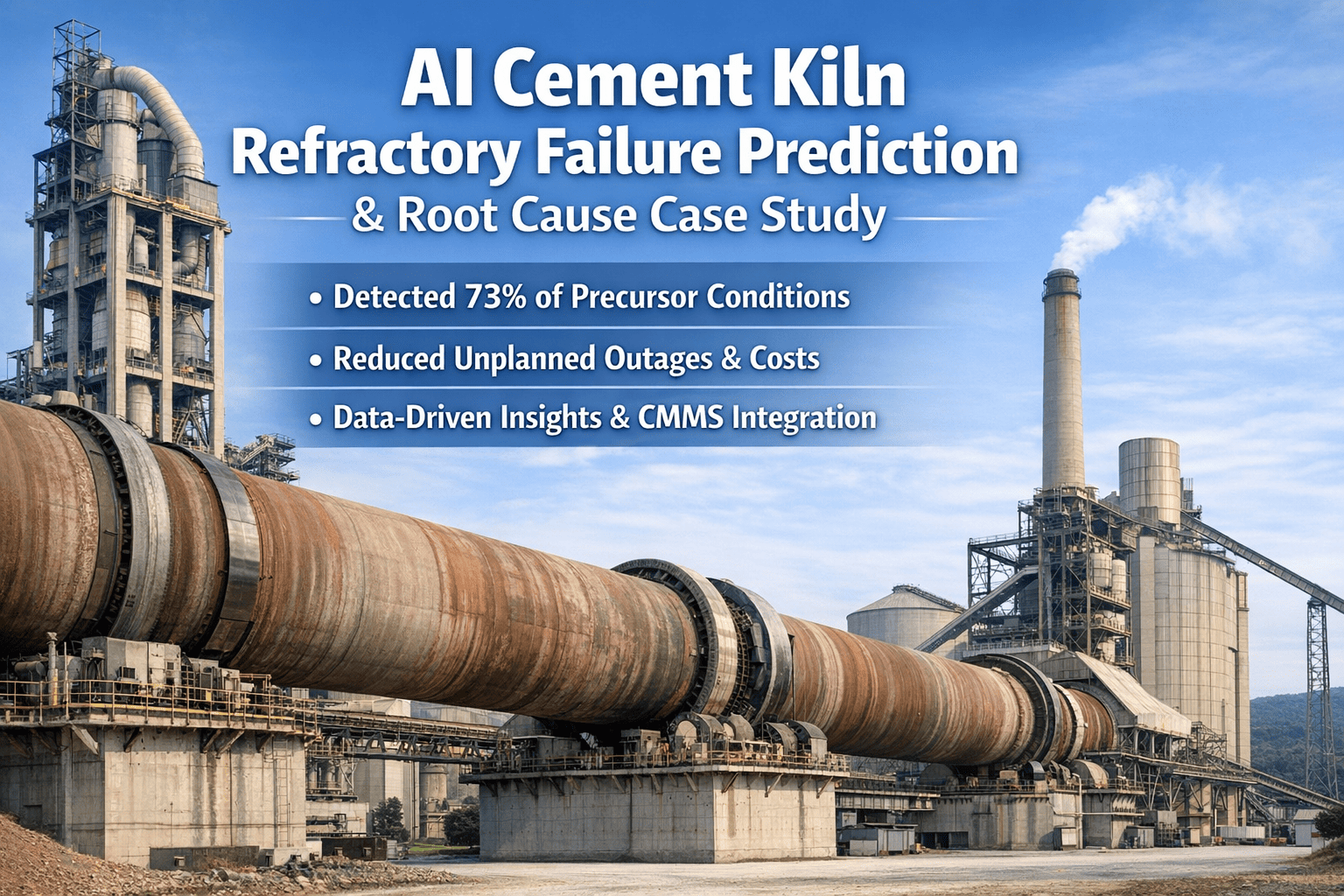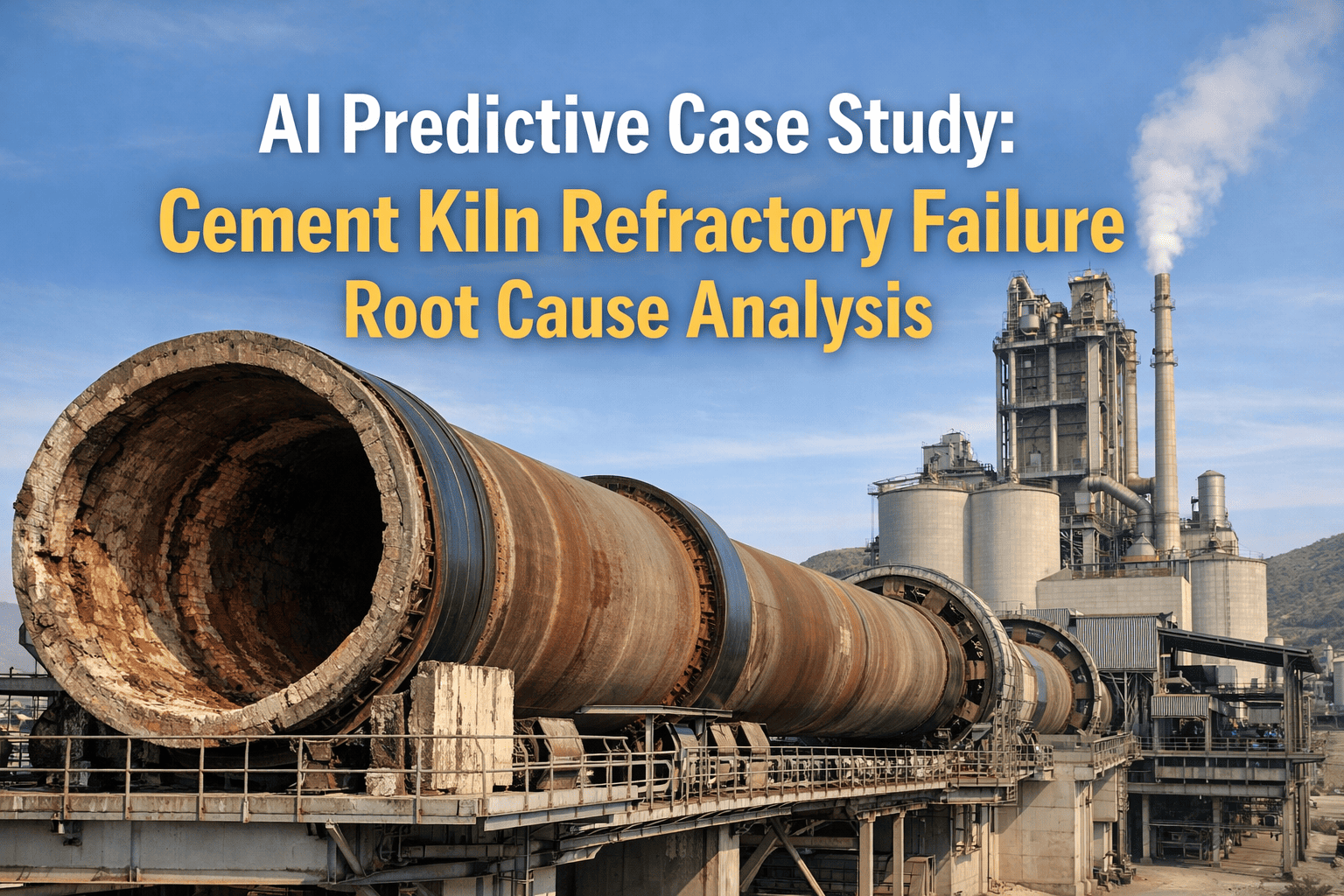
Most cement plant operators discover refractory failure the hard way — a sudden kiln shutdown that costs $500K to $2M in lost output per day. AI-driven predictive maintenance platforms now detect refractory degradation 3 to 6 weeks before failure, converting emergency rebuilds into planned maintenance events and cutting unplanned downtime by over 55%.
How AI Predicts Cement Kiln Refractory Failure Before It Happens
A deep-dive case study on AI-powered root cause analysis, failure scoring, and predictive alerts that help cement plants eliminate surprise shutdowns and multi-million-dollar emergency rebuilds.
Why Refractory Failures Keep Catching Cement Plants Off Guard
Cement kilns run at 1,450°C. The refractory lining — bricks and castables that protect the steel shell — degrades continuously under thermal cycling, chemical attack, and mechanical stress. The failure is not sudden. The warning signs are there for weeks. But without structured data collection and AI pattern recognition, maintenance teams simply cannot see them in time.
The AI Prediction Engine: What It Tracks and How It Thinks
Refractory failure prediction is not a single sensor reading — it is a pattern across multiple data streams. AI models trained on historical failure events learn to recognize combinations of signals that, individually, look unremarkable but together indicate a zone approaching failure.
AI Root Cause Analysis: From Signal to Diagnosis
Traditional root cause analysis happens after failure. AI root cause analysis happens before — identifying not just that a zone is degrading, but why it is degrading and which maintenance intervention will address the root cause rather than the symptom.
| Failure Mode | Root Cause Indicators | AI Detection Signal | Lead Time | Recommended Action |
|---|---|---|---|---|
| Brick Spalling | Rapid thermal cycling; coating instability; alkali infiltration | Shell temperature variance pattern + coating loss log frequency | 3–5 weeks | Schedule zone repair in next planned stop |
| Chemical Attack | High sulfur fuel; alkali-rich raw mix; inadequate refractory grade | Clinker alkali drift + shell hotspot growth rate | 4–6 weeks | Review material specification + fuel source |
| Mechanical Wear | Kiln ovality; misaligned riding rings; high feed burden | Drive power trend + ovality measurement history | 2–3 weeks | Ovality correction + zone inspection at next stop |
| Coating Collapse | Feed chemistry shift; burner position change; sulfur cycle disruption | Temperature spike pattern + feed chemistry log correlation | Days to 2 weeks | Burner adjustment + accelerated inspection |
| Joint Failure | Brick sizing variation; poor installation; thermal shock | Localized shell hotspot with no coating loss history | 3–4 weeks | Zone replacement during planned maintenance window |
Scroll right to see all columns
Your Kiln Is Generating the Data. Are You Reading It?
Oxmaint's AI maintenance platform connects to your existing kiln sensor data, inspection logs, and maintenance history to build a refractory health model specific to your operation — not a generic template. Plants that deploy it see their first predictive alert within 2 weeks of going live.
Refractory Health Scoring: A Zone-by-Zone View of Your Kiln
The most powerful output of AI refractory monitoring is a health score per kiln zone — updated continuously as new sensor data comes in. Instead of asking "is the kiln ok?", maintenance teams can ask "which zone is most at risk and what is the predicted time to failure?"
Shell temperature trending upward over 18 days. Coating loss event logged 11 days ago. Predicted failure window: 3–4 weeks. Schedule zone inspection at next planned stop.
Stable shell temperature. No anomalous drive current trend. Last brick replacement 7 months ago. No intervention required in current campaign.
Three shell hotspots above 380°C detected. Drive current elevated by 12% over baseline. Predicted failure window: 10–14 days. Immediate planned stop or controlled production reduction advised.
Consistent readings. Alkali exposure within expected range for current raw mix. Minor shell temperature increase noted — within normal variation. Monitoring continues.
What Cement Plants Actually Achieve With AI Refractory Prediction
Predictive refractory management is not theoretical. Plants using Oxmaint's AI platform track concrete improvements across shutdown frequency, rebuild cost, and lining service life — measurable in the first 6 months of deployment.
Plants with structured AI monitoring convert virtually all refractory-related shutdowns from emergency to planned — the single highest-impact maintenance outcome in cement production.
Planned procurement vs emergency sourcing, optimized brick grade selection based on actual failure mode data, and extended lining life through early intervention drive significant material cost savings.
By addressing root causes instead of reacting to failures, plants extend the usable life of each lining campaign — reducing the number of full rebuilds per year and the downtime that comes with them.
When refractory events are predicted and planned, maintenance crews stop spending half their bandwidth on emergency mobilization and spend it on higher-value preventive work instead.
Frequently Asked Questions
The core inputs are shell temperature scan history, kiln drive power trends, and maintenance logs of past coating loss and repair events. Clinker chemistry data and fuel sulfur content significantly improve accuracy. Oxmaint integrates with existing DCS and historian systems — most plants are live within a week without any custom integration work.
Across cement plants using AI monitoring, prediction models achieve 80–90% accuracy at the 3-week prediction horizon for brick spalling and chemical attack modes — the two highest-frequency failure types. Shorter-window events like coating collapse have lower predictive accuracy, but AI still provides earlier warning than human observation. Book a demo to see accuracy benchmarks from plants similar to yours.
Most cement plants are fully operational with Oxmaint's AI monitoring within 2–4 weeks. The first phase — importing historical maintenance logs and sensor data — takes 3–5 days. Initial health scores are visible within the first week. The predictive model improves in accuracy as more plant-specific data accumulates. Start your free trial to begin the setup process.
Yes. AI models can work with manual inspection data, periodic shell scanner readings, and maintenance logs — no continuous sensor feed is required. Prediction accuracy is lower than in fully instrumented kilns, but plants without modern sensor infrastructure still see significant improvement over purely reactive maintenance. Discuss your plant's specific setup with our team.
Refractory health scoring is a zone-by-zone numeric index (typically 0–100) that combines shell temperature trend, coating loss history, operational stress factors, and time since last repair into a single risk indicator. Scores below 50 trigger predictive alerts with recommended action. Oxmaint's health scoring dashboard updates continuously and is accessible on any device.
Your Next Refractory Failure Can Be Planned, Not Surprised
Cement plants using Oxmaint's AI refractory prediction see their first actionable health alert within 2 weeks of going live. No IT project. No custom integration. Just the advance warning your maintenance team needs to turn a crisis into a scheduled repair.