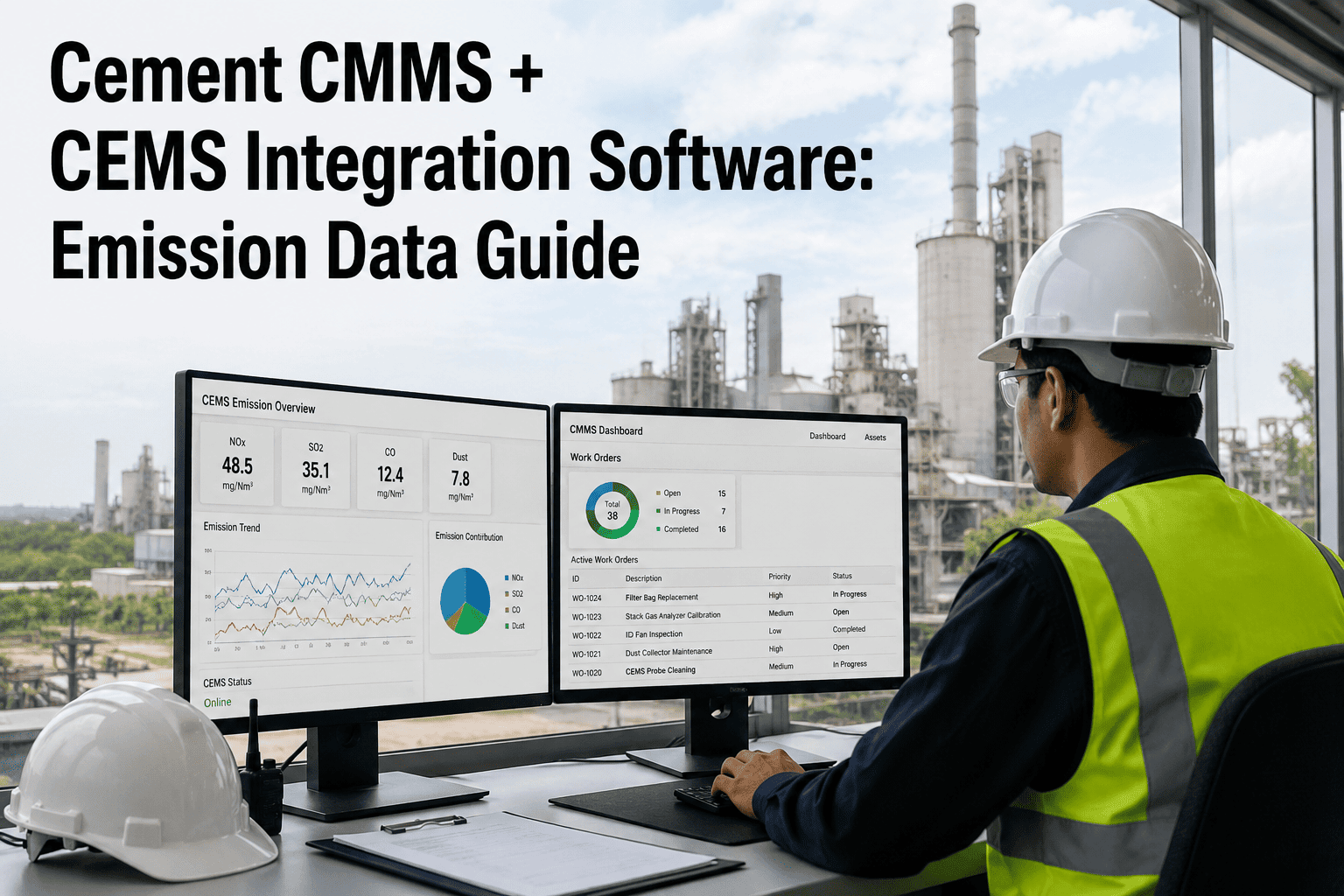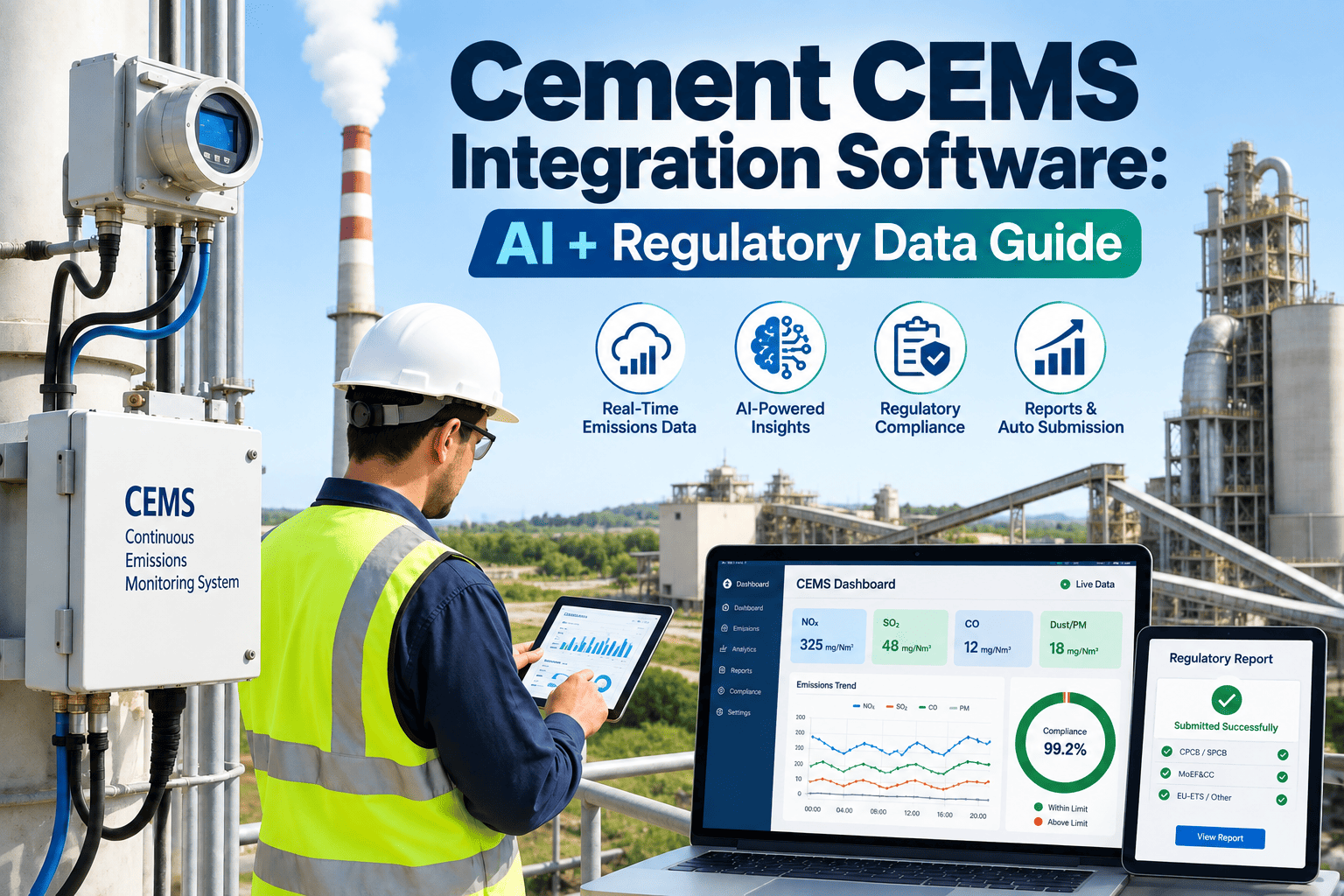
A cement kiln's continuous emissions monitoring system logs a fresh NOx, SO2, CO, and opacity reading every few minutes, feeding regulators exactly the numbers they need to issue a violation. What it rarely does on its own is tell your maintenance team why a curve is climbing or what to repair before a trend becomes a reportable exceedance. One Midwest plant watched SNCR reagent pressure drift for eleven straight days before anyone connected it to NOx creeping toward the permit ceiling — the notice of violation that followed carried a six-figure penalty and a mandated stack retest. Sign in to OxMaint to connect your CEMS data acquisition system directly to AI root-cause analysis and automatic work orders, or book a demo to see it mapped to your plant's pollutant list and permit thresholds.
Turn CEMS Readings Into Work Orders Before They Turn Into Violations
Cement CEMS already tell regulators what happened. OxMaint's AI layer tells your maintenance team what to do about it — mapping every NOx, SO2, CO, opacity, mercury, and HCl reading to a root cause and an auto-generated work order, hours before an exceedance is ever recorded.
Why CEMS Data Alone Doesn't Stop a Violation
A cement kiln at 1,400°C produces a mix of regulated pollutants at every stage of clinker production — nitrogen oxides from the burning zone, sulfur dioxide pulled from both fuel and raw meal chemistry, carbon monoxide as a combustion-efficiency signal, particulate matter measured through opacity, mercury tracked on a rolling monthly average, and hydrogen chloride wherever alternative fuels are co-processed. Regulators want a number every few minutes; your kiln team needs the maintenance action that keeps that number where it belongs. That gap between a sensor reading and a scheduled inspection is where most avoidable exceedances happen.
The Regulatory Web Every Reading Has to Satisfy
The same CEMS instrument stack usually has to satisfy several overlapping regulatory frameworks at once, each with its own format, averaging period, and submission deadline. Missing a calibration on one framework can invalidate data across all of them simultaneously — which is why data availability, not just emission levels, is the metric most compliance teams lose sleep over.
| Framework | What It Covers | Core Requirement | Typical Cadence |
|---|---|---|---|
| NESHAP Subpart LLL | Kiln, clinker cooler, raw mill, finish mill, HAP limits | PM, opacity, HCl, mercury compliance | Annual certification |
| NSPS Subpart F | Kilns and coolers built or modified after 1971 | NOx, SO2, PM emission standards | Continuous + periodic testing |
| Title V Operating Permit | Major source facility-wide operations | Consolidated permit conditions | 5-year renewal, annual certification |
| State Air Quality Permit | State-specific construction and operating limits | Often tighter opacity caps than federal floor | 5–10 year renewal cycles |
| GHG Reporting (Part 98) | Clinker production and fuel-based CO2 | Annual mass-balance calculation | Annual report |
One Dashboard for Every Pollutant, Every Framework, Every Kiln
OxMaint pulls live data straight from your existing CEMS data acquisition system, checks it against every framework your permit references, and converts a drifting reading into a scoped, assigned, trackable work order — before it becomes a line item in a violation notice.
Manual CEMS Review vs AI-Integrated Response
Most cement plants already have the sensors. What separates a plant that avoids exceedances from one that reports them after the fact is what happens between the reading and the response. Sign in to OxMaint to see how that gap closes when AI sits between your CEMS and your CMMS.
| Manual Review | OxMaint AI Integration | |
|---|---|---|
| Review frequency | Once or twice per shift on a control-room screen | Continuous, every reading interval |
| Rolling average visibility | Reviewed at month end, after the fact | Projected in real time, days ahead |
| Root-cause identification | Manual cross-check of process logs | Automatic correlation to reagent, fuel, raw meal data |
| Work order creation | Written after the exceedance is noticed | Auto-generated at the warning threshold |
| Night and weekend coverage | Depends on shift staffing | Full coverage, mobile alerts regardless of shift |
| Audit trail | Scattered across logs and spreadsheets | Single digital record from reading to repair |
From Reading to Work Order — How the Loop Closes
Detection without a maintenance action attached to it is just a data point. OxMaint's pipeline takes every CEMS reading through classification, correlation, and dispatch automatically, so a drifting pollutant never sits unnoticed on a dashboard.
Exceedance Severity Classification
Not every drifting reading needs the same response. OxMaint classifies each pollutant trend across a severity spectrum so your team can tell a reading worth watching apart from one that needs a technician on site within the hour.
Frequently Asked Questions
Your CEMS Is Already Telling You Something. Is Anyone Turning It Into a Work Order?
OxMaint connects your NOx, SO2, CO, opacity, mercury, and HCl readings to AI root-cause analysis and automatic CMMS work orders — closing the gap between a drifting number and a scheduled repair before the exceedance is ever recorded.