A cement kiln does not fail its first campaign because the refractory was poorly chosen — it fails because the dry-out was rushed. Every brick and castable lining carries physically bonded water from mixing and chemically bound water from the cement hydrate, and both have to leave the lining slowly, in a specific order, at a specific rate, or the trapped steam pressure tears the surface apart before the kiln ever sees clinker. A 168-hour heat-up curve with the wrong hold at 110°C can undo eighteen months of refractory planning in a single shift. Plants that protect that curve — hold by hold, degree by degree — are the ones that get a full campaign life out of every brick, and that discipline is exactly what plants build inside OxMaint.
Cement Kiln Dry-Out Schedule Software
Turn the supplier's heat-up curve into an enforced, hold-by-hold schedule — with thermocouple checkpoints, rotation intervals, and steam-release monitoring logged against every refractory campaign.
Why a Heat-Up Curve Is Not a Straight Line to Operating Temperature
A supplier dry-out curve looks simple on paper — a line from ambient to 1000°C — but it is really a series of ramps and holds, each one built around a specific physical change happening inside the lining. Skip a hold, rush a ramp, or misjudge how thick the lining is, and the water trying to escape turns into steam pressure with nowhere to go. That is the mechanism behind almost every early-life refractory failure, and it happens well before the kiln ever produces its first tonne of clinker.
Free / Physically Bonded Water
Water left over from mixing and placement, sitting in the pore structure. Released between ambient and roughly 110°C. This is the largest volume of moisture and the stage where most rushed schedules cause surface blistering.
Chemically Bound Water
Water locked into the calcium aluminate cement hydrate itself. Released between roughly 150°C and 300°C as the hydrate breaks down. Slower ramp rates are mandatory here regardless of how the free-water stage went.
Ceramic Bond Formation
Above roughly 500°C the material transitions from a cement-bonded structure to a fired ceramic bond. Uneven heating here creates thermal gradients that show up later as spalling under kiln load, not during dry-out itself.
The Six-Stage Dry-Out Curve — Every Hold Point Enforced in Sequence
This is the curve structure refractory suppliers issue for a typical castable-and-brick kiln lining, adapted to the hold points plants actually schedule around. Every stage below needs its own work order, its own thermocouple confirmation, and its own sign-off before the next ramp is allowed to start — which is the entire point of running it through a CMMS instead of a printed chart taped to the control room wall.
Minimum Cure Before Ignition
Castable sections need a minimum 24-hour set before any heat is applied, and 48 to 72 hours is preferred on thick pours. Brick sections need no cure time — the mortar sets during the dry-out itself.
Ramp to 110°C
First controlled ramp at roughly 10 to 13°C per hour. Ventilation confirmed adequate to carry escaping vapour away from the shell. Personnel kept clear of inspection doors during this stage.
Hold at 110°C
The most critical checkpoint on the whole curve. Free water evaporates here, and the hold has to run long enough for moisture to migrate out through the full lining thickness — roughly 1.5 hours per inch, capped around 8 hours.
Ramp to 250–300°C
Slower ramp than stage two, typically 10°C per hour, because chemically bound water starts releasing in this band. Steam observed at inspection doors means holding constant until it clears before resuming.
Hold at 300°C
Extended hold while the calcium aluminate hydrate finishes breaking down and the binder polymerises into its ceramic form. Cold-face thermocouple readings should stabilise before this hold is closed out.
Final Ramp to Operating Temperature
Faster ramp, roughly 25 to 30°C per hour, up to sintering-zone application temperature. Auxiliary drive rotates the shell on a scheduled interval throughout to prevent sagging on the hot side.
What a Rushed Dry-Out Actually Costs a Plant
The dry-out schedule rarely gets its own line item in a shutdown budget, so the cost of rushing it hides inside categories nobody connects back to the curve. A compressed hold at 110°C does not show up as a failure on day one — it shows up as spalling under kiln load eight months later, and by then almost nobody traces it back to a schedule that got cut short to save a shift.
Trapped steam pressure blows surface layers off castable sections, sometimes visibly, sometimes as hidden subsurface damage that only shows up on the next inspection.
Uneven ceramic bond formation from an inconsistent ramp creates weak zones that fail early under thermal cycling, cutting months off an otherwise well-installed lining.
A lining that fails early forces an unplanned shutdown at the worst possible point in the production calendar, with none of the lead time a scheduled reline would have had.
Pressure to get the kiln back on feed pushes hold times shorter than the curve calls for — the exact decision that causes the damage the next shutdown has to fix.
Stop Running Dry-Out on a Printed Chart and a Stopwatch
OxMaint turns the supplier's heat-up curve into scheduled work orders with hold-point sign-off, thermocouple logging, and rotation-interval tracking — so nobody has to guess whether a shift is pushing the brick too hard.
Four Checkpoints Every Dry-Out Schedule Has to Track in Parallel
The temperature curve gets all the attention, but a dry-out that holds temperature perfectly can still damage a lining if these four supporting checkpoints are not tracked alongside it. Each one has its own instrument, its own logging frequency, and its own trigger for pausing the ramp.
Shell & Cold-Face Thermocouples
Temporary thermocouples placed at the cold face confirm heat has actually penetrated the full lining thickness — the real signal that a hold is complete, not just the clock.
Hood Pressure & Ventilation
Adequate ventilation carries escaping water vapour out of the shell. Pressure held slightly positive keeps hot gas working for the plant instead of venting uncontrolled.
Fan & Draught Sequencing
Primary and cooler fans stay running through the curve while preheater and ID fans are stepped in sequence, protecting draught balance so the ramp stays even across the shell.
Auxiliary Drive Rotation
The shell is rotated on an increasing interval schedule throughout heat-up to prevent sagging and uneven expansion on the side facing the burner.
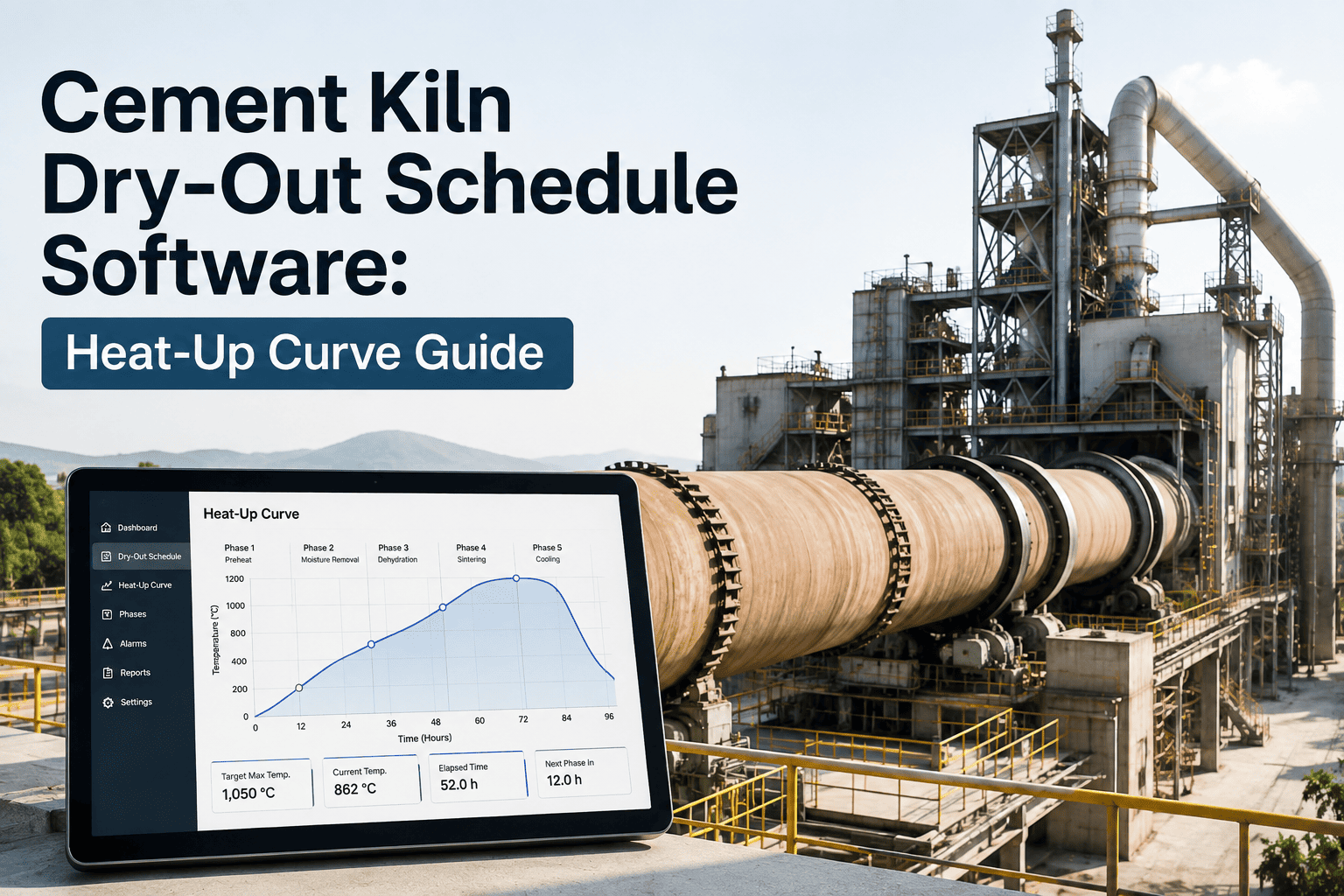
A Dry-Out Schedule Mid-Curve — What the Live Record Looks Like
Below is what a dry-out schedule looks like from inside a CMMS at hour 96 of a 168-hour curve, on a kiln with a mixed castable-and-brick lining. Every hold, every checkpoint, and every deviation is a logged event tied to the refractory campaign file, not a handwritten note on a clipboard that gets thrown away after startup.
Chart-and-Stopwatch Dry-Out vs a CMMS-Enforced Curve
Most plants already have the supplier's heat-up curve — it comes with the refractory order. What separates a plant that gets a full campaign life from one that relines early is whether that curve is actually enforced hold by hold, or whether it becomes a target that shift changes and production pressure slowly erode.
| Dry-Out Element | Chart & Stopwatch | CMMS-Enforced Curve | Typical Outcome |
|---|---|---|---|
| Hold Point Verification | Judged by elapsed time on a clock | Confirmed by cold-face thermocouple reading | Hold closed only when lining is actually ready |
| Shift-to-Shift Handover | Verbal handover, notes on paper | Curve status and open deviations visible to next shift instantly | No lost context between shifts |
| Deviation Response | Steaming noted, judgment call on pause length | Auto-flagged deviation with standard pause protocol | Consistent response regardless of who is on shift |
| Campaign Record | Chart discarded or filed, rarely reviewed | Full curve archived against refractory campaign | Wear trends traceable back to the dry-out itself |
| Production Pressure | Holds shortened when feed date is tight | Hold points locked until sign-off criteria are met | Campaign life protected regardless of schedule pressure |
Six Practices That Protect a Refractory Campaign From Day One
Plants that consistently stretch refractory campaigns past what the supplier projected are not using different brick — they are running the same six practices on every dry-out, every time, without exception for schedule pressure.
Curve Loaded Against the Actual Lining
Supplier curve entered as a schedule with hold points matched to the specific brick and castable thickness installed, not a generic template reused from the last campaign.
Thermocouple Logging
Cold-face and shell readings logged at fixed intervals throughout, giving an objective signal for when a hold is genuinely complete instead of relying on elapsed time alone.
Sign-Off Before Next Ramp
Each stage requires a supervisor sign-off against the logged readings before the system allows the next ramp to be scheduled, removing the judgment call from a tired shift.
Rotation Interval Enforcement
Auxiliary drive rotation scheduled to tighten automatically as temperature climbs, preventing the sagging that silent gaps in rotation cause on the burner side.
Standard Steam Response
Steaming at an inspection door triggers an automatic hold rather than a judgment call, with the ramp resuming only once the standard clearance criteria are met.
Curve Archived Against Wear Data
The full time-temperature record is filed against the refractory campaign so later inspection findings can be traced back to exactly how the dry-out was run.
What Curve Discipline Returns Across a Campaign
These outcomes are what kiln teams report after moving dry-out management from a printed chart to a CMMS-enforced schedule, tracked across the first full refractory campaign following the change.
Reported by kiln teams after two to three campaigns of curve-guided, monitored dry-out and startup discipline.
Every hold verified by thermocouple reading and signed off before the next ramp is scheduled, on every dry-out run.
Curve status and open deviations visible to the next shift instantly, removing the judgment call from a tired handover.
Every ramp, hold, and rotation interval archived against the refractory campaign file for the next inspection cycle.
Frequently Asked Questions
Why is the 110°C hold considered the most critical point on a dry-out curve?
What ramp rate is typical for a cement kiln refractory dry-out?
What happens if steam is observed at an inspection door during heat-up?
How does a CMMS enforce a dry-out curve instead of just displaying it?
How long does a full kiln dry-out and heat-up cycle typically take?
Protect the Next Campaign Before the First Brick Goes In
OxMaint keeps the heat-up curve, every hold point, every thermocouple reading, and every deviation inside one refractory campaign record — so curve discipline does not depend on which shift is on duty.