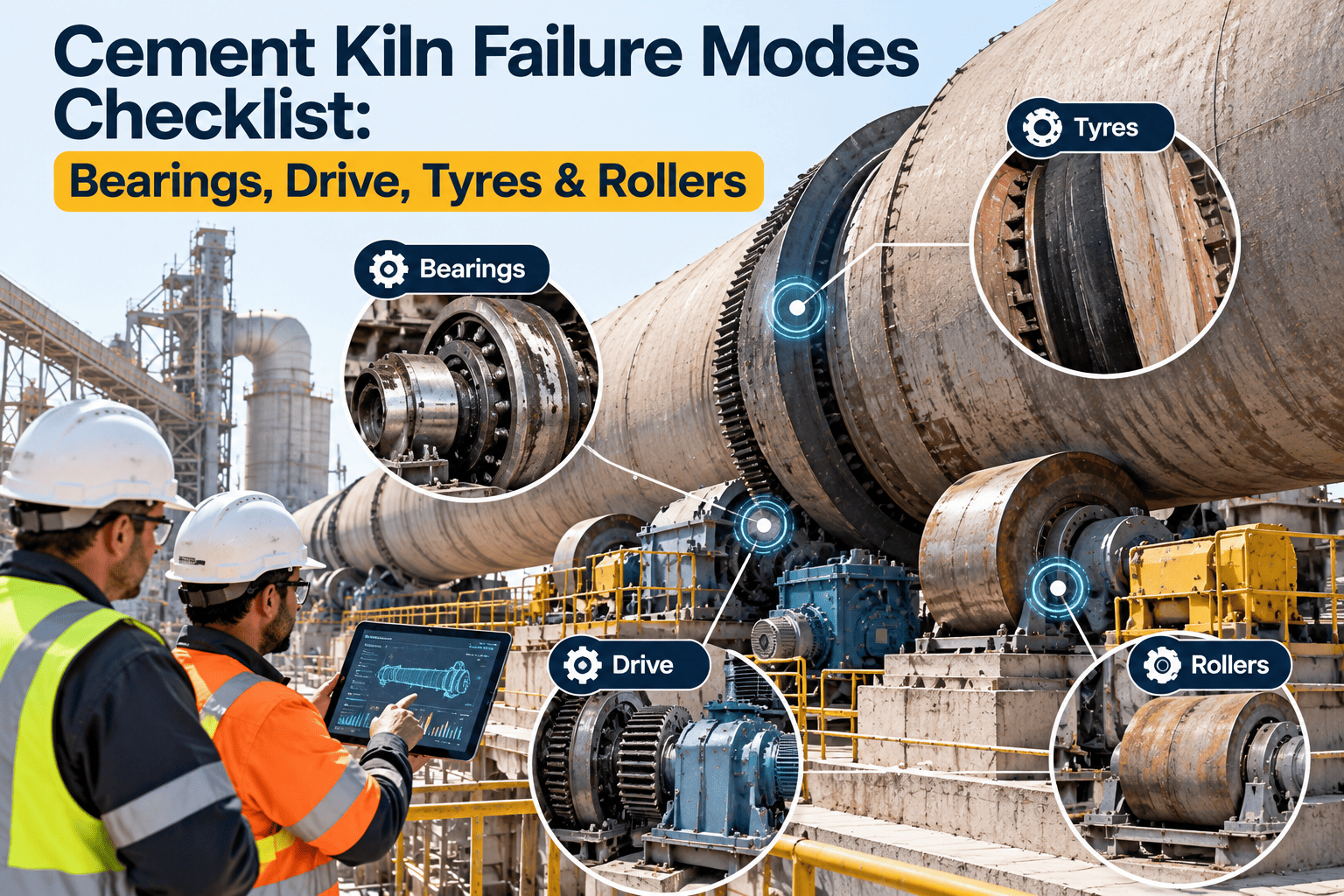
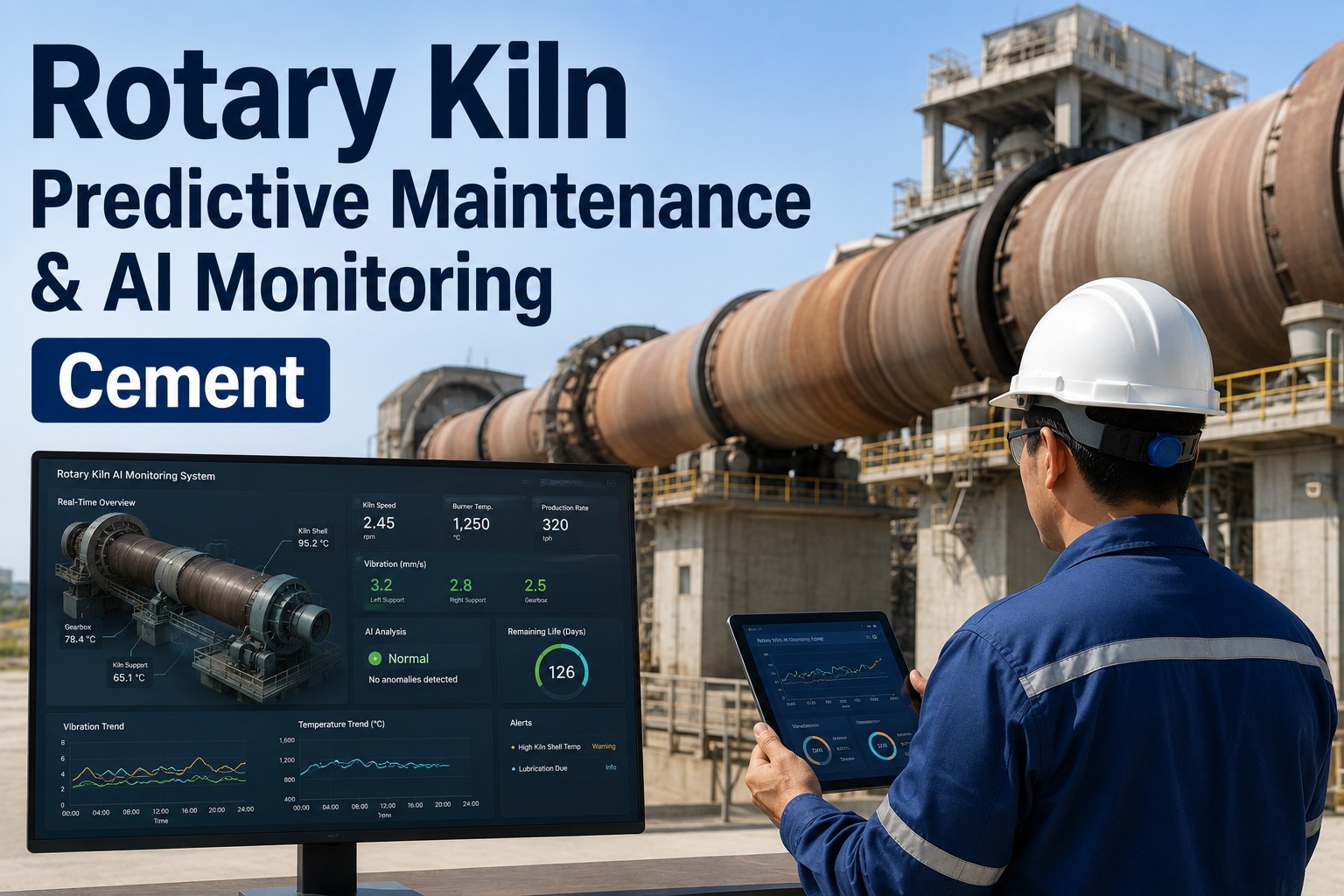
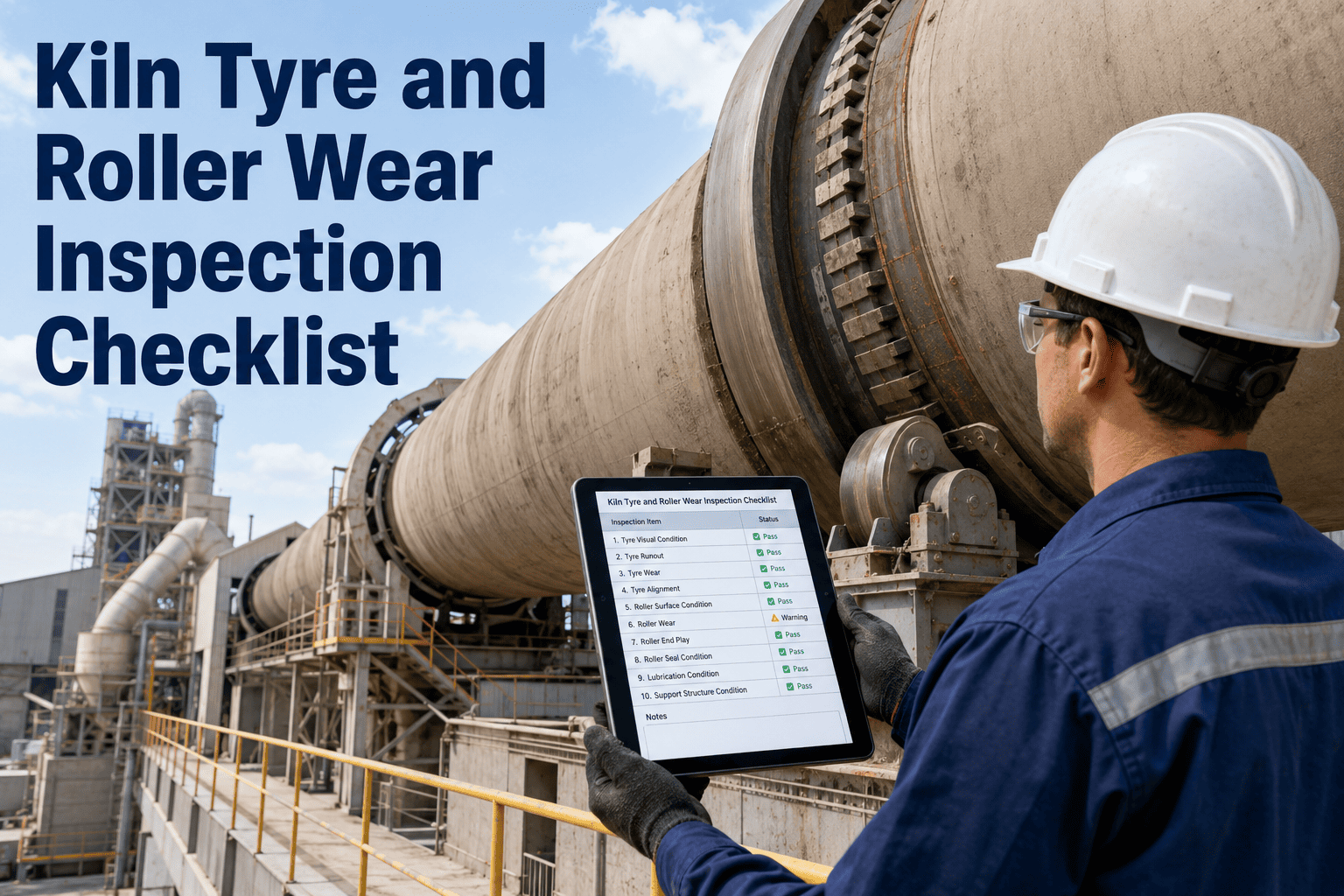
Kiln tyre creep is the silent cost multiplier inside every cement plant — the differential rotation between a rotating tyre and its shell accumulates undetected until refractory damage, shell wear, and unplanned stoppages force a relining event that runs $200,000 or more. Continuous axial position monitoring sensors now make it possible to detect tyre migration in real-time, and when that sensor data flows directly into a CMMS like OxMaint, roller skew adjustments get scheduled automatically — before creep ever crosses an ISO alarm threshold.
Cement Plant Maintenance · Rotary Kiln · Predictive Scheduling
Kiln Tyre Creep & Roller Adjustment Scheduling with CMMS
Every millimetre of uncontrolled tyre creep accelerates shell distortion, cracks refractory, and edges your kiln toward a six-figure relining bill. Real-time axial sensors combined with CMMS-driven work order automation stop creep before it starts — not after it destroys.
$200K+
per kiln relining event
72 hrs
avg unplanned downtime per tyre failure
ISO 10816
vibration alarm thresholds for kilns
The Core Problem
What Is Kiln Tyre Creep — And Why Does It Destroy Kilns?
The rotating tyre is designed to slip slightly on the shell — that controlled clearance is normal. Creep becomes a problem when that differential rotation exceeds design limits, creating heat, wear, and structural stress that compounds with every rotation.
Controlled Slip
0 – 3 mm/rev
Normal operating range. Tyre floats on shell pads. No corrective action required.
→ Creep Increases →
Watch Zone
3 – 8 mm/rev
Monitor closely. Schedule roller skew check. Increase inspection frequency.
→ Alarm Threshold →
ISO Alarm
8 mm/rev+
Immediate roller adjustment required. Shell pad wear accelerating. Refractory at risk.
Failure Chain
The Four-Stage Damage Sequence When Creep Goes Unmonitored
01
Shell Pad Wear
Differential rotation grinds the migration pads and shell contact surface. Heat builds at the tyre-shell interface.
02
Ovality Development
Uneven thermal loading distorts the shell cross-section. The kiln begins cycling between oval and round with every rotation.
03
Refractory Cracking
Ovality flexes the refractory brick lining 2–4 times per revolution. Joints open, bricks loosen, hot spots appear on the shell.
04
Emergency Shutdown
Shell hot spot breaches safe operating temperature. Kiln must stop. Relining begins — 72+ hours downtime, $200,000+ cost.
Monitoring Technology
How Axial Position Sensors Catch Creep in Real-Time
Modern continuous monitoring replaces the manual chalk-mark method — where a technician marked the tyre and shell, then waited a full revolution to measure offset. Sensor-based systems capture axial displacement continuously, feeding data streams that CMMS platforms can act on immediately.
Inductive Proximity Sensors
Mounted on the tyre and shell, measuring relative axial displacement with ±0.1 mm accuracy at operating temperatures up to 120°C.
Best for: kilns with stable shell temperatures and existing cable routing infrastructure.
Laser Displacement Sensors
Non-contact measurement of tyre face position relative to a fixed reference bracket. Immune to vibration drift that affects contact sensors.
Best for: high-vibration kilns, large diameter tyres, or plants requiring contactless measurement.
LVDT Transducers
Linear Variable Differential Transformer sensors provide continuous DC output proportional to tyre migration — ideal for direct SCADA integration.
Best for: plants with existing SCADA infrastructure wanting CMMS-level work order automation.
CMMS-Driven Kiln Maintenance
Connect your tyre sensors to automatic CMMS scheduling — stop relining surprises before they cost you.
OxMaint integrates with kiln monitoring sensors to trigger roller adjustment work orders automatically when creep thresholds are reached. Every adjustment is logged, every technician is notified, every audit trail is complete.
CMMS Integration
How Sensor Data Flows Into Automated CMMS Work Orders
The gap between a sensor reading and a completed roller adjustment is where most plants lose the benefit of their monitoring investment. A CMMS with sensor integration closes that gap automatically — no spreadsheet, no radio call, no missed shift handover.
S
Sensor Reads Axial Position
Continuous displacement data is logged every rotation — typically 0.5–2 Hz depending on kiln speed and sensor type.
T
Threshold Comparison
CMMS compares rolling average against configurable ISO thresholds. Watch zone triggers alert; alarm zone triggers work order.
W
Work Order Auto-Generated
Roller skew adjustment work order is created with tyre ID, current creep value, recommended skew correction, and assigned technician.
A
Adjustment & Verification
Technician completes roller skew correction. CMMS logs post-adjustment sensor reading to confirm creep reduction.
Roller Adjustment Guide
Roller Skew Adjustment — What CMMS Work Orders Must Specify
A roller skew adjustment is not simply tightening a bolt. Each adjustment changes the axial thrust vector acting on the kiln — the wrong direction or magnitude creates a new problem while solving the original. CMMS work orders for roller adjustment need to be precise.
| Creep Reading |
Direction of Tyre Migration |
Roller Adjustment Action |
Expected Response Time |
| 3 – 5 mm/rev |
Uphill (toward feed end) |
Skew upper rollers 1–2 mm toward downhill; re-measure after 4 hours |
6 – 12 hours to stabilise |
| 5 – 8 mm/rev |
Downhill (toward discharge) |
Skew lower rollers 2–3 mm toward uphill; check thrust bearing load |
4 – 8 hours to stabilise |
| 8 mm/rev+ |
Either direction |
Emergency roller correction + shell pad inspection within 24 hours |
Immediate — monitor continuously |
| Oscillating creep |
Alternating directions |
Inspect tyre clearance; possible shell pad wear requiring replacement |
Schedule at next planned stop |
Common Questions
Kiln Tyre Creep Monitoring — Frequently Asked
How often should kiln tyre creep be measured manually if no sensors are installed?
Manual chalk-mark measurements should be taken every shift (8–12 hours) under normal conditions, and every 2–4 hours when creep was elevated in the previous reading. Without continuous sensors, you are always reacting to creep that has already accumulated — CMMS-connected sensors eliminate this lag entirely.
Discuss sensor integration options with our team.
Can a CMMS automatically adjust roller skew, or does a technician still need to be involved?
CMMS platforms like OxMaint automate the work order generation, technician notification, and adjustment documentation — but the physical roller skew adjustment itself requires a qualified mechanical technician on-site. Automated systems are not yet capable of executing mechanical adjustments safely on rotating kilns.
See how OxMaint manages the workflow.
What is the typical payback period for sensor-based kiln tyre creep monitoring?
Most cement plants recover the full cost of sensor installation and CMMS integration within one avoided relining event — typically under 12 months. A single $200,000+ relining avoided more than covers three to five years of monitoring system operating costs.
How does kiln tyre creep relate to refractory brick life?
Tyre creep drives shell ovality, and ovality is the primary mechanical cause of refractory brick joint failure. Kilns operating within creep limits typically achieve 12–18 months of refractory life; kilns with chronic creep may reline every 6–9 months. Controlling creep is directly controlling refractory costs.
Does OxMaint integrate with existing kiln PLC or SCADA systems?
Start Monitoring Tyre Creep Automatically
Stop Paying $200,000 to Learn That Your Creep Was Too High.
OxMaint connects kiln tyre sensors to automated roller adjustment scheduling — so your maintenance team acts on creep data before refractory damage begins, not after a forced shutdown. Cloud, on-premise, or air-gapped deployment for every plant environment.