Cement plants are among the most energy-intensive industrial facilities in the world, consuming 110–150 kWh per tonne of clinker — and energy costs represent 30–40% of total production expenditure. As the sector moves to cut carbon exposure and reduce grid dependency, utility-scale rooftop solar installations are becoming standard capital investments, with arrays sized to offset 15–25% of total electrical consumption. But solar infrastructure installed on a cement plant roof operates in a uniquely hostile environment: cement dust, coal particulate, and iron oxide accumulation degrade panel output at rates 3–5 times higher than clean industrial sites. Without a structured CMMS-integrated maintenance programme, that capital investment silently underperforms — and nobody knows until the finance team pulls the year-end generation report and finds actual output 20–30% below financial model assumptions. Start a free OxMaint trial and bring your solar assets into a structured, CMMS-managed maintenance programme today.
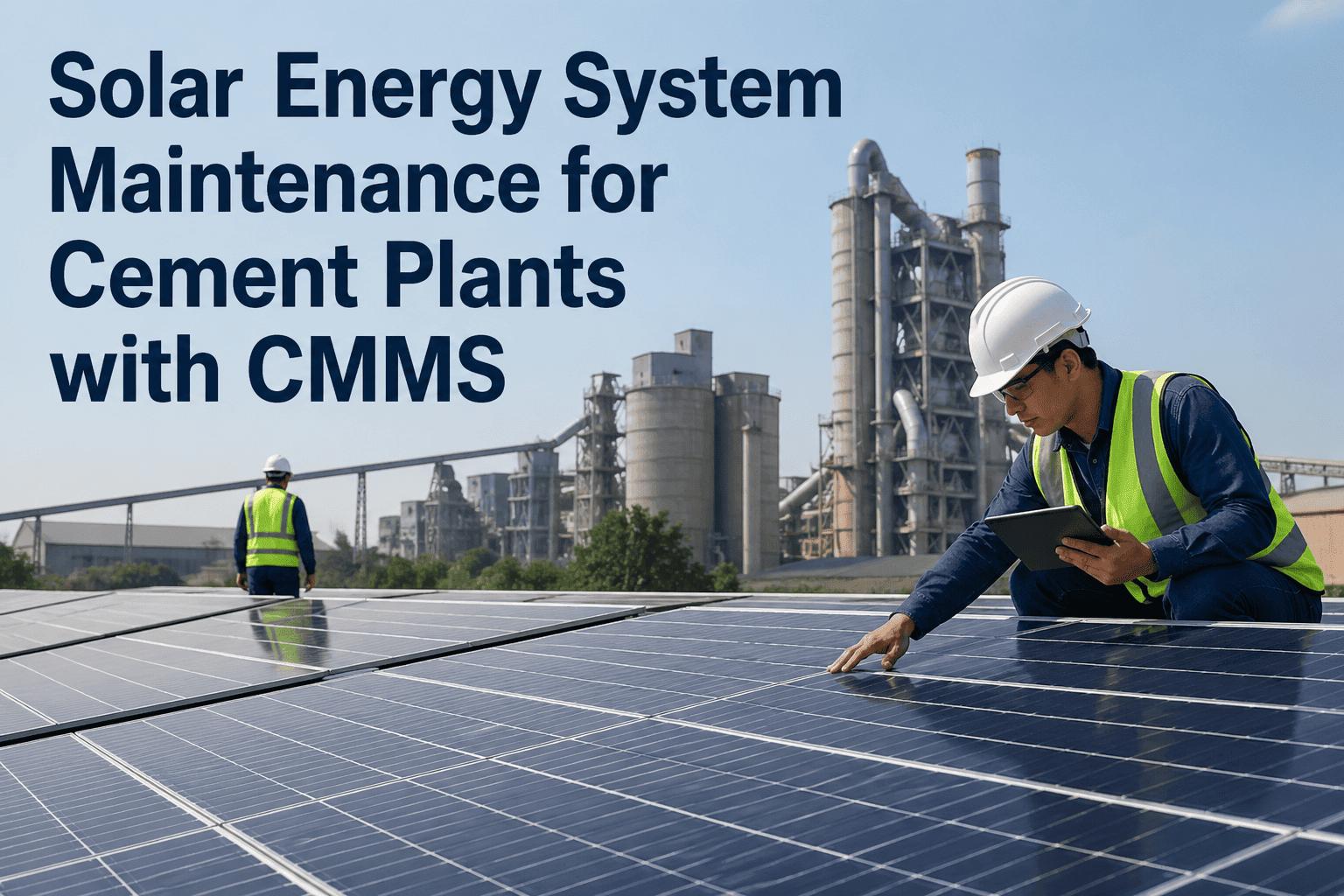
Solar Energy System Maintenance for Cement Plants with CMMS
Panel cleaning schedules, inverter thermal monitoring, string performance tracking, and cable inspection — structured inside a CMMS so your solar investment delivers the financial return it was modelled on.
The Silent Degradation Problem No SCADA Dashboard Solves
SCADA systems tell you what is happening right now. They do not schedule the action needed to prevent what happens next. In a cement plant environment, three degradation mechanisms compound silently — each invisible in real-time dashboards until total output loss becomes impossible to ignore.
Fine cement particles coat panel surfaces and form a cementation layer during dew cycles — blocking sunlight transmission far more aggressively than standard environmental dust. Studies on cement plant environments show 12.7% soiling loss increase over just five months without intervention. Unlike general industrial sites, cement dust bonds to glass surfaces rather than simply settling, requiring mechanical cleaning — not just rainfall.
Cement plant ambient temperatures and particulate-contaminated air accelerate inverter component wear. Capacitor degradation begins years before failure — but only thermal monitoring with tracked baselines catches drift before it becomes a fault. A single undiagnosed string inverter failure at a 1 MW installation costs approximately $1,250 per day in lost generation.
Vibration from heavy cement production machinery — mills, kilns, crushers — creates micro-crack propagation in PV cells at rates higher than standard rooftop applications. Underperforming strings are not identified until output losses compound. Without string-level degradation tracking in a CMMS, warranty claims are rejected because the documented maintenance history does not exist.
See how OxMaint schedules solar maintenance tasks, tracks string performance, and auto-generates work orders from SCADA anomalies — built for industrial cement plant environments.
CMMS-Managed Solar Maintenance Schedule for Cement Plants
Cement plant solar maintenance intervals must be compressed relative to clean-site recommendations. The following schedule accounts for the elevated soiling rate in cement environments and integrates with OxMaint's PM scheduling engine.
| Maintenance Task | Standard Site Interval | Cement Plant Interval | CMMS Trigger | Risk if Missed |
|---|---|---|---|---|
| Panel surface cleaning | Quarterly | Every 3–4 weeks | Calendar + soiling sensor alert | 20–35% output loss within 2 months |
| Inverter thermal inspection | Semi-annual | Monthly | Temperature deviation from baseline | Capacitor failure, string shutdown |
| String performance check | Monthly | Weekly via SCADA feed | Performance ratio drop >3% | Undetected micro-cracks, warranty void |
| DC cable & connector inspection | Annual | Semi-annual | Scheduled PM + visual inspection log | Hotspot failure, fire risk |
| Combiner box inspection | Annual | Quarterly | Scheduled PM work order | String isolation failure, fuse damage |
| Mount structure torque check | Annual | Semi-annual | Scheduled PM work order | Structural failure from kiln vibration |
| Roof penetration audit | Annual | Annual | Scheduled PM + post-monsoon trigger | Water ingress, structural damage |
How OxMaint Connects Solar Asset Data to Maintenance Action
The gap between a SCADA alert and an executed work order is where cement plant solar assets lose the most revenue. OxMaint closes that gap by treating every solar component as a tracked asset with its own service history, PM schedule, and performance KPI.
OxMaint connects to your solar monitoring platform via REST API or webhook. Inverter faults, performance ratio drops, and string anomalies feed directly into the maintenance system — no manual log review required.
When a defined threshold is breached — performance ratio drops 3%, inverter temperature exceeds baseline by 8°C, string output falls below 92% — OxMaint generates a structured work order with asset ID, fault description, and priority classification.
Work orders are assigned with checklist steps specific to the fault type. Technicians complete inspections on mobile, capturing readings, photographs, and resolution notes — building the maintenance history required for warranty claims and ISO 50001 compliance.
Every completed work order feeds into the asset's performance history. OxMaint generates rolling trend reports — energy output vs. maintenance investment, cleaning cycle effectiveness, and inverter reliability trends — giving plant managers the data to optimise maintenance spend.
Solar Asset Hierarchy in OxMaint
OxMaint structures your solar installation as a maintained asset hierarchy — from the array level down to individual string performance — so every component has a service record, a PM schedule, and a performance baseline.
Solar Maintenance KPIs That Finance and Operations Both Care About
A CMMS without defined KPIs generates records, not insights. These are the metrics OxMaint tracks automatically across your cement plant solar portfolio.
| KPI | How It Is Measured | Target | What It Reveals |
|---|---|---|---|
| Performance Ratio (PR) | Actual output ÷ theoretical maximum output | ≥82% (cement plant adjusted) | Overall system health vs. design assumptions |
| Soiling Loss Rate | PR before cleaning vs. PR after cleaning per zone | <5% between scheduled cleans | Whether cleaning intervals match actual soiling rate |
| Inverter Availability | Hours operating ÷ total hours in period | ≥98.5% | Reliability of conversion equipment |
| PM Completion Rate | Scheduled tasks completed on time ÷ total scheduled | 100% | Whether the maintenance programme is actually running |
| Generation vs. Financial Model | Actual kWh ÷ modelled kWh per period | ≥95% of financial model | Whether the solar investment is delivering projected ROI |
What Solar O&M Professionals Say About Industrial Sites
The finance team approves a solar project on a 20-year cash flow model assuming 85% performance ratio. Five years in, the actual PR is 74%, soiling has not been measured since year one, and the inverter OEM is refusing a warranty claim because the required biennial service was never logged. The gap between the finance model and operational reality is always the O&M discipline — and O&M discipline requires a CMMS treating every inverter and combiner box as a tracked asset, not an Excel tab updated twice a year.
Solar O&M Consultant — Former Director of Asset Performance, 220 MW Commercial Solar PortfolioCement plant solar maintenance is a fundamentally different discipline from clean-site O&M. Cement dust forms a cementation layer during dew cycles — it bonds to panel glass rather than simply settling. Standard quarterly cleaning cycles designed for office rooftops are completely inadequate. Maintenance teams who do not adjust intervals to the plant environment will see their performance ratio erode 15–25% before the next annual energy audit even flags the issue.
PV Installation Professional, NABCEP Certified — 15 Years Industrial Renewable Energy CommissioningFrequently Asked Questions
Your Solar Investment Was Modelled on 85% Performance Ratio. Is It Delivering?
OxMaint tracks string output, schedules cleaning cycles calibrated to cement plant soiling rates, monitors inverter thermal health, and builds the documentation your warranties and energy audits require — all from one platform, without a separate energy management system.