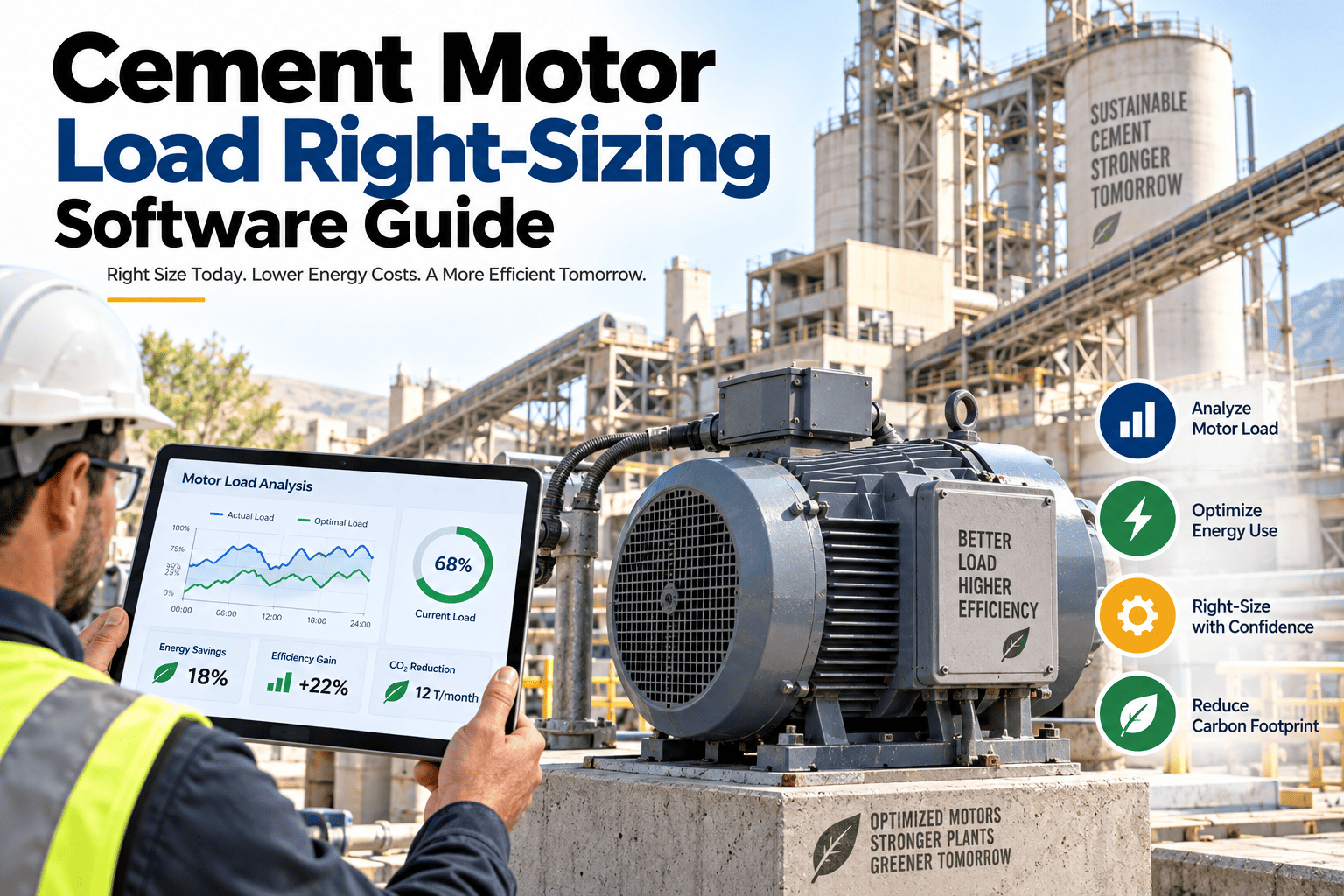
Motors account for roughly 60–80% of total electricity use in a cement plant, yet most plants have never measured how many of those motors actually run near the load they were sized for. Conservative design margins, process changes after commissioning, and mechanical throttling instead of speed control leave large numbers of drives running well below rated capacity for years. Oversized motors quietly lose several efficiency points at partial load, and the fix is rarely a wholesale motor replacement program — it starts with knowing which drives are worth right-sizing first.
Oversized motors don't fail. They just quietly cost you a few percent of every kilowatt-hour, forever.
A motor running at 40% of rated load loses efficiency compared to one matched to its duty. Across hundreds of drives on kiln, mill and fan circuits, that gap adds up to real money — and most plants have no systematic way to find it.
Why oversized motors are so common in cement plants
Motor sizing decisions get made once, at design or commissioning, and rarely get revisited as process conditions change. Three habits explain most of the oversizing found in a typical plant audit.
Motors are commonly specified with a safety margin above calculated duty to cover future capacity or worst-case process conditions that rarely occur day to day.
Throughput targets, raw material mix and product specification change over a plant's life, but the motor fleet is almost never resized to match the new normal.
Dampers, guide vanes and throttling valves restrict output on fans and pumps while the motor keeps drawing near-full power, converting the difference into wasted heat instead of useful work.
Which motors to audit first
Not every oversized motor deserves the same attention. Weighing load factor against run hours and motor size points an audit team toward the drives with the fastest payback.
| Load factor | Run hours | Motor size | Priority |
|---|---|---|---|
| Below 40% | Continuous (kiln, mill, fan) | Above 75 kW | Highest — right-size or VFD first |
| 40–60% | Continuous | Above 75 kW | High — VFD or speed-control review |
| Below 40% | Intermittent duty | Above 75 kW | Moderate — confirm before capital spend |
| 40–60% | Continuous | Below 75 kW | Moderate — bundle with other work |
| Above 75% | Any | Any | Low — motor is well matched to duty |
A five-step workflow for a right-sizing audit
Catalog the fleet
Record nameplate rating, efficiency class, rewind history and drive type for every motor above roughly 15 kW as a searchable asset register.
Log actual load
Measure current draw or power against rated capacity over a representative production cycle, not a single snapshot reading.
Rank by opportunity
Sort candidates by annual kWh, run hours and load factor to find where a right-sizing or VFD investment pays back fastest.
Choose the right fix
Decide between a smaller motor, a variable frequency drive, or leaving the motor as-is when duty cycles genuinely require the extra headroom.
Verify and re-measure
Confirm the new load factor after the fix and feed the result back into the asset record so the next audit starts from real data, not assumptions.
- Fan motor rated for 132 kW running at 35% load continuously
- Output restricted with a damper, motor still drawing near-rated current
- No record of actual load versus nameplate anywhere in the plant
- Energy waste invisible on a single monthly utility bill
- Motor resized or fitted with a VFD matched to real duty
- Damper opened fully, speed control replaces mechanical throttling
- Load factor logged against the asset and reviewed on a schedule
- Savings visible per drive, not buried in a single plant-wide total
Find your right-sizing candidates before the next energy audit
Track motor load, run hours and efficiency class in one CMMS record built for cement plants.
How a CMMS keeps a right-sizing program from stalling after the first audit
Most plants run an energy audit once, find the oversized motors, and lose track of the findings within a year because the data lives in a report instead of the maintenance system. A CMMS keeps the motor record live.
Motor asset register
Nameplate data, efficiency class, rewind count and drive pairing live on the asset record, ready for the next audit instead of a fresh spreadsheet.
Condition-based triggers
Vibration and load trends can trigger a right-sizing review automatically once a drive shows sustained low-load operation.
Work order scheduling
Motor swaps and VFD installations get scoped as planned work orders with parts and downtime windows, not squeezed into an unplanned stop.
Reporting dashboards
Plant managers can see fleet-wide load factor distribution and track right-sizing progress against the original audit list over time.
A short checklist before scoping a right-sizing project
Confirm load was measured over a full production cycle, not a single low-demand shift.
Check whether the process genuinely needs the current headroom before downsizing a motor permanently.
Compare VFD versus smaller-motor cost and payback for each candidate rather than defaulting to one fix.
Review rewind history — a rewound motor may already be running at reduced efficiency independent of sizing.
Re-measure load factor after the change and log it against the asset for the next review cycle.
Cement motor load right-sizing — frequently asked questions
What load factor signals an oversized motor?
A motor running consistently below roughly 40–50% of rated load on a continuous-duty application is generally worth reviewing for right-sizing or VFD installation.
Is a VFD always better than replacing the motor?
Not always — a VFD suits variable-load applications like fans and pumps well, but a motor that is simply oversized for a constant, fixed duty may be better served by a smaller, correctly rated replacement.
How long does a typical right-sizing audit take?
Cataloging and load-logging the motor fleet above roughly 50 kW usually takes two to three weeks, depending on plant size and how much existing data is already available.
Does right-sizing help with anything besides energy cost?
Correctly sized motors typically run cooler and with less mechanical stress, which can extend bearing and insulation life alongside the energy savings.
How does a CMMS make right-sizing a repeatable program?
It keeps motor load, run hours and efficiency data attached to the asset record permanently, so findings from one audit carry into the next instead of starting over. Get started or book a demo to see the motor asset workflow.
Turn a one-time energy audit into an ongoing motor program
Track load factor, run hours and right-sizing candidates in one CMMS built for cement plants.
Free trial available · No credit card required