A cement plant CMMS implementation that takes 12 to 18 months to reach usability is not a deployment — it is a failed project. Plants running rotary kilns at $45,000 per hour of unplanned downtime cannot afford 18 months of half-operational maintenance software while consultants configure generic asset taxonomies that were never built for refractory zones, girth gear backlash tolerances, or ball mill liner wear cycles. Oxmaint reaches full operational function at an integrated cement plant in 60 to 90 days, starting with the highest-consequence assets and the most critical PM schedules from week one. Book a demo to walk through the full 12-week cement plant implementation roadmap with your maintenance team and see what full operational function looks like at day 90.
CMMS Implementation: Cement Plant Deployment Performance Benchmarks
CMMS Implementation Compliance Requirements by Region
A structured CMMS deployment at a cement plant must satisfy equipment record, inspection documentation, and maintenance history requirements across every operational jurisdiction. Oxmaint configures inspection scheduling, audit documentation, and compliance record generation from day one of deployment so your plant has audit-ready records before the first regulatory visit after go-live.
| Region | Key Frameworks | Oxmaint Coverage from Day One |
|---|---|---|
| USA | OSHA 29 CFR 1910, MSHA 30 CFR Part 56, EPA Title V maintenance logs, ASTM inspection standards | PM work order records, equipment inspection logs, technician sign-off audit trails, compliance report exports |
| UAE | OSHAD-SF inspection requirements, Civil Defence equipment codes, SASO standards, Ministry of Industry | Digital inspection work orders, multi-site compliance dashboards, maintenance record exports from go-live |
| India | Factories Act 1948, BIS IS 14489, CPCB equipment records, DGMS kiln and quarry directives | Statutory inspection scheduling, maintenance registers active from Phase 1, compliance certificate tracking |
| Germany | BetrSichV equipment safety, DIN EN 13306 maintenance definitions, TUV inspection requirements, EU ETS | DIN-aligned maintenance records, inspection documentation, condition archiving per asset from day one |
| UK | PSSR 2000, PUWER 1998, HSE cement plant guidance, Building Safety Act, RIDDOR reporting | Inspection work order scheduling, statutory compliance exports, full maintenance history from first PM cycle |
| Canada | CSA Z1000 maintenance management, Provincial OHS Acts, ACGIH guidelines, CCOH standards | Multi-site PM dashboards active from Phase 2, inspection audit trails, equipment compliance records |
Oxmaint configures compliance record generation, inspection scheduling, and audit documentation for cement plants across every region above from day one of deployment — your team has audit-ready maintenance records before the first PM cycle closes, not months after the system goes live.
What Does a Cement Plant CMMS Implementation Actually Involve?
A cement plant CMMS implementation is the structured process of registering every maintainable asset in a digital hierarchy, configuring PM schedules tied to cement-specific operating triggers, deploying mobile work order workflows to field technicians, and activating compliance reporting — in a sequence that delivers operational value from week one rather than waiting for full system completion before maintenance teams see any benefit. Book a demo to see the full implementation sequence mapped against your plant's current maintenance programme and equipment structure.
Asset Registry Build
Import existing equipment lists or build from scratch using Oxmaint's cement asset taxonomy covering kilns, mills, crushers, preheaters, coolers, and auxiliary drives. Five-tier hierarchy configured with nameplate data, rated service life, and condition baselines. QR codes applied to plant floor assets in the first two weeks of deployment.
PM Schedule Configuration
Preventive maintenance schedules built from cement-specific operating triggers: kiln revolution counts, ball mill running hours, crusher throughput tonnage. Calendar-based intervals replaced with condition-triggered PM generation tied to actual equipment wear patterns from day one of the active PM schedule build in Phase 1 of deployment.
Mobile Technician Rollout
Field technicians receive the Oxmaint mobile app with work orders, checklists, parts lists, and asset history before leaving the workshop. QR scanning confirms task start at the equipment location. Full offline capability for kiln gallery, mill building, and preheater tower areas without stable WiFi or cellular coverage on the plant floor.
KPI Dashboard Activation
PM completion rate, mean time between failures, backlog age, and emergency versus planned repair ratio tracked as operational KPIs from the first week of active work order generation. Compliance audit report generation tested against regulatory requirements for the plant's jurisdiction before the first scheduled inspection after go-live date.
See the Full 12-Week Cement Plant Deployment in a 30-Minute Demo
Oxmaint walks through every deployment phase with your plant's specific equipment profile, existing maintenance data, and production schedule in a session that maps week-by-week milestones to your actual go-live constraints. Book a demo with your maintenance and IT team to see the implementation roadmap matched to your plant.
Four Implementation Failures That Delay CMMS Value in Cement Plants
These four failures explain why most cement plant CMMS deployments take 12 to 18 months to deliver usable maintenance management capability, and why plants continue running reactive maintenance programmes long after the software licence has been paid.
Generic Asset Taxonomy That Does Not Model Cement Plant Equipment
Generic CMMS platforms require 3 to 6 months of custom configuration to build an asset hierarchy that models rotary kiln zones, girth gear assemblies, preheater cyclone stages, ball mill liner sections, and clinker cooler grate sections as distinct maintainable assets with their own PM triggers and condition scoring parameters. Oxmaint ships with cement-specific asset taxonomy pre-built and ready to populate from the existing equipment register on day one of deployment.
Calendar-Based PM Migration That Fails to Capture Cement Operating Triggers
Migrating existing paper PM schedules into a CMMS on their original calendar intervals preserves the fundamental problem: PM that is disconnected from actual equipment operating cycles. A kiln refractory inspection scheduled every 90 calendar days regardless of campaign length and revolution count is as likely to occur during a planned shutdown as during full production, creating no usable improvement in maintenance quality over the existing paper-based approach.
Mobile App Deployment Without Offline Capability for Plant Floor Environments
Cement plant production floors, kiln galleries, mill buildings, and preheater towers frequently lack stable WiFi or cellular coverage. A mobile work order app that requires connectivity is abandoned by field technicians within 60 days of rollout, reverting the plant to the paper job card system the CMMS was deployed to replace, with the additional cost of the software licence producing no operational benefit whatsoever.
Big-Bang Implementation That Delays Any Value Until Full System Go-Live
Attempting to configure the entire cement plant asset registry, all PM schedules, full inventory integration, and complete reporting dashboards before any team begins using the system means the maintenance programme sees no improvement for 6 to 12 months while configuration continues. Plants running reactive maintenance cannot absorb a 6-month value delay when unplanned kiln stops cost $45,000 per hour and emergency repairs consume 38 to 52% of the maintenance budget.
How Oxmaint Structures Cement Plant CMMS Implementation
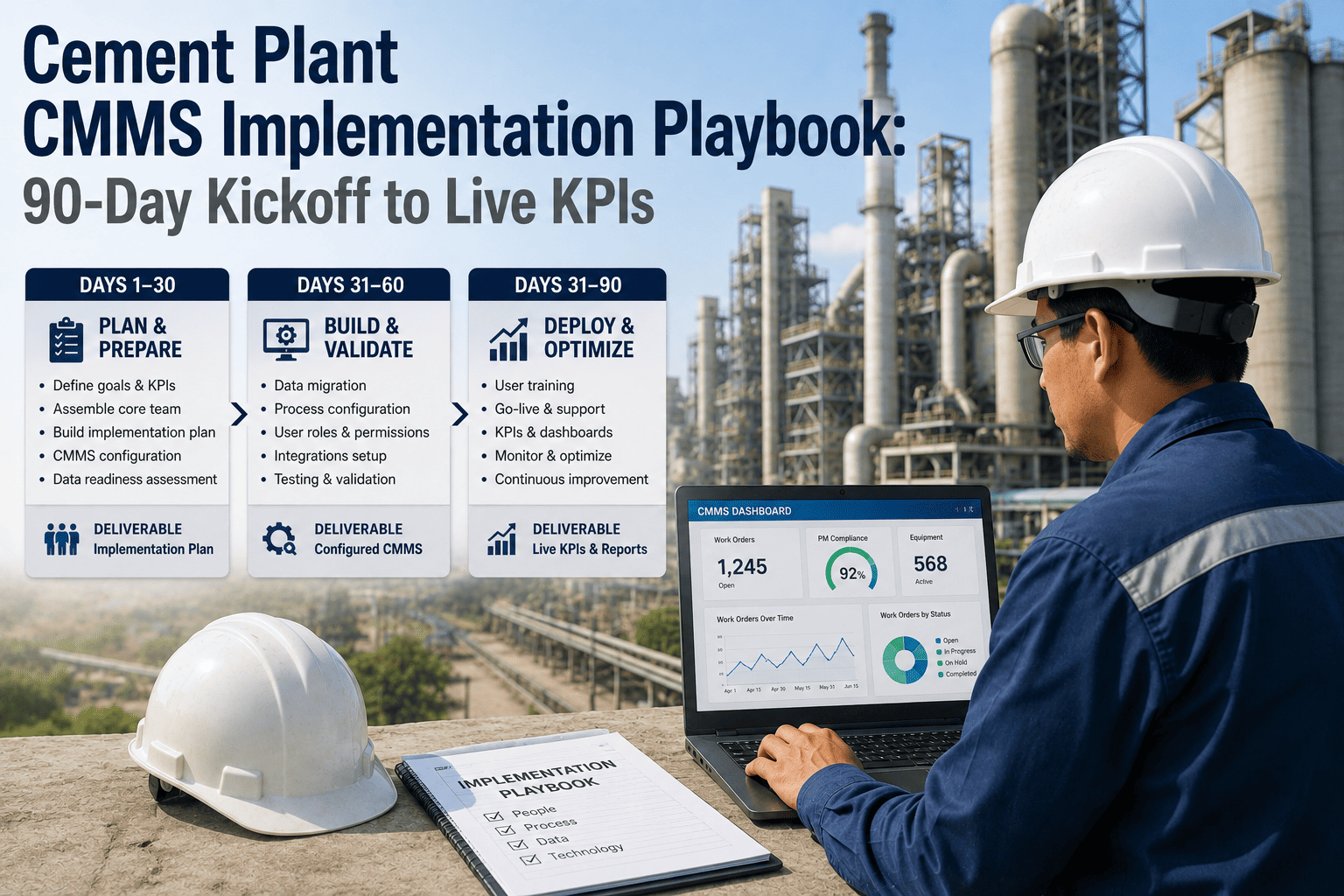
Oxmaint uses a phased deployment sequence that delivers operational value from week one rather than waiting for full system completion. Each phase adds capability to a running system, so the maintenance team begins using the platform before the deployment is complete. Book a demo to see how the phased deployment sequence maps to your plant's current maintenance structure and production schedule.
12-Week Deployment Roadmap: Phase-by-Phase Progress
Every cement plant CMMS deployment follows the same four-phase roadmap. Phase completion criteria are defined before deployment begins so both the maintenance team and Oxmaint implementation support have clear go or no-go criteria at each phase gate before the next phase activities commence. Book a demo to map this roadmap against your plant's current maintenance programme and identify which phase you can start from on day one.
Oxmaint Implementation Support: What Cement Plants Get
Every Oxmaint cement plant deployment includes structured implementation support from an engineering team with direct experience in cement manufacturing asset management. No third-party implementation consultants, no additional professional services fees for standard configuration, and no extended onboarding programmes that delay go-live by 6 to 12 months. Book a demo to see the full implementation support scope and confirm the deployment timeline for your plant's equipment base and team size.
Start Your Cement Plant CMMS Deployment in 30 Days or Less
Oxmaint implementation begins with a structured kickoff session mapping your existing equipment register, priority PM schedules, and compliance requirements to a deployment sequence that delivers active work orders within the first two weeks of the project. Book a demo to confirm the deployment timeline for your plant's equipment base, team size, and go-live target date.
Oxmaint vs Traditional CMMS Implementation: The Deployment Gap at Cement Plants
The difference between Oxmaint's phased deployment and a traditional enterprise CMMS implementation at a cement plant is measurable in weeks to first work order, months to full PM compliance, and total implementation cost from licence to operational use. Book a demo to see a direct deployment timeline and cost comparison against your current or planned CMMS platform.
| Deployment Factor | Oxmaint Phased Deployment | Traditional Enterprise CMMS |
|---|---|---|
| Time to First Active Work Order | First PM work orders generated and assigned to technicians within 2 weeks of project kickoff. Maintenance team using the mobile app with real work orders before the end of deployment Phase 1 without waiting for full system configuration to complete across all equipment classes. | First active work orders typically generated 4 to 6 months after project kickoff, following asset taxonomy build, system configuration, data migration validation, and user acceptance testing phases that must complete before the maintenance team begins using the system for live maintenance tasks. |
| Time to Full PM Programme Compliance | PM compliance rate above 80% achieved by end of Phase 2 (week 6). Full programme compliance above 84% across all equipment classes reached by end of Phase 4 (week 12) from the deployment start date with no gap period where the maintenance team reverts to paper-based work order management. | Full PM programme compliance typically takes 12 to 18 months to establish after go-live, as teams simultaneously learn the system, correct configuration errors, and manage the transition from paper-based workflows while continuing to run the existing maintenance programme in parallel to avoid coverage gaps. |
| Cement Asset Taxonomy Configuration | Cement-specific asset hierarchy for rotary kiln, girth gear, ball mill, vertical roller mill, clinker cooler, and preheater cyclone pre-built in Oxmaint and ready to populate from the existing equipment register without custom taxonomy development before deployment can begin and generate operational value for the maintenance team. | Custom asset taxonomy build for cement plant equipment classes typically requires 3 to 6 months of configuration consulting before the hierarchy is validated and PM schedules can be attached to the correct equipment records. Generic CMMS taxonomy must be extended to model cement-specific assets such as refractory zones and girth gear assemblies from scratch. |
| Implementation Cost Structure | No heavy implementation consulting fees or professional services charges beyond the standard deployment support scope included with the Oxmaint subscription. Total implementation cost known before project start with no scope expansion billing for standard cement plant configuration activities across asset registry, PM schedule build, and mobile app rollout phases. | Implementation consulting typically adds 40 to 80% to the first-year total cost of enterprise CMMS deployment at a cement plant. Configuration scope changes during deployment generate additional professional services billing. Data migration and integration work typically charged separately from the base implementation engagement, extending the total cost beyond the initial project estimate. |
| Plant Shutdown Requirement | Zero plant shutdown events required at any phase of Oxmaint deployment. Asset registry build, PM schedule configuration, mobile rollout, and compliance reporting activation all completed against a live running plant without requiring any production curtailment or outage scheduling for the CMMS deployment project activities. | Some enterprise CMMS implementations require planned maintenance windows for data migration validation, system cutover, and legacy system decommissioning activities. System cutover from the legacy maintenance management approach to the new platform may require a brief parallel running period that imposes administrative overhead on an already stretched maintenance team. |
| Post-Go-Live Support and Optimisation | Monthly MTBF and PM compliance reviews with Oxmaint support team in the 6 months after full go-live. PM interval optimisation as condition data accumulates. RUL calculation refinement from actual replacement event data. No additional professional services charges for standard post-go-live optimisation support activities during the first year of deployment. | Post-go-live support typically charged at professional services rates for configuration changes, additional training, and system optimisation requests. Ongoing support contract costs add to the total cost of ownership beyond the initial implementation engagement. PM interval optimisation from real condition data typically requires additional consulting engagement to configure and validate. |
Cement Plant CMMS Implementation: Results Within 90 Days of Deployment
These benchmarks represent average results from cement plants that completed Oxmaint deployment across their full equipment base within the 12-week roadmap timeline without extending any phase beyond its planned completion date.
Frequently Asked Questions: CMMS Implementation at Cement Plants
QHow long does a full Oxmaint CMMS deployment take at an operating cement plant?
QDoes CMMS deployment at a cement plant require a production shutdown?
QWhat existing data does Oxmaint need to begin implementation at a cement plant?
QWhich compliance frameworks does Oxmaint support from day one of deployment globally?
QCan a cement plant migrate from SAP PM to Oxmaint without losing maintenance history?
QWhat is the payback period for a cement plant CMMS implementation with Oxmaint?
Continue Reading: Cement Plant CMMS and Maintenance Resources
Explore these in-depth guides to build a complete picture of cement plant CMMS selection, asset lifecycle management, and maintenance digital transformation across your operations.
Cement Plant Maintenance Software: Complete Buyer's Guide
Features, pricing models, ROI benchmarks, and deployment timelines for selecting the right CMMS in dry and wet process cement manufacturing across all plant sizes globally.
Read the Full GuideOxmaint vs SAP PM for Cement Plants: Head-to-Head Comparison
Deployment timeline, implementation cost, kiln and mill management capability, and 5-year total cost of ownership compared between Oxmaint and SAP PM for cement manufacturing operations.
View the ComparisonMobile CMMS for Cement Plants: Dustproof Field Maintenance Guide
How mobile CMMS with offline capability transforms field maintenance execution in kiln galleries, mill buildings, and preheater towers without relying on stable plant floor WiFi or cellular coverage.
Explore Mobile GuideCement Plant Asset Lifecycle Management with CMMS
Track every cement plant asset from commissioning baseline to replacement decision with RUL calculations, condition scoring, and 10-year CapEx forecasting built into every asset record.
Read Lifecycle GuideStart Your Cement Plant CMMS Deployment Today
Oxmaint deploys across your cement plant's full asset base in 60 to 90 days. No heavy implementation fees, no extended onboarding programme, no shutdown required at any deployment stage. Book a 30-minute demo with your maintenance team and walk through the 12-week deployment roadmap mapped to your plant's equipment base, production schedule, and compliance requirements from your first session.