
Cement plants spend 25 to 35% of production costs on maintenance — yet most of that goes to reactive repairs costing 4 to 6 times more than planned interventions. TPM changes that ratio by shifting equipment ownership from a central maintenance department to every operator and technician. The critical variable is implementation: manual TPM achieves 34% of planned OEE targets; CMMS-supported TPM achieves 87%. Book a demo to see OxMaint supporting every TPM pillar from AM checklists to focused improvement and OEE analytics.
TPM and CMMS Compliance Frameworks by Region
TPM implementation must align with regional maintenance management and occupational health frameworks. OxMaint automates documentation and compliance records across all major regions — OSHA 29 CFR 1910 (USA), OSHAD-SF (UAE), Factories Act 1948 (India), BetrSichV and DIN EN 13306 (Germany), PUWER 1998 (UK), and CSA Z1000 (Canada). Audit trails, AM checklists, PM inspection records, and OEE dashboards generate automatically from work order data. Book a demo to see OxMaint generating compliance documentation for your region.
Run Every TPM Pillar Through One CMMS Platform
OxMaint connects AM checklists, PM scheduling, OEE tracking, focused improvement, and safety compliance into a single TPM platform for 24/7 cement manufacturing. Book a demo to see TPM running against your plant’s equipment structure.
The 8 TPM Pillars for Cement Manufacturing
TPM structures improvement around eight mutually reinforcing pillars — each addressing a specific failure in how cement plant equipment is owned and maintained. This article maps each pillar against two implementation realities.
Head-to-Head: Manual TPM vs. CMMS-Supported TPM Across All 8 Pillars
| TPM Pillar | With OxMaint CMMS | Manual TPM (Paper-Based) |
|---|---|---|
| Autonomous Maintenance | Digital AM checklists completed on mobile at the equipment. Timestamps, photos, and readings captured automatically. Compliance tracked per shift. Abnormality tags raised digitally and routed to maintenance. | Paper checklists filed in binders. Compliance unverifiable — operators sign off without completing tasks. Abnormalities noted in logbooks no one reviews. AM activity collapses within 6 to 12 months. |
| Focused Improvement | OEE loss data from every kiln stop feeds focused improvement teams with valid Pareto analysis. Top 3 losses identified automatically. Kaizen actions tracked as CMMS work orders with named owners and deadlines. | Kaizen teams work from supervisor estimates. No reliable OEE baseline. Improvement actions recorded in meeting minutes that are never tracked. Same losses repeat every quarter. |
| Planned Maintenance | PM schedules tied to kiln revolutions, mill throughput, and running hours — not calendar dates. PM compliance reaches 84% within 12 months. Overdue escalations generated automatically. | Calendar-based PM intervals set at commissioning and never updated. PM compliance averages 31%. Inspections deferred during production peaks and never rescheduled. Deterioration accumulates across every deferred cycle. |
| Quality Maintenance | Equipment condition thresholds linked to quality outcomes — VRM vibration above 6mm/s triggers inspection before off-spec cement reaches dispatch. Quality work orders raised automatically on threshold breach. | Quality defects investigated after customer complaint. Equipment condition not linked to quality outcomes. Cause identified as “process variation” without finding the specific equipment trigger. Same defect recurs on next run. |
| Early Equipment Management | Full CMMS failure history and total cost of ownership informs procurement. Replacement equipment evaluated against maintainability criteria from work order data. Capital planning built from asset condition scores. | Equipment purchased on capital cost alone. Failure history not consulted. Problematic designs repeated in new purchases. Total cost of ownership unknown at time of capital approval. |
| Training and Education | AR-guided work instructions deliver equipment-specific procedures at the asset location. Training records linked to competency requirements. Skill gaps identified from recurring defect patterns per technician. | Training records in HR systems disconnected from maintenance activities. Technicians work on equipment without verified competency. Knowledge held by individuals and lost at retirement. Training ROI unmeasurable. |
| Safety, Health and Environment | LOTO procedures, confined space permits, and hot work approvals managed as mandatory pre-task steps. Work orders cannot start without permit sign-offs. Incident records linked to equipment and work order history. | Safety permits issued on paper. Technicians begin work before permits are processed. Incident investigation relies on incomplete paper shift logs. Compliance rate unverifiable at audit. |
| Administrative TPM | Spare parts catalogue linked to asset records. Minimum stock alerts trigger reorder automatically. Parts consumption tracked by work order history. Stockout events reduced 73% within 12 months. | Spare parts in a separate warehouse system disconnected from work orders. Stockouts discovered during live shutdowns. Emergency procurement at 2.8 to 4.2 times cost. No visibility of parts consumption by failure mode. |
See All 8 TPM Pillars Running in OxMaint
Every pillar in the comparison above is live in OxMaint — from AM checklists to spare parts stockout prevention and OEE-linked focused improvement. Book a demo to walk through each pillar against your equipment and shift structure.
How OxMaint Implements Each TPM Pillar: The 4-Phase Rollout
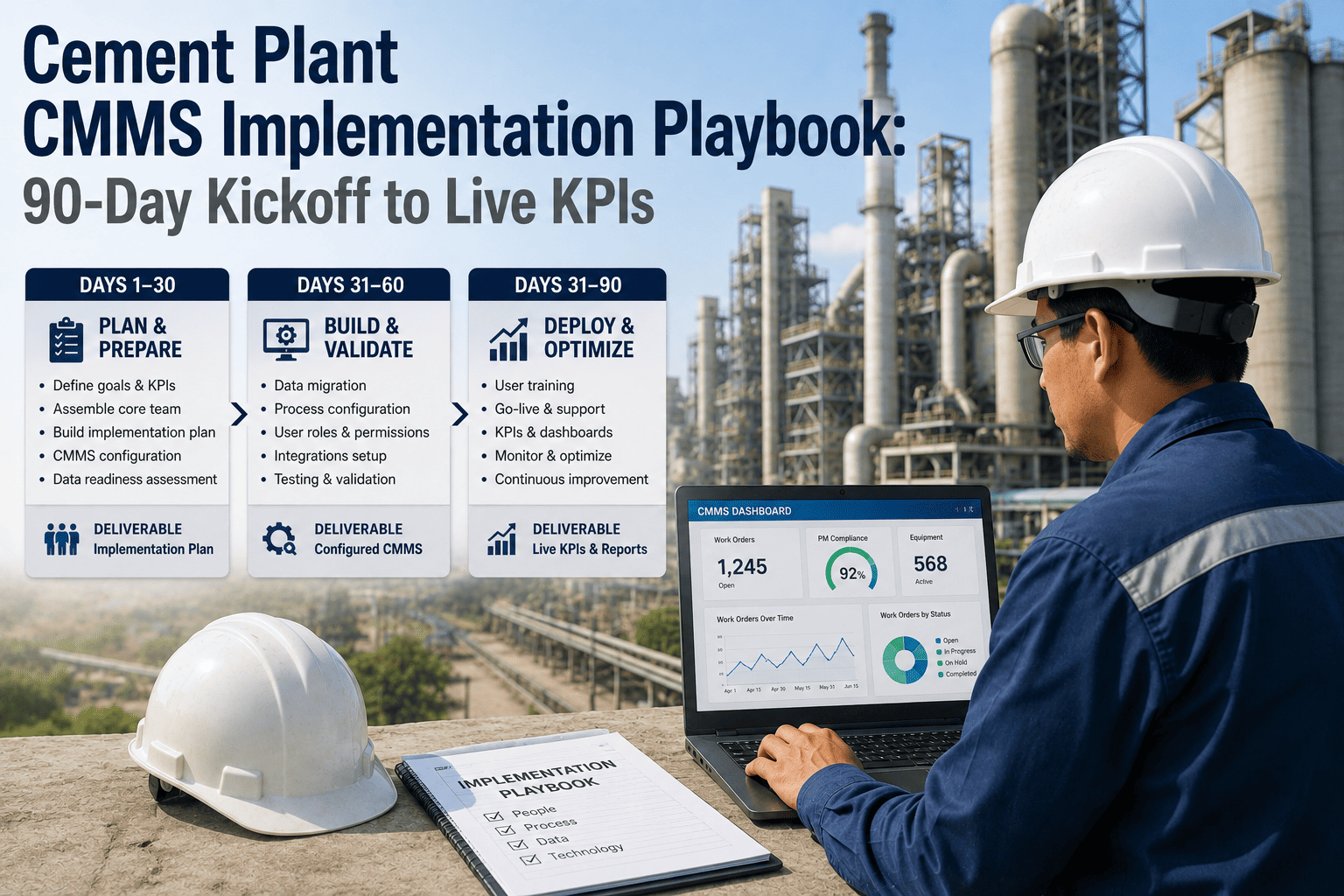
OxMaint deploys TPM across a cement plant’s full equipment base in four structured phases. Each phase activates specific CMMS capabilities that make the corresponding TPM pillars measurable, sustainable, and improvable. Book a demo to see the full TPM deployment roadmap for your plant.
OEE Comparison: Manual TPM vs. CMMS-Supported TPM at Cement Plants
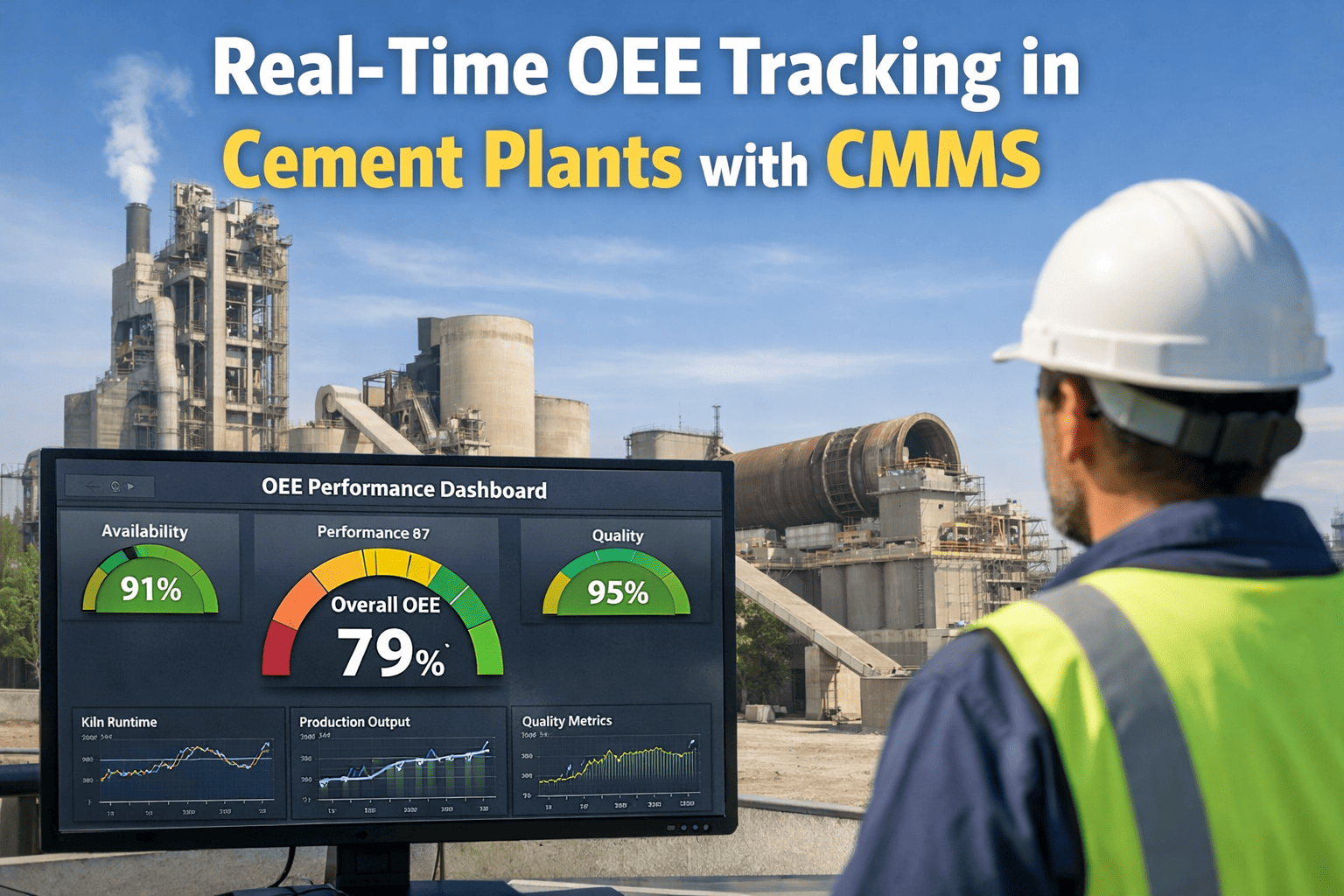
OEE is the headline TPM metric. The gap between manual and CMMS-supported TPM is widest in availability — PM compliance collapses without digital enforcement. Performance and quality components also diverge within 12 months.
Performance: 93–96% — Speed losses tracked and eliminated. VRM and kiln operating at nameplate capacity.
Quality: 97–99% — Equipment condition thresholds linked to product quality. Off-spec events traced to specific triggers.
Performance: 84–90% — Speed losses estimated not measured. Focused improvement team lacks OEE data to identify top losses.
Quality: 91–96% — Quality events investigated after customer complaint. Equipment condition not linked to quality tracking.
TPM Performance Benchmarks: CMMS-Supported vs Manual
TPM ROI Comparison: Investment and Returns by Pillar
The financial case is pillar-specific. The table below shows payback timing and annual savings for a mid-size cement plant. Book a demo to run a custom ROI calculation for your plant.
| TPM Pillar | CMMS Activation Cost | Annual Savings Generated | Payback |
|---|---|---|---|
| Autonomous Maintenance | $8,000 to $15,000 setup | AM defect detection prevents $180,000 to $280,000 per avoided breakdown. Bearing and refractory events reduced 71%. | 4 to 8 weeks |
| Focused Improvement | $6,000 to $12,000 | OEE improvement of 8 to 14 percentage points. Each OEE point equals $420,000 annual production value at 5,000 TPD. | 2 to 4 weeks |
| Planned Maintenance | $10,000 to $20,000 | PM compliance increases from 31% to 84%. Emergency repair share drops from 45% to 17% of maintenance budget. | 6 to 10 weeks |
| Administrative TPM | $8,000 to $18,000 | Stockout-driven shutdown extensions eliminated. Emergency parts at inflated cost reduced 73% within 12 months. | 3 to 6 weeks |
| Full 8-Pillar TPM | $40,000 to $80,000 | $2.4M average annual savings. OEE improvement from 63% to 85%. Emergency repair share: 45% to 17%. | 8 to 16 weeks |
Frequently Asked Questions: TPM at Cement Plants
QWhat is the difference between TPM and standard preventive maintenance?
QWhy do most manual TPM programmes fail within 24 months?
QHow long does CMMS-supported TPM implementation take at an operating cement plant?
QWhich TPM pillar delivers the fastest OEE improvement?
QHow does OEE measurement work in OxMaint?
QCan OxMaint integrate with existing DCS and SCADA systems?
Continue Reading: Cement Plant Maintenance Performance Resources
Compare the CMMS platforms cement plants use to implement and sustain TPM — side-by-side on AM checklist depth, OEE integration, PM automation, and deployment speed.
RCM and TPM are complementary frameworks. See how RCM-informed failure mode analysis strengthens the Planned Maintenance and Focused Improvement pillars and drives top-quartile MTBF performance.
OEE is the headline TPM metric. See where your plant sits against 200+ global cement plants on MTBF, OEE, PM compliance, and cost-per-tonne — and what TPM-driving improvements the top quartile has made.
TPM requires capabilities that free-tier CMMS tools cannot deliver at scale. Learn which features become the constraint on each TPM pillar and the upgrade path that unlocks full programme maturity.
Start Your Cement Plant TPM Programme with CMMS Support Today
OxMaint deploys all 8 TPM pillars in 60 to 90 days — AM checklists, OEE tracking, focused improvement analytics, and spare parts integration in phases, no shutdown required. Book a 30-minute demo and see the platform running against your actual kiln, mill, and equipment structure.



-in-cement-plants.png)