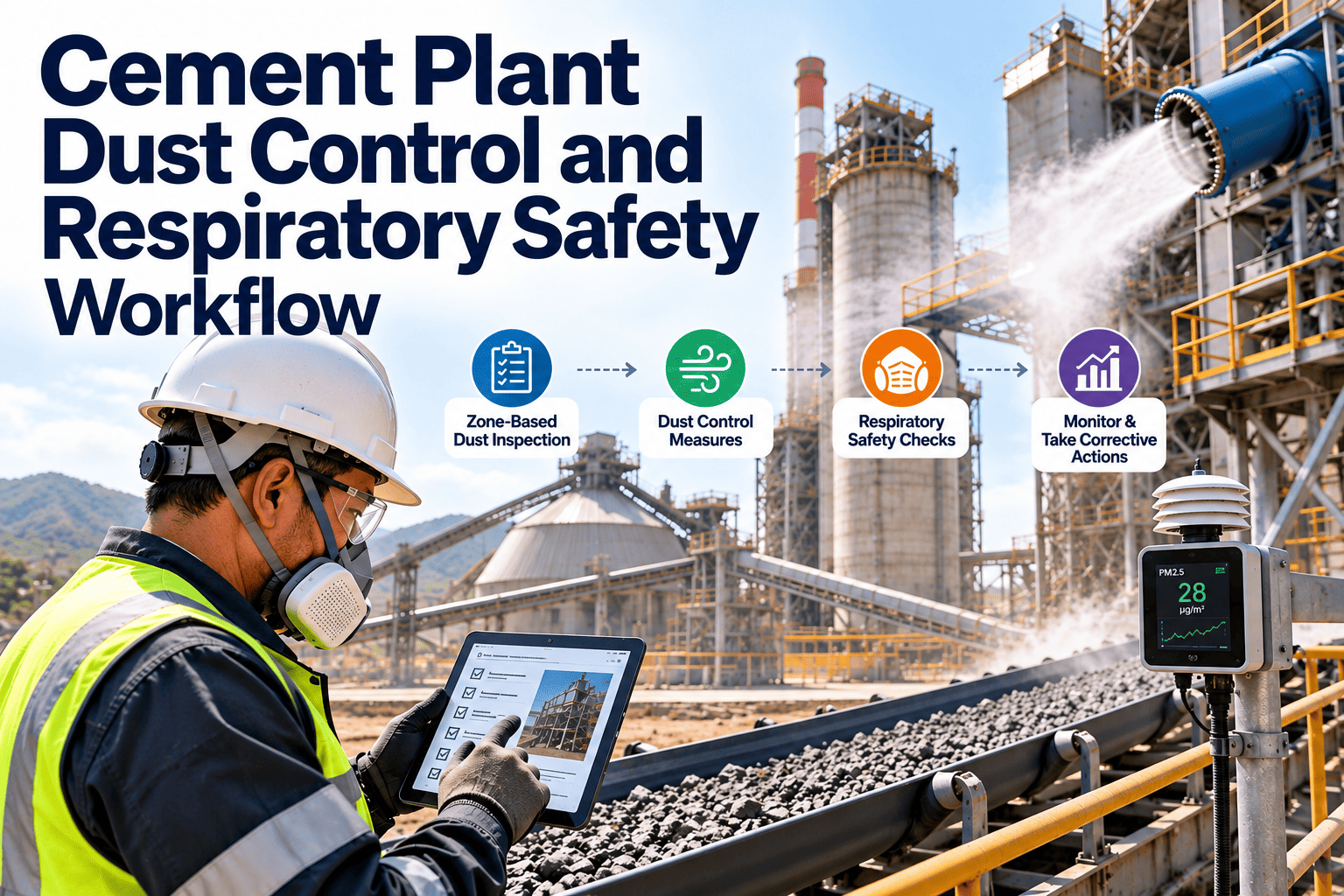
Cement Plant Dust Control and Respiratory Safety Workflow

By Corin Hale on October 10, 2026

cement-plant-dust-control-and-respiratory-safety-workflow

Dust is part of cement making from the quarry face to the packing plant, and the fine fraction that reaches a worker's breathing zone is the part that matters most. Limestone, clay and sand can carry crystalline silica, while cement dust is alkaline and irritating to the airways, eyes and skin. Good control depends on capture hoods, sealed transfer points, healthy collectors and a respiratory program that works as the last line, not the first. This workflow shows how maintenance and safety teams can connect those controls, and how cement maintenance software can keep the inspections, repairs and records in one place.

Safety & Compliance · Dust Exposure and Control

Cement Plant Dust Control and Respiratory Safety Workflow

A seven-stage workflow that links dust sources, capture equipment, collector health, exposure monitoring and respiratory protection, so dust controls are maintained like production-critical assets.

7Inspection Categories
45Check Points
6Frequency Levels
Source controlEnclose, seal and reduce generation
Capture and ventilationHoods, ducts and fans at transfer points
CollectionBaghouses and filters in good condition
MonitoringExposure and collector performance data
RespiratorsLast line of protection

Cement Plant Dust Control and Respiratory Safety Checklist

Work through the categories in sequence, from finding the source to capture, collection, monitoring and respiratory protection. Tick each item and raise a work order for every exception.

SEvery shiftWWeeklyMMonthlyQQuarterlyAAnnual or outageEEach job or event
01Dust Source Survey Walk

Walk each area on a fixed route and note visible emissions at transfer points, chutes, vents and loading spouts, with location and photo.WWeekly · Area supervisor

Record settled dust depth on platforms, handrails and cable trays, because new buildup points to a nearby leak.WWeekly · Area supervisor

Check spillage under conveyors, around elevator boots and beneath air slides, and trace each spill to its source.SShift · Operator

Confirm dust suppression sprays, where used, have clear nozzles, correct aim and adequate water pressure.WWeekly · Area technician

Check haul roads, stockpiles and open storage for dust generation, and confirm water or binder application schedules are followed.WWeekly · Quarry supervisor

Compare the survey with the previous walk, and flag locations where the same dust source appears repeatedly.MMonthly · Safety officer
02Capture and Collection Equipment

Hoods and enclosures at transfer points are intact, positioned correctly and not removed or propped open for access.WWeekly · Area technician

Belt skirts and seals contact the belt evenly, with no gaps that let dust escape or material spill.WWeekly · Conveyor technician

Ducts, expansion joints and inspection doors are checked for cracks, holes, wear-through and missing gaskets that cause leakage and reduce airflow.MMonthly · Mechanical technician

Collector differential pressure is read and compared with the design range. A fall below normal can indicate torn bags, while a rise can signal blinding or cleaning faults.SShift · Operator

Pulse valves, solenoids, compressed air pressure and moisture separators are checked so cleaning cycles perform as designed.WWeekly · Maintenance technician

Visible emissions from stacks and vents are observed, and any visible plume at an outlet that is normally clear raises a work order immediately.SShift · Operator

Hopper level, rotary airlocks and screw conveyors are checked so full hoppers do not blind bags or back dust into the clean side.WWeekly · Maintenance technician

Fan condition is checked for vibration, imbalance from buildup, belt tension and motor load, since weak airflow reduces capture across the whole system.MMonthly · Reliability technician

Bag replacement is logged by position and date, with failed bag locations reviewed for patterns related to cage damage, moisture or temperature.EEach replacement · Maintenance planner
03Fugitive Dust and Housekeeping

Cleaning is done with industrial vacuums fitted with suitable filtration, and dry sweeping of settled dust is not used.SShift · Area supervisor

Compressed air is not used to blow dust from clothing, equipment or floors, and the rule is enforced at the point of use.SShift · Area supervisor

Wet cleaning methods are used where process and electrical safety allow, and the water is controlled and drained.WWeekly · Area supervisor

Cleaning schedules are set by area and priority, and spills are cleaned during the shift they occur and not left to the end.SShift · Operator

Recurring spill sources have a repair work order open, with an owner and due date.WWeekly · Maintenance planner

Waste dust from vacuums and collectors is handled in covered containers and moved without creating fresh dust clouds.WWeekly · Area supervisor
04Maintenance Task Controls

Before bag and cage changes, the compartment is isolated, opened in a controlled way and the tube sheet vacuumed before bags are removed.EEach job · Job lead

Before clearing blocked chutes or hoppers, a permit is issued, the equipment is isolated and compressed air is not used to dislodge material.EEach job · Permit issuer

Before opening mill, kiln or cooler inspection doors, the draft condition is confirmed and the door is open for the shortest practical time.EEach job · Area supervisor

When replacing skirts, liners or chute plates, wet methods or local extraction are used and cleanup is planned for the end of the task.EEach job · Job lead

For silo and bin entry, a confined space permit is in place and the dust and engulfment hazards are assessed together.EEach job · Permit issuer

The planned task lists the required respirator type and the dust control method, and the crew confirms both at the toolbox talk.EEach job · Job lead
05Exposure Monitoring

Personal air sampling is carried out on representative tasks such as packing, bag changes, cleaning and conveyor work, and not only at fixed locations.QQuarterly · Industrial hygienist

Results are compared with the limits that apply to the site, and anything near the action level triggers a review of controls.QQuarterly · Safety officer

Sampling pump calibration and sample chain of custody are recorded for every campaign.EEach sampling · Industrial hygienist

Workers are told their results, and results are filed with the task, area and control status at the time.EEach sampling · Safety officer

Medical surveillance requirements for exposed workers are identified and tracked to completion where regulations require them.AAnnual · Health provider
06Respiratory Protection Program

A written program names the program administrator and lists tasks and areas where respirators are required.AAnnual · Safety officer

Workers have completed medical evaluation before fit testing or use, and results are filed with the health provider.EBefore first use · Health provider

Respirator type and filter class match the hazard, and fit testing is done for each model and size, with records current.AAnnual · Safety officer

Workers perform a user seal check each time, and facial hair or equipment that interferes with the seal is addressed.EEach use · Worker

Respirators are cleaned, inspected and stored in clean sealed containers, away from dust and heat, with damaged units removed.WWeekly · Area supervisor

Filters and cartridges are replaced by schedule and by condition, such as breathing resistance or visible damage, with stock levels tracked.WWeekly · Storekeeper

Supervisors observe respirator use during bag changes, cleaning and confined entries, and corrective coaching is recorded.MMonthly · Supervisor
07Escalation, Records and Sign-Off

Any visible plume from a normally clear stack has an urgent work order opened, and restricted access is applied while it is investigated.EEach event · Operator

Falling or rising collector differential pressure outside the design band creates a work order within the same shift.SShift · Operator

Every dust-related work order records the location, cause, repair and verification reading after completion.EEach event · Maintenance planner

Respirator inspections, fit tests and training dates are linked to the worker and area records.MMonthly · Safety officer

Repeat dust sources and overdue repairs are reviewed with plant management and spare parts or budget is adjusted.MMonthly · Plant manager

The area supervisor signs the completed checklist and any exceptions carry an owner and a due date.EEach route · Area supervisor

Treat Dust Collectors as Critical Assets

Schedule collector inspections, record differential pressure and bag replacements, and link every leak to a work order in Oxmaint so dust control stays maintained and visible.

The Seven-Stage Dust Control Workflow

Each stage has an owner, a trigger and an output so dust problems move from observation to closed work.

01
IdentifyOwner: area supervisorWalk each area on a defined route and record visible emissions, spillage and settled dust, with photos and location.
02
AssessOwner: safety officerLink the finding to the task, the people exposed and the exposure data already collected for that area.
03
RepairOwner: maintenance plannerRaise a work order for the source, such as a worn skirt, leaking duct or failed bag, with priority matched to the exposure risk.
04
VerifyOwner: reliability technicianCheck differential pressure, airflow and visible emissions after repair to confirm the control works.
05
MonitorOwner: industrial hygienistSample personal exposure on representative tasks and compare results with applicable limits.
06
ProtectOwner: safety officerAssign respirators for tasks that still need them, after medical evaluation, selection and fit testing.
07
ReviewOwner: plant managementReview repeat sources, overdue repairs and exposure trends, then adjust preventive tasks and budgets.

Where Dust Comes From Along the Cement Process

Dust control starts by knowing which operations generate it and which maintenance failures make it worse.

Process stageDust sourceMaintenance failure that increases exposure
Quarry and crushingDrilling, blasting, crushing, screening, haul roadsWorn spray nozzles, damaged enclosures, blocked suppression lines
Raw material handlingBelt transfer points, stacker and reclaimer, storage pilesWorn skirts and seals, misaligned belts, spillage
Raw mill and kiln feedMill vents, feed chutes, elevatorsLeaking expansion joints and inspection doors
Kiln, preheater and coolerKiln dust, cooler vents, bypass dustCollector bag failures, poor sealing of hoppers
Cement mill and silosMill vents, silo filling, bucket elevators, air slidesCracked air slide fabric, filter bags leaking on silo vents
Packing and loadingPacker spouts, bag drops, truck loading spoutsTorn loading spout bellows, spilled bags, damaged hoods

Hierarchy of Controls Applied to Cement Dust

Respirators matter, but they sit at the bottom of the hierarchy. This ladder shows how each level supports the next.

1. Eliminate or reduce at sourceEnclose transfer points, reduce drop heights, repair leaks and keep process equipment sealed.
2. Engineering controlsLocal exhaust ventilation, dust collectors, water suppression and closed conveying systems.
3. Administrative controlsCleaning schedules, restricted access, rotation, signage, permits and training.
4. Respiratory protectionSelected, fit-tested and maintained respirators for tasks where exposure cannot be controlled enough by other means.

Reading Collector Condition Signals

Use these signals as prompts for inspection. Final limits should come from the equipment manufacturer and your plant design.

SignalWhat it can meanFirst action
Differential pressure well below normalTorn or missing bags, leaking tube sheet sealsInspect clean side for dust deposits and check bag condition
Differential pressure steadily highBlinded bags, cleaning system fault, moistureCheck pulse valves, compressed air and hopper level
Visible plume at stack or ventBag failure or seal leakRaise urgent work order and plan isolation for inspection
Dust at transfer point despite running collectorLow capture airflow, damaged hood, duct leak or blocked branchCheck duct leaks, damper position and fan performance
Frequent bag failure in one zoneHot spots, abrasive inlet, poor cage conditionReview inlet design and temperature records
Settled dust building on platformsFugitive leaks nearby or poor housekeepingTrace source and update cleaning schedule

Exposure Monitoring and Applicable Limits

Crystalline silica and cement dust limits depend on jurisdiction and regulator. For example, OSHA's general industry silica standard, 29 CFR 1910.1053, sets a permissible exposure limit of 50 micrograms per cubic metre as an eight-hour average, with an action level of 25. Mine and quarry operations may fall under MSHA rules, so confirm which regulation governs each area.

Personal samplingSample workers on representative tasks, such as packing, bag changes, cleaning and conveyor work, and not only on fixed areas.
Area and process monitoringCombine area measurements with collector pressure and emission observations to find where controls are weakening.
Medical surveillanceFollow regulatory requirements for health monitoring of workers with regular exposure to respirable silica or irritant dust.

Reactive Dust Management Versus Planned Control

The difference shows up in how problems are found, repaired and verified.

Reactive approach
  • Dust problems found when workers complain or an inspector visits
  • Bag failures discovered after a visible plume appears
  • Repairs delayed because spares are not on site
  • Respirator records kept in separate files that nobody reviews
  • No link between exposure results and maintenance history
Planned approach
  • Routine inspection routes find leaks and spillage early
  • Differential pressure trends flag failing bags before emissions rise
  • Spare bags, cages and gaskets reserved against work orders
  • Respirator, fit test and training records tied to the worker and area
  • Exposure results reviewed alongside repair history to find weak controls

Escalation Triggers

Agree thresholds in advance so dust problems do not wait for the next audit.

Immediate actionVisible plume from a normally clear stack, collector failure with personnel working nearby, or respirator use failing in a high-exposure task. Stop or restrict the task and notify safety.
Priority repairSustained dust at a transfer point, duct leaks, falling differential pressure or exposure results near the action level. Open a high priority work order.
Planned workWorn skirts, ageing bags and recurring spillage that do not yet affect exposure results. Schedule corrective work with a due date.

Spares and Stock That Keep Dust Controls Running

A dust repair that waits for parts keeps exposure high. Stock decisions should follow failure history, not guesswork.

ItemWhy it mattersStocking approach
Filter bags and cagesFailed bags are the most common cause of collector emissionsHold a set per critical collector based on bag life history
Pulse valve diaphragms and solenoidsCleaning faults raise differential pressure and reduce airflowKeep kits for the valve models in use
Skirt rubber, seals and gasketsSmall gaps at transfer points release dust continuouslyStock standard lengths and fasteners near conveyors
Respirator filters and cartridgesWorkers cannot be protected if replacements run outTrack usage per area and reorder at a set level

How Oxmaint Supports the Workflow

Dust control depends on small repairs completed on time. Oxmaint helps by connecting inspections to work orders, spares and records.

KPIs for Dust Control and Respiratory Safety

MetricMeasureDirection
Collector inspection completionCompleted inspections divided by scheduled inspectionsNear 100%
Dust-related work order backlogOpen dust control work orders past dueFalling
Bag life by collectorAverage time between bag replacements per collectorStable or rising
Exposure results above action levelSamples above action level divided by all samplesFalling
Fit test currencyRespirator users with current fit test divided by all users100%
Repeat dust sourcesLocations with repeated dust findings in a periodFalling

Frequently Asked Questions

Why is respirable dust a priority in cement plants?

Fine particles can reach deep into the lungs, and raw materials may contain crystalline silica. Cement dust also irritates skin, eyes and airways.

Are respirators enough to control cement dust?

No. They are the last line of defence after source control, capture and collection. Reliable collectors reduce the need for respirators.

How often should baghouse bags be inspected?

Set intervals from manufacturer guidance and bag failure history, and trend differential pressure continuously. Book a demo to see scheduling.

What records support a dust control program?

Keep inspection logs, repair history, monitoring results, fit tests and training. Get started to store them against assets.

Which regulation applies to my plant?

It depends on location and operation, such as OSHA, MSHA or national rules. Confirm with your safety and legal teams.

Keep Dust Controls Working Between Audits

Connect dust collector inspections, repairs, exposure records and respirator checks in Oxmaint, and give safety and maintenance teams one shared view of what needs attention.

Share This Story, Choose Your Platform!