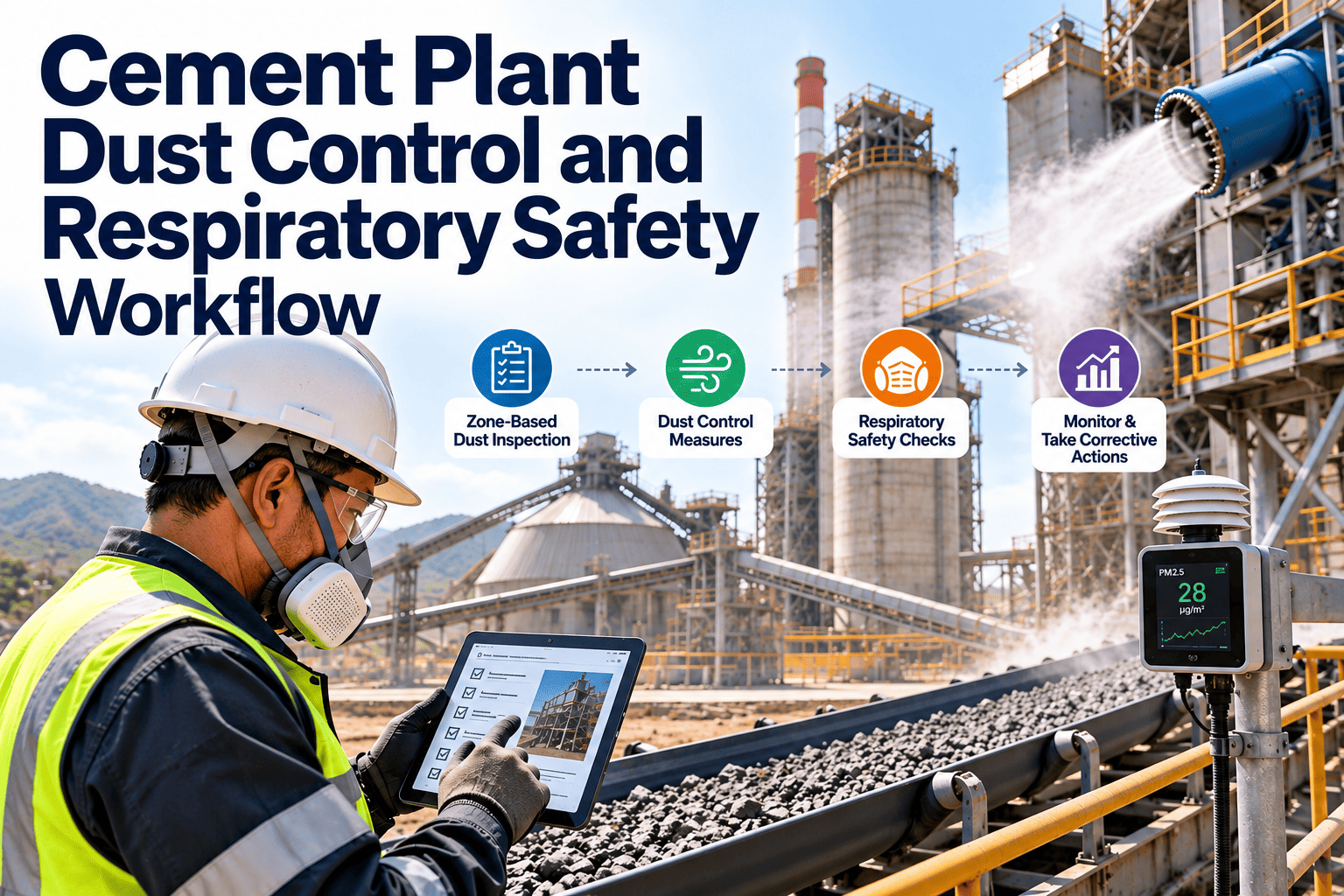
Cement plant workers face one of the most hazardous breathing environments in any industrial sector. Dust concentrations at raw material crushers reach 38.6 mg/m³ — nearly four times OSHA's permissible exposure limit — while ambient PM2.5 levels near kiln operations have been recorded at 12,200 µg/m³ peak, over 490 times the WHO 24-hour guideline. The 2025 BMJ Open study on cement workers confirmed dose-response relationships between dust exposure and measurable lung function decline, with 85% of crusher section workers reporting chronic respiratory symptoms. Yet the most dangerous reality is this: most of these cases were preventable. Digital HSE platforms are helping cement plant safety managers build systematic, real-time dust control programs that eliminate the paper-trail gaps responsible for compliance failures and worker injury. Sign up for Oxmaint and start protecting your team with automated dust monitoring, PPE compliance tracking, and OSHA-ready audit reports in one platform.
Cement Plant Dust Control & Respiratory Safety: Complete Guide
This guide covers every aspect of cement plant dust hazard management — from understanding the four dust types that threaten worker health, to selecting the right engineering controls, to building a CMMS-powered compliance program that keeps your plant audit-ready 365 days a year.
The Four Dust Types That Destroy Lung Health in Cement Plants
Cement plant air carries a combination of particulate matter types — each attacking the respiratory system differently. Understanding what you are dealing with is the first step to selecting controls that actually work. Standard dust masks protect against only one of these four categories.
Respirable Crystalline Silica (RCS)
Found in raw material quarrying and grinding. Particles under 10 microns penetrate deep into the alveoli, bypassing the body's natural filtration entirely. Causes silicosis — an irreversible, progressive lung disease with no therapeutic reversal. OSHA's PEL for the respirable fraction is 0.05 mg/m³. Exposure over years produces fibrotic lung tissue that cannot be treated, only prevented.
Portland Cement Dust (PCD)
Highly alkaline at pH 11.5 — when inhaled, it reacts with moisture in the airway to form a caustic solution that burns mucosal tissue. Long-term exposure causes chronic bronchitis, measurably reduced forced expiratory volume (FEV1), and COPD. The hexavalent chromium content independently triggers occupational asthma, with symptoms that persist for years after exposure ends.
Cement Kiln Dust (CKD) & Bypass Dust
Fine alkaline particulate captured from kiln exhaust gases. A single production line generates up to 300 tons per day. Its 1–10 micron particle size allows long-distance travel from the plant, affecting nearby communities as well as workers directly. Contains arsenic and cadmium — heavy metals that independently elevate pulmonary damage and long-term cancer risk.
Fine Particulate Matter (PM2.5 / PM10)
Ambient monitoring near cement plants has recorded average PM10 concentrations of 388 µg/m³ — with peak PM2.5 readings reaching 12,200 µg/m³. The WHO's 24-hour PM2.5 guideline is 25 µg/m³, meaning peak exposures exceed safe limits by 490×. Long-term exposure links conclusively to emphysema, cardiovascular mortality, and elevated cancer risk across multiple large-scale studies.
Why Multiple Dust Types Compound the Risk
Simultaneous exposure to silica, Portland cement, bypass dust, and fine PM creates a compounding effect worse than any single hazard alone. A program designed only for general dust will fail to address silica fibrosis risk. Wet suppression that handles coarse PM10 may leave silica and PM2.5 particles untouched. Effective control requires a layered strategy matched to each dust type in each zone.
Dust Concentration by Production Zone: Know Your Highest-Risk Areas
Not all areas of a cement plant carry equal risk. The hierarchy of dust exposure is consistent across facilities worldwide, and your control program must be zone-specific to be effective. Sign up for Oxmaint to deploy automated zone-level monitoring with instant work order triggering when dust thresholds are exceeded.
Raw Material Crusher
The highest dust exposure zone in any cement plant. Crusher section workers have the highest prevalence of respiratory symptoms of any job classification. Controls: wet fog suppression (85–95% suppression), enclosed hood systems with local exhaust ventilation ducted to bag filters, and negative pressure enclosures around the crusher body. PPE: Full-face P100 respirator minimum. SCBA for confined access within the crusher enclosure.
Raw Mill & Grinding
Combined total dust and PM10 concentrations place this zone in the highest-risk category for long-term lung function decline. Studies confirm FEV1 decline correlates directly with exposure duration here. Controls: high-efficiency bag filter systems maintaining negative pressure, pulse-jet cleaning cycles managed by CMMS, and enclosed transfer points at all material inlets and outlets.
Cement Packaging Area
Second-highest measured dust concentration by zone after the crusher. Point-of-fill enclosures with dedicated local exhaust ventilation are essential. Bag dump stations must maintain negative pressure at all times during operation. Regular filter servicing for packaging area dust collectors is a critical preventive maintenance item — filter bypass events cause immediate exposure spikes that real-time monitoring can catch instantly.
Kiln Feed & Clinker Areas
Electrostatic precipitators (ESPs) are the primary control technology at kiln exits, handling high-temperature gas flows that would damage fabric filters. Enclosed transfer points between the kiln outlet and clinker cooler, sealed clinker conveyor covers, and regular inspection of ESP plate alignment and high-voltage energization are all critical CMMS-scheduled preventive maintenance tasks.
In-Plant Transport & Logistics
Average dust concentrations of 506.77 g/m³ measured near internal transport operations. Sealed conveying systems, regular road wetting programs, and covered raw material stockpiles reduce ambient exposure for logistics personnel significantly. Vehicle cab filtration with positive pressure HEPA filtration protects drivers where ambient suppression is not fully effective.
Automate Dust Monitoring. Protect Every Worker.
Oxmaint's CMMS gives cement plant safety managers a centralized platform to schedule PPE inspections, log dust exposure readings, trigger work orders when filter systems need servicing, and generate OSHA-ready compliance reports — automatically, in real time. Stop managing dust safety with spreadsheets.
The 5-Layer Engineering Control Hierarchy for Cement Plant Dust
Industrial hygiene practice establishes a strict hierarchy for dust control. Engineering controls must always be implemented before relying on PPE — a requirement enforced explicitly by both OSHA and ISO 45001. Here is the proven layered defense model for cement manufacturing, in priority order.
Elimination and Substitution
Redesign processes to eliminate dust-generating activities at the source. Use pre-wetted raw materials where feasible to prevent dust liberation during crushing and grinding. Replace dry pneumatic transfer systems with enclosed, sealed conveyance wherever technically possible. Process design choices at this level deliver the highest long-term impact on exposure reduction — far more than any downstream PPE or monitoring program.
Engineering Controls — Bag Filters, ESPs, and Cyclones
Bag filters achieve 99.9% efficiency for particles above 1 micron and are required at all high-dust transfer points. Pulse-jet cleaning maintains performance between scheduled inspections. Electrostatic precipitators (ESPs) handle high-volume, high-temperature gas streams at kiln exits where bag filters would be damaged. Cyclone separators serve as first-stage coarse separation before bag filters, significantly reducing filter loading and extending service life. All three require rigorous CMMS-managed preventive maintenance schedules to maintain specification performance.
Wet Suppression Systems
Fog cannon systems at crusher zones achieve 85–95% dust suppression for coarse and medium particle fractions. Water spray bars at conveyor transfer points prevent dust liberation at high-velocity material drop points. Foam systems for stockpile areas suppress wind-blown fugitive dust from raw material storage. Important limitation: wet suppression has minimal effectiveness against the finest silica and PM2.5 fractions — it must be used in combination with filtration, never as a standalone control for high-risk zones.
Administrative Controls
Job rotation programs limit individual cumulative dust exposure by distributing high-exposure time across multiple workers. Shift scheduling minimizes overlap between peak-emission operations and personnel in adjacent zones. Mandatory annual spirometry for all high-exposure zone workers provides early warning of lung function decline before irreversible structural damage occurs. Digital permit-to-work systems control access to confined spaces — baghouse interiors, silo entries, and kiln vessels — where dust concentrations can reach acutely hazardous levels without warning.
Personal Protective Equipment — The Last Line of Defense
PPE is always the final barrier — never the primary or sole reliance. Zone-specific respirator selection follows NIOSH/CDC guidance based on measured ambient concentrations. N95/P95 half-face respirators for packaging areas and general production floor access (APF 10×). Full-face P100 respirators mandatory for crusher zones and baghouse interior work (APF 50×). SCBA required for any emergency entry into atmospheres with unknown or IDLH-level concentrations (APF 10,000×). Fit testing is mandatory before first use and annually thereafter.
Maintaining the effectiveness of this entire control hierarchy depends on systematic tracking and scheduled maintenance of every dust control system across the plant. Book a demo of Oxmaint to see how automated preventive maintenance scheduling keeps bag filters, ESPs, and wet suppression systems performing at specification.
Respiratory PPE Selection Guide by Exposure Level
The wrong respirator in a high-exposure zone is equivalent to no protection. This selection framework follows NIOSH and CDC guidance for measured ambient concentrations. Every zone in your plant should have a documented PPE requirement tied to measured or estimated exposure levels — not general practice or worker preference.
Up to 100 mg/m³ — APF 10×
Zones: Packaging areas, cement mill exterior, general production floor access. N95, R95, or P95 filtering half-face respirators. P99 and P100 variants may substitute for enhanced protection. Not adequate for direct crusher bay work or baghouse interior access.
Up to 250 mg/m³ — APF 25×
Zones: Kiln feed areas, raw mill interior work, filter maintenance activities. Powered air-purifying respirator in continuous-flow mode. Eliminates breathing resistance fatigue during extended work in confined high-dust environments — a critical ergonomic factor in real-world compliance.
Up to 2,500 mg/m³ — APF 50×
Zones: Crusher bay maintenance, baghouse interior entry, direct bypass dust contact. Full-face air-purifying respirator with N100/R100/P100 filter. Tight-fitting facepiece required. Fit testing mandatory before first use and annually. Facial hair prevents adequate seal — zero exceptions.
IDLH or Unknown — APF 10,000×
Zones: Emergency response only. Self-contained breathing apparatus, full facepiece, pressure-demand mode. Required for uncontrolled dust releases and any confined space not positively verified as safe. Buddy system and trained rescue team mandatory for any SCBA entry — no exceptions.
How Oxmaint Closes the Dust Control Loop
The reason dust management programs fail is not ignorance of controls — it is that monitoring data never reaches the maintenance team fast enough to prevent exposure spikes. Oxmaint bridges sensor data, scheduled maintenance, compliance logs, and PPE tracking in one connected system. Start your free Oxmaint trial to connect real-time dust monitoring with automated work order generation and see your compliance posture improve from day one.
Sensor Monitoring & Threshold Alerts
IoT dust sensors feed PM2.5, PM10, and silica concentration data into Oxmaint's real-time dashboard. When readings exceed pre-set safety thresholds, the system automatically generates a corrective work order, assigns it to the relevant maintenance team, and logs the timestamp with sensor data for compliance records — all within seconds of the threshold breach.
Filter & Dust Collector PM Scheduling
Bag filter condition, differential pressure readings, and cleaning cycle logs are tracked against maintenance intervals. PM work orders are auto-generated before filter bypass events occur — preventing the sudden dust emission spikes that represent both an OSHA violation and a direct worker health hazard. Filter inspection history drives service life trending and budget forecasting.
PPE Compliance & Digital Work Permits
Before workers enter high-dust zones, Oxmaint verifies PPE inspection status and issues digital work permits. Expired respirator certifications block zone access until resolved. Every permit, PPE check, and zone access event is logged automatically — creating the audit trail that OSHA inspectors require and that paper-based programs simply cannot consistently produce.
Medical Surveillance Scheduling
Annual spirometry requirements for high-exposure workers are scheduled as recurring work orders. The system tracks completion status, flags overdue medical reviews, and stores results against individual worker profiles. When lung function measurements trend downward across successive annual checks, the platform surfaces this in safety dashboards — giving HSE managers early warning before irreversible damage occurs.
OSHA-Ready Compliance Reporting
Every sensor reading, work order, PPE inspection, permit issuance, and corrective action auto-populates OSHA 29 CFR 1910.1000-formatted compliance reports. Inspection-ready documentation is available in one click — eliminating the days of document gathering that characterize compliance audits at facilities still using paper or spreadsheet-based systems.
Long-Term Health Consequences of Cement Dust Exposure
The clinical evidence on long-term cement dust exposure is unambiguous. A 2025 BMJ Open study on Turkish cement workers confirmed dose-response relationships between measured dust exposure and pulmonary function decline. A 10-year Spanish study found the highest cancer-related mortality among populations near cement factories. These are the disease outcomes your dust control program exists to prevent.
Irreversible fibrotic lung disease from crystalline silica inhalation. Three stages: acute (weeks of intense exposure), accelerated (5–15 year exposure), and chronic (long-term lower-level exposure). No treatment reverses established fibrosis. Prevention through engineering controls is the only effective intervention.
Cement workers show significantly higher COPD prevalence than control populations. FEV1 declines measurably with increasing cumulative dust exposure — workers at 10,180 µg/m³ exposure show dramatically lower forced expiratory volumes than workers exposed at 192 µg/m³. The decline is dose-dependent and accelerates with continued exposure.
Hexavalent chromium in Portland cement triggers sensitization-based occupational asthma. Workers can develop this allergy after years of apparently normal exposure — and once sensitized, even trace amounts trigger severe bronchospasm. Cross-sensitization means affected workers may also react to chromium compounds encountered outside work.
Significantly higher stomach cancer incidence found among cement production workers in Korean Portland cement factories. Spanish 10-year data found elevated colon-rectal and pleural cancer mortality near cement facilities. Heavy metal exposure — arsenic, cadmium, and hexavalent chromium — compounds carcinogenic risk independent of particle exposure alone.
Is Your Dust Control Program Audit-Ready?
Cement plant HSE managers using Oxmaint report faster compliance documentation, fewer respiratory incidents, and real-time visibility over filter maintenance cycles. Connect sensor data, work orders, PPE tracking, and medical surveillance into one platform — and generate OSHA-formatted reports in one click, not one week.
Frequently Asked Questions: Cement Plant Dust Control & Respiratory Safety
What is the OSHA permissible exposure limit (PEL) for cement dust?
OSHA sets the PEL for Portland cement total dust at 15 mg/m³ and for the respirable fraction at 5 mg/m³ under 29 CFR 1910.1000 Table Z-1. For respirable crystalline silica — the primary driver of silicosis and lung cancer risk — the PEL is 0.05 mg/m³. Raw material crusher zones routinely exceed these limits by 3–8× without engineering controls. OSHA requires facilities to conduct regular exposure monitoring, maintain 30-year records, and implement engineering controls before relying on respirators.
How often should bag filters be inspected and maintained in a cement plant?
Best practice is daily differential pressure monitoring, weekly visual inspection of pulse-jet cleaning function, and quarterly full inspections of filter bags for tears, blinding, or bypass. CMMS platforms like Oxmaint automate these schedules and alert maintenance teams when differential pressure trends indicate impending filter failure — preventing the sudden dust emission spikes that represent both an OSHA violation and a direct worker health hazard.
What are the early warning signs of occupational lung disease in cement workers?
Early indicators include persistent stuffy nose (reported in 85% of crusher section workers), productive cough lasting more than three weeks, unexplained shortness of breath during light activity, wheezing episodes, and recurrent chest tightness. Annual spirometry — measuring FEV1 and FVC — is the gold-standard early detection tool. A drop below 80% of predicted FVC% signals the need for immediate exposure reduction and specialist referral.
Is silicosis reversible if caught early?
No. Silicosis is irreversible at all stages. Early detection and complete removal from silica exposure can halt or significantly slow progression, but fibrotic tissue already formed cannot be treated or reversed. Prevention through engineering controls is the only effective strategy — there is no medical treatment for established silicosis.
What makes cement kiln bypass dust uniquely hazardous?
Cement kiln dust combines three hazard properties simultaneously: its pH of 11.5 makes it highly caustic; its 1–10 micron particle size allows deep penetration into the alveoli; and its heavy metal content — including arsenic and cadmium — adds independent carcinogenic risk. A single production line generates up to 300 tons per day of this material, and without effective bag filtration and enclosure, it travels long distances from the plant perimeter.
Can wet suppression alone protect workers from cement dust?
No. Wet suppression is effective at suppressing coarse and medium particle fractions but has limited effectiveness against the finest silica particles and PM2.5 fractions — precisely the particles most hazardous to lung health. Fog cannon systems achieve 85–95% suppression of visible dust, but the invisible respirable fraction that causes silicosis may be largely unaffected. Wet suppression must always be used in combination with engineering enclosures, bag filtration, and PPE.
How does a CMMS platform improve respiratory safety compliance at cement plants?
A modern CMMS like Oxmaint centralizes all dust safety activities: automated PM scheduling for bag filters, ESPs, and wet suppression systems; digital PPE inspection logs with expiry tracking; work permit management for high-dust zone entry; real-time sensor data integration with automatic work order generation when thresholds are exceeded; and OSHA-formatted compliance report generation in one click. This eliminates the paper-trail gaps that cause compliance failures and ensures corrective actions are triggered immediately when dust control equipment underperforms.
Related Resources for Cement Plant Optimization
Digital HSE Safety Management for Cement Plants
How leading cement manufacturers are replacing paper-based safety programs with integrated digital HSE platforms to reduce incidents and maintain audit readiness year-round.
OSHA & ISO 45001 Compliance in Cement Manufacturing
A complete operational framework for meeting OSHA 29 CFR and ISO 45001 occupational health requirements — with digital checklists, audit workflows, and real-time reporting tools.
EHS Incident Tracking & Safety Management
Real-time incident logging, root cause analysis workflows, and corrective action tracking for cement plants. Build a data-driven safety culture that prevents respiratory incidents before they escalate.
Confined Space Entry Safety in Cement Manufacturing
Baghouse interiors, kiln vessels, and silo entry all require rigorously managed confined space procedures. Covers permit systems, atmospheric testing, rescue plans, and CMMS integration.