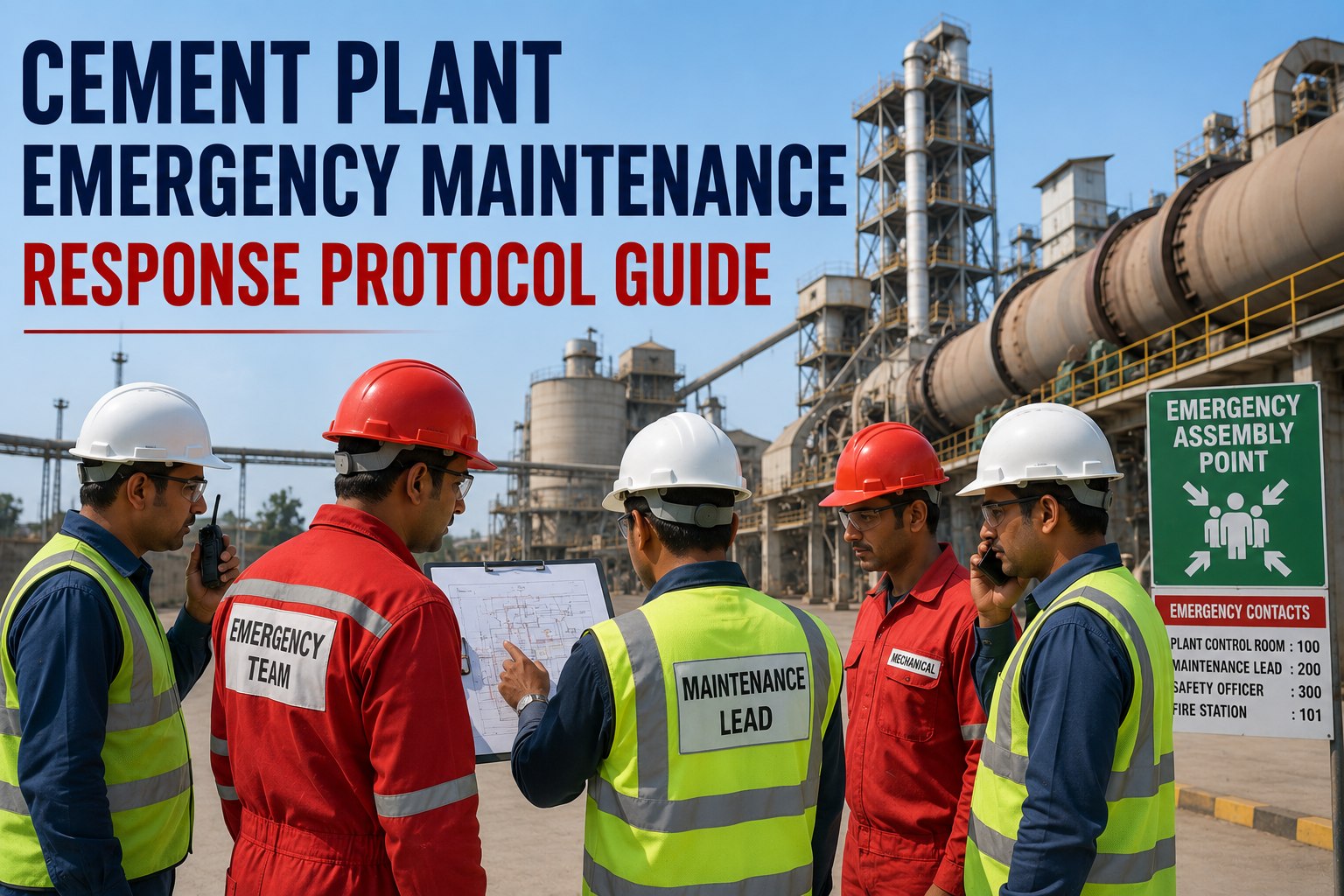
When a kiln trips mid-clinker or a raw mill seizes at 3 a.m., the difference between a four-hour recovery and a three-day outage comes down to one document: your cement plant emergency maintenance response protocol. Industry benchmarks show that 60–80% of unplanned downtime cost is decided in the first 30 minutes of response — before spare parts are even pulled. This guide breaks down the escalation chain, on-call structure, CMMS-driven mobilization, and equipment-specific playbooks (kiln, raw mill, crusher) that high-availability cement operations use to keep OEE above 85%. Build yours faster with a ready-to-deploy emergency work-order template — Start Free Trial — and turn your next unplanned event into a controlled recovery.
Is your plant ready to lose $40,000 an hour — or ready to recover in 30 minutes?
A single kiln emergency stop at a 5,000 tpd plant can burn $38K–$52K per hour in lost production, fuel cool-down, and restart energy. The plants that recover fastest don't rely on heroics — they run a documented, CMMS-driven emergency maintenance response protocol that mobilizes the right crew, the right parts, and the right approvals in under five minutes.
The 4-Tier Emergency Escalation Ladder
Mature cement operations structure emergency response around four severity tiers, each with a defined trigger, maximum response time, and decision owner. Tiers map directly to ISO 55000 asset-criticality logic and TPM autonomous-maintenance boundaries.
Operator-Level Containment
Triggered by localized alarms — bearing temp spike, conveyor drift, baghouse pressure deviation. Shift operator executes a pre-defined safe-state action (isolate, lock, switch to standby) and logs a priority-1 CMMS work order within five minutes.
Maintenance Crew Dispatch
Triggered when Tier 1 containment fails or the fault affects a critical path asset (kiln, raw mill, finish mill). On-call mechanical or electrical technician is auto-dispatched via CMMS with the asset's emergency SOP, spare-part list, and lockout/tagout plan attached.
Plant-Wide Emergency Stop
Triggered by kiln shell distortion risk, cooler grate failure, or any event threatening safety, refractory integrity, or emission limits. Shift manager initiates controlled kiln stop, fuel cut-back sequence, and emergency clinker diversion per the plant's written emergency stop procedure.
Corporate + Specialist Mobilization
Triggered for events with 24+ hour recovery, structural damage, or regulatory exposure. Corporate reliability team, OEM field service, and refractory contractors are mobilized through pre-negotiated emergency contracts. Root-cause analysis begins within 24 hours.
The 5-Minute Emergency Work Order Sprint
The window between fault detection and first wrench-turn is where most cement plants bleed money. A CMMS-configured emergency response protocol compresses that window to under five minutes by automating the four mobilization steps below.
Fault Detection & Auto-Classification
0–60 secSCADA alarm or operator observation feeds into the CMMS, which auto-classifies severity using asset criticality ratings (A/B/C) and failure-mode libraries. A-priority assets (kiln, preheater, main drive) bypass the normal work-order queue and spawn an emergency WO instantly.
Crew Dispatch with Context
60–120 secThe CMMS pushes a mobile alert to the on-call technician with the asset ID, location, emergency SOP PDF, LOTO checklist, and required spares list — eliminating the 8–12 minutes typically lost to phone trees and drawing-room searches.
Parts Reservation & Staging
120–240 secThe system simultaneously reserves critical spares from stores, prints pick tickets, and alerts the storekeeper. For kiln-related events, it also flags hot-work permits and crane availability, so staging overlaps with travel time instead of serializing it.
First Wrench-Turn & Live Status
240–300 secTechnician arrives on site with parts, permits, and procedure in hand. The CMMS broadcasts live status to the control room and plant manager dashboard, so recovery decisions — restart, hold, or extend — are made with real visibility, not radio guesses.
Kiln, Raw Mill & Crusher — Targeted Emergency Playbooks
Generic emergency procedures fail because each major cement asset has a distinct failure physics, cooldown curve, and restart risk profile. Below are the condensed first-response actions for the three highest-cost emergency events in a cement plant.
Kiln Emergency Stop
- ✓ Reduce main burner fuel to 30% within 90 seconds; cut to zero if shell distortion risk is flagged.
- ✓ Maintain induced-draft fan at minimum speed to protect refractory from thermal shock.
- ✓ Engage auxiliary drive immediately — a stationary kiln at 1,400°C will warp within 15 minutes.
- ✓ Divert clinker to emergency chute; isolate cooler grate bed per written kiln emergency procedure.
- ✓ Notify refractory contractor if stop exceeds 4 hours; schedule shell-temp scan before restart.
Raw Mill Emergency Response
- ✓ Isolate feed immediately on mill-high-temperature or mill-high-vibration alarm (≥ 8 mm/s).
- ✓ Switch to bypass damper to maintain kiln gas flow — prevents preheater temperature excursion.
- ✓ Keep separator running for 10 minutes post-feed-cut to clear material and prevent grinding-bed collapse.
- ✓ Inspect mill slide-shoe bearings and lubrication skid before any restart attempt.
- ✓ Log vibration trend in CMMS; auto-flag for RCFA if three events occur in 30 days.
Crusher Jam Response
- ✓ Hard-stop crusher drive on motor-overload or tramp-metal detection; never attempt auto-reverse with material present.
- ✓ Lockout/tagout feeder, crusher, and discharge conveyor before any manual clearing — non-negotiable.
- ✓ Inspect hammer or impact-bar condition during clearing; 70% of recurring jams trace to worn wear-parts.
- ✓ Verify magnetic separator and metal detector function before restart — tramp metal is the root cause in 60% of cases.
- ✓ Restart with empty chamber and gradual feed ramp to 60% load over 15 minutes.
Who Calls Whom — The On-Call Communication Matrix
In a cement emergency, ambiguous communication kills recovery time. The matrix below defines the notification chain, channel, and maximum delay for each role across all four tiers — codified directly in the CMMS escalation rules engine.
| Role | Tier 1 | Tier 2 | Tier 3 | Tier 4 |
|---|---|---|---|---|
| Shift Operator | Executes | Notifies supervisor | Initiates E-stop | Logs event |
| Maintenance Supervisor | Auto-alerted | Dispatches crew | On-site lead | Coordinates RCFA |
| Shift Manager | Dashboard view | Notified ≤ 10 min | Decision owner | Notifies plant mgr |
| Plant Manager | — | Summary report | Notified ≤ 15 min | Decision owner |
| EHS Officer | — | Notified if safety risk | On-site ≤ 20 min | Regulatory lead |
| Corporate Reliability | — | — | Dashboard alert | Mobilized ≤ 60 min |
Worked Example — A 5,000 tpd Plant at 3:14 a.m.
Consider a mid-size plant running 180 critical assets with an annual maintenance spend of $4.2M. At 3:14 a.m., the kiln main drive reports a bearing temperature spike to 95°C — 18°C above alarm threshold. Here's how the two scenarios unfold:
Turn your next 3 a.m. call into a 30-minute recovery.
Deploy a CMMS-configured emergency maintenance response protocol with pre-built kiln, raw mill, and crusher playbooks in under 48 hours.
Cement Plant Emergency Maintenance — Frequently Asked Questions
What is a cement plant emergency maintenance response protocol?
It is a documented, tiered procedure that defines how your plant detects, classifies, escalates, and recovers from unplanned failures of critical assets like kilns, raw mills, and crushers. A mature protocol covers on-call organization, communication chains, spare-parts staging, equipment-specific playbooks, and CMMS automation — so the first 30 minutes of response are predictable, not improvised.
How fast should a kiln emergency stop procedure be executed?
The controlled fuel cut-back must begin within 60 seconds of the triggering alarm, the auxiliary drive must be engaged within 5 minutes to prevent shell distortion, and the full E-stop sequence (including clinker diversion and cooler isolation) should be complete within 15 minutes. Plants that exceed these windows face refractory damage and potential shell warp, which extends recovery from hours to days.
How does a CMMS improve emergency response times in cement plants?
A CMMS compresses the detection-to-wrench-turn window from a typical 20–35 minutes down to under 5 minutes by auto-creating emergency work orders, dispatching on-call technicians with SOPs and LOTO plans attached, and reserving spare parts in parallel. It also logs every event for RCFA, ensuring recurring failures are caught and engineered out. You can see the workflow in action — Book a Demo to review the escalation rules engine.
What are the most common emergency maintenance events in a cement plant?
The top three by frequency and cost are kiln bearing failures and refractory hot-spots, raw mill jams and grinding-bed collapses (often triggered by vibration or feed interruption), and crusher tramp-metal jams. Together these account for an estimated 55–70% of unplanned downtime hours at a typical integrated cement plant, making them the highest-ROI targets for documented emergency playbooks.
How often should an emergency maintenance response protocol be reviewed?
The full protocol should be reviewed and tabletop-drilled at least twice a year, with a post-event debrief after every Tier 3 or Tier 4 incident. Contact lists, on-call rotations, and CMMS escalation rules must be updated whenever staffing changes, new assets are commissioned, or an RCFA reveals a gap in the existing procedure. Stale protocols are the leading cause of confusion during real emergencies.
Build your cement plant emergency response protocol today.
Pre-configured kiln, raw mill, and crusher playbooks · CMMS-driven escalation · Mobile dispatch in under 5 minutes. Deploy in 48 hours, not 8 weeks.
Free 14-day trial · No credit card