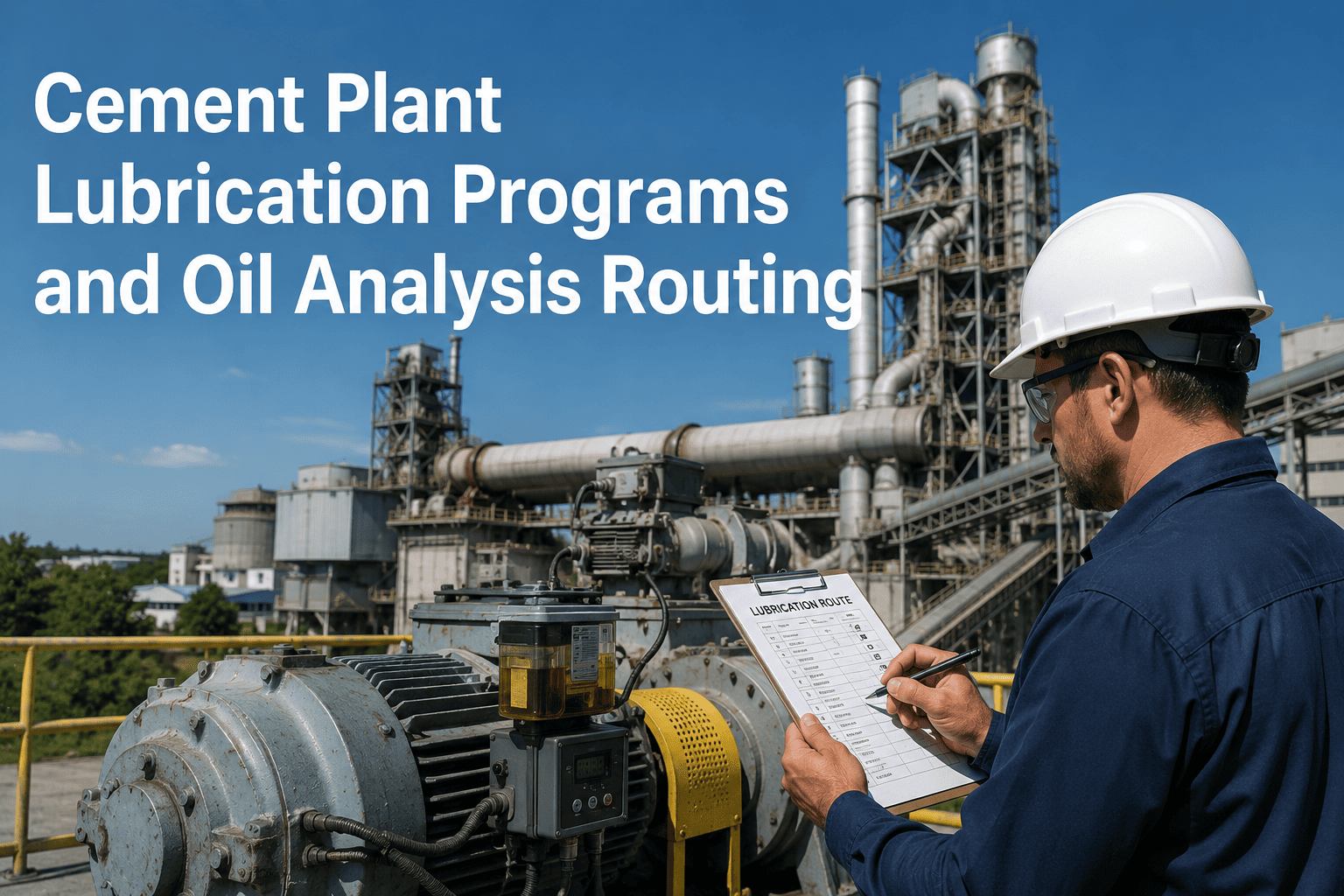
Gearbox oil analysis is the single most informative diagnostic tool available to a cement plant reliability engineer, and the most consistently underused. The lab reports arrive on a 90-day cadence with viscosity, particle count, wear metals, and oxidation markers neatly tabulated — and then sit in an inbox, unconverted into action, because the path from result to corrective work order is undefined. A rising iron trend on the kiln main gearbox does not phone the maintenance planner. Silicon ingress on the raw mill drive does not raise a ticket. By the time vibration signatures or thermal anomalies fire on those same components, the gearbox has already crossed from intervenable to catastrophic, and the cost has multiplied by two orders of magnitude. This action plan defines the parameter thresholds, equipment-specific targets, and CMMS-to-work-order workflow that turns oil analysis from a filing exercise into a predictive maintenance asset. To see how OxMaint links every laboratory result to a structured corrective work order, book a 30-minute demo or start a free trial.
Cement Plant Reliability · Lubrication Management · Predictive Maintenance
Cement Plant Gearbox Oil Analysis Action Plan
Every oil report carries a verdict on the gearbox inside. Without a defined action protocol mapping result to work order, the verdict is filed instead of acted on — and the next failure arrives unannounced.
$0.8M–$2.5M
Cost of a single VRM gearbox seizure at a 5,000 TPD cement plant
60–120 days
Lead time oil analysis provides before mechanical symptoms appear
80%
Of premature gearbox bearing failures trace back to lubrication root causes
15 ppm
Jump in iron between consecutive samples that demands investigation
Reading the oil report
Six Parameters That Carry the Full Diagnostic Signal
A laboratory oil analysis report often runs to twenty or more fields. Six of those fields carry the dominant diagnostic signal for enclosed industrial gearboxes. The remaining parameters are useful for confirmation and trending but rarely the basis for first-pass triage. The grid below maps each primary parameter to what it reveals and the trigger threshold that should generate a CMMS work order.
01 · Fe
Iron Particle Count
Reveals wear from gears, shafts, and bearing races — the dominant ferrous components in every cement plant gearbox.
TriggerIron above 100 ppm or a step jump of more than 15 ppm between consecutive samples
02 · Cu
Copper Concentration
Reveals wear from bronze bearing cages, thrust washers, and oil cooler tubes — secondary wear that often precedes ferrous escalation.
TriggerCopper above 15 ppm or a rising trend across three consecutive samples
03 · ISO 4406
Particle Cleanliness Code
Reveals total contamination load — combination of generated wear particles and external ingress through seals or breathers.
TriggerCleanliness code rises two levels from the gearbox baseline in any 7-day window
04 · H2O
Water Content
Reveals seal failure, cooler tube leakage, or condensation in vented gearboxes — every 100 ppm of water cuts bearing life materially.
TriggerWater above 500 ppm investigate source; above 1,000 ppm change oil immediately
05 · cSt
Viscosity Deviation
Reveals oxidation, contamination, fuel or process fluid ingress, or grade mixing during top-up — viscosity drives film thickness directly.
TriggerDeviation of more than 15% from new-oil baseline triggers root cause investigation
06 · Si
Silicon Marker
Reveals dust ingress through failed breathers or shaft seals — the leading external contamination route in cement plant environments.
TriggerAny rising silicon trend signals seal or breather failure regardless of absolute value
Threshold action matrix
The Three-Band Response Protocol Mapped to Every Result
Every parameter result falls into one of three response bands — Normal, Caution, or Action. The band determines the CMMS workflow that follows. Normal results log against the asset trend and require no work order. Caution results generate an investigative work order with a defined response window. Action results escalate to a corrective work order with a hard deadline before the next operating shift starts.
| Parameter |
Normal Band |
Caution Band |
Action Band |
| Iron (Fe) ppm |
Below 50 |
50 to 100 |
Above 100 or 15+ ppm jump |
| Copper (Cu) ppm |
Below 8 |
8 to 15 |
Above 15 or rising trend |
| ISO 4406 cleanliness |
Baseline level held |
One level rise |
Two or more levels rise |
| Water content ppm |
Below 200 |
200 to 500 |
Above 500 |
| Viscosity deviation |
Within 5% of baseline |
5 to 15% deviation |
Above 15% deviation |
| TAN (mg KOH/g) |
Below 0.5 above new oil |
0.5 to 1.5 above new oil |
Above 1.5 above new oil or doubled |
| Silicon (Si) ppm |
Baseline trend flat |
Slow upward trend |
Step jump or sustained rise |
Equipment-specific targets
Different Gearboxes Demand Different Oil Cleanliness
A single plant-wide cleanliness target produces both over-spec maintenance on tolerant equipment and under-spec protection on the critical drives that need the cleanest oil. The four major gearbox categories in a cement plant each operate at distinct loading, speed, and tolerance profiles, and each requires its own ISO 4406 target and sampling interval. Calibrate the OxMaint asset records to these baselines on first commissioning of the lube programme.
Kiln Main Drive Gearbox
High torque · Continuous duty
ISO 4406 target
18/17/14 or better
Sampling interval
Every 2,000 hours / quarterly
Critical parameter
Iron trend & viscosity
Failure cost band
Highest — multi-week outage
VRM & Ball Mill Gearbox
Planetary drive · Heavy load
ISO 4406 target
17/16/13 or better
Sampling interval
Every 1,500 hours / monthly
Critical parameter
Ferrous index & water content
Failure cost band
Severe — planetary set replacement
Conveyor Drive Gearbox
Variable load · Outdoor exposure
ISO 4406 target
20/18/15 acceptable
Sampling interval
Semi-annual or 4,000 hours
Critical parameter
Silicon ingress & water
Failure cost band
Moderate — single line affected
Crusher Gearbox
Shock load · High temperature
ISO 4406 target
19/17/14 or better
Sampling interval
Every 1,000 hours / monthly
Critical parameter
Wear metals across multiple elements
Failure cost band
High — feed line stoppage
OxMaint for Lubrication Reliability
Auto-Flag Every Out-of-Spec Result. Auto-Generate Every Corrective Work Order.
OxMaint links each gearbox asset to its configured ISO 4406 target, wear metal alarm thresholds, and TAN ceiling. The moment a laboratory result is logged against the asset — whether entered manually or imported via API from the partner lab — out-of-band readings auto-flag, a corrective work order generates with the fault type and recommended action, and the asset deterioration trend updates immediately for the reliability engineer dashboard.
From report to work order
The Five-Stage Action Plan Every Lab Result Travels Through
An oil analysis programme creates value only when the path from sample bottle to closed work order is defined, automated, and audited. The five-stage workflow below is the minimum viable structure for converting laboratory reports into reliability outcomes. Each stage has owners, inputs, outputs, and a CMMS record artifact that survives audit scrutiny twelve months later.
Stage 1
Sample & Submit
Sample taken at scheduled operating hour interval from the gearbox sample valve, not the drain. Bottle labelled with asset ID, hours since last sample, hours since last oil change. Submitted with OxMaint sample reference number.
Stage 2
Receive & Log
Laboratory result imported via API or entered manually into OxMaint against the gearbox asset record. Structured fields capture viscosity, ISO cleanliness, wear metals, water, TAN, and PQ index. Result becomes part of the asset trend automatically.
Stage 3
Auto-Flag
Each parameter compared against the asset-specific alarm thresholds configured during commissioning. Caution or Action band results trigger an automatic work order with fault type, affected gearbox, severity, and the response deadline based on band.
Stage 4
Investigate & Act
Assigned technician executes inspection per work order — filter change, seal inspection, oil flush, breather replacement, or unplanned shutdown depending on parameter. Findings logged back to the work order with photos and measurement readings.
Stage 5
Close & Trend
Work order closed with root cause code from a structured pick list. Follow-up sample scheduled at the accelerated interval. Asset trend chart updated and reviewed at the next reliability meeting against the gearbox's twelve-month deterioration curve.
Case in point
How a Kiln Main Gearbox Sample Trend Caught Pinion Pitting Six Weeks Early
The case below is a synthesis of cement plant kiln gearbox monitoring patterns documented in industry literature. It illustrates how a structured action plan turns three consecutive lab reports into a planned intervention during a scheduled shutdown — rather than an unplanned outage two months later. The timeline reads as it would appear in the OxMaint asset trend view, one sample at a time.
Sample N
Baseline established
Iron 22 ppm, copper 4 ppm, ISO 17/16/13, water 110 ppm, viscosity within 2% of new oil. All values logged Normal band against the kiln main gearbox asset record. No work order generated. Next sample scheduled at 2,000 operating hours.
Sample N+1
Iron creep detected
Iron 38 ppm — Normal band, but a 16 ppm jump exceeds the configured step alarm. ISO cleanliness drifted to 18/16/13, also a one-level rise. Both values flag a Caution work order: inspect filter differential pressure and accelerate next sample to 1,000 hours rather than 2,000.
Sample N+2
Chromium & nickel emerge
Iron 71 ppm, chromium 8 ppm, nickel 4 ppm — the trifecta of steel bearing race wear. ISO code now 19/17/14, two-level rise from baseline. Action band work order generated. Vibration team dispatched for full spectral check, intervention planned for the next monthly maintenance window.
Shutdown
Inspection confirms pinion pitting
Planned shutdown inspection finds early-stage pitting on one pinion gear tooth flank. Component replaced under controlled conditions during the existing maintenance window. Avoided several days of unplanned kiln downtime and secondary damage to the bearing race. Cost contained at planned-work levels.
Frequently asked questions
Gearbox Oil Analysis — Reliability Engineer Questions
Why are absolute oil analysis thresholds less useful than trended data for cement plant gearboxes?
A single absolute threshold applied across all gearboxes ignores the substantial variation in design, loading, and lubrication method between assets. A heavily loaded reversing crusher gearbox may run continuously at 200 ppm iron since commissioning, while a kiln main drive should never exceed 80 ppm. Applying a generic 100 ppm alarm to both produces false alarms on the crusher and missed escalations on the kiln. The correct method is to establish a per-asset baseline during the first four to six samples, then alarm on step changes from that baseline. OxMaint stores baseline values per asset and alarms on deviation, not on global thresholds, which is what turns oil analysis into a true predictive tool.
How often should oil sampling actually be performed on a cement plant kiln main gearbox?
Sampling frequency should be tied to operating hours rather than calendar months for any high-criticality gearbox. A kiln main drive running 8,000 to 8,400 hours annually warrants quarterly sampling at minimum, which equates to one sample every 2,000 operating hours. If a Caution or Action band result lands on the trend, the sampling interval should accelerate to monthly or weekly until the parameter returns to baseline. Calendar-only programmes routinely miss developing faults on equipment running well above expected operating hours or fail to catch faults that emerge between scheduled samples.
OxMaint schedules sampling against operating hours automatically and accelerates intervals when trends warrant.
What does a rising silicon trend in gearbox oil actually mean?
Silicon in gearbox oil almost always indicates external contamination through a failed seal or breather rather than internal wear. In a cement plant environment, airborne dust contains aluminium silicates and free silica at concentrations that quickly raise oil silicon when any ingress path opens. Any upward trend in silicon — even from a low absolute value — signals that the gearbox housing is no longer hermetic and that abrasive contamination is now reaching internal wear surfaces. The corrective action is shaft seal inspection and breather replacement before secondary wear metals begin escalating. Ignoring silicon trends is one of the most common drivers of unexpected gearbox wear acceleration in cement plants.
Should oil change intervals be calendar-based or condition-based on cement gearboxes?
Condition-based oil changes are materially more efficient than fixed calendar intervals for any gearbox under continuous instrumentation. A calendar interval changes good oil because the date arrived and leaves degraded oil in service because the next date has not arrived yet. Condition-based changes use TAN, viscosity, particle count, and water content trends to decide — keeping good oil in service longer and replacing degraded oil before damage accumulates. Documented programmes extend drain intervals between 25% and 50% with no reliability penalty, which on a plant with twenty gearboxes is a meaningful operating cost reduction. The prerequisite is structured sampling and structured CMMS thresholds — neither works on its own.
How does OxMaint connect laboratory oil analysis results to corrective work orders?
OxMaint stores each gearbox as an asset with its own configured oil analysis parameter limits, ISO 4406 target, and sampling schedule. Laboratory results enter the system either through manual entry of structured fields or via API import from supported oil analysis labs on enterprise deployments. Each parameter is checked against the asset thresholds at the moment of entry. Any Caution or Action band reading triggers an automatic corrective work order with the fault type, severity, asset reference, and recommended action populated from a configurable rule set. The result becomes part of the asset's trend chart immediately, and the technician receives the work order in their queue without manual triage.
Book a walkthrough to see the configuration on a live demo environment.
OxMaint · Predictive Maintenance for Cement Gearboxes
Make Every Oil Analysis Report a Closed Work Order Instead of a Filed PDF
A gearbox seizure that costs the plant a week of production never arrives without warning — the warning is sitting in the most recent oil analysis report. OxMaint gives cement plant reliability teams configured per-asset alarm thresholds, automatic work order generation on out-of-spec results, trend visualisation per parameter, and a closed-loop audit record connecting each laboratory result to the corrective action that followed. The next intervention should be planned, scoped, and budgeted before the next sample arrives.