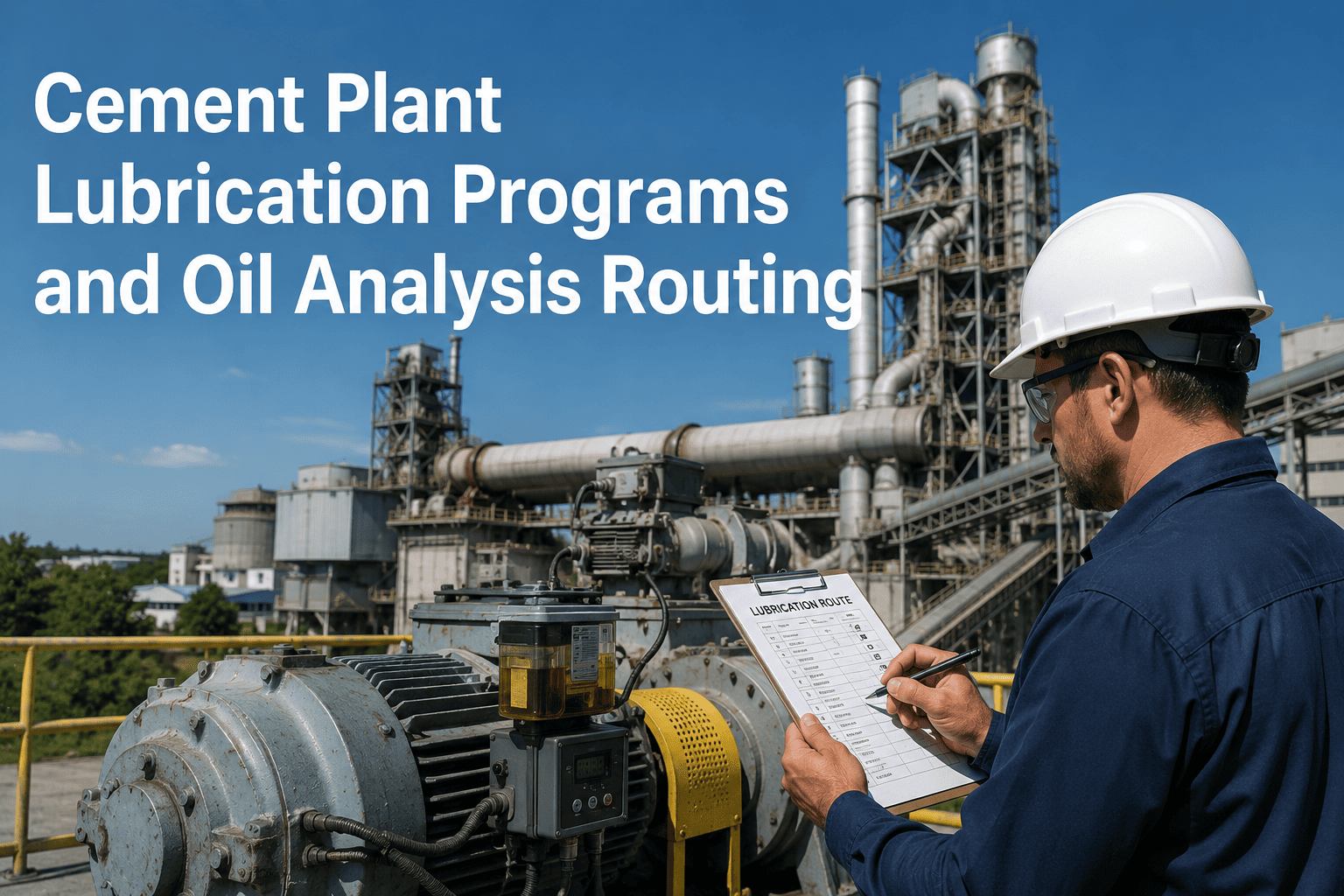
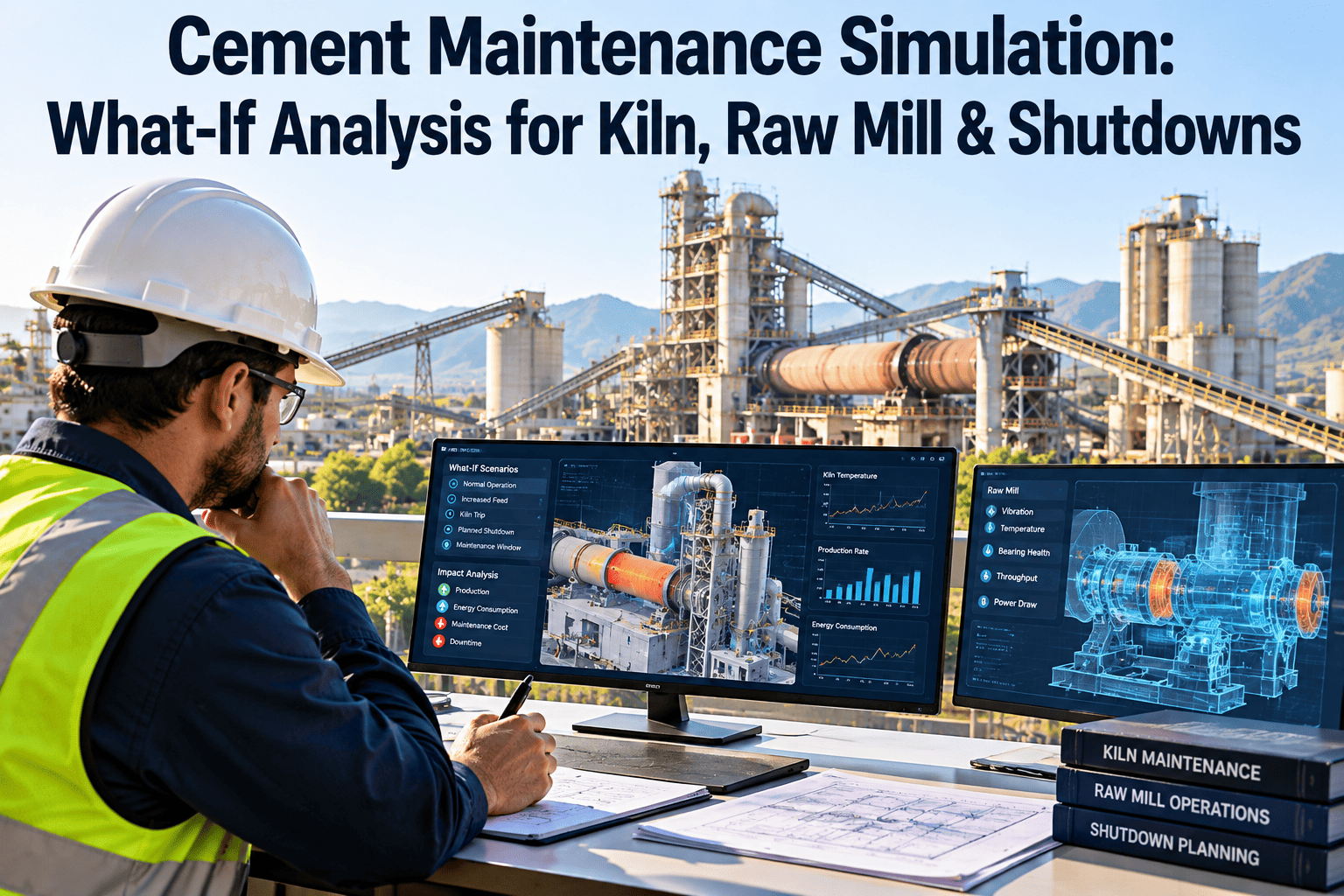
Lubrication failure is responsible for more than 50% of premature bearing failures in cement plants — yet most plants have no structured system to verify that the right lubricant was applied, in the right quantity, to the right point, at the right interval. The kiln support roller bearings run at 1,450°C proximity, mill gearboxes operate under extreme pressure loads, and crusher eccentric bearings absorb continuous impact — each requiring a specific lubricant grade, application method, and interval that generic maintenance schedules consistently miss. Beyond over- and under-lubrication, cement plants face a subtler and more expensive problem: cross-contamination from wrong lubricant application and degradation acceleration from dust ingress into open bearing housings. A structured lubrication programme with CMMS-tracked routing, oil sampling schedules, and barcode-verified application transforms lubrication from the maintenance team's least visible activity into one of its highest-ROI reliability investments. Oxmaint's lubrication module gives you full route management, oil analysis integration, consumption tracking, and compliance visibility across every lube point in your plant. Start your lubrication programme on Oxmaint and eliminate wrong-lubricant events permanently.
50%+
Of bearing failures trace to lubrication problems
44%
Reduction in lubrication labour time with optimised routing
2,000 hrs
Typical kiln support roller oil change interval
₹40–60L
Annual lubrication labour savings from CMMS route optimisation
Lubricant Selection by Equipment — Why One Grease Does Not Fit All
Cement plants operate across extreme temperature zones, load profiles, and contamination levels within the same facility. Using the same lubricant grade across kiln bearings, mill gearboxes, and conveyor idlers is a common and expensive mistake. Each equipment category requires specific lubricant chemistry matched to its operating conditions.
Kiln Support Roller Bearings
TypeISO VG 460 synthetic gear oil
ReasonHigh temp proximity, heavy load, slow speed
IntervalEvery 2,000 operating hours
Volume12 litres per bearing housing
Critical CheckOil temperature, discolouration, metal particles
Ball Mill & VRM Gearboxes
TypeEP-grade synthetic gear oil ISO VG 320
ReasonExtreme pressure, high torque, continuous operation
IntervalQuarterly oil analysis, annual change
VolumePer OEM fill spec, logged in CMMS
Critical CheckViscosity, TAN, iron and copper particle count
Crusher Eccentric Bearings
TypeLithium complex EP grease, NLGI 2
ReasonImpact loads, heavy contamination, moderate temp
IntervalWeekly manual regreasing per CILT round
VolumeQuantity per OEM spec — over-greasing is failure mode
Critical CheckPurge condition, grease colour, housing temperature
ID Fan & Preheater Fan Bearings
TypePolyurea grease for high-temp zones
ReasonTemperatures exceeding 80°C, dust contamination
IntervalPer operating hours, not calendar — logged in CMMS
VolumeExact quantity — over-greasing kills fan bearings
Critical CheckPurge point condition, bearing temperature trend
Girth Gear & Pinion
TypeOpen gear lubricant — spray applied
ReasonExposed tooth mesh, adhesive film required
IntervalAutomatic spray system — volume audited weekly
VolumeSpray rate per revolution logged automatically
Critical CheckTooth film coverage, nozzle condition, spray timing
Conveyor Head & Tail Bearings
TypeCalcium complex grease, water-resistant
ReasonWater washout risk, moderate temp, dust exposure
IntervalMonthly on main pulleys, quarterly on idlers
VolumePer bearing housing size — chart posted at each point
Critical CheckBearing temperature, grease purge colour, seizure signs
Never Apply the Wrong Lubricant Again — CMMS-Enforced Specification Compliance
Oxmaint prevents work order closure unless the technician scans the correct lubricant barcode confirming specification compliance. Every lube event is timestamped, quantity-verified, and tied to the asset's maintenance history — eliminating wrong-lubricant events and pencil-whipping permanently.
CMMS-Optimised Lubrication Route Planning
Most cement plant lubrication routes are organised alphabetically by equipment tag — the order that makes sense to a database administrator, not a technician on the plant floor. Alphabetical routing sends technicians back and forth across the facility, burning hours on walking rather than on servicing equipment. Optimised routing built around physical equipment location, not asset tag number, consistently reduces route time by 40–45%.
Alphabetical Tag Routing
8.5 miles
walked per shift per technician
6.2 hrs
total route time per round
78%
completion rate — technician exhaustion leads to skipped points
vs
CMMS Location-Optimised Routing
4.8 miles
walked — 44% reduction from optimised sequence
3.5 hrs
route time — 44% time saving per round
98%
completion with QR/barcode verification at every point
Oil Analysis Programme — Frequency, Parameters, and Action Thresholds
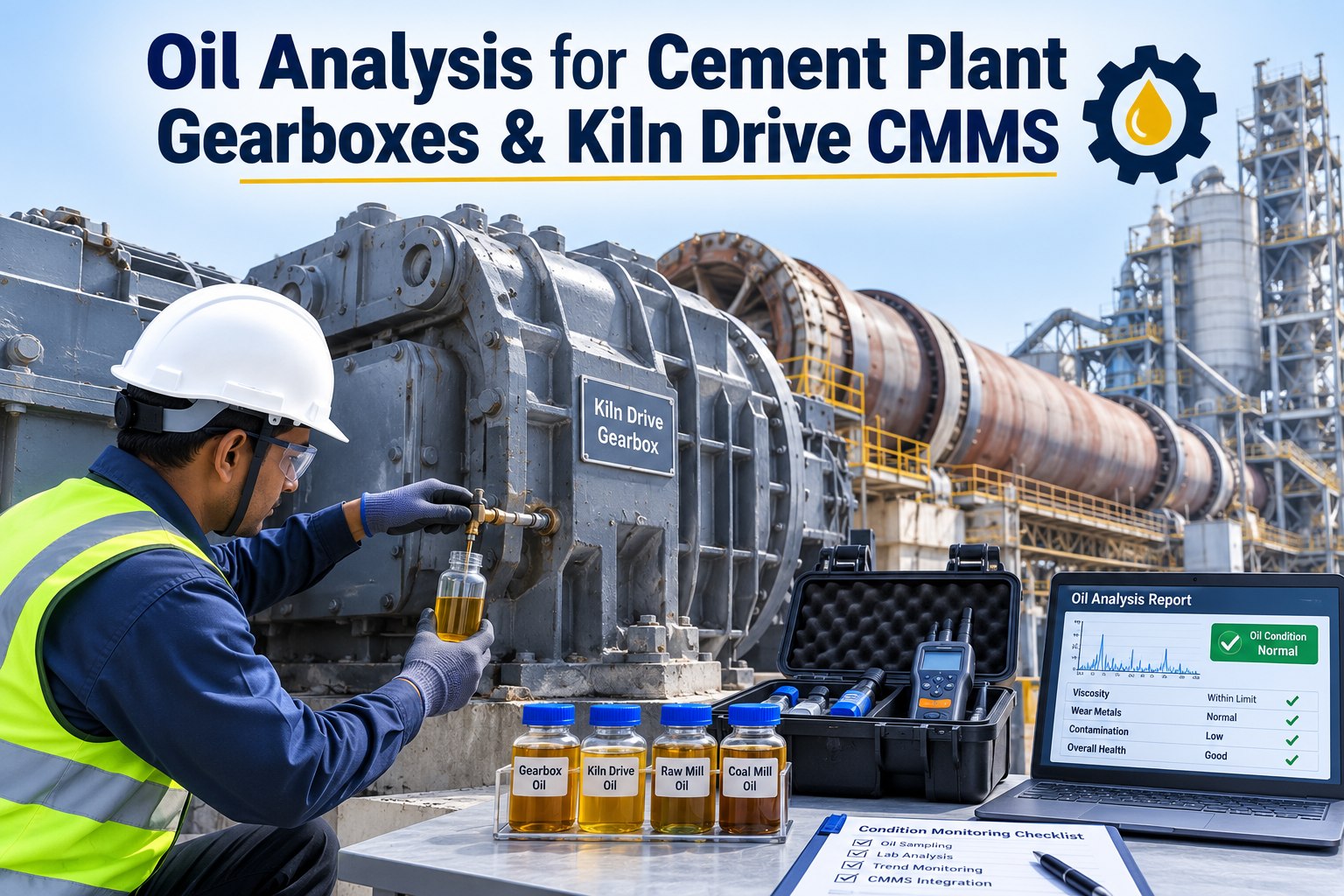
Oil analysis converts lubrication from a time-based schedule into a condition-based programme. A gearbox oil sample costs ₹800–1,500 per analysis. The same gearbox failing unexpectedly costs ₹8–25 lakhs in parts and downtime. Oil analysis is one of the highest-ROI condition monitoring investments available in cement plant maintenance, provided samples are taken consistently and results are acted upon within the CMMS workflow.
Oil Analysis Programme — Equipment Priority, Frequency & Parameters
Preventing the 5 Most Common Lubrication Failures in Cement Plants
01
Over-Greasing Fan Bearings
Over-greasing is more common than under-greasing and causes bearing failure through churning heat buildup. CMMS enforces exact quantities — technicians cannot close a work order with an unchecked grease volume confirmation. Fan bearing life extends 40–80% when quantities are standardised.
02
Wrong Lubricant Application
Polyurea and lithium greases are chemically incompatible — mixing them through cross-application degrades both. CMMS barcode verification at the lubricant store confirms the correct product before the technician reaches the equipment. Specification compliance becomes system-enforced rather than memory-dependent.
03
Extended Oil Change Intervals
Gearbox oil changes deferred because "it looks fine" are the primary path to unexpected gearbox failure. Oil analysis on kiln and mill gearboxes provides the objective condition data that overrides opinion-based deferral decisions. CMMS routes the lab result directly to a work order when thresholds are exceeded.
04
Dust Contamination of Open Bearings
Cement plant dust with a Mohs hardness of 3–4 acts as a lapping compound when it enters bearing races. Bearing isolator inspection and seal condition checks built into CILT rounds catch seal failures before contamination progresses to measurable wear. Silicon content in oil analysis confirms when contamination has already occurred.
05
Lubrication Point Omissions
In a large cement plant with 300–600 lubrication points, technician changeover and workload pressure reliably result in omissions on every manual route. CMMS-tracked route completion with QR verification at each point identifies omissions before they extend to the next round. Non-completion generates an automatic escalation to the supervisor within the same shift.
Every Lube Point. Every Interval. Every Specification. Tracked and Verified.
Oxmaint's lubrication module gives cement plants full route management with GPS-optimised sequencing, barcode-enforced lubricant specification compliance, oil analysis integration that auto-generates corrective work orders, and consumption tracking that identifies leaks and over-application before they become failures. From kiln support rollers to conveyor idlers — every lube event documented, verified, and linked to equipment health history. Book a demo to see the lubrication module configured for your plant's specific equipment register.
Frequently Asked Questions
How does Oxmaint prevent wrong lubricant application in the field?
Each lubrication work order in
Oxmaint specifies the exact lubricant grade, volume, and application method. The work order cannot be marked complete without the technician scanning the lubricant barcode to confirm the correct product was used. This system-enforced specification check eliminates cross-contamination from wrong lubricant events that no training programme can fully prevent. It creates a permanent record of every lube application for failure analysis.
How often should we sample oil from cement plant gearboxes?
Critical gearboxes — kiln drive, ball mill main drive, VRM main gearbox — should be sampled monthly. High-priority gearboxes including ID fans and crusher drives warrant quarterly sampling. The cost of a monthly oil analysis sample (₹800–1,500) is negligible compared to the early warning value on assets where failures cost ₹8–25 lakhs.
Book a demo to see how Oxmaint schedules and tracks oil sampling automatically.
What is the biggest mistake cement plants make with fan bearing lubrication?
Over-greasing is the single most common fan bearing failure mode — and it is more destructive than under-greasing. Excess grease churning generates heat that degrades both the grease and the bearing. Oxmaint's CMMS enforces exact quantities per bearing housing using OEM specifications, ensuring technicians apply precisely the right amount regardless of experience level or time pressure.
Sign up free to configure bearing lubrication standards for your plant.
How do we build a CMMS-tracked lubrication route from scratch?
Start by listing every lubrication point in your plant with its equipment tag, lubricant specification, volume, and interval — this data typically exists in OEM manuals and should be loaded into
Oxmaint's asset register. Then map physical locations and let the system generate an optimised route sequence. Most cement plants can build their initial route in 2–3 days using Oxmaint's guided asset catalogue builder.
Book a demo to walk through the setup process live.
Can oil analysis results trigger automatic work orders in Oxmaint?
Yes. Oxmaint integrates lab result data and compares each parameter against configured thresholds for each asset. When iron content in a mill gearbox exceeds 150 ppm or viscosity shifts beyond 15%, the system auto-generates a corrective work order routed to the appropriate maintenance engineer — closing the loop between lab result and field action without requiring manual intervention.
Sign up free to see the oil analysis integration configured.