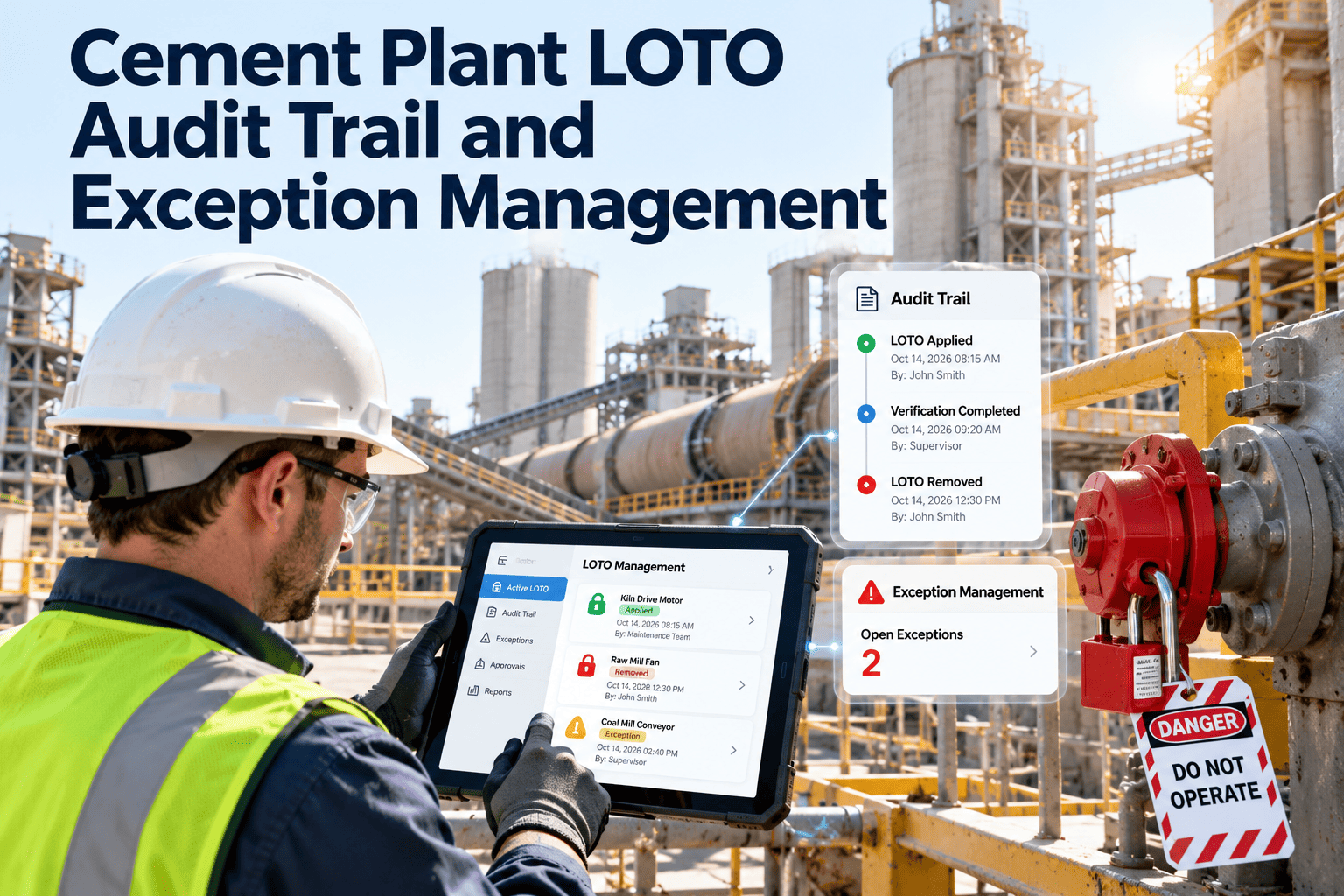
Lockout/tagout fails in cement plants less often because people ignore it, and more often because the paperwork cannot keep up with the work. Kilns, mills, conveyors, silos and fans carry stored energy, and a single job can involve several crews, shifts and isolation points. When locks change hands, a job overruns or a test needs temporary energization, the record gets messy. This guide explains how to build a reliable LOTO audit trail and manage exceptions, using Oxmaint maintenance management software to link isolation records to the work they protect.
Cement Plant LOTO Audit Trail and Exception Management
Record every isolation from request to release, and handle shift changes, lock removals and test energization as controlled exceptions rather than gaps.
Why cement plants need a stronger LOTO record
Cement equipment combines heavy rotating mass, bulk material, high temperature and large electrical loads. That makes both the isolation and the evidence of it more complex than in a simple workshop.
What a complete LOTO audit trail contains
An audit trail should let a safety auditor reconstruct who isolated what, when, why and how it was verified, without relying on memory.
| Record element | What to capture | Why an auditor asks for it |
|---|---|---|
| Job and asset link | Work order, equipment tag and area | Shows which task the isolation protected |
| Energy sources | Electrical, mechanical, hydraulic, pneumatic, thermal, gravity, material | Proves all hazardous energy was considered |
| Isolation points | Breaker, valve, gate or block with unique identifier | Allows the isolation to be checked and repeated |
| Lock and tag data | Lock number, owner, time applied | Shows personal control of the isolation |
| Verification | Try-start result, test of absence of voltage, pressure bleed confirmation | Proves zero-energy state before work began |
| People involved | Authorized employees, contractors, supervisor | Shows who was protected and who approved |
| Changes and handovers | Shift transfers, added crews, scope changes | Shows continuity of protection |
| Release and restart | Removal sequence, area clear check, restart authorization | Shows the equipment was returned to service safely |
Common LOTO exceptions in cement operations
Exceptions are normal in large plants. The risk lies in handling them informally.
Shift handover with locks still applied
The outgoing crew leaves but the job continues. The incoming crew must apply their own protection and the transfer must be recorded.
Lock removed by someone else
The lock owner is absent. A defined procedure with verification and supervisor approval is needed, and every step is logged.
Temporary energization for testing
Equipment needs to run briefly for alignment or checks. The sequence of clearing, energizing, testing and re-isolating must be controlled.
Scope change during the job
New tasks or equipment appear mid-job. The isolation plan must be reviewed and extended before work begins.
Isolation point unavailable or faulty
A breaker will not lock or a valve leaks. The alternative isolation must be assessed and approved with a recorded reason.
Turn LOTO exceptions into recorded, approved decisions
Connect isolation records, approvals and work orders so every exception leaves a clear audit trail.
A controlled exception workflow
Every exception can follow the same four-stage path, which keeps decisions consistent across shifts and contractors.
Declare
Record the exception type, asset, job and reason before acting.
Assess
Identify the energy sources, people affected and any extra controls needed.
Approve
A named supervisor approves, with conditions and a time limit if needed.
Close out
Confirm the normal isolation is restored and capture lessons.
Group lockout and contractor coordination
Large jobs, especially during kiln and mill shutdowns, involve many people under one isolation. Control needs to be clear and recorded.
- Primary authorized person: one named person owns the group isolation and keeps the master record.
- Personal locks: each worker applies a personal lock at the group lock box before starting, and removes it only when finished.
- Contractor alignment: contractor crews follow the plant procedure, and their authorization and training are checked before work.
- Interface points: jobs sharing isolation points or adjacent equipment need a documented coordination step.
- Daily review: at each handover the group lock status, people on site and open exceptions are reviewed and recorded.
Stored energy release and verification checklist
Turning off power is not the same as removing every hazardous energy. Verify each source, and record the result.
Electrical
- Breaker opened and locked
- Absence of voltage tested
- Capacitors discharged where relevant
- Control power also isolated
Mechanical and gravity
- Drive prevented from turning
- Take-up and counterweights secured
- Elevated parts blocked
- Material flow stopped and held
Fluid, heat and material
- Pressure released and valves locked
- Air cannons isolated and vented
- Cooling time confirmed
- Hot or loose material controlled
Authorization and training matrix
Record who may isolate, verify and approve, and tie that status to dated training so expired authorizations are visible.
| Role | Typical responsibility | Evidence to keep |
|---|---|---|
| Authorized employee | Applies locks and works under the isolation | Training date, competency check, refresher record |
| Affected employee | Works near equipment and respects the lock | Awareness training record |
| Supervisor or approver | Approves plans and exceptions | Approval history, delegated authority |
| Contractor | Follows plant isolation rules on site | Induction record, plant-specific briefing |
| Auditor or safety lead | Reviews records and procedures | Audit schedule, findings and closure |
Patterns that weaken a LOTO audit trail
These problems appear in audits again and again. Spotting them early lets teams correct the process before an incident or inspection.
- Records created after the job: entries written at the end of the shift cannot prove the sequence of steps.
- Generic procedures: a general instruction does not identify the real isolation points on a specific mill or silo.
- Verification skipped or not recorded: the try-start or zero-energy test is the key evidence of safety.
- Handover gaps: locks and permits remain, but the people behind them have changed without a recorded transfer.
- Exceptions with no owner: temporary decisions stay open and become the new normal.
Using exception data to improve the process
Every recorded exception is also a clue. Review them regularly and ask what the process failed to provide.
- Frequent shift handover exceptions may point to poor job planning or unrealistic task durations.
- Repeated test energization may call for a safer test procedure or better equipment access.
- Faulty isolation points suggest a repair backlog or a need to improve equipment design.
- Scope changes on shutdown jobs show where planning and inspection before the outage fell short.
- Review exception trends by area and shift monthly, and share the findings with supervisors so the same gaps are not repeated.
Equipment-specific isolation points to document
Generic procedures miss the details that matter. Write equipment-specific procedures and attach them to the asset record.
| Equipment | Special energy or hazard | Typical procedure detail |
|---|---|---|
| Kiln main drive and auxiliary drive | Stored rotational energy, backdrive, hot interior | Positive isolation of both drives, brake and turning gear control |
| Raw and cement mills | Heavy rotating mass, grinding media, hydraulic systems | Drive isolation, rotation prevention, confined space coordination |
| Preheater cyclones and calciner | Hot meal, build-up collapse, air cannon pressure | Air cannon isolation, cooling time, material release controls |
| Clinker cooler | Hydraulic drive energy, hot clinker, fans | Hydraulic pressure release, fan lockout, cooling verification |
| Silos, hoppers and bins | Material engulfment, flow, gravity | Feed and discharge isolation, entry permits, flow prevention |
| Conveyors and bucket elevators | Gravity take-up, backstop, stored tension | Take-up securing, backstop and drive isolation |
| Large fans and dust collectors | Windmilling, damper movement, dust | Damper locking, rotation prevention, zero-flow checks |
LOTO during kiln and mill shutdowns
Annual outages concentrate hundreds of tasks and many contractors into a short window, which stresses every part of the isolation process.
- Prepare isolation plans for major jobs in advance
- Check lock, tag and lock box stock
- Confirm contractor training and authorization
- Define who approves exceptions on each shift
- Review open isolations at every handover
- Track scope changes and extend plans before work
- Keep one live list of active locks by area
- Close isolations promptly when jobs finish
Corrective actions after an audit finding
A finding is only useful if it leads to a change that can be verified later.
Log
Record the finding against the area, procedure or asset.
Assign
Create a corrective work order with an owner and due date.
Fix
Update the procedure, repair the isolation point or retrain the crew.
Verify
Check later jobs to confirm the change worked and is being followed.
Regulatory and standards context
Rules vary by country and by site type, so confirm which apply to your plant and quarry operations.
- In the United States, OSHA 29 CFR 1910.147 covers the control of hazardous energy and calls for periodic inspection of energy control procedures.
- Quarry and mining operations may fall under MSHA rules, which have their own lockout requirements.
- ISO 45001 and similar management system standards expect documented controls, records and continual improvement.
- Many plants add corporate standards and contractor requirements that go beyond the legal minimum.
- Whatever the rule set, regulators and insurers generally look for procedures that are specific to the equipment, personnel who are trained and authorized, and evidence that the procedures are actually reviewed and followed.
- Records should be retained according to your own policy and local requirements so past isolations and audits can be produced when asked.
Before and after structured LOTO recordkeeping
The change is from paper that is hard to trace to records tied directly to work.
- Permits stored in binders across several offices
- Lock lists kept separately from work orders
- Shift handovers noted verbally
- Exceptions approved by phone with no record
- Audits take days of searching
- Isolation tied to the work order and asset
- Lock and verification data captured on mobile
- Handovers recorded in the job history
- Exceptions follow a defined approval path
- Audit questions answered from one record
How Oxmaint supports LOTO documentation
Oxmaint helps maintenance teams connect isolation steps and approvals to the work orders and assets they relate to.
- Work orders: attach isolation requirements, procedures and sign-offs to the job so nothing is separate from the task.
- Asset records: store equipment-specific isolation procedures and diagrams with each critical asset.
- Mobile checklists: record verification steps, photos and time stamps at the equipment.
- Scheduling: plan periodic procedure reviews and inspections as recurring tasks.
- Reports: review overdue reviews, exception counts and incomplete closures by area.
- Compliance records: keep an organized history for internal audits and external inspections.
KPIs for LOTO audit and exception management
Measure discipline and quality of records, not only the absence of incidents.
| KPI | What it shows | Desired trend |
|---|---|---|
| Jobs with a linked isolation record | Coverage of the LOTO process | Close to complete |
| Exceptions per month by type | Where the process is under pressure | Understood, then reduced |
| Exceptions closed with approval | Control of exception decisions | Complete |
| Procedure review compliance | Periodic inspection discipline | On schedule |
| Audit findings closed on time | Responsiveness to gaps | Rising |
| Verification step completion | Quality of zero-energy checks | Complete |
Internal audit checklist for LOTO records
Use a sample of recent jobs and check each point below. Focus on evidence, not intentions.
Planning
- Equipment-specific procedure available
- All energy sources listed
- Isolation points identified
- Contractors included in the plan
Execution
- Locks applied by authorized people
- Verification recorded
- Group lockout controls used when needed
- Handovers documented
Release
- Work completed and area cleared
- Locks removed in the right order
- Restart authorized and recorded
- Exceptions closed with approval
Building a LOTO record program in 90 days
Start with the highest-risk equipment and the shutdown jobs, then expand.
Define
List critical equipment, write or review procedures and agree the exception types.
Digitize
Attach procedures to assets and link isolation steps to work orders.
Audit and improve
Sample recent jobs, review exceptions and refine procedures and training.
LOTO audit trail FAQs
What is a LOTO audit trail?
It is the record of each isolation: who applied it, how it was verified, who was protected and how it was released.
How should lock removal exceptions be handled?
Follow a written procedure with verification and supervisor approval, and log every step. Get started to record it.
Does a CMMS replace LOTO procedures?
No. It stores and links procedures and records to work, supporting the safety process rather than replacing it.
Which cement equipment needs special attention?
Kilns, mills, cyclones, silos and coolers carry stored energy and material hazards that need specific procedures.
Can we see the workflow before deciding?
Yes, book a demo to review isolation and exception records.
Be ready for the next LOTO audit before it is announced
Give your cement plant isolation records that are complete, linked to work and easy to review.