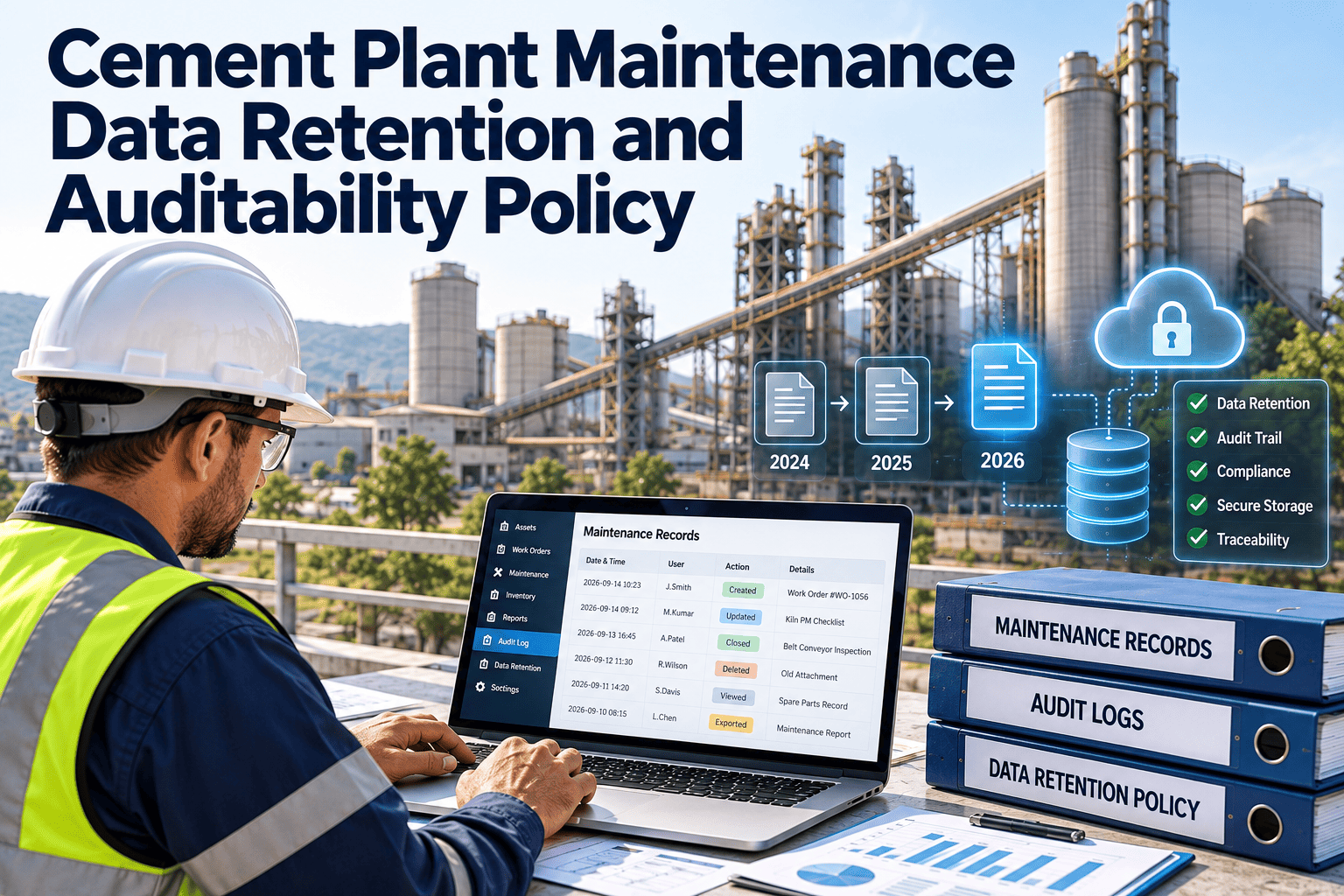
When an auditor, insurer or incident investigator asks what was inspected on a kiln drive, a lifting device or a pressure vessel two years ago, the answer lives in maintenance records. In many cement plants those records are scattered across paper logbooks, contractor reports, spreadsheets and personal phones. This policy checklist defines what to keep, for how long, who may change it and how to prove nothing was altered. Teams that centralize records in cement plant maintenance software find retention and audit preparation far easier to enforce.
Cement Plant Maintenance Data Retention and Auditability Policy
A practical checklist for deciding which maintenance records to retain, how long to keep them and how to make every entry traceable to a person, a time and a reason.
1CaptureRecord at the equipment
2ValidateReview and approve
3LockPrevent silent edits
4RetainKeep for the set period
5ArchiveMove to controlled storage
6DisposeDelete with approval
What Auditors and Investigators Actually Ask For
The questions are predictable. The policy should make each one answerable within minutes, not days.
Was this equipment inspected on schedule?
Planned inspection records with completion dates and signatures
Who did the work and were they authorized?
Work order history, technician identity and permit or lockout records
What was found and what was done about it?
Defect notes, photos, corrective work orders and closing comments
Was a record changed after the event?
Audit trail showing original value, new value, user and time
Which parts were fitted?
Issue records, batch or serial references and supplier documents
Record Classes Covered by the Policy
Group records into classes so each class gets one retention rule, one owner and one storage standard.
Asset master recordsEquipment register, hierarchy, nameplate data, manuals and drawings.
Work historyPreventive, corrective and emergency work orders with labor and parts.
Inspection recordsRoutine rounds, statutory inspections and checklist results with photos.
Safety and permit recordsLockout and tagout, hot work, confined space and working at height permits.
Condition monitoring dataVibration, temperature, shell scans, oil analysis and thermography.
Inventory and procurementSpare part issues, purchase orders, certificates and warranty claims.
Contractor recordsService reports, competence evidence, insurance and handover sign-offs.
Change and approval recordsModification requests, procedure revisions and approvals of record edits.
Suggested Retention Schedule: Starting Point Only
Periods below are common starting positions for discussion. Confirm every period against local law, mining or safety regulators, insurer conditions, customer contracts and legal counsel before adoption.
| Record Class | Suggested Starting Retention | Retention Trigger | Record Owner |
|---|
| Asset master and drawings | Life of asset plus review period | Asset decommissioning | Reliability engineer |
| Work orders and PM history | Life of asset or a fixed long period | Work order closure | Maintenance planner |
| Statutory and pressure equipment inspections | As required by regulation, often longer than internal needs | Inspection date | Compliance lead |
| Permits and lockout records | Set by safety policy and local rules | Permit closure | Safety officer |
| Condition monitoring summaries | Several years for trend value | Measurement date | Condition monitoring analyst |
| Raw high-frequency sensor data | Short period, then summarized | Capture date | Data owner |
| Contractor service reports | Life of the equipment serviced | Report approval | Contract manager |
| Audit trail logs | At least as long as the records they protect | Log creation | System administrator |
Six Auditability Principles
AAttributableEvery entry shows who created or changed it, using a personal login rather than a shared account.
BContemporaneousEntries are made at the time of work, with time stamps from the system and not typed by hand.
CCompleteFailures, deferrals and cancelled tasks are kept, not only successful completions.
DOriginal and unalteredCorrections add a new entry with a reason. The original value remains visible.
ELegible and retrievableRecords can be found by asset, date, work type or person without manual searching.
FProtectedBackups, role-based access and tested recovery keep records safe from loss and tampering.
Policy Checklist: Governance and Ownership
Policy owner named and approved by plant leadershipEvidence: signed policy with version number and review date.
Each record class has an owner and a retention ruleEvidence: retention schedule reviewed by compliance and legal.
Applicable regulations and insurer requirements listedEvidence: register of obligations with source and last check date.
Annual policy review scheduledEvidence: dated review minutes and updated revision history.
Training delivered to technicians, planners and supervisorsEvidence: attendance records and short competence check.
Policy Checklist: Work Orders, Inspections and Permits
Every work order links to a specific asset IDCheck: no free-text equipment names. Risk: history cannot be traced.
Mandatory fields enforced before closureCheck: failure cause, work performed, labor, parts and completion date.
Inspection results captured with readings and photosCheck: out-of-range values trigger a follow-up work order automatically.
Statutory inspection certificates stored in the asset recordCheck: expiry dates tracked and reminders issued before due date.
Lockout and permit records linked to the work orderCheck: permit number, isolation points and sign-off times are traceable.
Deferred and cancelled tasks keep a reason and approverCheck: no silent deletion of overdue preventive work.
Offline entries synchronize with original capture timeCheck: remote areas such as quarry and conveyor galleries are covered.
Policy Checklist: Condition Monitoring and Sensor Data
Data tiers defined: raw, summarized and event recordsCheck: raw data kept briefly, summaries and alarm events kept longer.
Sensor calibration and replacement history storedCheck: a reading can be tied to a calibrated instrument at that date.
Alarms linked to the response takenCheck: each alarm shows acknowledgement, decision and resulting work order.
Kiln shell scans and thermography files indexed by assetCheck: images retrievable by date and location without folder searching.
Analytics or model outputs retain their input data referenceCheck: a prediction can be explained later from stored inputs and version.
Build Records You Can Defend in Any Audit
Keep work orders, inspections and compliance evidence in one searchable maintenance system with clear ownership and history.
Policy Checklist: Spares, Contractors and Change Control
Critical spare issues recorded against work ordersCheck: part number, quantity, issuer and receiving technician are logged.
Certificates for lifting, pressure and electrical parts attachedCheck: documents stay with the part record, not in a personal inbox.
Contractor reports uploaded before invoice approvalCheck: report, competence evidence and sign-off all present.
Procedure and checklist changes follow an approval stepCheck: old versions stay available for work done under them.
Equipment modifications update the asset registerCheck: drawings, spares lists and PM tasks reflect the change.
Policy Checklist: Access, Security and Disposal
Role-based permissions separate who can create, edit, approve and deleteCheck: access reviewed on joiners, movers and leavers.
Personal logins only, no shared accountsCheck: shift handover does not depend on a common password.
Backups run on schedule and restores are testedCheck: dated restore test results are kept.
Legal hold process stops deletion during disputes or investigationsCheck: hold requests are logged and released by an authorized person.
Disposal requires owner approval and leaves a destruction recordCheck: expired records are reviewed before removal, not auto-purged blindly.
Data migration preserves history and audit logsCheck: legacy records are mapped and sampled for accuracy after import.
Roles and Responsibilities Across the Record Lifecycle
A policy fails when nobody knows who approves, who maintains and who may delete. Assign each role clearly and write it into the procedure.
| Role | Responsibility | Evidence of Performance |
|---|
| Technician | Records work accurately at the time of the task, with readings and photos | Complete work orders and inspection forms |
| Maintenance planner | Checks closure quality, failure coding and parts data | Monthly completeness review |
| Supervisor | Approves closures and corrections, and reviews overdue tasks | Approval history and deferral reasons |
| Compliance lead | Maintains the retention schedule and regulatory register | Dated reviews and obligation updates |
| System administrator | Controls access, backups, audit logs and recovery tests | Access reviews and restore test results |
| Plant manager | Owns the policy and resolves conflicts between production and records | Signed policy and annual review minutes |
Special Situations the Policy Must Cover
Routine retention is easy to agree. The harder cases are the ones that appear during incidents, inspections and ownership changes.
Incident investigationFreeze related work orders, permits, sensor data and photos. Record who requested the hold and why.
Regulatory inspectionAssign one person to retrieve records, log what was shared and keep a copy of the submission.
Equipment sale or transferDecide which history, manuals and certificates move with the asset and which stay with the plant.
Plant ownership changeMap record classes, owners and storage locations before systems or contracts change.
System replacementPlan export of full history and audit logs, then verify samples before switching off the old tool.
Contractor exitCollect final reports, certificates and access removal evidence before closing the contract.
Warranty claimsKeep installation, commissioning, service and failure records together for the claim period.
Insurance reviewPrepare inspection and repair evidence for critical equipment and know where it is stored.
What Each Policy Section Should Contain
Use this outline when drafting the written policy so reviewers can verify every requirement.
- Purpose and scope, stating which sites, systems and record classes are covered.
- Definitions of record, original entry, correction, archive and legal hold.
- The retention schedule, with period, trigger, owner and storage location for each class.
- Entry standards, including mandatory fields, time stamps, naming rules and photo requirements.
- Correction rules explaining how errors are fixed without deleting the original value.
- Access rules by role, including review frequency and removal on departure.
- Backup, recovery and archive standards with test frequency.
- Disposal rules, approvals and the destruction record to be kept.
- Audit and review schedule, including the quarterly mock trace and annual policy review.
Handling Photos, Attachments and Mobile Entries
Photos and attachments often carry the strongest evidence, yet they are the least controlled files in most plants.
- Attach photos to the work order or inspection point instead of storing them on personal phones.
- Keep file names and metadata so the asset, date and author remain identifiable.
- Set size and format rules so storage stays manageable without losing readable detail.
- Require time-stamped capture for critical findings such as cracks, leaks and worn components.
- Remove unrelated personal images and protect any images showing people or sensitive plant areas.
Common Record Gaps and Their Consequences
| Gap Found | Typical Consequence | Policy Fix |
|---|
| Paper logs stored in a site office | Records lost to damp, fire or staff turnover | Digital capture at the equipment with controlled archive |
| Work orders closed without notes | No failure history for root cause analysis | Mandatory closure fields |
| Spreadsheet PM schedules with open editing | Overdue tasks quietly changed or removed | Locked schedules with change logging |
| Contractor reports in email only | Evidence missing when asked for later | Upload requirement tied to payment |
| Shared logins on tablets | Entries cannot be attributed | Individual accounts and role permissions |
| Sensor data kept forever with no summary | High storage cost and slow retrieval | Tiered retention with event summaries |
Run a Mock Audit Trace Every Quarter
Pick one critical asset, such as a kiln drive gearbox or cement mill motor, and trace it end to end. Time each step.
Step 1Retrieve the asset record and confirm nameplate data and documents are current.
Step 2Pull twelve months of work orders and check mandatory fields are complete.
Step 3Select one defect and follow it from inspection finding to closed corrective work.
Step 4Open the audit trail for one edited record and confirm the original is visible.
Step 5Record gaps, assign owners and track fixes as work orders.
Metrics That Show Records Are Audit Ready
| Metric | Purpose | Review |
|---|
| Work orders closed with all mandatory fields | Record completeness | Monthly |
| Statutory inspections with valid certificates on file | Compliance coverage | Monthly |
| Time to retrieve a full asset history | Audit response speed | Quarterly trace |
| Records edited after closure with a logged reason | Change discipline | Monthly |
| Successful backup restore tests | Data protection | Per schedule |
| Active users with outdated access rights | Access hygiene | Quarterly |
How Oxmaint Supports the Policy
- Asset records hold documents, history and inspection results under a single equipment ID.
- Work orders and preventive schedules keep dated completion records and technician details.
- Mobile inspection forms capture readings and photos at the point of work.
- Reports help compliance teams pull work history and inspection evidence by asset or date range.
- Inventory records tie parts consumed to the work that used them.
Frequently Asked Questions
How long should cement plants keep maintenance records?
It depends on record class, regulation and insurer terms. Use the schedule above as a draft and confirm it with legal counsel.
Do sensor readings need the same retention as work orders?
Usually not. Keep summaries and alarm events longer, and shorten raw high-frequency data once summarized.
What makes a maintenance record auditable?
A named user, a system time stamp, preserved original values and a logged reason for each change.
Can records be corrected after closure?
Where do we start with legacy paper records?
Begin with critical assets and statutory records.
Book a demo to plan a phased migration.
Put Your Retention Policy Into Daily Practice
Replace scattered logbooks and spreadsheets with traceable records that stay complete, searchable and ready when the audit request arrives.