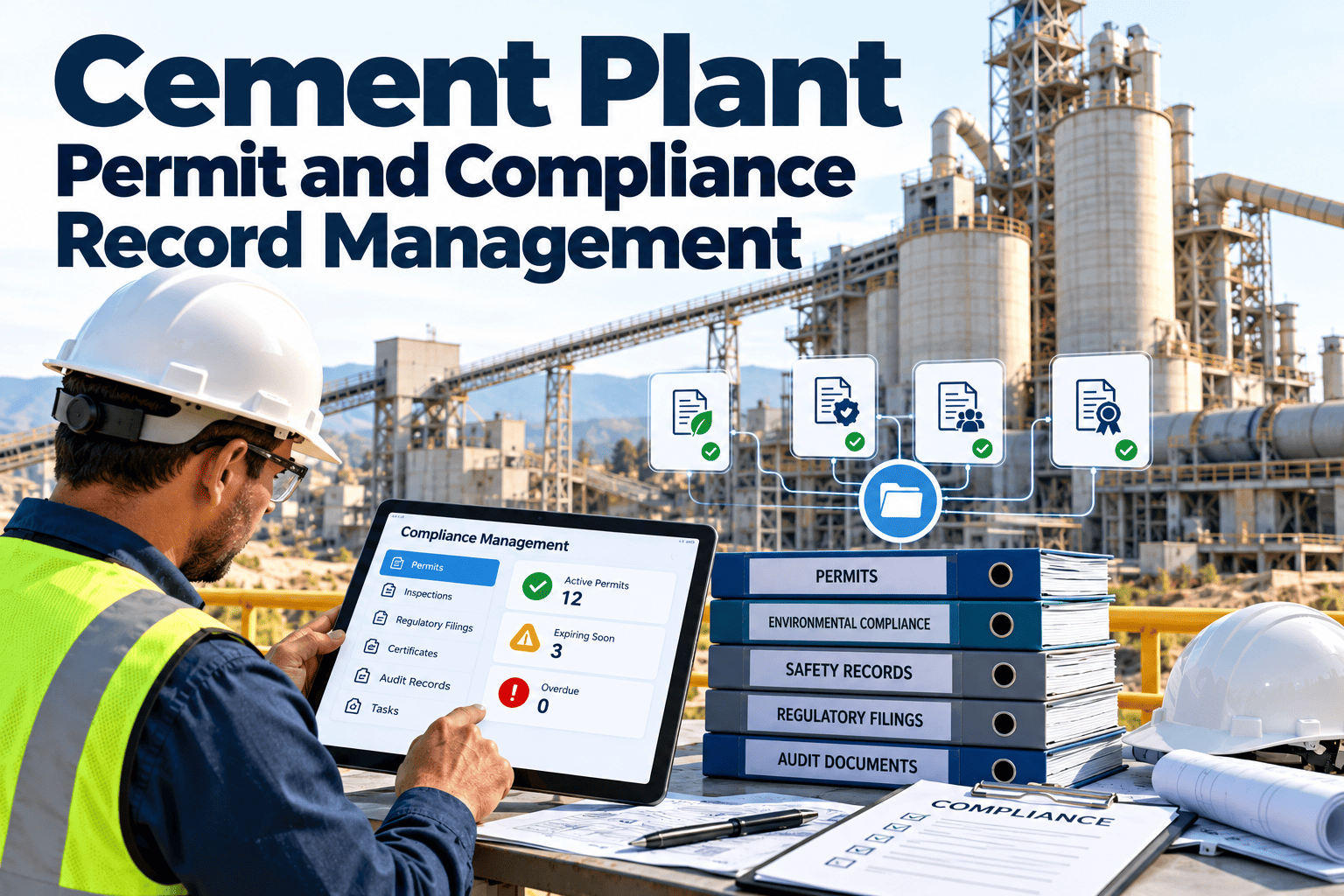
Cement plants operate under a dense web of obligations covering air emissions, waste co-processing, quarry safety, pressure equipment, electrical systems, lifting gear and worker protection. The permit itself is only the starting point, because regulators and auditors ask for proof that inspections, calibrations and repairs actually happened. When that proof sits in binders, spreadsheets and email threads, finding it under pressure becomes a risk of its own. A structured approach, supported by Oxmaint maintenance management software, keeps compliance evidence attached to the work that creates it.
Safety and Compliance · Cement Plant Records
Cement Plant Permit and Compliance Record Management: Prove the Work, Not Just Promise It
Link every permit condition, statutory inspection and calibration to a scheduled task, a completed record and a retrievable audit trail.
Scattered evidence
Paper logbooks
Personal spreadsheets
Email attachments
becomes
One record trail
Permit condition
Scheduled task
Signed completion
The Day the Auditor Arrives: A Realistic Timeline
09:00
Opening meeting
The auditor lists the permit conditions and periods to be sampled.
10:30
First evidence request
Calibration certificates for continuous emissions monitors and stack test reports are requested.
12:00
Gaps appear
One inspection record is in a former supervisor's notebook and another has no signature.
15:00
Findings drafted
Missing or weak evidence turns into non-conformances, even though the work may have been done.
The most common compliance failure is not skipped work. It is work that cannot be proven quickly and convincingly.
What Cement Plants Typically Have to Document
Requirements differ by country, site and permit, so confirm exact obligations with your regulator and legal team
| Obligation area | Typical evidence | Related maintenance activity | Common record weakness |
|---|---|---|---|
| Air emissions control | Stack test reports, monitor calibration, bag filter and ESP inspection logs | Filter bag changes, cleaning system checks, analyzer calibration | Calibration dates tracked outside the maintenance system |
| Continuous monitoring systems | Quality assurance checks, downtime and data validity records | Sensor cleaning, replacement, drift checks | No link between analyzer faults and repair history |
| Waste and alternative fuel handling | Acceptance records, feed system checks, storage inspections | Feeder, dosing and storage area inspections | Inspection findings not tied to corrective action |
| Quarry and mobile equipment safety | Pre-use checks, statutory examinations, repair records | Crusher, haul truck and loader inspections | Paper pre-use sheets lost or unreadable |
| Pressure systems and lifting equipment | Examination certificates, test dates, defect reports | Boiler, receiver, crane and hoist servicing | Expiry dates held by one person |
| Electrical and fire protection | Test results, thermography, extinguisher and alarm checks | Panel inspections, system testing | Results filed without asset reference |
| Lockout and energy isolation | Procedures, permits, audits and training links | Isolation checks during repairs | Permit and work record kept separately |
See Your Compliance Calendar in One Place
Replace scattered reminders with scheduled tasks that carry due dates, owners and completion evidence.
Why Manual Compliance Records Break Down
Cause 1
Ownership sits with individuals
When an engineer changes role, the knowledge of what is due and where evidence lives often leaves with them.
Cause 2
Permits and maintenance are separate systems
The permit says what must happen, while the maintenance plan decides what is scheduled. Without a link, gaps are invisible.
Cause 3
Evidence is created after the fact
Records filled in days later lose detail, timing and credibility.
Cause 4
Findings do not close the loop
An inspection that finds a defect but never creates a corrective task leaves the plant exposed and the record incomplete.
The Compliance Record Lifecycle
1
Interpret
Translate each permit condition or regulation into a clear, testable plant requirement.
2
Assign
Link the requirement to assets, a task, a frequency and a responsible role.
3
Schedule
Generate recurring tasks with reminders and escalation before due dates.
4
Execute
Complete the task with checklist results, readings, photos and sign-off at the point of work.
5
Correct
Raise corrective work orders for failed checks and track them to closure.
6
Retain and retrieve
Keep records for the required period and find them by asset, date or requirement.
Risk Map: Which Record Failures Hurt Most
Expired statutory examination on lifting or pressure equipment
High likelihood of enforcement and safety exposure
Missing calibration evidence for emissions monitoring
Data validity questions and reporting issues
Inspection findings with no corrective action
Repeat findings at audit
Unsigned or undated completion records
Evidence challenged and rejected
Inconsistent file names and locations
Slow retrieval and wasted audit time
Before and After: Handling a Statutory Inspection Due Date
Manual tracking
- Due dates kept in a personal calendar
- Contractor certificate arrives by email
- Copy saved to a shared folder, name varies
- Next due date entered by hand, if remembered
Record managed in a maintenance system
- Recurring task created on the equipment record
- Reminder and escalation reach the owner and backup
- Certificate attached to the completed task
- Next task generated automatically from the completion date
An Annual View: Spreading Compliance Work Through the Year
Quarter 1
Annual permit review, lifting equipment examinations, emergency system testing
Quarter 2
Analyzer calibrations, bag filter inspections ahead of peak production, electrical thermography
Quarter 3
Pressure system examinations, quarry equipment statutory checks, contractor audits
Quarter 4
Shutdown-linked inspections, internal compliance audit, record clean-up and reporting
Distribute due dates deliberately. Clusters of expiring items in one month overload technicians and increase the chance of a miss.
Emission Control Equipment: Where Maintenance Records Meet the Permit
Bag filters
Bag condition and cleaning cycle
Record differential pressure checks, bag replacements, cage and valve repairs and compressed air supply checks. A rising pressure trend with no recorded action is a weak position at audit.
Electrostatic precipitators
Fields, rappers and insulators
Log field outages, rapper function, insulator cleaning and trip history, so a drop in performance can be traced to repair or delay.
Monitoring systems
Analyzers and sample lines
Keep calibration, cleaning, replacement and fault records on the analyzer asset, not in a separate environmental file only.
Abatement systems
Reagent dosing and injection
Where used, record pump, nozzle and flow meter checks so dosing equipment is shown to be working as intended.
When a monitor reads high or a filter performs poorly, regulators and internal reviewers will ask what maintenance was done and when. The asset history should answer that in one view.
Contractor and Permit-to-Work Records
Cement plants rely on specialist contractors for kiln refractory, inspections and shutdown work
- Store contractor competence, insurance and induction evidence where the work order can reference it.
- Link each permit-to-work, isolation and confined space entry record to the job it covers.
- Require completion reports, test certificates and as-left photos before a work order is closed.
- Record who accepted the equipment back into service and on what date.
Weak contractor evidence
- Report received after the shutdown ends
- No link to the work order or asset
- Acceptance recorded verbally
Strong contractor evidence
- Report attached before the order closes
- Findings create follow-up tasks
- Handback signed and dated in the system
Training, Competency and Authorization Records
| Task type | Typical competency evidence | Why it matters in a record review |
|---|---|---|
| Electrical isolation and testing | Authorization, training dates, refresher status | Shows the person was qualified when the work was done |
| Work at height and confined spaces | Certified training and medical or fitness checks where required | Supports permit-to-work validity |
| Lifting operations | Operator and rigger competence records | Links statutory examination to safe use |
| Analyzer calibration | Technician training on the specific instrument | Supports data quality claims |
Maintenance systems usually do not replace a training database, but work orders can reference required skills so the right people are assigned.
Record Integrity: What Makes Evidence Credible
Attributable
The record shows who did the work and who approved it.
Contemporaneous
It was created at or near the time of the work.
Complete
Readings, results and attachments are all present.
Traceable
Edits and closures leave a visible history.
Retrievable
It can be found by asset, date or requirement without delay.
Shutdown Compliance: Using the Outage as a Compliance Window
- List every statutory examination and calibration that can only be done while the kiln or mills are stopped.
- Build these tasks into the shutdown work package with dates, inspectors and access needs.
- Ensure pressure vessels, ducts, filters and electrical systems are inspected while they are accessible.
- Close out each task before restart and verify no safety critical item remains open.
- Carry observations into the next plan so repeat defects are tracked instead of rediscovered.
Common Mistakes When Digitizing Compliance Records
Copying the old spreadsheet without redesigning tasks
Carries over unclear frequencies and owners
Loading every requirement at once
Overloads teams and weakens adoption
Letting any user close any compliance task
Weakens approval and credibility
Skipping a mock audit
Gaps are found by the auditor, not by the plant
A good rollout starts with the highest-risk records, proves the process on a few assets and then expands by area.
Management Review: Turning Records Into Decisions
1
Weekly
Review overdue and due-soon compliance tasks with area supervisors and assign blockers.
2
Monthly
Examine on-time rate, evidence completeness and open corrective actions by department.
3
Quarterly
Review repeated findings, emissions equipment trends and contractor performance.
Questions leadership should be able to answer from the system
- Which permit or statutory tasks are overdue today, and who owns each one?
- Which assets have the most failed inspections or repeated defects?
- How long do corrective actions stay open after a failed compliance check?
- Which records would be hardest to produce if an inspector arrived tomorrow?
When these answers come from live records instead of a pre-audit scramble, compliance becomes part of normal plant management.
Linking Condition Findings to Compliance Risk
Separate worlds
- Reliability team tracks filter pressure trends
- Environmental team tracks emission results
- No shared view of cause and repair
Connected view
- Condition readings trigger inspection work orders
- Repairs are recorded on the same asset
- Both teams see the sequence from symptom to fix
Document Control Basics for Maintenance Procedures
- Keep one current version of each inspection checklist, with a revision date and an approver.
- Retire old checklists so technicians never complete a form that no longer matches the permit.
- Record procedure changes together with the reason, such as a new permit condition or an equipment modification.
- Review key procedures after incidents, audit findings or process changes, and log the review outcome.
- Link updated procedures to the affected assets so the next scheduled task uses the new version automatically.
Good document control stops a well-meant inspection from failing audit because it followed an outdated checklist.
Roles and Responsibilities: Who Owns What
| Role | Responsibility in the record process |
|---|---|
| Environmental or compliance manager | Interprets permit conditions and confirms evidence meets requirements |
| Maintenance planner | Builds recurring tasks, schedules work and manages shutdown compliance scope |
| Technician or inspector | Completes checks, records readings and attaches evidence at the point of work |
| Area or production supervisor | Reviews open findings and releases equipment for testing |
| Plant manager | Reviews overdue items and removes obstacles to closure |
How Oxmaint Supports Permit and Compliance Records
Recurring inspection and calibration tasks
Schedule time-based tasks for monitors, filters, lifting gear and safety systems, with reminders to owners.
Mobile checklists and attachments
Technicians record results, add photos and attach certificates directly to the work order.
Asset-linked history
Each piece of equipment holds its inspections, defects and repairs, so auditors see a continuous record.
Corrective work from failed checks
A failed inspection can generate a work order that stays open until the defect is closed and verified.
Reporting for review
Dashboards show overdue compliance tasks, completion rates and repeated findings for management review.
Metrics That Show Audit Readiness
On-time rate
Share of compliance tasks completed before the due date.
Overdue count
Open statutory or permit tasks past due, tracked daily.
Evidence completeness
Completed tasks with required signature, reading and attachment.
Finding closure time
Days between a failed check and verified corrective work.
Retrieval time
Time to produce a record when an auditor asks for it.
Audit Readiness Checklist
- Every permit condition has a named owner, linked assets and a scheduled task.
- Statutory examination and calibration due dates are visible to at least two people.
- Completed records include date, person, result and supporting evidence.
- Failed checks generate corrective actions with owners and target dates.
- Contractor certificates are attached to the relevant asset, not left in email.
- A retention rule exists and is applied to digital records.
- A mock audit is run at least once a year using only system records.
Frequently Asked Questions
Does a CMMS replace our environmental management system?
No. It supports it by scheduling and recording the maintenance evidence your permits require.
Which records should we digitize first?
Start with items that carry legal exposure, such as statutory examinations and monitor calibrations.
How do we handle contractor certificates?
Attach them to the completed task on the asset record. Sign up to try it with a few assets.
Can old paper records be kept?
Yes. Scan key historical records and attach them to assets so history stays continuous.
Can Oxmaint be set up around our permit?
Yes. Book a demo to map your conditions to recurring tasks.
Be Ready for the Next Audit Before It Is Scheduled
Build a record trail where every permit requirement has a task, an owner and proof of completion that can be found in minutes.