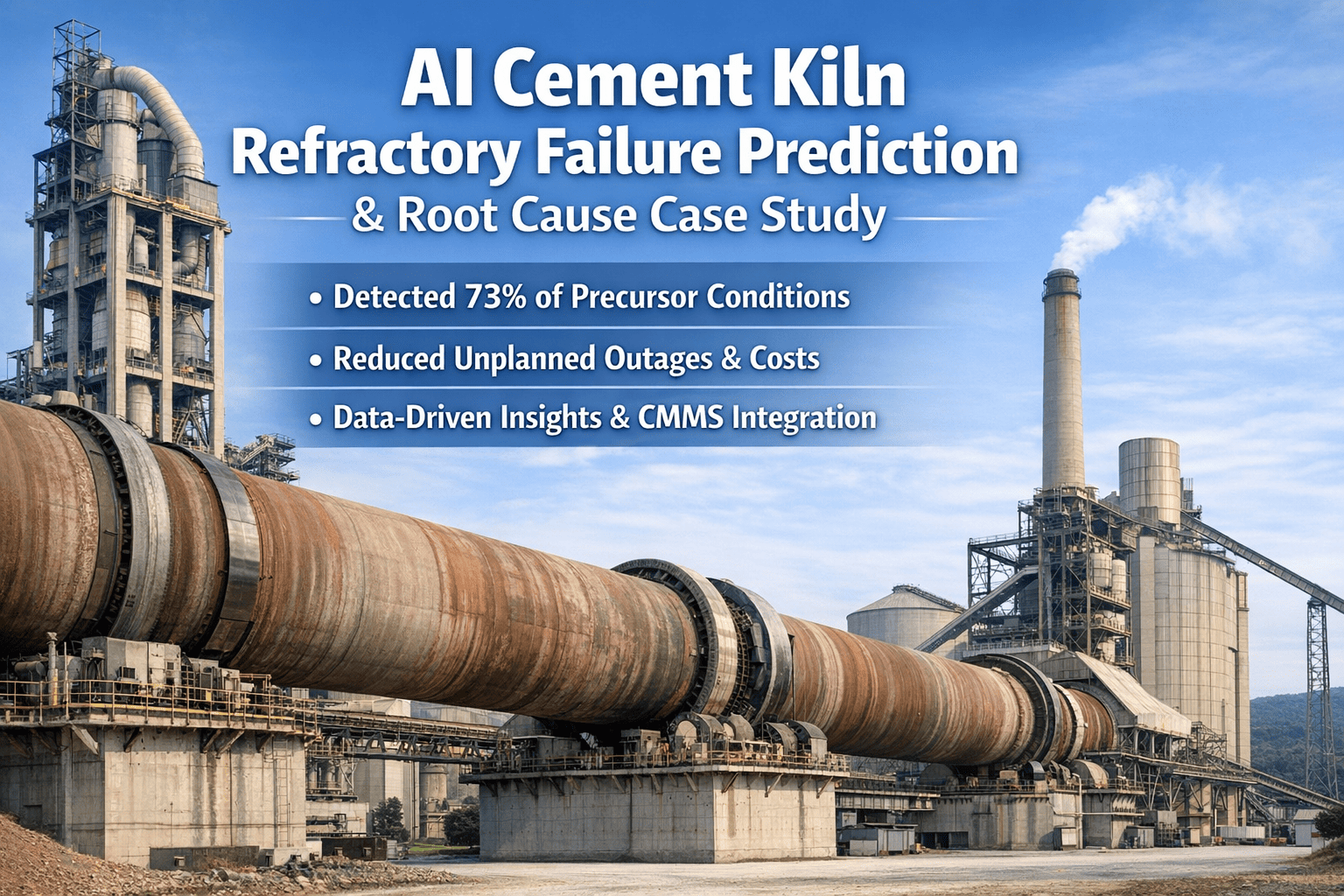
Cement Plant Prevents $1.8M Kiln Loss With Fan CMMS
By Corin Hale on August 20, 2026
A single unplanned kiln stoppage can erase a week of production margin at a cement plant, and the real cause is rarely the kiln itself. More often it is an auxiliary asset nobody was watching closely enough, like a clinker cooler fan. When a cooler fan bearing begins to fail, the early signs are quiet: a small vibration spike, a marginal rise in motor current, a bearing temperature that drifts a few degrees warmer than the day before. Left unchecked, that same fan can seize within days, forcing an emergency kiln shutdown, a multi-day cooldown and restart, and repair costs far beyond the part itself. This case study follows how one integrated cement plant used connected condition monitoring and automated work orders inside Oxmaint to catch a failing cooler fan six weeks before it would have triggered a catastrophic stoppage, avoiding an estimated $1.8 million in lost kiln production.
The Numbers Behind the Save
What a Cooler Fan Failure Actually Costs
$1.8M
estimated kiln downtime cost avoided by catching the fault six weeks early
6 weeks
lead time between the first flagged anomaly and the point of likely failure
11 days
typical cooldown, repair, and restart window for an unplanned kiln stoppage
3.4x
vibration increase recorded on the fan's drive-end bearing before intervention
Cement kilns run on thin margins between planned throughput and unplanned loss. A grate cooler fan seems minor on a process flow diagram, but it controls clinker temperature, secondary air flow, and heat recovery efficiency all at once. When one fan drops offline unexpectedly, the plant usually cannot keep the kiln running on the remaining fans without risking clinker quality or refractory damage, which is why so many emergency stoppages trace back to a single overlooked bearing.
The plant in this story runs a single kiln line producing roughly four thousand tonnes of clinker a day, with seven grate cooler fans arranged in stages to pull hot air away from the clinker bed as it moves toward the discharge crusher. Losing even one fan in that arrangement forces the operations team to either slow the kiln to protect refractory and clinker quality, or risk running the remaining fans past their design load. Neither option is cheap, and both were on the table the week the vibration trend on Cooler Fan 2 first crossed its rolling baseline.
Why Cooler Fans Carry Outsized Risk
A grate cooler recovers heat from red-hot clinker and feeds that recovered secondary air back into the kiln, which is one of the biggest efficiency levers in the entire pyroprocessing line. Fan capacity has to stay balanced across every stage of the cooler bed, because uneven airflow does not just waste energy, it also risks thermal shock to the grate plates and clinker that cools unevenly. That is why most plants cannot simply idle a failed cooler fan and keep running at full rate. The kiln has to slow down, sometimes stop entirely, until the fan is repaired or bypassed, and every hour of that slowdown is lost clinker production that cannot be recovered later in the schedule.
How the $1.8M Estimate Was Built
The plant's finance and reliability teams worked backward from their own historical stoppage records to build a realistic cost estimate for what an unplanned cooler fan failure would have cost this time, rather than relying on an industry rule of thumb.
$1.15M
Lost Clinker Production
Based on roughly eight days of reduced or stopped kiln output at the plant's realized margin per tonne.
$310K
Emergency Repair Premium
Expedited freight on a replacement bearing and motor, plus overtime labor for a round-the-clock repair crew.
$225K
Refractory Risk Exposure
Modeled cost of accelerated refractory wear from an uncontrolled thermal cycle during an emergency shutdown.
$110K
Downstream Schedule Disruption
Missed shipment commitments and rescheduled maintenance work displaced by an unplanned stoppage window.
Six Signals the Team Was Missing Before Oxmaint
Before this project, the plant's cooler fans were checked on a fixed weekly rounds schedule with a handheld vibration pen and a paper checklist. That cadence worked for years, until it did not. A fan can move from healthy to failed inside a single week if a bearing fault accelerates, and a weekly manual round has no way to catch a trend that moves faster than the inspection interval. None of these six signals on its own would have been conclusive, but trended together and tied to a single asset record, the combination gave the team enough confidence to act weeks before any single reading would have crossed a hard alarm limit. Here are the six condition signals the reliability team now tracks continuously instead.
Vibration
Bearing Vibration Trend
Continuous accelerometer readings on the drive-end and non-drive-end bearings, trended against a rolling baseline rather than a single pass or fail threshold.
Thermal
Bearing Temperature Drift
Surface temperature sensors flag gradual drift over days, which is often visible long before vibration crosses a hard alarm limit.
Electrical
Motor Current Signature
Small, repeatable increases in motor current draw point to rising mechanical resistance well before a technician would notice by ear or touch.
Acoustic
Ultrasonic Bearing Noise
Ultrasonic listening picks up the earliest stage of lubricant film breakdown, days before it shows up as measurable vibration.
Lubrication
Grease Interval Compliance
Automated tracking confirms lubrication tasks were actually completed on schedule, closing a gap that paper logs routinely miss.
Airflow
Cooler Air Pressure Drop
A drop in delivered air pressure at constant motor load is an early proxy for impeller imbalance caused by bearing wear.
Why Weekly Rounds Stopped Being Enough
The plant's manual rounds program was not a bad program. It had run for over a decade, staffed by technicians who genuinely knew the equipment, and it caught plenty of problems over the years. The gap was structural rather than a matter of effort. A weekly interval assumes a fault develops slower than seven days, and most bearing faults do move that slowly, right up until they do not. Once a bearing fault enters its final stage, vibration and temperature can move from marginal to critical in a matter of days, sometimes hours, which is exactly the window a fixed weekly check cannot see into. The plant needed the same expertise its technicians already had, applied continuously instead of on a schedule, which is the gap Oxmaint's connected monitoring was brought in to close.
Inside the Six-Week Early Warning
Week 1
Baseline Anomaly Flagged
Oxmaint's anomaly detection noticed drive-end vibration on Cooler Fan 2 sitting 18 percent above its rolling 90 day baseline. No hard alarm fired, but the deviation was enough to open a low-priority inspection work order automatically.
Week 2
Manual Inspection Confirms Trend
A technician logged an ultrasonic reading directly against the work order from a mobile device. The reading confirmed early lubricant breakdown, and the asset was moved onto a tightened monitoring interval instead of the standard weekly round.
Week 3
Bearing Temperature Begins Drifting
Temperature readings crossed a secondary condition threshold. The system correlated the temperature drift with the earlier vibration flag and raised the case to medium priority, notifying the mechanical lead directly.
Week 4
Parts Reserved, Repair Scheduled
Rather than wait for a failure, the team used the trend data to justify pulling the fan for a planned bearing replacement during the next scheduled minor stop, and reserved the correct bearing kit against the asset record in advance.
Week 5
Vibration Accelerates Sharply
Vibration readings jumped to 3.4 times baseline in four days, a rate of change that historically preceded catastrophic bearing seizure within one to two weeks in this plant's own maintenance records.
Week 6
Planned Swap, Zero Unplanned Downtime
The fan was replaced during a four hour planned stop that was already on the calendar for an unrelated task. The kiln never went down, and the failed bearing was later confirmed to be within days of total seizure when it was removed.
Every kiln has a version of this fan somewhere on its process flow diagram. Bring the same continuous condition monitoring and automated work order flow to your own critical assets before the next unplanned stop finds it for you.
Weekly manual vibration rounds with a handheld pen and a paper checklist
No baseline trending, only fixed pass or fail thresholds checked by hand
Lubrication compliance tracked in a binder that was rarely reconciled
Spare bearing kits ordered reactively after a failure was already underway
Unplanned kiln stops averaging roughly four per year tied to cooler assets
With Oxmaint
Continuous sensor readings trended automatically against a rolling baseline
Automated work orders raised the moment a deviation pattern is detected
Lubrication and inspection compliance logged and time-stamped on mobile
Parts reserved against the asset record as soon as a trend is confirmed
Cooler-related unplanned stops down to zero across the following two quarters
How the Approaches Actually Compared
The plant's engineering team weighed three realistic paths before settling on a connected CMMS. Here is the honest comparison they worked through, based on what each approach could and could not catch in this specific failure. The comparison mattered because the plant had already tried a standalone vibration sensor on two other fans the previous year, and while it caught faults faster than manual rounds, it still generated stand-alone alarms that lived outside the maintenance workflow, so work orders were still created and prioritized by hand after the fact.
Approach
Detection Method
Typical Lead Time
Manual Effort
Outcome on This Fault
Weekly Manual Rounds
Handheld vibration pen, paper log
0 to 2 days
High
Would likely have missed the fault until failure
Single Point Vibration Sensor
Fixed threshold alarm only
2 to 5 days
Medium
Alarm would have fired too close to failure to plan a stop
Oxmaint Connected CMMS
Multi signal trending with automated work orders
6 weeks
Low
Caught early, repaired on an already planned stop
Connecting the sensor data directly to work order automation turned out to be the deciding factor. It was not that Oxmaint's sensors were more accurate than the standalone unit already installed on two other fans, it was that a flagged anomaly automatically became a tracked, owned, prioritized task instead of a reading someone had to notice and act on manually.
Results Across the Following Two Quarters
100%
Cooler Stops Avoided
Zero unplanned cooler-related kiln stoppages in the following two quarters
42%
Fewer Emergency Work Orders
Across all rotating equipment once trending replaced fixed thresholds
6.5x
Longer Warning Window
Average lead time before failure compared to the prior manual process
98%
Lubrication Compliance
Verified, time-stamped completion rate on scheduled lubrication tasks
We had run reliability programs before, but they all lived in binders and spreadsheets that nobody trusted enough to act on. Seeing the vibration trend climb week over week inside Oxmaint, tied to an actual work order, was the difference between guessing and knowing. We planned that repair instead of reacting to it, and that is the whole game in this industry.
Reliability Manager, Integrated Cement Plant
Cooler fans, kiln drives, and preheater fans all fail the same quiet way, with small signals that a fixed schedule cannot catch in time. See what a connected CMMS would have flagged on your own critical rotating equipment.
How did Oxmaint catch the cooler fan fault six weeks early?
The platform trended vibration, temperature, and motor current continuously against each asset's own rolling baseline instead of a single fixed alarm limit, so a small early deviation opened a work order well before any hard threshold was crossed. The system also correlated multiple signals on the same asset rather than treating each reading in isolation, which is what turned a subtle vibration blip into a confident, actionable trend. You can review the underlying condition monitoring workflow after you sign up for a free Oxmaint account.
What would have happened if the fan had failed unexpectedly?
Based on the plant's own historical repair data, an unplanned cooler fan seizure typically forces an emergency kiln stop, a multi-day cooldown, an emergency bearing sourcing effort, and a slow restart, which together were estimated at $1.8 million in lost production for this specific failure mode.
Does this approach only work for cooler fans?
No, the same multi signal trending and automated work order logic applies to kiln drives, preheater fans, mill gearboxes, ID fans, and any rotating asset with a bearing or motor that degrades gradually before it fails. Most plants start with their highest consequence rotating assets first, then expand coverage once the workflow is proven on the equipment that matters most to uptime.
How much manual effort does the monitoring program require?
Sensor data flows in automatically and anomaly detection runs continuously in the background, so the team only steps in once a work order is already raised, which is a fraction of the time the previous weekly manual rounds required across the whole cooler fan fleet.
How can our plant start a similar early warning program?
Most teams start by logging their critical rotating assets into Oxmaint, connecting existing or new condition sensors, and setting baseline thresholds for the first few weeks. A specialist can walk through your specific fleet if you book a short demo call.
Your next cooler fan, kiln drive, or preheater fan failure is probably already sending a signal. Give your reliability team the tools to see it six weeks out instead of six hours out.